You’re twelve minutes into the OKR review.
Three teams have shared their slides. Each one had a number. Each one was technically green. Nobody asked a real question. They think they’re OKR progress tracking. Your team is up next, and you already know what you’re going to say. You’ve said it the last three quarters.
This is not a strategy meeting. It’s theater. It’s checking boxes. Bottom line: it’s not helping.
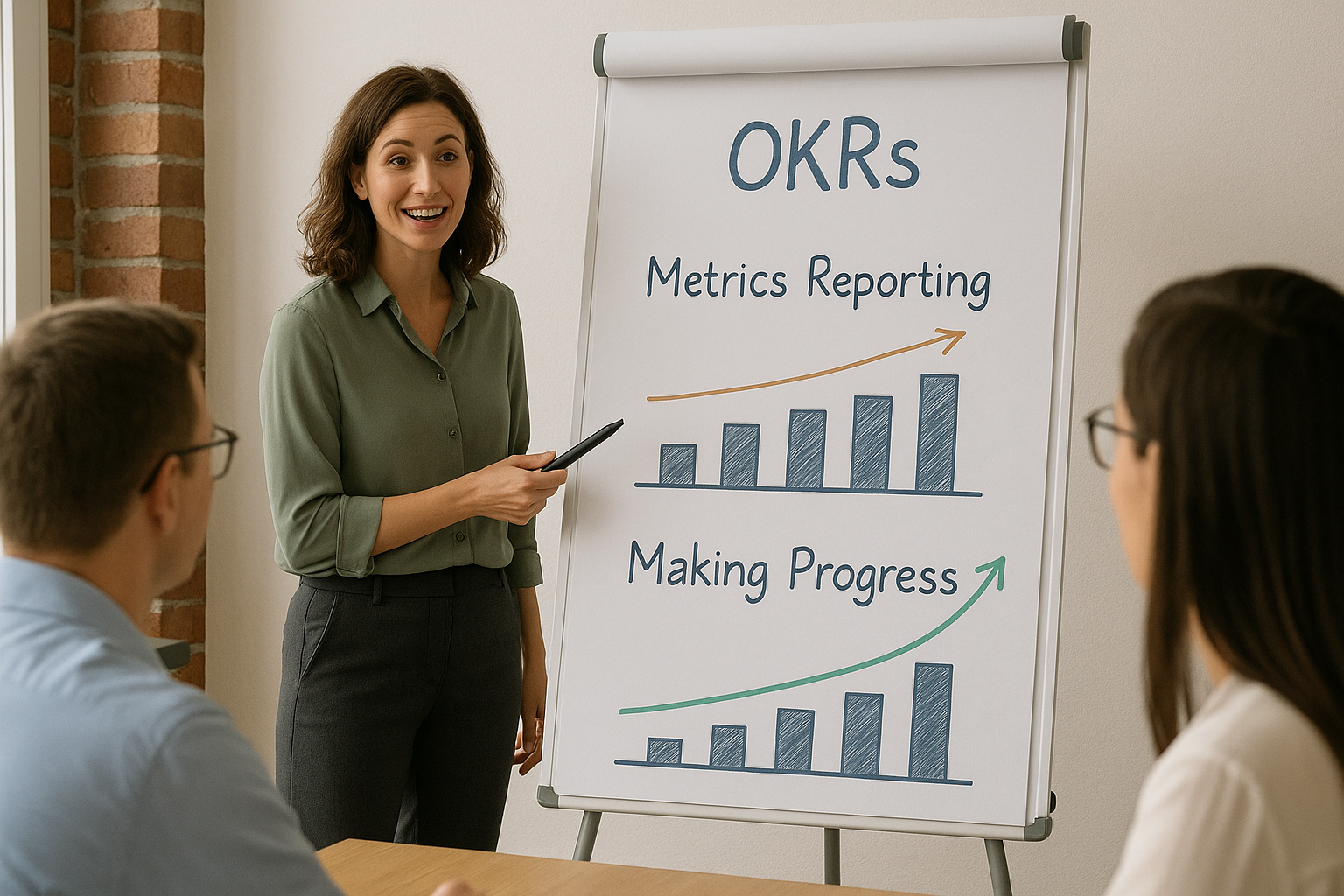
What’s the difference between OKR reporting and real OKR progress tracking? Reporting tells you where the number was last week. Progress tracking tells you whether the work this week is going to move it. One produces a slide. The other produces a decision. Most teams get the two confused, and the OKR cycle quietly collapses into the first one.
You didn’t take a department lead role to host status updates dressed up with quarterly goals. But that’s what most OKR check-ins have become. The framework gets blamed for it.
The fix isn’t a better template. It’s not a different framework. It’s understanding what OKR progress tracking is actually supposed to do, and what it isn’t.
Why Your Meetings Feel Performative: Proper OKR Progress Tracking Is A Discipline
Three structural problems quietly turn OKR reviews into reporting theater. Most departments hit at least two.
Your key results measure things you don’t directly influence. When the metric is total company revenue or organization-wide NPS, your team reports a number that swings on factors fifteen layers removed from the work. The update becomes “still tracking the same number we were tracking last week.” There’s no leverage. Nothing to discuss.
Your OKRs are the KPIs you were already running. If your Q3 OKRs are the same dashboards you watched in Q2, they aren’t OKRs. They’re business-as-usual metrics with a fresh font. Nothing about them forces a strategic shift, so the check-in has nothing strategic to surface.
You only review them when the cycle ends. Twelve weeks of silence, then a postmortem. By then the lessons are decorative. The quarter is over. The next quarter starts with the same setup that produced the last one.
When all three are present, the check-in becomes a forum for explaining numbers. Not for moving them.
The Three Shifts Department Heads Need to Make
Each shift is small. Together they turn an OKR review from a status meeting into a decision-making session.
1. Pick Metrics You Can Actually Move
The first failure mode is choosing key results so broad that nobody on your team can directly influence them. “Increase company revenue by 15%” is not a key result. It’s a wish that includes you in it.
A useful key result for a department is a leading indicator. Something close enough to your team’s daily work that the action you take this week shows up in the number this week. John Doerr makes this point throughout Measure What Matters. The KRs that drive real OKR programs are the ones the team can actually move.
If you run an e-commerce checkout team, the number isn’t “company revenue.” It’s “checkout completion rate from 62% to 71% by end of quarter.” That’s a metric your team can move with the work your team actually does.
The test: if your team did everything right this week, would the number reflect it? If not, the metric is too far away.
2. Pick Strategic Priorities, Not Operational Ones
The second failure mode is using OKRs to track what your team would already track without them. “Maintain 99% uptime” might be important. It’s not an OKR. It’s a baseline.
OKRs are the things that should be different by the end of this cycle. Not the things you monitor every quarter. If your team has the same OKRs in Q4 that you had in Q1, the OKR cycle is coasting on inertia.
Before you write the next set, ask one question. What’s the one shift this team needs to make this quarter that no one else in the org can make for us? That’s where the OKR lives. Everything else is a KPI.
3. Move From Quarterly Reviews to Weekly Check-Ins With Confidence Scores
The third failure mode is reviewing OKRs only at the end. This is where most departments lose the cycle. Twelve weeks is too long to go without a calibration.
A weekly check-in changes the shape of the conversation. Lower stakes per session means more honest signals. A confidence score on each key result, a simple 0-to-1 read on whether you’ll hit the target, captures drift in real time. Numbers don’t lie about how a team feels mid-cycle. Slides do.
In OKR Leader, every check-in pairs the latest number with a confidence score from the owner. If the metric still looks fine but confidence has dropped from an 0.8 to a 0.5, that’s a conversation. A reporting-only setup would never catch it. A progress-tracking setup catches it on a Tuesday.
For the structure that turns those weekly check-ins into useful conversations, see How to Run a Check-In That’s Actually Worth Having.
What OKR Progress Tracking Actually Looks Like
Real OKR progress tracking has three signals embedded in every check-in, not one.
- The metric. Where the number is now and how it moved since last check-in.
- The confidence. A 0-to-1 read from the owner on whether the target is still in reach.
- The decision. What needs to change this week, whether that’s a priority shift, an unblock, or a tradeoff, based on signals one and two.
A reporting-only setup gives you signal one. A progress-tracking setup gives you all three. The first one tells you what happened last week. The second tells you what to do this week.
If your OKR check-in ends without anyone making a decision, you didn’t run a check-in. You ran a status meeting.
A Quick Test for Whether Your OKRs Are Actually Working
Pull up your current OKR set. Ask three questions about it.
- If your team hits every key result this quarter, will something material be different about the business? If the answer is “the numbers will look better but nothing will be structurally different,” your OKRs are KPIs.
- If your team did the right work this week, would you see it in the metric this week? If not, the metric is too far from the work.
- When did you last make a real decision in an OKR check-in? If it’s been a month, the check-in isn’t a check-in.
Two or three “no”s and your OKR cycle is in reporting mode. That’s the fix point. The teams that hit ambitious targets aren’t the ones with prettier frameworks. They’re the ones that recalibrate often enough for the framework to actually do something.
You Were Brought In to Move Things, Not to Track Them
Your job is not to maintain a slide deck of green numbers. Your job is to figure out what your team should move this quarter, and then move it. OKRs are supposed to make that easier. By surfacing what matters. By creating a weekly cadence to recalibrate. By giving you a structure for decisions instead of a structure for status updates.
When OKRs feel like overhead, it’s because they’ve been wired into reporting instead of into the work. The fix isn’t more rigor. It’s a different kind of rigor. The kind that asks “what changed?” and “what now?” every Tuesday for fifteen minutes, instead of waiting for the postmortem.
Stop reporting on your OKRs. Start moving them. The check-in next week is a good place to start.
Book a Demo and see how OKR Leader builds confidence scores and decision prompts directly into the check-in flow.
FAQs: OKR Progress Tracking
What is OKR progress tracking?
OKR progress tracking is the practice of monitoring how your team is actually moving toward the outcome named in each key result, not just reporting the latest metric. Real progress tracking captures three things at every check-in: the current value of the metric, the owner’s confidence in hitting the target, and the decisions that come out of those signals.
How is OKR progress tracking different from KPI reporting?
KPI reporting tells you the state of an ongoing process. OKR progress tracking tells you whether a deliberate change is on track. KPIs don’t usually require a decision when reviewed. OKRs should. Every check-in should produce at least one shift in priority, an unblock, or a tradeoff. If your reviews don’t, you’re treating OKRs as KPIs in disguise.
How often should I review OKR progress?
Weekly. Bi-weekly at the absolute minimum for slower-moving cycles. Monthly is too long. Twelve weeks of silence followed by a quarterly postmortem is how OKR cycles quietly fail. A 15-minute weekly check-in catches drift while there’s still time to do something about it.
What is a confidence score in OKR check-ins?
A confidence score is a simple 0-to-1 read from the key result owner on whether the target is still in reach. Paired with the latest metric, it surfaces signals that numbers alone miss. A metric that looks fine while confidence is collapsing is one of the most useful early-warning indicators in OKR practice. It’s a core part of how OKR Leader structures every check-in.
What’s the most common mistake Department Heads make with OKRs?
Picking key results that measure outcomes their team can’t directly influence, like overall company revenue or NPS, and then spending the cycle reporting numbers they can’t move. The fix is to pick leading indicators that respond to your team’s specific work, so the check-in becomes a conversation about action rather than a recital of factors outside your control.
TL;DR
Most OKR check-ins are reporting theater. Numbers get shared, nobody makes a decision, the cycle drifts. Real OKR progress tracking is different. It uses leading indicators your team can actually move. It focuses OKRs on strategic shifts rather than business-as-usual KPIs. It runs weekly check-ins that pair the metric with a confidence score and a decision. If your OKR reviews end without anyone deciding anything, you’re not tracking progress. You’re producing a report. Time to switch.