
TL;DR: OKR myths stall more rollouts than bad strategy ever did. The biggest of the OKR myths is that OKRs are a goal-setting template. Three objectives, each with three key results, repeated each quarter. The template is the smallest part of the practice. OKRs are also a way of leading aligned autonomous teams, a weekly cadence of learning, and a discipline of focus. Teams that fall for the OKR myths and copy only the template end up with a quarterly homework assignment, not a system that closes the strategy-execution gap.
A pie chart landed in my LinkedIn feed this week. It pulled an old myth out of Lean Six Sigma: that Lean is “a set of process improvement tools.” The post made the point that Lean is really a way of thinking, a culture of continuous experimentation, and a complete respect for people. The tools are the small slice at the bottom.
OKRs have the same problem. The OKR myths that dominate online content collapse the whole practice down to one slice: the template.
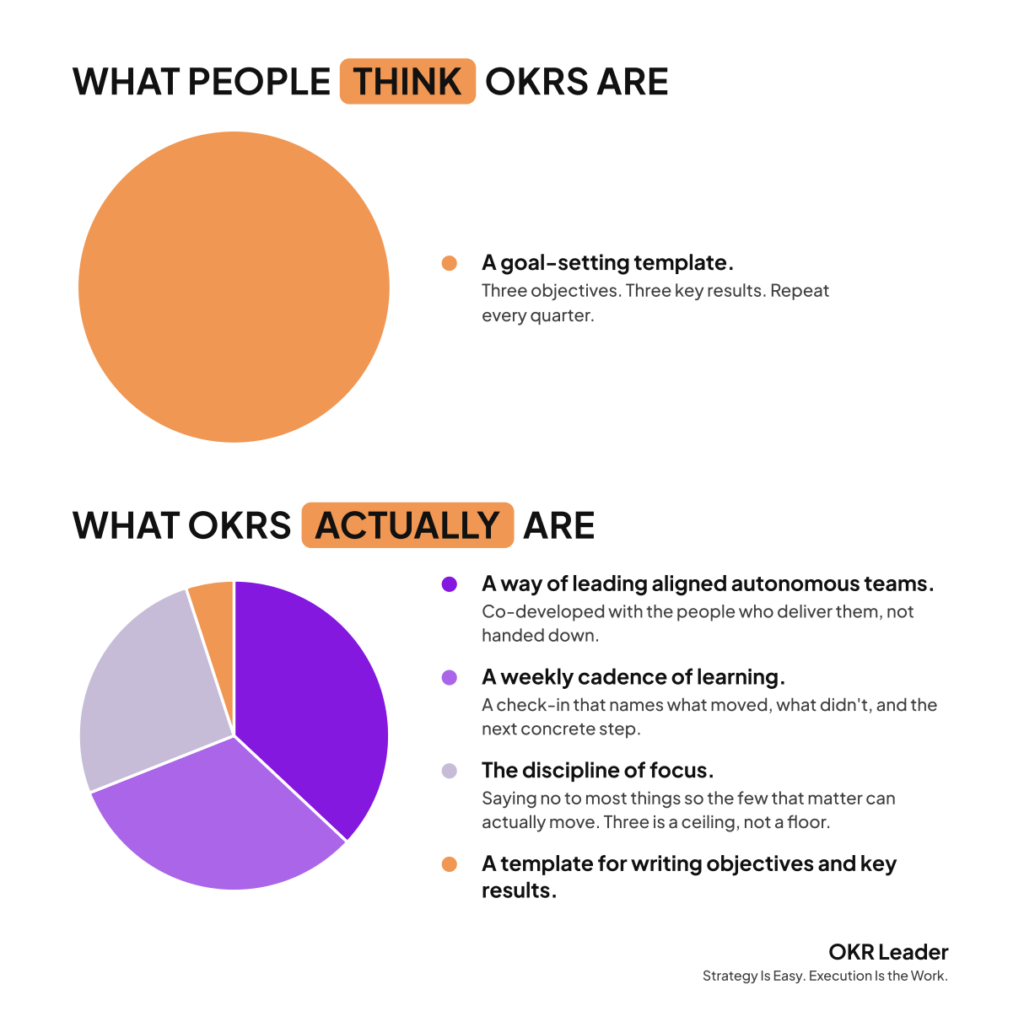
Most teams adopt OKRs as if the template were the whole thing. Three objectives. Three key results each. Fill them in, share the doc, score them in 90 days. When the cycle doesn’t close on what the planning deck promised, the verdict comes in fast: “OKRs don’t work for us.”
Template-only adoption never delivers the strategic-execution shift teams adopt OKRs to get. OKRs are a four-part practice, and the template is one part of four. Most rollouts adopt the one part and skip the other three, then point at the OKR myths in the discourse to explain why nothing changed.
This shows up across every persona I work with. The VP of Strategy who installs OKRs at the org level and watches them go decorative by Q2. The founder who has read every OKR book and still can’t get a clean quarter to close. The department head whose team treats OKR-writing day as a tax. The pattern is the same every time. The team has the template. The team filled it in. The team is now wondering why nothing in their week feels different.
The OKR myths that dominate the conversation all collapse onto one belief about the template. The template is the artifact inside a much larger practice, not the practice itself.
What Are OKRs Really? A 30-Second Definition
OKRs (Objectives and Key Results) are a strategic-execution practice that combines four things working together: a way of leading aligned autonomous teams; a weekly cadence of learning and adjustment; a discipline of focus that protects what matters most; and a structured template for writing the objectives and key results themselves. The template is the slice everyone sees. The other three are what actually drive results.
If your team has the template and not the other three, you have OKR theatre, not OKR practice.
OKR Myths and the Goal-Setting Template
Here is the most common adoption pattern. A leader reads Measure What Matters. They open a Notion page. They fill in three objectives and three key results per team. They declare the rollout complete. The template gets filled. The doc gets shared. The quarter starts. By Wednesday of week three, nobody is looking at the page.
The template by itself is the OKR equivalent of buying gym equipment. The equipment isn’t the workout. The workout is showing up four times a week for six months. The equipment without the practice is furniture.
So what turns the template into a practice? Three other things, each bigger than the template itself.
What OKRs Actually Are (Slice 1): A Way of Leading Aligned Autonomous Teams
The first thing OKRs are, the biggest slice of the practice, is a leadership model. They’re a way of running teams that doesn’t depend on the leader being in the room when decisions get made.
Aligned, autonomous teams aren’t a corporate slogan. They’re a specific operating state. Each person on the team has enough context about what the company is trying to do this quarter that they can make good calls on their own, without waiting to be asked. Autonomous, because they don’t need to ask. Aligned, because they’re asking the right question.
The template doesn’t produce that state. The leadership work around the template does. That work looks like:
- Co-writing the OKRs with the team, not handing them down. The people who own delivering the OKR have to help write the OKR. Teams handed an objective they didn’t help shape treat it as homework instead of work, and the moment a customer fire pulls focus, the homework gets dropped first. Co-development is what gives the team enough ground-truth context to defend the OKR when the urgent arrives.
- Naming the “why” behind each objective. Every OKR has to connect to something the team can recognize. A strategic priority. A competitive threat. A capability the team is trying to build. An OKR that doesn’t connect to anything meaningful won’t survive the first off-roadmap request that pulls attention.
- Giving teams permission to say no. A leader who installs OKRs but won’t let department heads turn down off-roadmap requests has installed an OKR aesthetic, not an OKR practice.
This slice is where the leadership change lives. It’s also the slice most rollouts skip entirely because it’s harder than filling in a template.
For a deeper look at how this dynamic plays out across an enterprise, see strategic planning to goal achievement: the OKR bridge.
What OKRs Actually Are (Slice 2): A Weekly Cadence of Learning
The second slice is the rhythm. One of the load-bearing OKR myths is that planning plus scoring is enough work for a quarter. The middle of the quarter is where execution actually happens, and OKRs are built around a weekly check-in to surface it. A short conversation where the team names what moved, what didn’t, and what the next move is. The check-in is where execution actually happens. Without it, OKRs are quarterly performance art.
Most teams underweight this slice because they think the quarter starts with planning and ends with scoring, and the time in between is “doing the work.” That framing is exactly why so many quarters run out of steam. The middle of the quarter is where strategic intent meets the daily firehose, and without a cadence that pulls teams back to the OKRs every seven days, the firehose wins.
A useful check-in does four things:
- It names what changed. From what, to what? The KR metric your team owns, last week’s value to this week’s. “Activation: 34% → 38%.” Not “we launched the new flow.”
- It surfaces what’s blocking the move. A check-in that only celebrates wins is a status report. A check-in that names blockers in time to act on them is execution work.
- It identifies the next concrete step. The check-in produces a decision, not a vibe.
- It re-aligns dependencies. Cross-team handoffs that were clean at kickoff drift by mid-quarter. The check-in surfaces drift while it is still fixable.
If your team’s check-in is a slide deck circulated for review, the cadence isn’t doing its job. The check-in is the bridge between the template and outcomes. It’s the slice nobody falls in love with. It’s also the slice that decides whether the quarter closes.
For the four questions to run a check-in worth having, see the OKR check-in template that drives decisions.
What OKRs Actually Are (Slice 3): The Discipline of Focus
The third slice is the one most OKR rollouts get backwards. The OKR myths around “set lots of ambitious goals” encourage exactly the opposite of what works. OKRs aren’t a tool for naming everything important. They’re a tool for protecting attention by saying no to most of it.
The common guidance says 3-5 objectives per team. Most teams treat the 5 as a floor instead of a ceiling. The result is the OKR set that runs from January through March looking impressive on the slide and falling apart by April, when six “high priorities” turn out to be one and a half that actually got delivered and four that got shrugged at.
Focus isn’t decoration. It’s the function of the system. The point of writing OKRs isn’t to capture the work the team would have done anyway. The point is to make the team’s strategic choices visible, so the urgent crowds out fewer of the important.
Christina Wodtke’s Radical Focus makes the case directly: OKRs only work when teams pick a small number of things and protect them aggressively. Greg McKeown’s Essentialism lands in the same place from a different direction. Both books arrive at the same operating truth: less, done well, beats more, done halfway. OKRs are a tool for that subtraction, not a tool for that addition.
The focus discipline shows up in five practices:
- Fewer objectives. Three is a working ceiling for most teams. If you can’t pick three from your list of six, you don’t have a focus problem you can solve with OKRs. You have a strategy problem you need to fix before you write OKRs.
- Outcome KRs, not activity KRs. If every team member completed 100% of the listed activity and the outcome still didn’t happen, the KR is activity-shaped. Rewrite it.
- Health metrics protected separately. OKRs are for change. Health metrics (churn, fulfillment time, cash, defect rate) are for protection. Don’t dress a health metric as a KR.
- Permission to drop. When something urgent collides with an OKR, the leader needs to say either “the OKR wins, this can wait” or “the OKR shifts, here is why.” Either call is fine. Saying neither is not.
- Visible tradeoffs. When the team is over-committed, the OKR system should surface it before week six, not at the post-mortem.
Focus is the slice that turns OKRs from a goal-setting exercise into a strategic operating system. Skip it, and OKRs become another planning artifact that ages badly between quarterly kickoffs.
What OKRs Actually Are (The Small Slice): The Template
The template is real and it matters. The format – objective + key results, qualitative + quantitative, time-boxed to a cycle – is genuinely useful structure for thinking about what change you’re trying to drive. Without the template, the conversation is too vague to plan from.
But the template is one part of a four-part practice. Adopting the template without the other three is the root of most OKR myths.
OKR Myths in Practice: Why Template-Only Adoptions Stall
A few reasons template-only adoptions stall:
- They scale to the wrong question. A bigger spreadsheet doesn’t make a deeper practice. You can write OKRs for 200 teams and still not run an aligned company.
- They underweight the human work. Co-development, weekly cadence, focus discipline. All three require leadership attention every week. Templates don’t.
- They report instead of execute. A team running on templates produces explanations of work. A team running on the full practice produces moved metrics.
- They mistake the first cycle for a verdict. OKRs aren’t a magic pill. The first cycle is almost always rough. The compounding return comes when the practice gets a second and third cycle to settle. Template-only adopters bail in cycle one.
If you’re early in an OKR rollout and you’re hearing “this isn’t working” by week six, the most useful question to ask isn’t “are our OKRs well-written?” It’s “are we doing the three things bigger than the template?”
OKR Myths: Frequently Asked Questions
What’s the most common OKR myth?
The most common OKR myth is that OKRs are a goal-setting template. Three objectives, three key results, repeat each quarter. The template is part of OKRs, but it is the smallest part. OKRs are also a way of leading aligned autonomous teams, a weekly cadence of learning and adjustment, and a discipline of focus. Teams that adopt the template without the other three slices generally conclude that OKRs don’t work, when what didn’t work was a template-only adoption.
What other OKR myths trip teams up?
Besides the template myth, the OKR myths that trip teams up most often are: OKRs are too rigid (the weekly cadence is built for adjustment, not lock-in), OKRs are only for tech (the practice applies to any team with strategic priorities and a quarterly horizon), and OKRs need a software tool to work (a shared doc and a recurring meeting are enough for the first cycle). All three OKR myths trace back to the same root: treating OKRs as a thing to install rather than a practice to build.
Are OKRs just for tech companies?
No. OKRs were built at Intel and popularized by Google, which is why early OKR content reads as engineering-centric. The underlying practice (co-developed objectives, weekly cadence, focus discipline) applies to any team that needs to turn strategic intent into coordinated quarterly action. The form changes by industry. The practice doesn’t.
Why do most OKR rollouts fail in the first cycle?
Most first cycles look rough because the team is learning four new skills at once: writing outcome-focused KRs, running a useful check-in, protecting focus from the daily firehose, and co-developing objectives instead of handing them down. The OKRs themselves are usually the easiest part. The practice around them takes a few cycles to settle. The teams that quit in cycle one mistake the learning curve for a verdict on the tool.
How is an OKR different from a regular goal?
A regular goal names what you want. An OKR names what you want (the objective), how you’ll know you got it (the key results, with starting values and target values), and connects to the wider system that drives it. Co-developed with the team. Checked in on weekly. Aligned to a strategic priority. A goal stands alone. An OKR is part of a practice.
Can a small team run OKRs without an OKR tool?
Yes, especially in cycle one. A shared doc, a recurring meeting, and a calendar reminder for the weekly check-in is enough infrastructure for a team of 8 to 15. Tools start to matter when the company is running OKRs across multiple teams that need to see each other’s progress, or when the leadership team wants to see status without each department head building a custom tracker.
What to Do With This
If you’re considering OKRs: don’t start with the template. Start with the leadership commitment. The template is the easy part. Co-development, the check-in cadence, and the focus discipline are the hard parts, and they’re what make the template earn its keep.
If you’ve already adopted OKRs and they’re not landing: skip the rewrite of the OKRs themselves. Look at the practice around them. Most OKR myths that block teams are about the template. The actual blocker is usually one of the three bigger slices. The 20-minute LEAD Toolkit scores your team across the four pillars that turn the template into a practice. It’s the fastest read on which slice of the pie is missing.
The template is the smallest slice. The practice around it is the rest.