
TL;DR: Every OKR scoring system gets gamed by quarter three or four. Not because the team is dishonest. Because the incentives quietly shift. People start setting targets they’ll hit, scoring conservatively to leave room for “great” the next cycle, and reverse-engineering numbers in week ten. The fix isn’t more rigor. It’s structural: separate scoring from compensation, model honest scoring at the leadership level, and run retrospectives that ask why scores landed where they did, not whether they look good.
You’re three cycles in. The team has the rhythm down. Quarterly planning runs smoothly. Check-ins hit their fifteen minutes. Scoring at quarter close happens on schedule.
So why does every team report 1.0 across the board? And why does that feel less like a win than it should?
If you’ve been running OKRs long enough to feel this, you’re hitting the predictable failure mode of mature OKR programs. The OKR scoring system that worked in cycle one starts producing inflated, sanitized numbers by cycle three. Not because anyone planned to game it. Because the incentives quietly shifted underneath the team and nobody renegotiated the rules.
Why does an OKR scoring system get gamed? Three forces compound across cycles. Comp pressure (real or perceived) makes safe targets feel like job security. Optics pressure makes 1.0 scores feel like proof of execution. And calibration drift happens when leaders never push back on suspiciously clean scores, so the team learns those scores are what gets rewarded. Once any of these takes hold, the scoring becomes performance theater. The fix is structural, not motivational.
If you’re earlier in your OKR journey and want the foundational view of what good scoring looks like, OKR Scoring: What a Good Quarter Actually Looks Like covers that ground. This piece picks up where that one ends: how to keep the scoring system honest once teams have learned how to look good in it.
Why an OKR Scoring System Gets Gamed
Three patterns drive most score inflation. They show up in different combinations across organizations, but the root cause is consistent: the system incentivized something other than honesty.
Compensation tied to scores. This is the brand POV at OKR Leader, and it’s worth restating: tying OKR scoring to performance reviews or compensation kills honest reporting. Once people know their score affects their bonus, raise, or career trajectory, they set safe targets they’re sure they can hit. You get sandbagging instead of ambition. The data stops being honest, and the framework loses the very thing it’s supposed to produce. Google’s re:Work guide on scoring OKRs makes the same point: OKRs are a planning and learning tool, not a performance management tool.
Optics pressure. Even without explicit comp tie-ins, the social pressure of reporting a 0.5 in front of the leadership team is real. Teams learn quickly that the path of least resistance is to either set targets they’ll comfortably hit or to soften the target retroactively when they’re at risk of missing.
Calibration drift. When leaders never push back on suspiciously clean scores, the team interprets that silence as endorsement. By cycle three, the team has trained itself to produce 1.0s because that’s what’s been rewarded with quiet approval. Score inflation, like any optimization, follows the incentive gradient.
What Score Gaming Actually Looks Like
You can spot a gamed OKR scoring system by a few specific signals.
- 1.0s across the board, every cycle. A healthy team will land scattered around 0.6-0.8 with occasional misses and occasional unexpected wins. A team that consistently scores 1.0 on every Key Result either has the wrong (too easy) targets or is gaming the scoring.
- Suspiciously round numbers. Outcomes that landed exactly on the target value. “We hit 100% of plan” should make you curious, not satisfied. The real world is rarely that clean. Numbers that exactly match the target usually indicate the target was set late or the score was rounded up.
- Late-quarter target reductions. A Key Result that was “lift conversion from 4% to 9%” in week one becomes “lift conversion from 4% to 6%” in week ten. The team is moving the goalposts to make a 0.7 score possible. The original ambition was the point.
- 0.4 to 0.6 reported as “met expectations.” When a team consistently scores in the 0.4-0.6 range and reports the cycle as “successful,” they’re calibrating against the wrong baseline. A 0.5 isn’t a successful Key Result. It’s a Key Result that missed by a meaningful margin and produced a learning.
These aren’t accusations. They’re patterns. The same team that produced honest 0.65 scores in cycle one can drift into gamed 0.95 scores by cycle four if nobody renegotiates the rules.
How to Keep Your OKR Scoring System Honest
Four structural shifts that re-anchor the scoring system in honesty rather than optics.
- Separate scoring from compensation completely. This is the foundation. If your performance review process pulls OKR scores as inputs, you’ve already created the incentive that breaks the system. The fix is editorial: OKR scoring goes in one bucket (planning and learning), performance management goes in another (review and compensation). Different inputs, different cadences, different conversations. Research from Harvard Business Review on goal-setting consistently lands on the same point: tying ambitious goals to comp produces sandbagging across organizations of every size.
- Model honest scoring at the leadership level. Teams take cues from the top. If your leadership team scores its own OKRs at 0.95 every cycle while their actual outcomes were uneven, the rest of the org learns that 0.95 is the expected target. If leadership reports 0.6 honestly when 0.6 is what happened, the rest of the org has permission to do the same.
- Push back on suspiciously clean scores. Calibration drift compounds in silence. When a team reports 1.0s across the board, the leadership question isn’t “great quarter, what’s next.” It’s “what would we have learned if we’d set targets that pushed harder?” A team that never produces a 0.5 isn’t winning. It’s protecting itself.
- Run a real retrospective, not a status review. The retrospective is where the OKR scoring system either gets re-anchored or drifts further. Ask three questions per Key Result: was this target genuinely ambitious, did the score reflect what actually happened, and what would we calibrate differently next cycle. The answers matter more than the scores.
The OKR check-in template supports this in-cycle: confidence scores during weekly check-ins surface drift before quarter close, which is when most gaming happens. A team that’s been honest about confidence in week six can’t easily fabricate a 1.0 score in week thirteen.
How Do You Spot a Sandbagged Team Mid-Cycle?
Three signals show up before quarter close.
The team’s confidence scores never drop below 0.8. A team that’s setting genuinely ambitious targets will hit weeks where confidence drops to 0.5 or 0.4. If confidence stays parked at 0.9 every week, the targets weren’t ambitious enough or the team isn’t surfacing real signal.
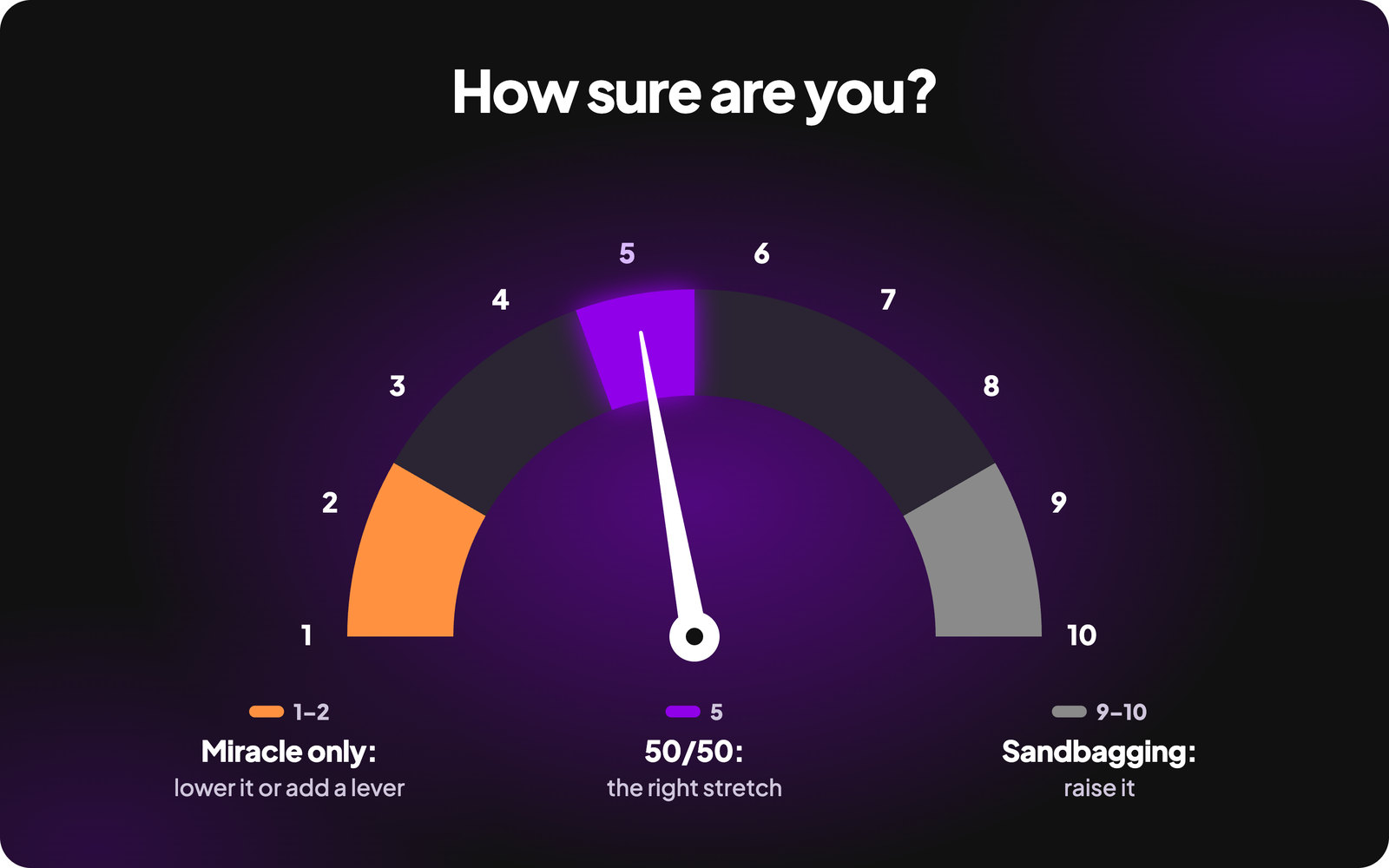
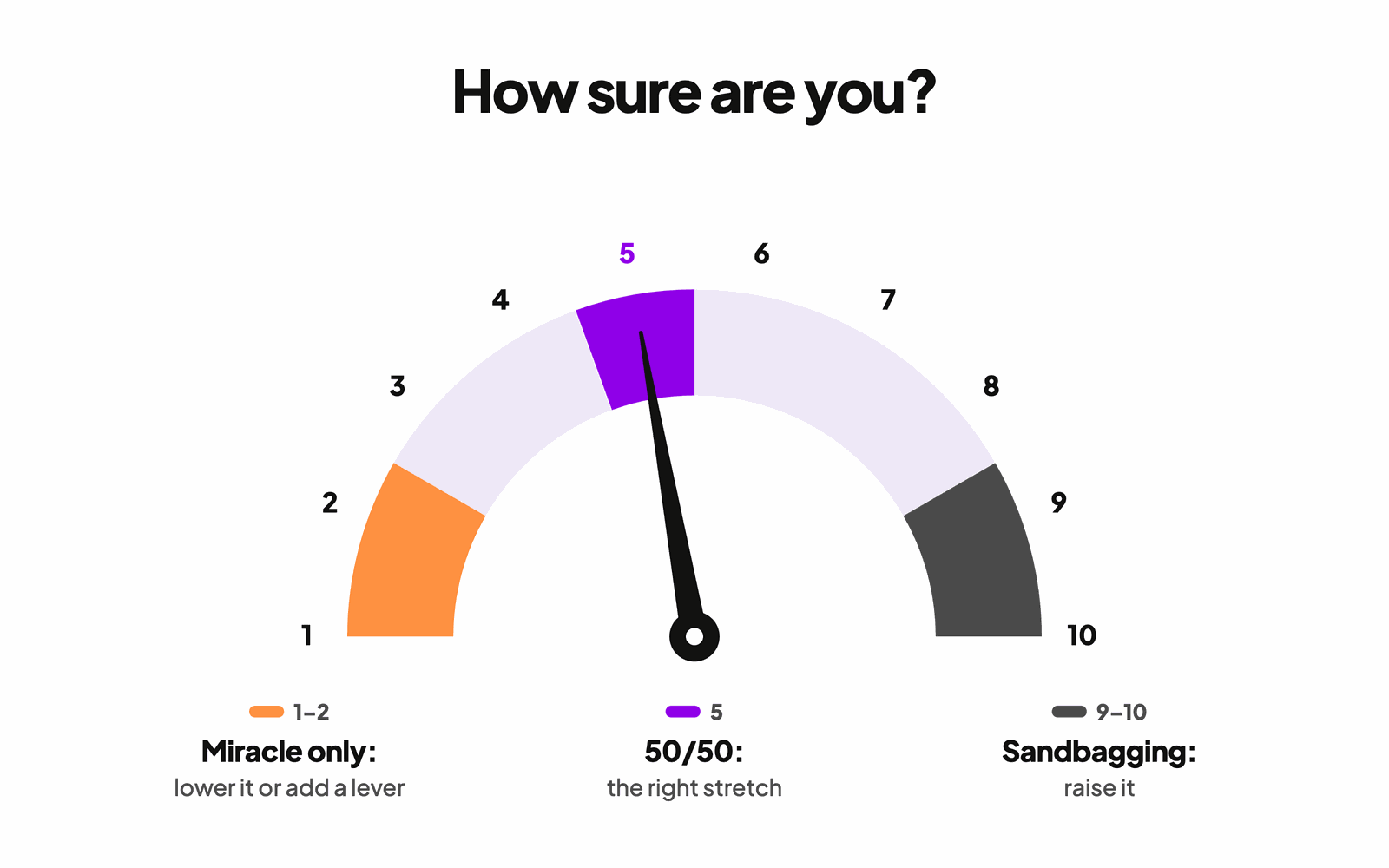
The Key Result moves linearly toward the target. Real outcomes don’t travel in straight lines. A KR that ticks up exactly the right amount each week is more likely a target that was set with the trajectory already known than a stretch that’s actually being earned.
The team frames blockers as “challenges we’re working through” without ever surfacing one for decision. Real ambition surfaces blockers because the team needs help. Sandbagged targets don’t, because the team has built in enough buffer to absorb the friction without flagging it.
If two of the three are present in week six, you have a sandbagged team. The fix isn’t accusation. It’s a calibration conversation: would the target meaningfully stretch the team if they kept pushing? If the answer is yes, raise the target now while there’s still time. If the answer is no, replace it with one that would.
What an Honest OKR Scoring System Produces
A team running an honest OKR scoring system produces a different kind of quarter close.
Mixed scores, not uniform 1.0s. Some 0.4s alongside some 0.85s. The mix is the data. Uniformity is the warning sign.
Real learning. The retrospective produces specific decisions about what to keep, what to change, and what to cut from the next cycle. A gamed scoring system doesn’t produce learning, because there’s nothing to learn from a manufactured 1.0.
A team that’s willing to set harder targets next cycle. This is the compounding effect. When the system rewards honesty, the team starts pushing the targets up. When the system rewards optics, the team starts pushing the targets down. Three cycles of either pattern produces meaningfully different outcomes for the business.
The point of the OKR scoring system isn’t the number. It’s the conversation the number forces. A 0.6 that surfaces a real problem to fix is more valuable than a 0.95 that confirms what was already going to happen.
See It in Action and walk through how OKR Leader keeps the scoring conversation calibrated across cycles.
Frequently Asked Questions
What does “gaming” an OKR scoring system actually mean?
Gaming an OKR scoring system means setting or reporting scores in ways that optimize for how the team looks rather than what the team learned. The most common forms are sandbagging (setting targets the team is sure to hit), late-cycle target reductions (lowering the bar in week ten so the score comes in clean), and rounding up borderline results to land exactly at 0.7 or 1.0. Gaming isn’t usually malicious. It’s an incentive response. When the system rewards clean scores more than honest ones, teams optimize accordingly.
Why does the 1.0 score show up so often if it’s a warning sign?
Because comp pressure, optics pressure, and calibration drift all push teams toward it. A team that scored 1.0 last cycle and got positive reinforcement learns that 1.0 is the path of least resistance. A team whose comp depends on the score sets targets they’ll hit. A team whose leadership never pushes back on a 1.0 takes the silence as endorsement. The 1.0 isn’t usually evidence of execution. It’s evidence that the incentives are pointing the wrong way.
How do you fix score inflation once it’s set in?
Three steps, in order. First, separate OKR scoring from compensation entirely if it isn’t already. Second, model honest scoring at the leadership level so the rest of the org sees what calibrated scoring looks like. Third, run the next retrospective with explicit calibration questions: was this target genuinely ambitious, what would we have learned at a 0.5, what changes about how we set targets next cycle. The fix takes one full cycle to land. Two cycles to feel normal.
Should OKR scoring be public across the organization?
Generally yes, with one caveat. Visible scoring builds shared accountability and lets teams calibrate against each other. The caveat is that public scoring multiplies optics pressure. The fix isn’t private scoring. It’s making leadership-level scores public first and unflinchingly honest, so the rest of the org has permission to do the same.
OKR Scoring Guide: Free Download
Get the OKR Scoring Guide for the full how-to: the 0-to-1 scoring scale, when to use Commit/Target/Stretch, end-of-cycle retrospectives, and the rules for keeping scores honest enough to drive change next quarter.