

The OKR Starter Course
Free OKR course
The OKR Starter Course
Learn to write, run and score OKRs with your team, one short lesson at a time. Thirteen lessons across five modules, with an activity at the end of each module that you complete with your own team’s real work.
Why this course
Set goals in January that still steer the work in March
Planning day goes well. Everyone leaves with three priorities and plenty of good intentions. Then a customer issue pulls two people off one of them, a hire falls through, and by week six the quarter’s goals have stopped coming up in meetings, even though nobody ever decided to drop them.
This course teaches the habits that keep goals inside the weekly work, so you can:
- Write goals your team can measure, with targets that stretch them and still feel within reach.
- Tie every goal to something the business needs this quarter.
- Write the goals together with the people who’ll do the work.
- Check progress in a 30-minute weekly meeting that changes what the team does next.
What you will learn
By the end of the course you’ll know how to
01
Tell an OKR apart from the rest of the work
Explain how an OKR differs from a KPI, a task and a project, in your own words.
02
Write Objectives people want to reach
Name a destination for the quarter, and leave the numbers for the Key Results.
03
Write Key Results that measure outcomes
Turn a to-do list into two to five measurable results, each with a single target.
04
Link every OKR to what the business needs
Connect each OKR to at least one of six anchors, so nothing on the list is an Orphan.
05
Spot dependencies early
Find where your team’s work relies on another team, and make it visible before it causes a delay.
06
Run the weekly check-in and score the quarter
Compare each Key Result’s number with last week’s, then score honestly when the quarter closes and carry the lessons into the next cycle.
Who it is for
This course is for you if you’re

An owner or leader of a growing company
You run a team of 10 to 60 people, and the goals you set at planning time get lost once the day-to-day takes over.
A manager or team lead
You’ve been asked to run OKRs with your team and you want a practical way to start that fits around your actual job.
A team about to start its first OKR cycle
Take the course before planning day, so everyone arrives using the same words and with a draft OKR in hand.
Inside the course
What’s included
13 written lessons
Each one takes 10 to 20 minutes to read.
A quick check in every lesson
Test yourself as you go, with the answers right there.
Five worksheets
One per module, to apply what you learned to your own team. Only you and the OKR Leader team can see your answers.
The LEAD Self-Assessment
A 20-question scorecard that shows which part of running OKRs your team finds hardest.
The OKR Check-In Canvas
A one-page guide you can print and use to run your weekly check-in.
Worked examples
Every lesson shows the step on a fictional company first, so you can see it done before you try it.
The lessons
Course curriculum
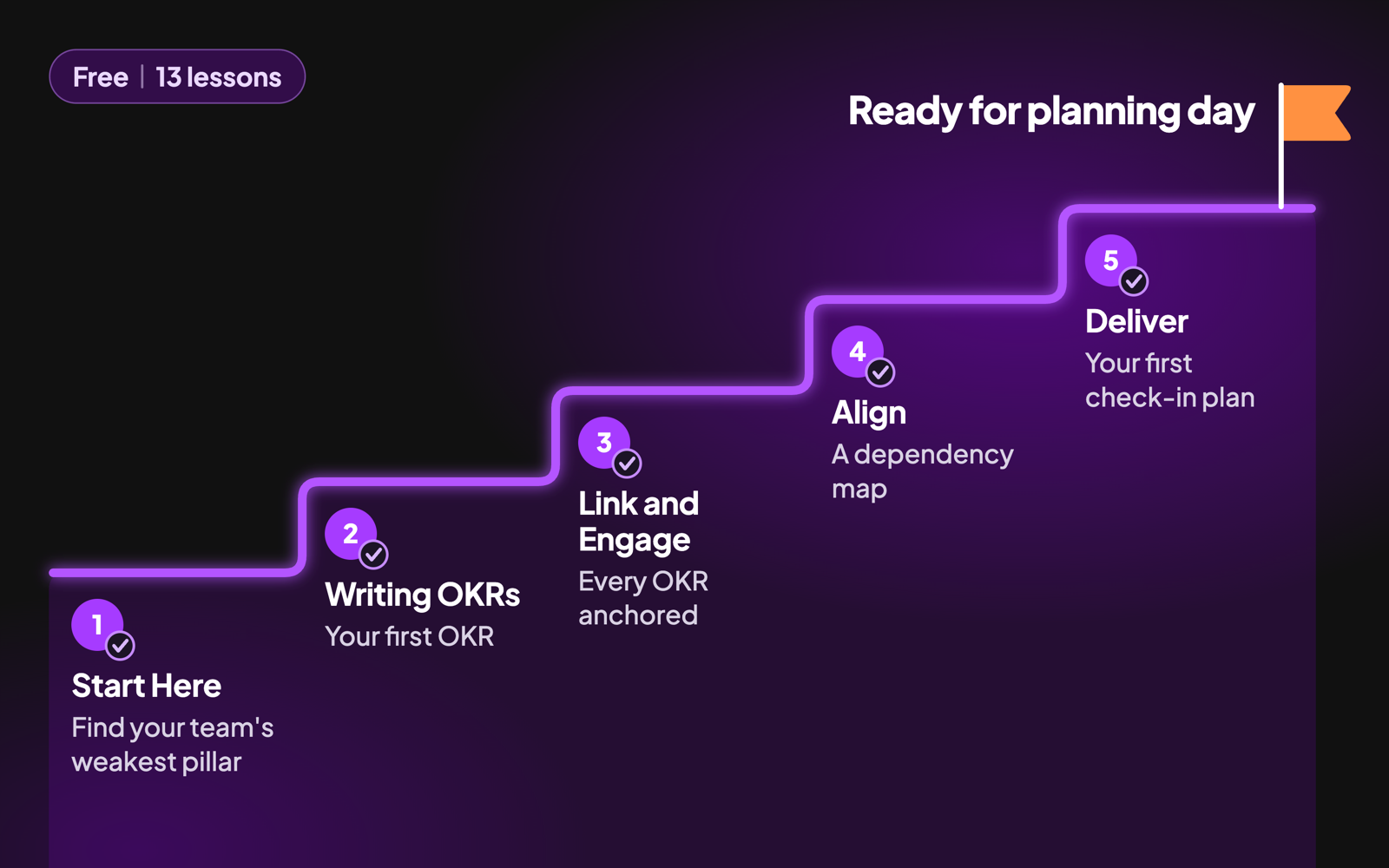
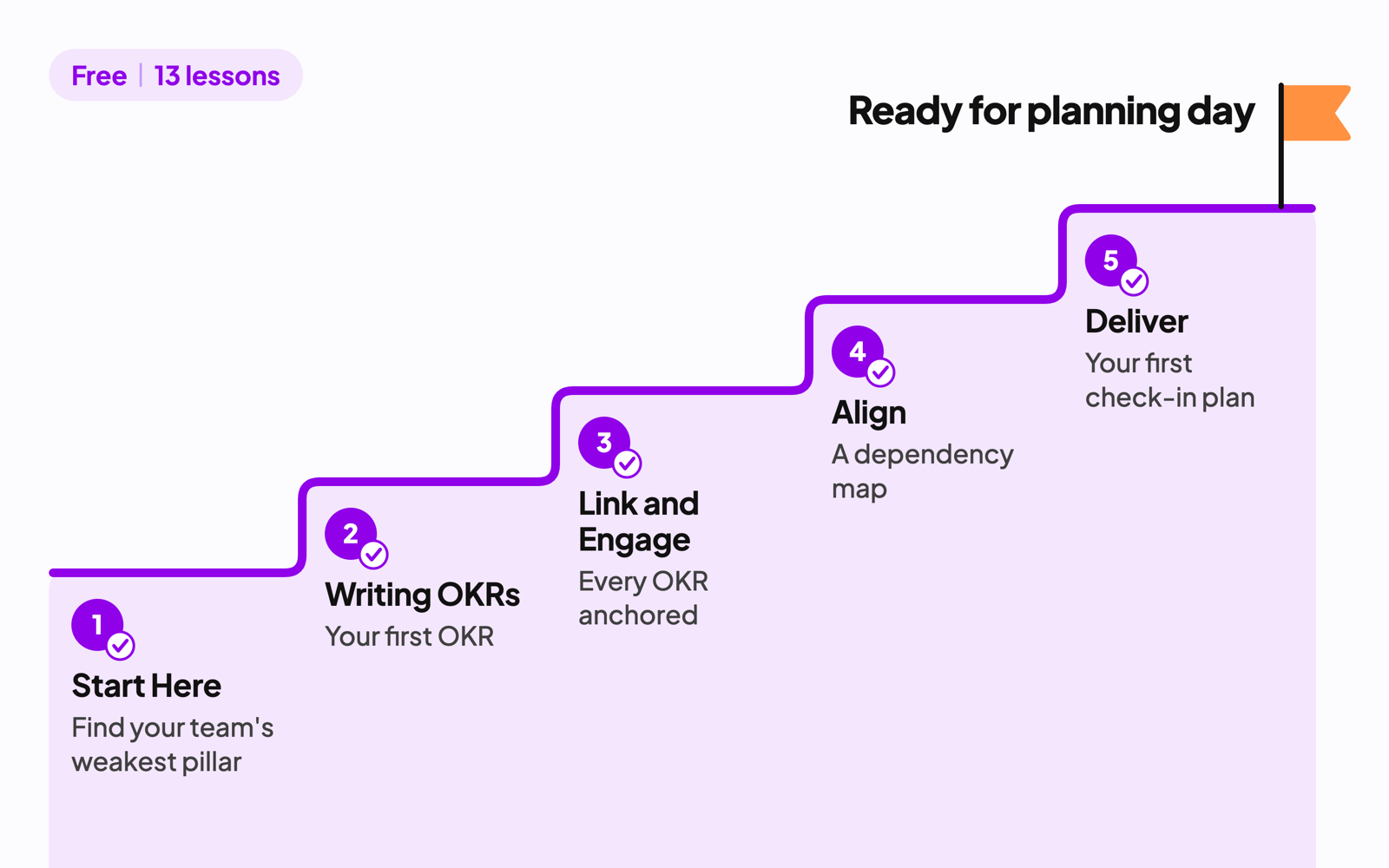
Module 1: Start Here
- What OKRs Are and What They Are For
- The LEAD Framework for Running OKRs
Module 2: Writing OKRs
- Writing Strong Objectives
- Writing Key Results That Measure Outcomes
- Setting Targets for Your Key Results
- When You Don’t Have the Number Yet
- Activity: Build Your First OKR
Module 3: Link and Engage
- Link: The Six Anchors
- Engage: Writing OKRs With Your Team
- Keep OKR Scores Out of Performance Reviews
Module 4: Align
- Alignment Is a Weekly Practice
- Changing an OKR Mid-Cycle
Module 5: Deliver
- The Weekly Check-In
- Scoring and the End-of-Cycle Review
About this course
- Price: Free
- Lessons: 13, in five modules
- Time: about 3.5 hours of reading, plus about 2 hours for the activities
- Pace: self-paced, with every lesson open as soon as you sign up
The method
Built on the LEAD framework
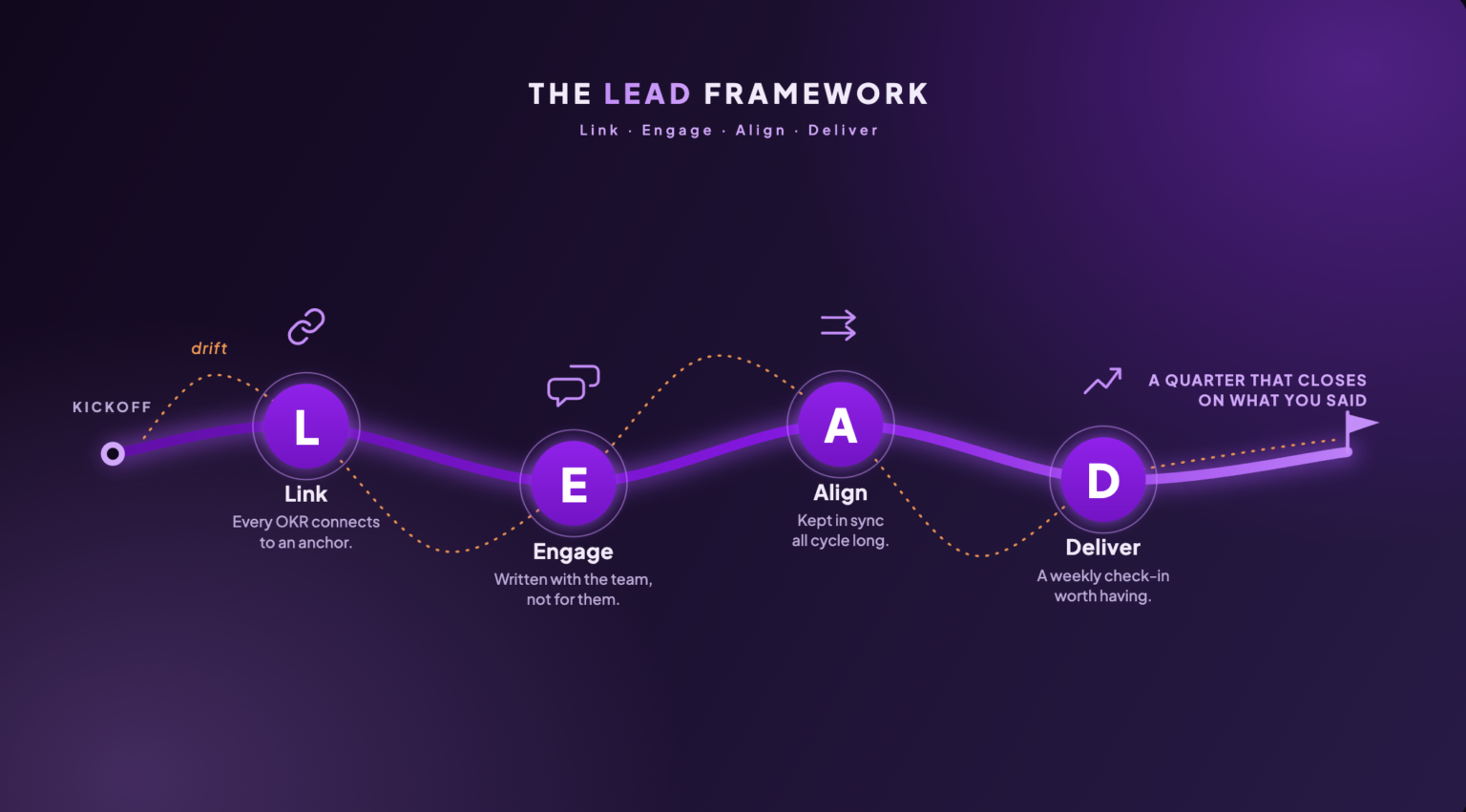
The course follows LEAD, OKR Leader’s framework for running OKRs. It has four parts, and each one covers a stage of the cycle where OKR programs lose momentum.
L
Link
An OKR with no anchor is an Orphan. Connect every OKR to a strategic priority, another team’s goal, or something your team is good at, up against or exposed to.
E
Engage
Write OKRs with the people who will carry them. Teams commit harder to goals they helped shape.
A
Align
Alignment is a weekly practice. Teams that depend on each other stay in sync all cycle long, and adjust together when the strategy shifts.
D
Deliver
Wednesday is where the quarter is decided. Run a weekly check-in worth having, score honestly at the end, and plan the actions that move each number.
Your instructor
Alison Beierlein, founder of OKR Leader

Alison is a certified Professional OKR Coach with more than 20 years of experience leading teams. She runs Moving Mountains Consulting from Pemberton, BC, and works with owner-led companies on the systems and weekly rhythm that keep a growing business moving. This course started as pre-work for the teams she works with, so they can arrive at their first planning session ready to go.
Questions
Frequently asked questions
Is the course really free?
Yes. There’s no payment step and no trial that turns into a paid plan. You create a free account on UPCoach, the platform that hosts the course, and every lesson opens right away.
How long does it take?
About 3.5 hours of reading, plus around 2 hours if you do all five activities. The lessons are 10 to 20 minutes each, so you can work through one on a coffee break and pick up where you left off.
Do I need OKR software?
No. Everything in the course works with a shared document or a spreadsheet.
Do I need a team to take it?
The activities work best on your own team’s real work. If you’re learning on your own, pick a team you know well and use that.
Can my whole team take it?
Yes. Each person signs up with their own account, and their worksheet answers stay between them and the OKR Leader team. Teams that take it before their first planning session arrive using the same words, each with a draft OKR.
We tried OKRs before and they faded. Is this still for us?
Yes. Module 5 covers the weekly check-in and the end-of-cycle review, the two habits that keep OKRs alive after planning day. Lesson 1.2 also points you to the LEAD Self-Assessment, which shows where your last attempt ran into trouble.
What happens after I finish?
Bring your worksheets to your next planning session. If you’d like help running your first cycle with your team, email hello@okrleader.com.
Start with the first lesson today
Lesson 1.1 takes about 15 minutes. By the end of it you’ll be able to explain to your team how an OKR differs from a KPI, a task and a project.