

OKR Examples: How to Find the Objectives and Key Results Worth Setting
OKR examples and ideas
OKR Examples: How to Find the Objectives and Key Results Worth Setting
OKR examples are most useful once you know where good ones come from. Planning day goes wrong when a team copies a list it found online, or writes down the same three goals it had last quarter. This page walks through the method we use with teams: brainstorm objective ideas within the six anchors, prioritize them by impact and ease, then choose the Key Results that show the outcome moving. At the bottom you’ll find idea banks by department, full of objective ideas and metrics to start from.
The short answer
How do you come up with good OKRs?
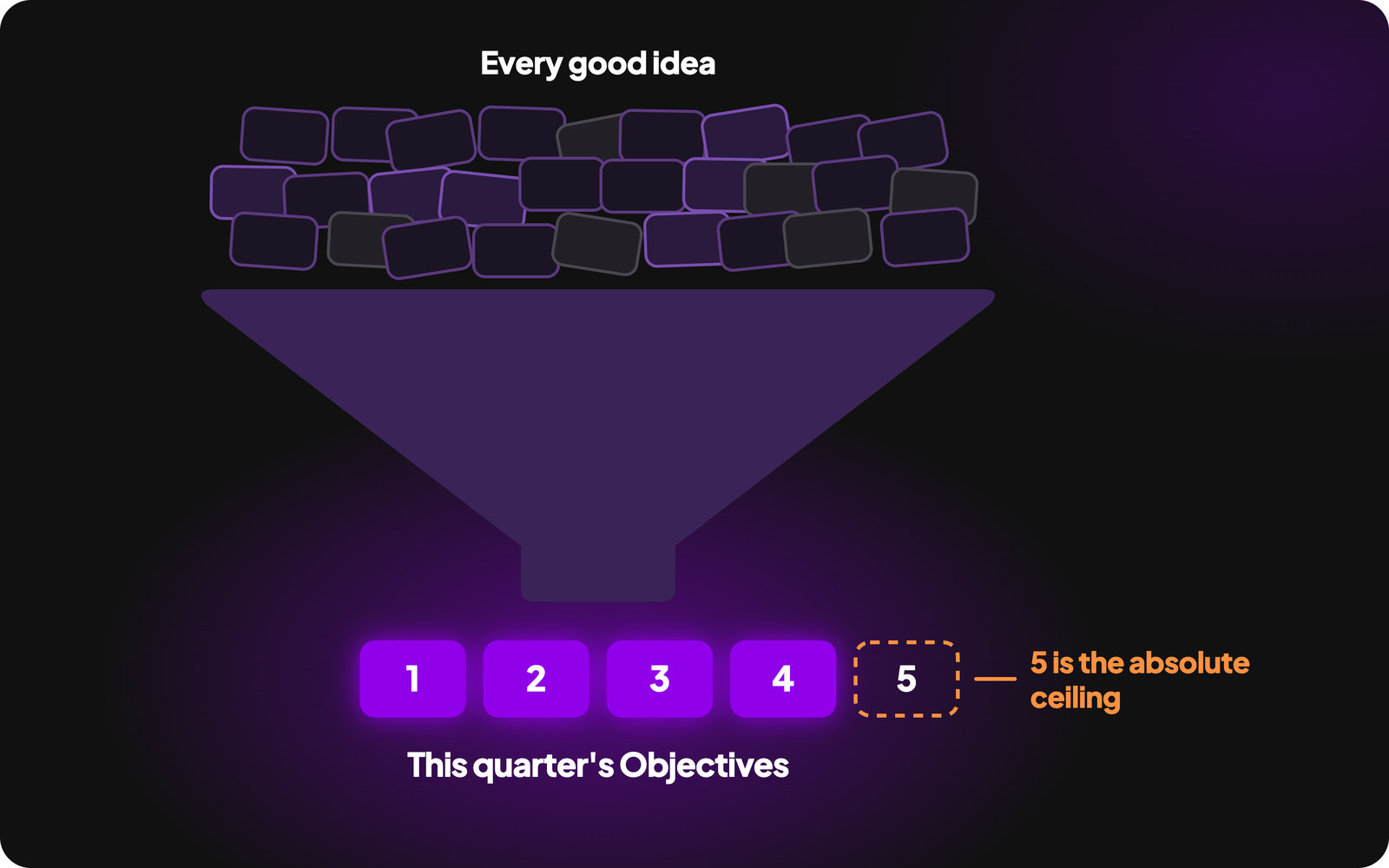
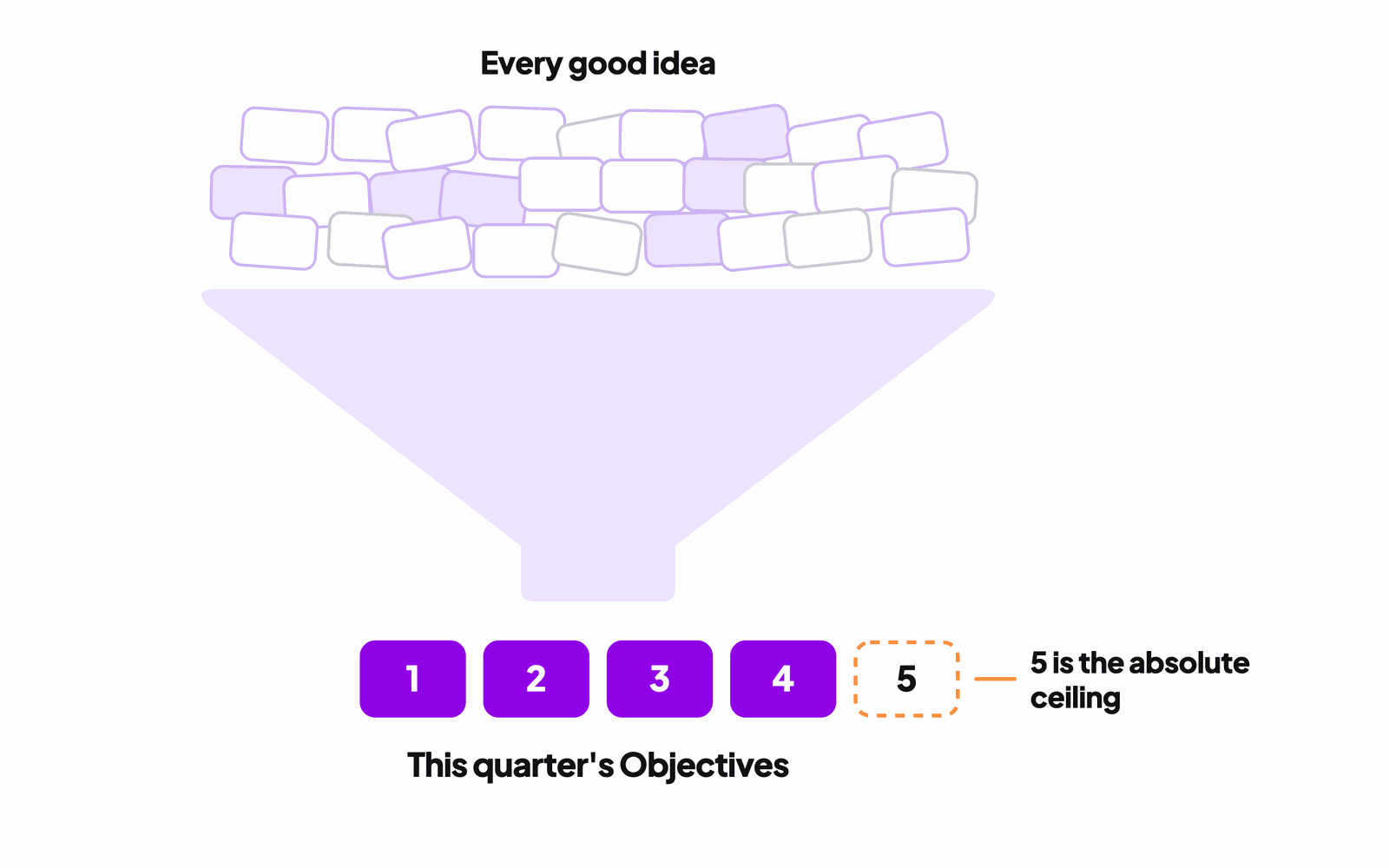
Good OKRs come from a wide list of ideas that gets cut down hard. Brainstorm objective ideas from each of the six anchors (strategic priorities, other teams’ goals, team strengths, opportunities, weaknesses and threats), score every idea on its impact and how easy it is to do, then keep one to four Objectives. For each one, pick two to five Key Results that measure the outcome you want, each written in full: an action verb, the metric, from X to Y and a deadline.
Step 1: brainstorm objectives
Questions to brainstorm from each of the six anchors
Every OKR needs to link to at least one of the six anchors. Plenty of teams treat that as a check at the end. It works better as the place you start, because each anchor asks a different question and pulls out ideas the others miss. Spend five to ten minutes on each one and write down everything, including the ideas that sound too small or too big.
Advances a strategic priority
Which company priority would stall if this team did nothing for a quarter? What would the CEO want this team to have moved by year end?
Supports another team’s objective
Ask the teams that depend on you what they need from you this quarter. Which of their goals can’t move until yours does?
Leverages a team strength
What does this team do better than anyone else in the company? Where would a little more of that pay off fast?
Captures an external opportunity
What are customers asking for that nobody offers yet? And what changed in the market, the technology or the rules in the last six months?
Mitigates a team weakness
Which health metric has been slipping? Where do customers or colleagues complain, and which handoff keeps breaking?
Defends against an external threat
Which competitor move or market change would hurt most if you ignored it? Where are customers most at risk of leaving?
When the list runs dry
Six brainstorming techniques that widen the list
Some teams fill a whiteboard in ten minutes. Others stare at the anchors and come up with the goals they already had. When the room gets stuck, try one of these.
Run a quick SWOT first
List the team’s strengths, weaknesses, opportunities and threats on one page. Four of the six anchors come straight from a SWOT, so every line on that page is a candidate objective.
Start from the end of the quarter
Picture the last day of the cycle and the team celebrating. Ask what happened. Then flip it: picture the quarter going badly and ask what went wrong. Both lists turn into objective ideas.
Turn problems into “How might we” questions
Rewrite each complaint or gap as a question, such as “How might we get new customers to their first win in a week?” Questions invite ideas, where complaints invite blame.
Map the customer’s path
Follow a customer from first hearing about you to buying, using, renewing and referring. Mark each step where people drop off or stall. Each of those steps is a possible objective.
Ask “why” five times
Take one symptom, such as missed delivery dates, and keep asking why until you reach a cause the team can change. Write the objective about that cause.
Brainstorm alone before you brainstorm together
Give everyone five minutes on their own to write ideas down, then share in pairs, then as a group. The 1-2-4-All format from Liberating Structures works well here, and it stops the loudest person from setting the agenda.
Step 2: prioritize
How do you prioritize OKR ideas?
A good brainstorm leaves you with far more ideas than any team can take on. Plot each one on two axes: how much it would move the outcome, and how easy it would be to do this cycle. The quadrant it lands in tells you what to do with it.
- Quick wins (high impact, easier) go first. They build momentum and free up capacity for bigger work.
- Big bets (high impact, harder) are worth an Objective, one or two at a time, with real time and people behind them.
- Fill-ins (low impact, easier) belong in the normal work, outside the OKRs.
- Skip for now (low impact, harder) goes on a parked list you review next cycle.
More ways to rank ideas
Four prioritization techniques to try with your team
The matrix works well for a quick first sort. When two ideas land in the same quadrant, or the team disagrees about where something goes, a score breaks the tie.
Impact and ease matrix
Draw the two axes on a whiteboard and place each idea as a group. It takes about 15 minutes and works best when the list is long and the team needs to see the shape of it.
ICE scoring
Score each idea from 1 to 10 for Impact, Confidence (how sure you are it will work) and Ease, then average the three. ICE comes from growth teams and it’s fast enough to run on 30 ideas in one meeting. To weigh an idea’s reach as well, try RICE, from Intercom, which adds Reach to the scores.
Weighted scoring for revenue goals
When I help clients grow revenue, we score Impact, Confidence, Assets (do you already have what it needs?) and Ease, then multiply the average by the number of growth levers the idea pulls: winning new customers, getting them to first value, earning more from each one and keeping them. Ideas that move several levers rise to the top. Our free OKR prioritization matrix uses the four core scores, which work for any team.
Dot voting
Give everyone three to five dots and let them vote on the shortlist. Use it last, after scoring, so the vote is between ideas that already passed the numbers.
Free tool
Score and plot your ideas in the OKR prioritization matrix
Type in your ideas, score each one and see them ranked and placed on the impact and ease grid automatically. Nothing to download, and your list stays in your browser.
Step 3: choose Key Results
How do you pick Key Results for an Objective?
Start from the outcome and work backward. Ask what number would prove the Objective happened, then which smaller numbers move first and push it. Drawing it as a tree helps teams see the difference between the results they want and the measures they can watch every week.
- Run the outcome test. If the team could finish every task and the outcome still might not happen, the Key Result measures activity. Rewrite it to measure what the activity was supposed to cause.
- Write every one in full. Start with an action verb, name the metric, give the starting value and the target, and set a deadline: “Increase renewal rate from X% to Y% by the end of Q4.”
- Mix lagging and leading numbers. A lagging number like renewal rate proves the outcome. Leading numbers, like weekly product use, move sooner and show you’re on track.
- Pair numbers that could be gamed. If you push speed, add a quality measure beside it, so nobody hits one by breaking the other.
- Write the hypothesis down. “We believe doing X will cause Y, and we’ll know when we see Z.” The Z becomes your Key Result.
Idea banks
OKR examples and idea banks by department
Each page lists the metrics that department tracks and a set of complete sample OKRs, with every Key Result written in full. We leave the numbers as X and Y on purpose. A target that fits a 20-person company can look wrong to a 2,000-person one, and the starting value has to come from your own data.
OKR ideas by problem
Prefer to start from a problem?
These pages start from the problem a leader brings to planning day and show how OKRs help with it.
- Cross-team alignmentTeams that depend on each other drifting apart during the quarter.
- Strategic focusToo many priorities and not enough time to deliver any of them.
- Track OKR progressFinding out a goal slipped after it’s too late to act.
- Strategy executionTurning the planning deck into this week’s work.
- Profit per employeeGrowing revenue without growing profit.

Frequently asked questions
Can I copy OKR examples from another company?
Use them as a starting point for ideas, then rewrite them around your own strategy and data. An OKR only works when it links to something your company cares about right now, and when the starting value comes from your own numbers.
How many OKR ideas should we brainstorm?
Aim for at least 20 ideas across the six anchors before you start cutting. A long list gives the team real choices when it comes time to prioritize.
How many Objectives should a team set?
One to four per cycle, and never more than five. Choosing one main Objective is fine too, and each Objective gets two to five Key Results.
What is the difference between a Key Result and a KPI?
A KPI is a number you watch all the time to know the business is healthy. Key Results are numbers you’re trying to change this cycle, from a starting value to a target. Our guide on KPIs vs OKRs covers when to use each.
Why do your examples use X and Y for the numbers?
Good targets depend on your company’s size, stage and starting point. A number from someone else’s example can make a sound idea look wrong for your team, so we leave the values for you to fill in from your own data.
Take your shortlist into planning day
Start a free trial and turn your top ideas into OKRs your team can track every week. Or take the free OKR Starter Course and learn to write them first.