

Strategy Execution From the Planning Deck to This Week’s Work
Use case: drive strategic initiatives
Strategy Execution From the Planning Deck to This Week’s Work
Strategy execution is where a good plan meets a full calendar. The leadership team agrees on three strategic initiatives, the deck goes into a shared folder, and six weeks later each initiative has a sponsor and very little time behind it. OKR Leader connects every initiative to the Objectives, projects and tasks that carry it, so you can see which initiatives are moving and which ones only exist on a slide.
Where it slips
Why do strategic initiatives stall?
The people running these initiatives care about them. Daily work keeps arriving, though, and it always feels more pressing than a goal that lands in two years. Without a weekly link between the two, the daily work wins.
When I talk with leadership teams, the stalled initiative is rarely a surprise to anyone in the room. Everyone could see it slowing down, and nobody had a regular place to raise it. These four warning signs show up first:
An initiative with no OKRs
Leadership named the initiative, and no team has an Objective this quarter that moves it forward.
Endorsed and never resourced
The initiative has a sponsor, and nobody’s calendar, team or budget changed to make room for it.
Projects running on their own
Teams are busy with projects that nobody has tied back to an initiative.
Reviewed once a year
The initiatives come up at the annual planning retreat and almost nowhere else.
The short answer
What is strategy execution?
Strategy execution is the work of turning a strategic plan into results. It means choosing the few initiatives the company can fund, translating each one into OKRs a team owns, giving those teams the time, people and budget to do the work, and checking progress every week. The strategy sets the direction for several years, and each quarter’s OKRs are the next measurable step along it.
How OKR Leader helps
Five ways OKR Leader keeps initiatives moving
Record the strategy where everyone can see it
Set up each strategy with its start and due dates, and break it into strategic pillars that every team can open and read.
Link Objectives to the strategy they serve
Each Objective shows the strategies it supports, so an initiative with no Objectives behind it is easy to spot at planning time.
Trace the week’s work back to the initiative
Projects link to the Key Results they’re meant to move, and tasks sit inside projects, so you can follow an initiative all the way down to what someone is doing this week.
Name who runs each part of the program
Each team has a named OKR lead, and program roles record who owns the rest of the work, from running check-ins to reporting to leadership.
Run every cycle on the same rhythm
Each cycle moves from setting and aligning OKRs to weekly check-ins to a formal close, so every initiative gets looked at weekly and reviewed every quarter.
Try this with your leadership team
How to drive strategic initiatives with OKRs
Work through these with your leadership team before the next planning cycle starts.
- Limit the strategy to the initiatives the company can actually fund this year, and write one sentence on why each one matters now.
- For each initiative, decide which team owns the next step this quarter, and have that team write an Objective linked to it.
- Before the cycle starts, agree on what each owning team will stop doing, who else will help, and what budget comes with the work.
- Review every initiative at a monthly leadership meeting, using the latest numbers and confidence ratings from the teams’ weekly check-ins.
Initiatives move when someone with authority puts real resources behind them and keeps showing up for them. These steps give that support a structure, and the weekly check-in keeps it in view all quarter.
Free resources
Go deeper on strategy execution
Frequently asked questions
What’s the difference between a strategic initiative and an OKR?
A strategic initiative is a multi-year bet, such as entering a new market. An OKR is the measurable step a team commits to this quarter that moves the initiative forward. One initiative can have several OKRs behind it, across several teams and several cycles.
How many strategic initiatives should we run at once?
As many as you can resource with real time, people and budget. For a company of 50 people, that’s two or three. Each extra initiative splits the same people further.
Who should own a strategic initiative?
A senior leader who can move time, people and budget toward it, with a team that owns each quarter’s OKRs for it. The leader’s job continues after the kickoff: keep asking about it, and keep the resources in place when other work competes for them.
Does every OKR need to link to a strategic initiative?
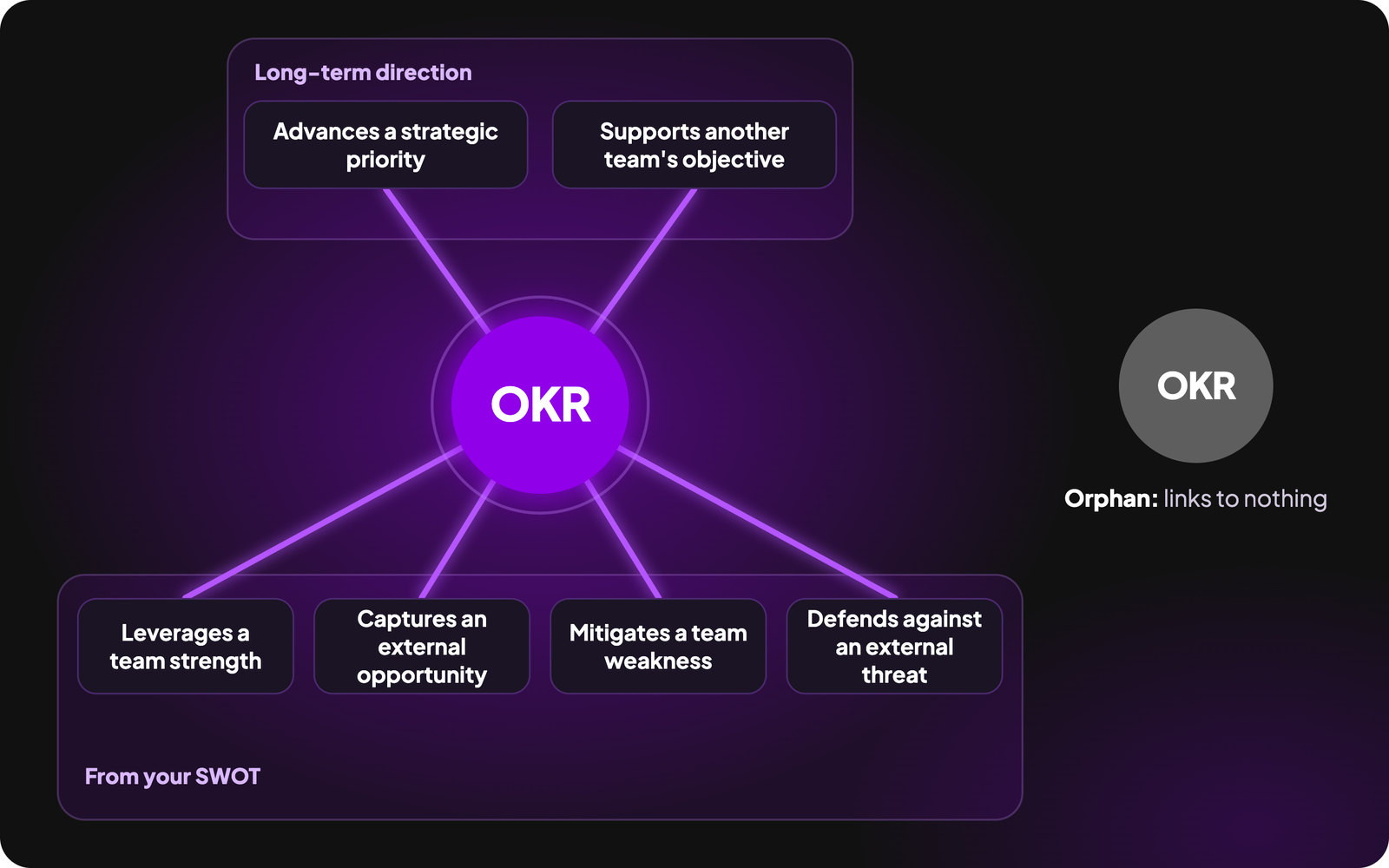
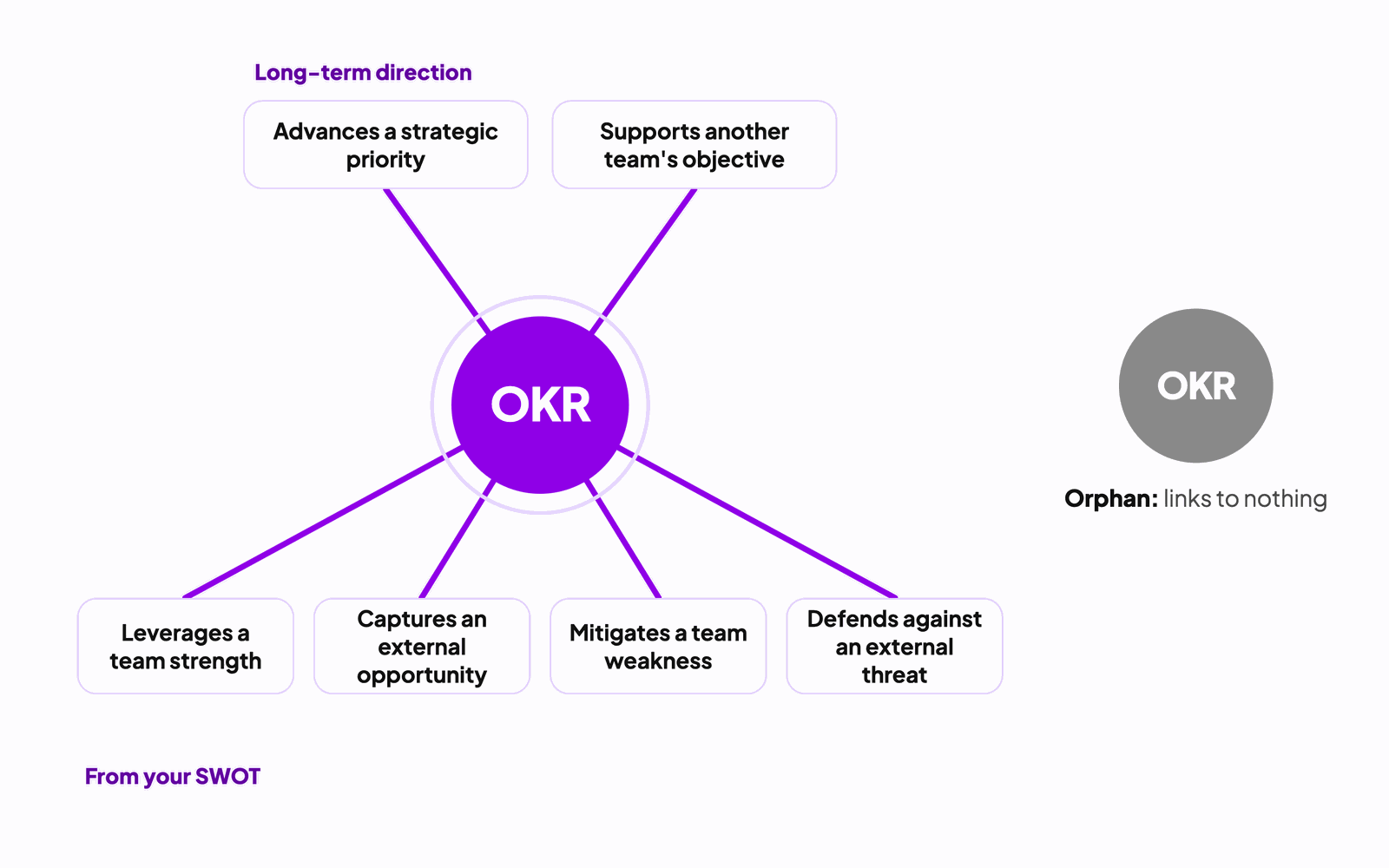
Every OKR needs to link to at least one of six anchors, and a strategic priority is one of them. The other five cover another team’s goal, a team strength, an external opportunity, a team weakness and an external threat. OKRs that respond to the market or to a slipping health metric still count.
What should we do if the strategy changes mid-year?
Update the strategy in one place, then review every OKR linked to it at the next round of check-ins. Retire or rewrite the ones that no longer fit, and tell the teams that depended on them.
Connect your strategy to this week’s work
Start a free trial and set up your strategy, its pillars and the first OKRs that move it. Or take the free OKR Starter Course first and learn how to link every OKR to the strategy.