
The LEAD Series | Episode 1 of 4: Link
One article for each pillar of the LEAD framework: Link, Engage, Align and Deliver.
TL;DR: To link OKRs to strategy, every objective has to connect to at least one of six anchors: a strategic priority, another team’s objective, a team strength, an external opportunity, a team weakness, or an external threat. The check happens once, at setup, and the answer is yes or no. An OKR that connects to none of the six is an Orphan, and it gets fixed or cut before the quarter starts. The team that owns the OKR should be able to name its anchor and say why it matters now. Urgent work that lands mid-quarter gets the same check: find out why it became urgent, then link it or park it.
An objective can be well written, carry three measurable key results and a named owner, and still have no business being on the list. Nobody can say what it serves. It got there because someone cared about it in the planning session, or because it was on last quarter’s list and nobody took it off.
I hear this when talking to leaders all the time, and it has nothing to do with anyone being sloppy. A planning session produces more ideas than a team can carry, and each one sounds reasonable in the moment. By the time the list is typed up, the thread back to the company’s direction has frayed on a few of them, and nobody notices until week eight, when those objectives are the first to slide.
Our overview of the LEAD framework covers all four pillars in one place. This post stays with the first pillar, Link, and goes into how to run it in a real planning cycle.
How do you link OKRs to strategy? You link OKRs to strategy by naming, for every objective, which of the six anchors it connects to and why that connection matters this quarter. If a team can name an anchor and a reason, the OKR is linked. A team that can’t answer has an Orphan on its hands, and it gets reworked or dropped before the cycle begins.
What does it mean to link OKRs to strategy?
Linking is the connection between an OKR and the reason it exists. It is a fact about the OKR, and you can check it the day the OKR is written.
The distance this closes is well documented. In research published in MIT Sloan Management Review, Donald Sull, Charles Sull and James Yoder surveyed 4,012 managers across 124 organizations and found that only 28% of the executives and middle managers responsible for executing strategy could list three of their company’s strategic priorities. If the people running the work can’t recall the priorities, the OKRs they write will drift from them without anyone choosing that.
When you link OKRs to strategy at setup, the priority gets written next to the goal. Anyone reading the OKR can see what it serves without having to remember the strategy deck.
One boundary worth holding: linking happens once, at setup. Keeping teams in sync with each other through the quarter is a separate job, and in the LEAD framework it belongs to the Align pillar. Link asks whether the connection exists. Align keeps the teams who share those connections moving together every week.
If the people running the work can’t recall the priorities, the OKRs they write will drift from them without anyone choosing that.
The six anchors an OKR can link to
Strategy is bigger than the annual plan. A team’s OKRs can legitimately come from the long-range direction of the company, and they can also come from what the team is seeing right now in its own work and its market. The six anchors cover both.
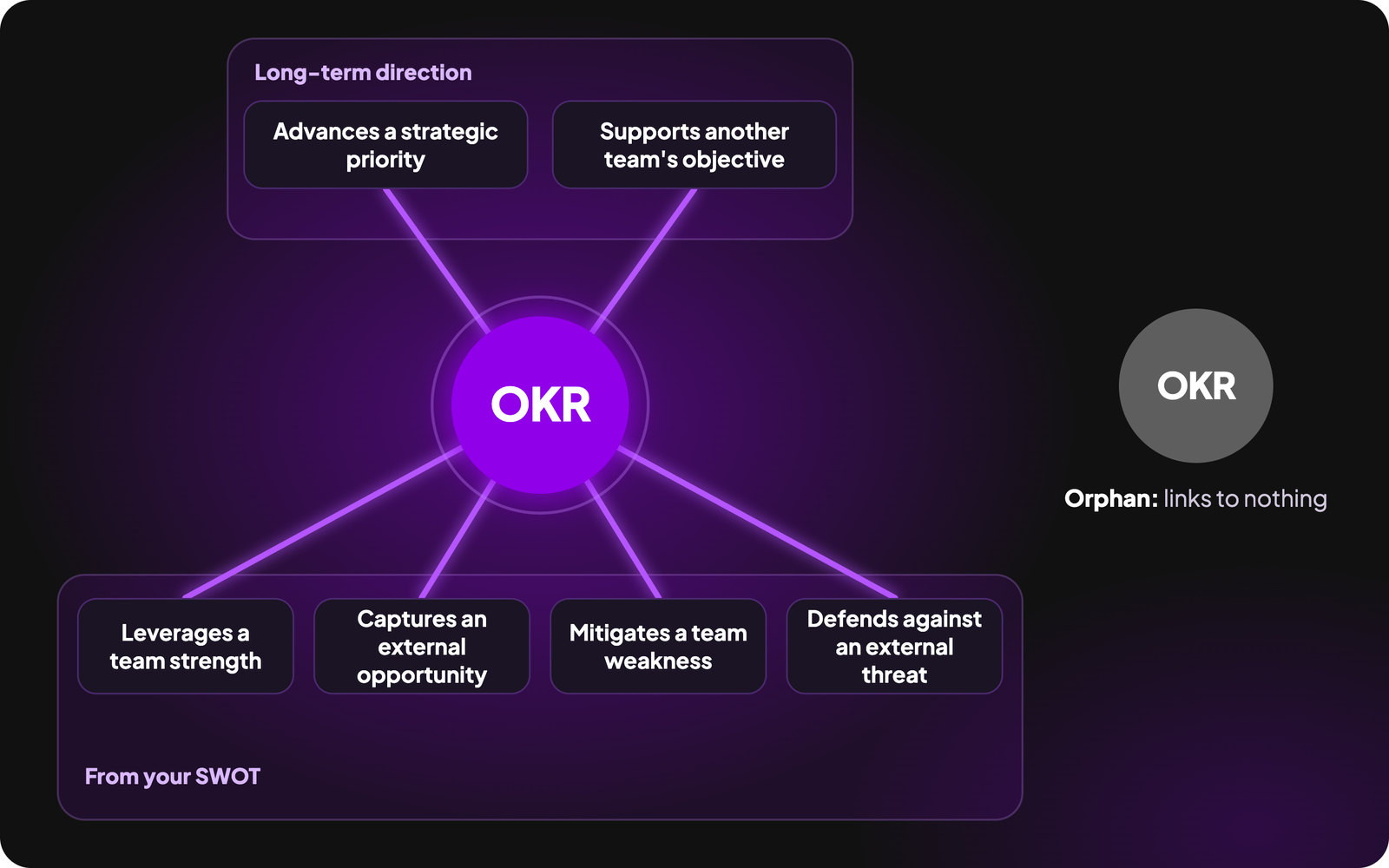
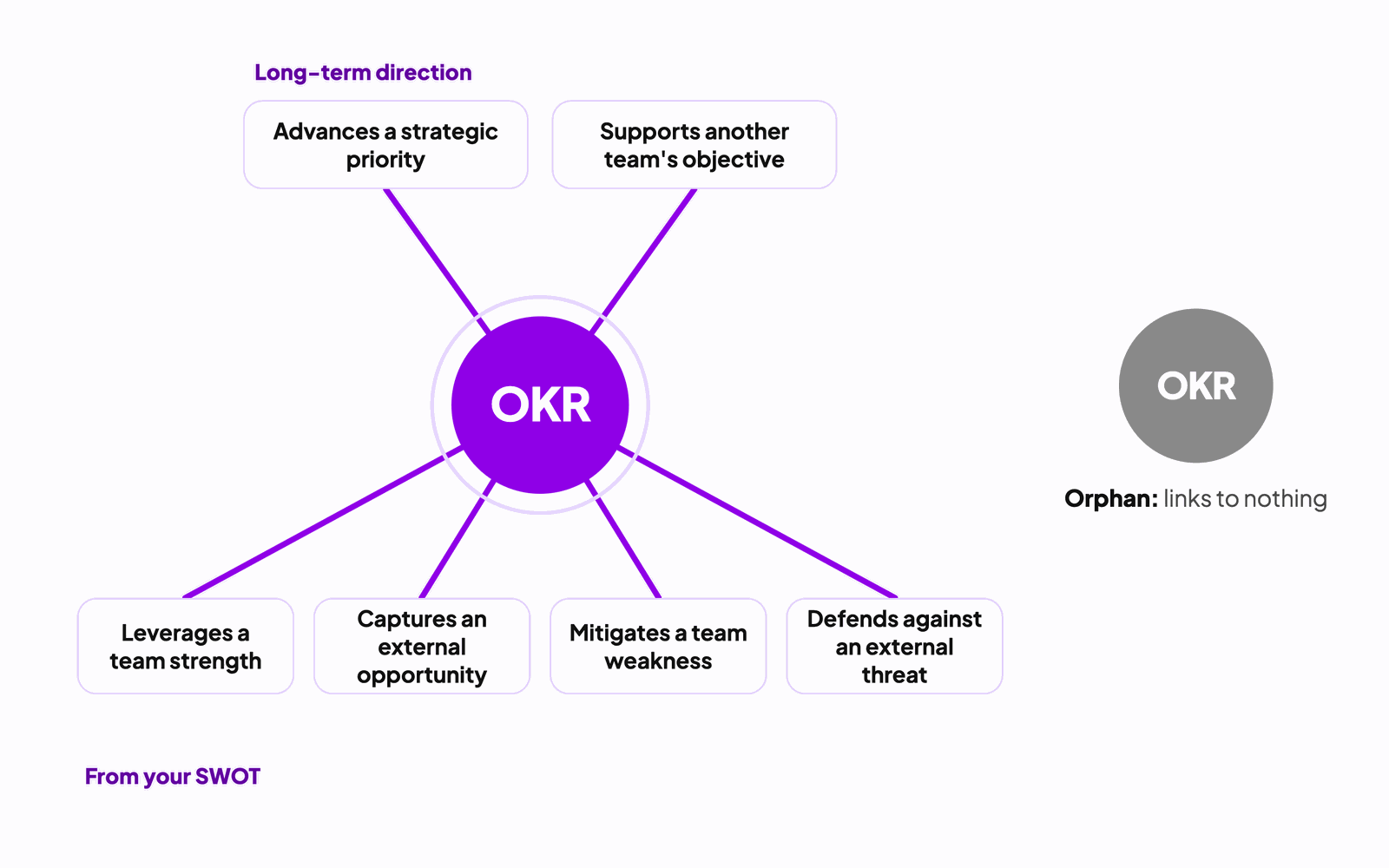
- Advances a strategic priority. The objective moves something in the company’s medium or long-range plan, such as a pillar in the strategic plan or a stated priority for the year.
- Supports another team’s objective. The objective exists so a different team can hit theirs. Platform and enablement teams write a lot of these.
- Leverages a team strength. The team has an advantage worth pressing, such as a product capability competitors lack or a customer relationship nobody else has.
- Captures an external opportunity. Something has opened up in the market, such as a new regulation, a competitor exiting or a new buyer segment showing up.
- Mitigates a team weakness. There is a gap the team needs to close. A health metric that has started slipping belongs here, because a slipping vital sign is a weakness showing up in the data.
- Defends against an external threat. A risk is coming from outside, such as a new competitor, a pricing shift or a platform change.
The first two anchors are the long-horizon layer. They connect to the company’s vision, mission and strategic plan, and to the teams you depend on. The other four come from a SWOT, and they keep the team responsive in the months between full strategy refreshes. A strategic plan written in January can’t anticipate the competitor that launches in April. Anchors 3 through 6 give that response a legitimate home.
An OKR can link to more than one anchor.
Don’t have a current SWOT? Start one
A SWOT is a simple picture of where your team stands right now. Strengths and Weaknesses are about the team itself. Opportunities and Threats come from outside it: the market, customers, competitors and regulation. A threat can be anything from outside that forces you to change your systems or the way you work, such as a new tariff, a regulatory change or a legal requirement, as well as the more familiar competitor launch. Our sample business profile shows one made-up company’s SWOT turned into linked OKRs for every department.
Plenty of teams write one at an annual offsite and never open it again, and some have never written one at all. Without a current SWOT, you can only link OKRs to strategy through the first two anchors, and anchors 3 to 6 turn into guesswork. It’s worth setting one up before your next planning cycle. A first version takes under an hour:
- Give everyone ten minutes alone to write two or three items for each of the four quadrants.
- Put every item on one page and group the ones that say the same thing.
- Pick the top three per quadrant by asking which ones would change what the team does this quarter.
- Keep it next to your OKRs, so both are in front of the team at planning.
Update it at least once a quarter, before planning, and any time urgent work reveals something new about the team or its market. The section on mid-quarter urgent work below shows how that plays out.
Why the “why now” matters as much as the anchor
Naming an anchor covers half the work when you link OKRs to strategy. The other half is saying why this quarter.
A lot of work can be traced back to a strategic priority if you squint. “Grow enterprise revenue” is on the plan, so nearly anything with a customer attached can claim it. The “why now” is what separates the objective that belongs in this cycle from the one that could just as easily wait for the next.
Ben Lamorte, who has coached OKR programs for over a decade, puts a written “why now” next to each objective. You can see the practice in his own OKR for The OKRs Field Book, where the objective comes with a few sentences on why the timing mattered. A couple of sentences is plenty. If a team can’t write them, the objective may still be a good idea, but for a later quarter.
How to link OKRs to strategy in your next planning cycle
Here is the sequence I’d suggest for a planning session. It adds about one conversation per objective.
- Put the strategy and the SWOT in the room. Before anyone drafts an objective, have the current strategic priorities and a recent team SWOT visible to everyone. Teams can only link to anchors they can see.
- Let each team draft its own objectives first. The people who will carry the OKR write it. Leadership reviews the drafts afterwards.
- Ask one question per objective. “Which anchor does this link to, and why this quarter?” The owner answers out loud in a sentence or two.
- Write the anchor next to the objective. Record it in whatever holds your OKRs, so the link survives the planning session and anyone can see it later.
- Sort anything without an answer. An objective with no anchor gets one of three outcomes before the cycle starts, covered below.
The whole check is binary: an objective is either linked or it’s an Orphan. That makes it fast, and it keeps the conversation away from debating wording.
A worked example helps. Here are three draft objectives from a hypothetical operations team, run through the question.
| Draft objective | Anchor named | Why now | Result |
|---|---|---|---|
| Make onboarding fast enough that new customers see value in their first week | 1. Advances a strategic priority (the plan names retention as this year’s top priority) | Early churn is concentrated in customers who never finish setup | Linked |
| Give the sales team a pricing model they can quote without escalating | 2. Supports another team’s objective (Sales has an objective to shorten the deal cycle) | Sales flagged pricing escalations as their biggest delay this quarter | Linked |
| Modernize our internal documentation | None named | “It’s overdue” | Orphan |
The third might be worth doing someday. “It’s overdue” doesn’t name an anchor, and it doesn’t explain why this quarter.
If you’d like a structured way to run this check across a whole team, the LEAD Toolkit includes a self-assessment covering the Link pillar alongside the other three.
What to do with an Orphan OKR
An Orphan is what you are left with when a team tries to link OKRs to strategy and nothing connects. It gets one of three outcomes, and each one is a legitimate answer.
- Fix it. The team had a real reason and didn’t say it. Once the reason is out loud, it maps to an anchor, and the objective gets rewritten so the link is visible. If the wording itself needs work, our step-by-step guide to writing effective OKRs covers the craft. Anchors 5 and 6 catch a lot of these, because defensive work is easy to forget to name.
- Move it out of the OKRs. Some work has to happen and doesn’t need to change anything this cycle. Routine operations and the health metrics you protect every quarter live outside the OKR set. They still get done, and they still get watched.
- Cut it. The objective came from habit or from one person’s enthusiasm, and nobody can connect it to anything the business needs this quarter. Dropping it frees capacity for the objectives that are linked. When you cut or park something a person asked for, tell them why and when it could come back. The scripts in the next section work here too.
I’d rather see a team walk out of planning with three linked OKRs than six where two are Orphans. The Orphans compete for the same hours and the same Wednesday attention, and they are the first to stall.
What about urgent work that shows up mid-quarter?
You link OKRs to strategy at setup, and the quarter keeps moving after that. Picture week four. Your biggest customer escalates an issue, a major vendor announces supply chain delays nobody saw coming, and the team you were counting on for campaign assets falls behind. Then a new tariff forces an update to your entire POS pricing system, and until that’s fixed, the team works through manual overrides and calculations that raise the risk of human error. Each one arrives with a deadline and someone waiting for an answer, and it’s tempting to either drop the plan or push the fire aside and hope.
Treat urgent work as a new OKR candidate and run the same Link check on it, the one you use to link OKRs to strategy before the cycle starts. Start by finding out why it became urgent, because the reason tells you whether it has an anchor. Keep asking until the answer gets past “because it’s due Friday.”
Work turns urgent for one of seven common reasons:
| Why it became urgent | Anchor | What to do |
|---|---|---|
| Something changed outside the team: a competitor launch, a new tariff or regulation that forces a system change, or a shift in what a big customer needs | 4 or 6: opportunity or threat | Update the SWOT, then decide between an OKR and a health metric |
| Something is slipping inside the team: a weekly number trending the wrong way, a process that now needs manual workarounds, a departure | 5: weakness | Update the SWOT, then decide between an OKR and a health metric |
| A window opened that won’t be there next quarter | 3 or 4: strength or opportunity | Update the SWOT, then decide between an OKR and a health metric |
| Another team needs your help to hit a goal the company already agreed to | 2: supports another team’s objective | Link it and agree the trade-off with that team |
| Another team’s plan ran late and the deadline landed on you | None | Do the part only your team can do and park the rest |
| A senior leader asked, loudly | None until they name one | Make the trade-off visible and let them choose (if it’s a directive, see below) |
| Routine work that happens to be due today | None, because it’s operations | Do it, and schedule the next one so it isn’t a surprise |
When the urgency is real
If the reason is one of the first four, write it into the SWOT first. Once it’s written down, the work has an anchor, and you can link it the same way you link OKRs to strategy at planning. Then decide how to handle it in the open:
- Make it an OKR when something needs to be measurably different by the end of the cycle. The POS pricing fix is a good example: the team needs to go from manual price overrides on every order to none, and that has a starting value and a target. The tariff goes under Threats in the SWOT and the workaround risk under Weaknesses, so you can link OKRs to strategy through either anchor.
- Keep it outside the OKRs when the job is to hold something steady. That work still gets done, and you watch it every week as a health metric.
Either way, name what it displaces. If a new OKR takes hours from an existing one, say which one slows down and agree it with whoever set the targets. When a health metric goes badly red, fixing it can outrank every stretch goal on the list, and that decision is better made on purpose than drifted into.
When the urgency is something else
Those last three reasons are harder, because the person asking genuinely needs something from you. The work stays off the priority list for now, and you still owe them a straight answer with a reason. Three scripts that work:
When another team’s plan ran late: “I can see this landed late for you. We can take on the part only our team can do, which is the data pull. The rest has to wait until the week of the 20th, because the three priorities we committed to this quarter need the time.”
When a senior leader asked loudly: “We can start on this Monday. To do that, the customer onboarding work stops for two weeks. Which would you rather we protect?”
When routine work is due: “We’ll get the report out by Friday. Can we put next quarter’s version in the calendar now, so it isn’t a fire next time?”
Write each request on a parked list and bring that list to your next planning session. Parked work gets a proper look when you plan the next quarter, which is fairer to the person asking than a no they never hear about.
When the order comes from above
Sometimes the push comes from someone with more authority than you, and it arrives as a decision already made. You can’t park it, and saying no isn’t really on the table. What you can do is make sure the decision gets made with its cost in full view, and that the plan changes openly.
- Ask what’s driving it. Senior leaders often know something the team doesn’t yet, such as a board concern, a customer at risk or a shift in strategy. If the reason is a real change, it belongs in the SWOT or the strategy, the new work gets a legitimate anchor, and you can link it the way you link OKRs to strategy at planning.
- Name what it displaces, in numbers. Say which committed OKRs slow down and by how much. “The onboarding objective slips three weeks, and the activation target drops from 40% to 32%” gives a leader something concrete to decide on.
- Ask them to confirm the trade-off, or to fund both. If they want the original commitments kept as well, that takes extra people, time or budget, and asking for it is part of the conversation.
- Update the OKRs in the open. Change the affected key results where everyone can see them, and tell any team that depends on the work. The LEAD Align pillar calls for exactly this when strategy shifts mid-cycle.
- Write it down. Keep a short note of the directive and the trade-off. At the end of the quarter it explains the miss honestly, so the team isn’t scored against a plan that leadership changed.
A script for the moment itself:
“Understood, we’ll pick this up this week. So we’re all working from the same plan: the onboarding objective slips to mid-November, and the activation target moves from 40% to 32%. I’ll update our OKRs today and let the Sales team know. If you’d like us to keep the original targets as well, we’d need one more engineer for six weeks.”
If directives like this land every few weeks, bring your notes to the next planning session. A pattern of top-down changes is useful information, and it may mean the team needs to hold some capacity in reserve each quarter.
The trap when you link OKRs to strategy: laddering by decree
There is a tempting shortcut. Leadership writes the objectives, assigns each one a strategic priority, and hands the finished set down to the teams. Every OKR is linked on paper, and it feels like the fastest way to link OKRs to strategy across a whole company.
It skips the part that makes the link hold. The team receiving the OKR didn’t choose the anchor and can’t explain the why now in their own words. In week five, when a customer escalation pulls two people off the work, nobody on that team has a reason ready to defend the objective, so it gives way.
When teams write their own OKRs and name their own anchors, the reasoning lives with the people doing the work. Leadership’s job in that room is to pressure-test the links and to say so when an anchor looks thin.
Frequently asked questions
How many anchors should each OKR link to?
One strong link is enough. Plenty of good OKRs link to two, such as an objective that advances a strategic priority and also defends against a competitor threat. The setup check only asks whether at least one link exists and whether the team can explain it.
Can an OKR link to strategy if it only supports another team?
Yes. Supporting another team’s objective is the second anchor, and it is a fully linked OKR. Platform, data and enablement teams write many of these. The support relationship should be named explicitly, including which team and which objective, so both teams can see the dependency.
What if our company doesn’t have a written strategy?
You can still link OKRs to strategy through the four SWOT anchors while the long-range plan gets written. A team that knows its strengths, weaknesses, opportunities and threats has enough to link against. That said, a company without a stated mission, vision and priorities will find planning harder every quarter, and writing those down is worth doing before the next cycle. Our guide to moving from strategic planning to goal achievement covers that step.
What if our team doesn’t have a SWOT?
Start one before your next planning cycle. Have each person write two or three items per quadrant, group the duplicates, and keep the top three in each. Update it at least once a quarter and whenever urgent work reveals something new. Without a current SWOT, you can only link OKRs to strategy through the two long-horizon anchors, and responsive work ends up looking like an Orphan.
What should we do with urgent work that shows up mid-quarter?
Find out why it became urgent before you say yes or no. If the cause is a real change inside the team or outside it, update the SWOT, link the work to that anchor, and make it an OKR or a health metric. A late plan elsewhere, a loud request or routine work gets parked with a stated reason and brought to the next planning session.
What if a senior leader orders the team to drop its priorities?
Treat it as a decision to make visible. Ask what’s driving it, because it may be a real change that belongs in the SWOT or the strategy, and then you link OKRs to strategy again on the updated plan. Next, name which OKRs slip and by how much, ask the leader to confirm that trade-off or provide what it would take to do both, update the OKRs where everyone can see them, and keep a note so the end-of-quarter score reflects the change.
How often should we check whether OKRs are linked?
Once per OKR, at setup, before the cycle starts, and again for any new OKR that comes out of urgent mid-quarter work. If the strategy changes mid-quarter, re-run the check on the affected OKRs. Week-to-week coordination between teams is a separate practice, which the LEAD framework handles under the Align pillar.
LEAD Toolkit: Free Download
The LEAD Toolkit covers all four pillars of the LEAD framework and includes a self-assessment that shows which pillar is weakest in your OKR program. Teams who suspect they have Orphans on the list can use the Link section to check every objective before the next cycle.
If your Q4 OKRs are already written, pull up the list this week and ask the anchor question about each one. The Orphans show themselves within a minute or two.