The LEAD Series | Episode 4 of 4: Deliver
One article for each pillar of the LEAD framework: Link, Engage, Align and Deliver.
TL;DR: OKR execution is the weekly work of turning a set of OKRs into decisions and action while the quarter can still be changed. It runs as a loop: a short check-in where every Key Result reports its movement, an action plan for anything at risk, an escalation path for blockers the team can’t solve alone, and an honest score at the end. Setting good OKRs earns you a shot at the quarter. The Wednesday loop decides whether you take it.
A leadership team can spend two days at an offsite writing sharp OKRs and lose the quarter by week six without a single bad decision. The work that slips away does it in small increments. A Key Result misses one check-in because the owner was pulled into a customer escalation. The next week it gets a vague “still in progress.” By the mid-cycle review, nobody can say what the number is.
OKR execution is the part of an OKR program that catches that slide while there’s still time to act on it. In the LEAD framework it’s the fourth pillar, Deliver, and its tagline is the shortest version of the argument: Wednesday is where the quarter is decided.
What is OKR execution?
OKR execution is the recurring practice of checking every Key Result against its target each week, deciding what changes when one falls behind, and scoring the cycle honestly when it closes. It covers three habits: a weekly check-in that ends in decisions, action plans for at-risk Key Results, and an end-of-cycle score the team can trust. Planning sets the direction, and OKR execution is how the team actually travels it.
In the LEAD framework, Link, Engage and Align are about setting OKRs worth running and keeping teams in sync. Deliver is where all three get tested against real weeks.
Where OKR execution slips between kickoff and week six
Picture a VP of Operations in week five of a quarter. Her team has an objective to cut onboarding time for new enterprise customers, with a Key Result to take average time-to-first-value from 41 days to 25. At kickoff it had energy. In week five it’s sitting at 39, and the check-in has become a quick round of “we’re working on it” before the meeting moves to something louder.
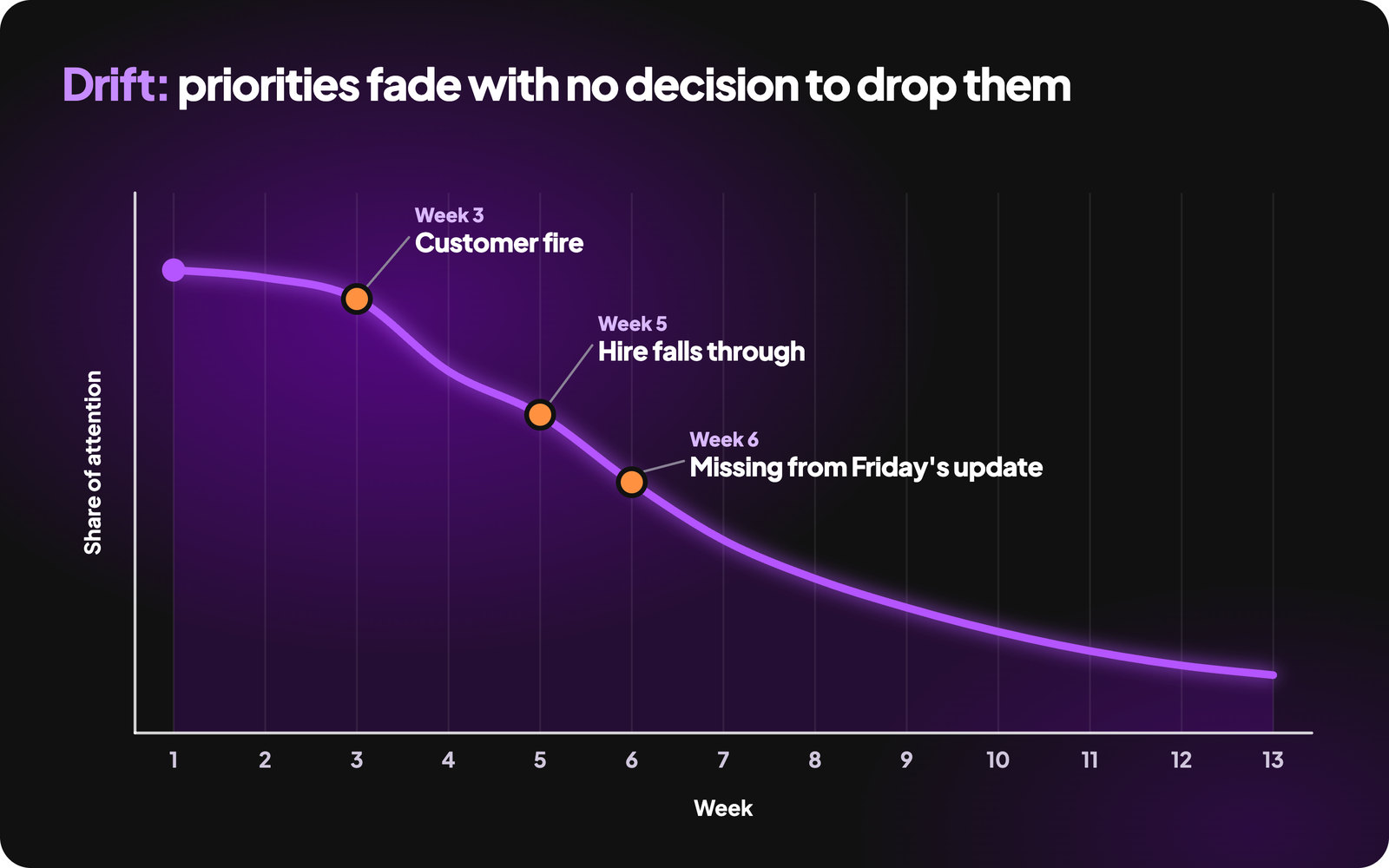
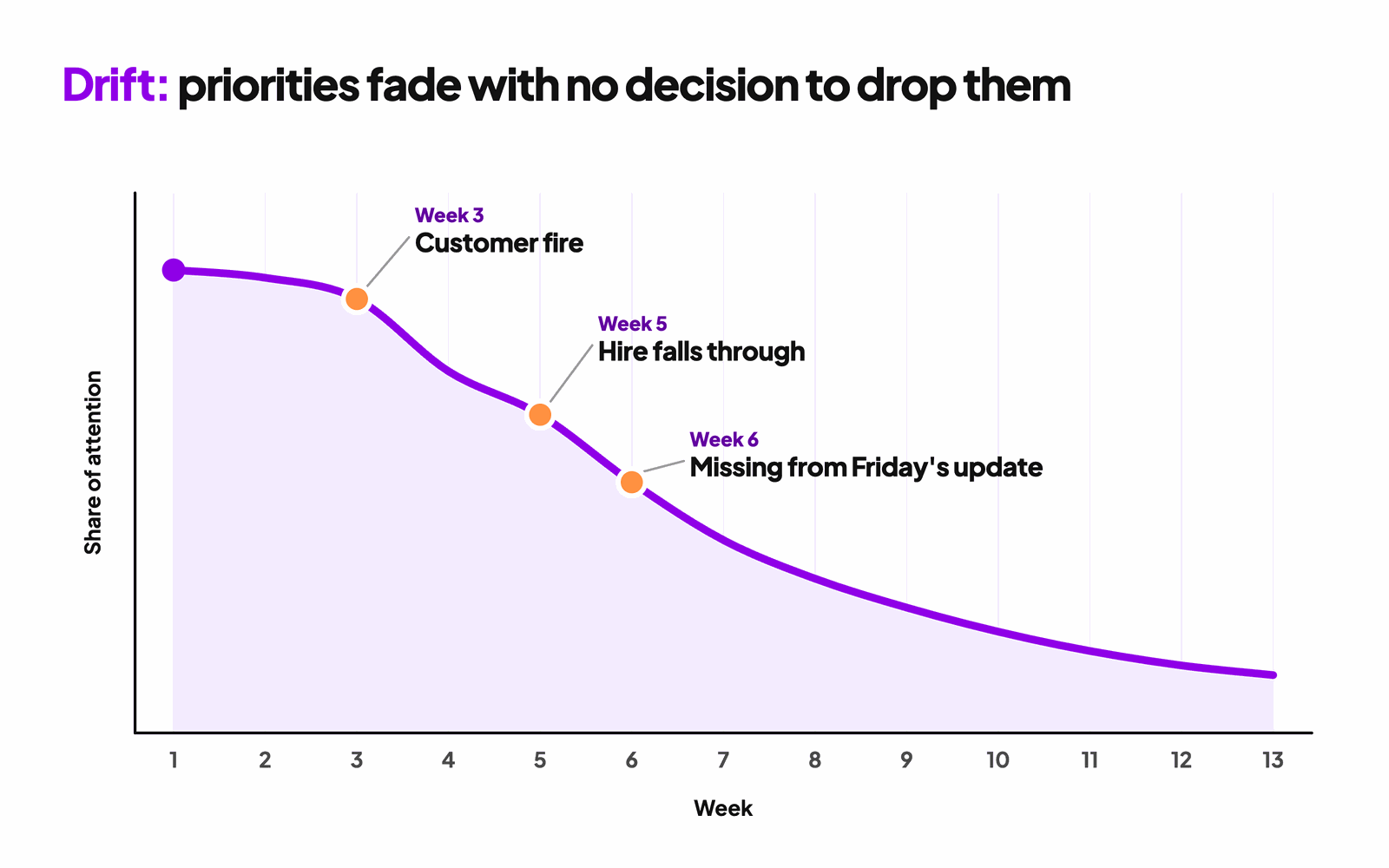
Nobody chose to drop it. A few things piled up:
- The check-in collected updates, and nobody in the room was expected to decide anything based on them.
- The Key Result owner described activity (“we rewrote the kickoff deck”) in place of the number, so the lack of movement stayed hidden.
- When the number stalled, there was no small, named next step, so the stall carried into the following week.
- The blocker (engineering capacity for an integration fix) belonged to another team, and there was no route for raising it.
Every item on that list is an OKR execution gap, and a better-written OKR wouldn’t have prevented any of them.
Every item on that list is an OKR execution gap, and a better-written OKR wouldn’t have prevented any of them.
Match the cycle length to how fast the number can move
Some metrics move within weeks. Others need months of iteration before they shift, such as perfecting a recipe or formula, or lifting the conversion rate on a marketing campaign through round after round of testing. When a slow-moving metric sits inside a quarterly cycle, the Key Result can look stalled for most of the quarter while the team is doing exactly the right work.
Gauge how long the change will realistically take while you’re still planning. Metrics that need a long run of iteration belong in a longer OKR cycle, and an organization can run annual OKRs for those alongside quarterly or four-month cycles for work that moves faster. Some software teams go the other way and run six-week cycles, because their work changes that quickly. Matching the cycle to the metric is one of the simplest ways to make OKR execution feel fair to the people doing it.
If the cycle length fits and a number still isn’t moving, check whether the OKR was linked to a real anchor, written with the team and kept in sync with the teams it depends on. Anything you can’t fix mid-cycle goes into your notes for the next planning session. And when those are in good shape, the likeliest explanation is that the team is working on a hard problem, which is what stretch goals are for.
The weekly OKR execution loop
The loop has four steps. They repeat every week, for every Key Result, and the whole thing is designed to be short when things are on track and to expand only where a number needs help.
- Check in. Every Key Result reports where its number moved since last week, plus the team’s confidence that it lands by the end of the cycle.
- Plan the next action. Any Key Result that is behind or losing confidence leaves the check-in with one specific action, one owner and a date.
- Escalate what the team can’t solve alone. A blocker that needs another team’s time, a budget decision or leadership support goes to leadership in a separate conversation, outside the team check-in.
- Record it. Write down the number and the confidence score, along with the action and any escalation, somewhere the whole org can see. Next week then starts from this week’s decisions.
At the end of the cycle, a fifth step closes the loop: score each Key Result honestly and carry what you learned into the next quarter’s planning.
How to run a weekly OKR check-in that ends in a decision
The check-in is the engine of OKR execution. Its job is to produce a decision for each Key Result: keep going, push harder, change the approach, or re-resource it.
Every Key Result answers one question first: from what, to what? That’s the metric the KR tracks, with last week’s value next to this week’s.
- Weak: “We launched the new onboarding flow.”
- Strong: “Activation went from 34% to 38%.”
The story about the onboarding flow comes after the number. Leading with the number keeps the conversation on the outcome, and it makes a stalled KR visible in the first ten seconds.
Then ask for a confidence score on a 0 to 1 scale, in 0.1 increments. A 0.8 means the team expects to land it, while a 0.4 says it’s slipping and the team wants help. The trend in that score across three or four weeks tells you more than any single status color.
When a number is flat, three learning questions keep the conversation on what the team is finding out:
- “What did we try since last week?”
- “What did we learn from it, even if the number didn’t move?”
- “What are we trying next, and when will we know whether it worked?”
Some teams also log a sentiment read for each Key Result: poor, medium or good. It captures what the team knows that the number doesn’t show yet. Sales performance might look strong this month while the marketing team reports that qualified leads have started drying up. The sales number won’t show that for weeks, but the pipeline says it’s coming, so a poor sentiment score on a Key Result that’s currently on track is an honest early warning.
Two phrases work well for keeping the check-in pointed at decisions:
- “Given that number, what do we change this week?”
- “What would have to be true for this to get back to a 0.7?”
The person who owns each Key Result (we call this role the KR Champion) walks in already knowing the current value. Nobody writes a pre-meeting report. Everything else, including the confidence read and the next step, gets worked out together in the room.
If you want a structure to start from, our OKR check-in template post walks through a check-in format built around decisions, and the free Weekly Check-In Template gives you a printable version.
What goes in an OKR action plan?
An OKR action plan is the one or two concrete steps a team commits to this week to move a Key Result that has stalled or slipped. It names the action, the person doing it and the date it gets done. The plan lives on the Key Result and gets reviewed at the next check-in.
The size matters. A good action plan fits inside a week. Anything bigger is a project, and projects belong in the team’s normal planning.
| Weak action plan | Strong action plan |
|---|---|
| “Improve onboarding.” | “Priya books calls with the three enterprise customers stuck past day 30 by Friday.” |
| “Look into the drop-off.” | “Marcus pulls the step-by-step funnel for September signups and brings it to next Wednesday’s check-in.” |
| “Work with Engineering on the integration.” | “Dana asks the Engineering lead for two days of integration time in next sprint, and escalates Monday if the answer is no.” |
The strong versions share three details: a named person, a specific action and a date. That structure has research behind it. A meta-analysis of 94 studies by Peter Gollwitzer and Paschal Sheeran found that specific if-then plans, which spell out when, where and how a person will act, had a medium-to-large effect on whether people reached their goals. An action plan with a name and a date is the team version of that.
When an action plan stops working
Small blockers stay in the check-in. The team writes an action plan, runs it, and looks at the number again next Wednesday.
Some blockers are outside the team’s reach. The fix needs another team’s capacity, a budget line, or a leadership decision about priorities. When a Key Result has carried the same blocker through two or three weeks of action plans without moving, the KR Champion takes it to leadership in a separate conversation.
Keeping escalation out of the team check-in protects both meetings. The check-in stays short and focused on what the team controls, and leadership hears a specific ask with a number attached. A useful script for that conversation:
- “This KR has been stuck at 39 days for three weeks. The blocker is two days of integration work from Engineering. Can we get it this sprint, or should we change the target?”
Either answer is a decision, and both are better than a fourth week of “still in progress.”
Key Results that depend on experiments need one more guardrail. “This takes a lot of testing” is often true, and it can also become a reason to show no progress all quarter. Give every test a start date and an end date when it begins, so each one reaches a conclusion. If several tests in a row come back with nothing, change the approach: expand the activities, bring in more resources, or go back to the drawing board for new ideas. Moving people or budget from another priority gets discussed, agreed and written down. And if a health metric goes red while all of this is happening, fixing it comes before the OKR work.
Scoring the cycle honestly
The final score is the last piece of OKR execution, and it only works if people trust it. Across a set of ambitious OKRs, a healthy team scores somewhere in the 0.6 to 0.8 range, with real variation between Key Results.
A cycle where everything lands at 1.0 looks great on a slide. Up close it points to targets set low enough to guarantee the result. A sandbagged score gets named in the retro so the next cycle’s targets can be set honestly.
A low score is information too. The cause might have sat outside the team’s control, or it might have been avoidable, in which case the team can do better next time. And sometimes the problem started above the team, because leadership didn’t resource the work properly or underestimated the effort it needed. Write down which one it was, because each one changes how the next cycle gets planned.
The weekly loop makes honest scoring much easier. When the team has looked at the number every Wednesday, the final score holds no surprises and has no story to protect. If your scoring system needs rebuilding, we go deeper on that in how to run an OKR scoring system without gaming it.
Why visible progress keeps a team invested
There’s a human reason the weekly loop works. Teresa Amabile and Steven Kramer studied the daily diaries of knowledge workers for their Harvard Business Review piece on small wins and found that, of everything that can lift motivation during a workday, the single biggest factor is making progress on work people care about.
A weekly check-in that shows a number moving from 41 to 36 gives a team that experience every week. The goal set at kickoff stays connected to the work people are doing on a Tuesday afternoon, and that connection is what keeps them invested through a hard stretch.
The OKR execution loop above is one habit inside a larger discipline, and it compounds over several cycles. In the first quarter you run it, the check-ins will feel clumsy and some action plans will be too vague. By the third quarter, the team knows what a good week looks like.
Frequently asked questions
How long should a weekly OKR check-in take?
It varies with what the Key Results need. A KR on track might take a couple of minutes, and one at risk with a real blocker can take fifteen. Structure the check-in around its steps and let the time follow. A short check-in is a good sign only when every Key Result still leaves with a decision.
Who should run the weekly check-in?
The team lead or an OKR coordinator facilitates, and each KR Champion reports on their own Key Result. Leadership doesn’t need to attend team check-ins. With the check-in data recorded where they can see it, leaders can review progress on their own schedule and step in when something is escalated.
What is the difference between an OKR action plan and a project plan?
An OKR action plan is one or two steps that fit inside a week and exist to move a specific Key Result. A project plan covers a larger body of work over many weeks. If an action plan keeps growing, the work probably belongs in the team’s project planning, with the next step from it feeding the action plan.
What if a Key Result needs months of testing to move?
Put it in a cycle that matches how long the change will take, such as an annual OKR running alongside your quarterly ones. Inside any cycle, give each test a start and end date, record what every test taught the team, and change the approach when several tests in a row show nothing.
What if a Key Result can’t be saved this quarter?
Say so early, in the check-in. Lower the confidence score, agree on whether to reduce scope, re-resource it or let it land where it lands, and record the decision. An honest 0.4 with a lesson attached gives the next planning session something to work with.
Does OKR execution need software?
The loop works with a shared document when a team is starting out. Software earns its place as the number of teams grows, because leadership needs to see every team’s numbers, confidence scores and escalations in one view without calling a meeting to collect them.
Where to go next
If check-ins are where your OKRs lose momentum, start with the free Weekly Check-In Template. It lays out the steps above on one page so your team can run next Wednesday’s check-in with them.
Pick one Key Result that has been drifting. At this week’s check-in, ask from what, to what, and leave with one action, one name and one date.