

Track OKR Progress While There’s Still Time to Act
Use case: track and improve performance
Track OKR Progress While There’s Still Time to Act
Too many quarters end with a review where the only thing left to do is explain the score. When you track OKR progress every week, that conversation happens in week three instead, while a slipping Key Result can still be rescued. OKR Leader gives each Key Result a weekly update with the current number, the owner’s confidence, any blockers and an action plan, so the team decides what to do next while the quarter is still open.
Where it slips
Why do teams stop tracking OKRs halfway through the quarter?
Updating a spreadsheet that nobody reads feels like admin. It slides one busy week, then a second, and by the time the quarterly review comes around the Key Results haven’t been discussed in a month.
The people involved care about the results. What they’re missing is a short, regular moment where the numbers get looked at and something changes because of them. Four warning signs show the tracking has stalled:
Updates are a status recital
Each person reads out what they did this week, and nobody asks whether the number moved.
Numbers arrive the night before
Key Results get updated in a rush right before the quarterly review.
Confidence never comes up
The team learns a Key Result is off track when the final score comes in.
Scores feed performance reviews
People set safe targets because their OKR score affects their pay.
The short answer
What does it mean to track OKR progress?
Tracking OKR progress means recording each Key Result’s current value every week, next to last week’s value and the target, along with the owner’s confidence that the team will reach it. Each week’s number shows which way the result is heading, and the confidence rating shows how worried the owner is. At the weekly check-in the team acts on both, and at the end of the cycle each Key Result gets an honest score between 0 and 1.
How OKR Leader helps
Five ways OKR Leader keeps progress visible
Update a Key Result in a couple of minutes
The owner enters this week’s value, how confident they are, what’s in the way and what happens next. Progress toward the target updates as soon as it’s saved.
Watch confidence over the cycle
A trend line shows each Objective’s average confidence week by week, so a slow slide stands out before it turns into a missed target.
Turn blockers into action
The action plan in each update becomes projects or tasks linked to the Key Result, with an owner and a due date, so the fix agreed at the check-in doesn’t get lost.
See every team’s progress in one view
The dashboard shows where the company’s and each team’s Objectives stand, so leaders can check progress without asking anyone for a report.
Score the cycle honestly and close it
At the end of the cycle each Key Result gets a final score, then the cycle closes, so next quarter starts from a complete record of what happened.
Try this with your team
How to track OKR progress in a weekly check-in
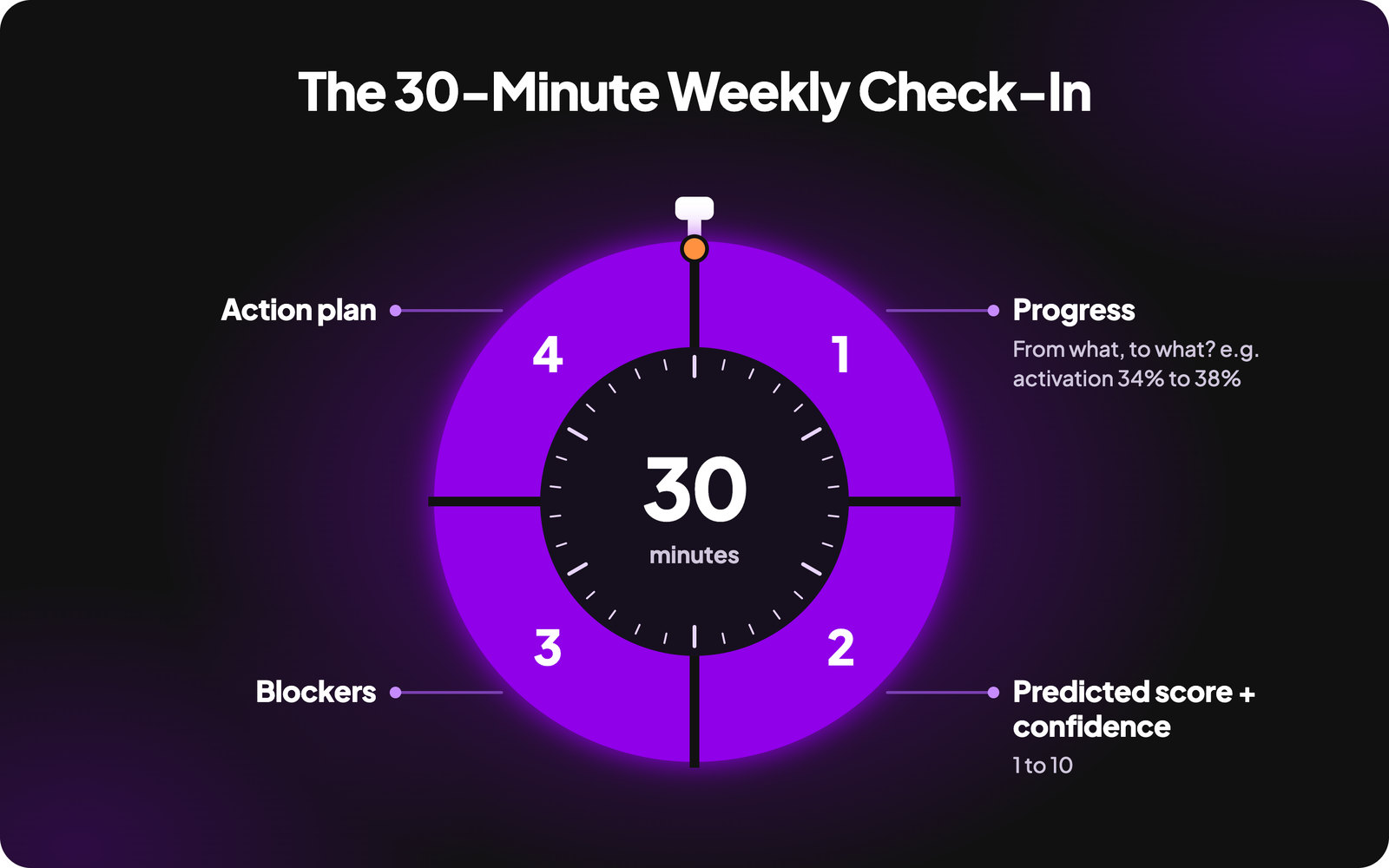
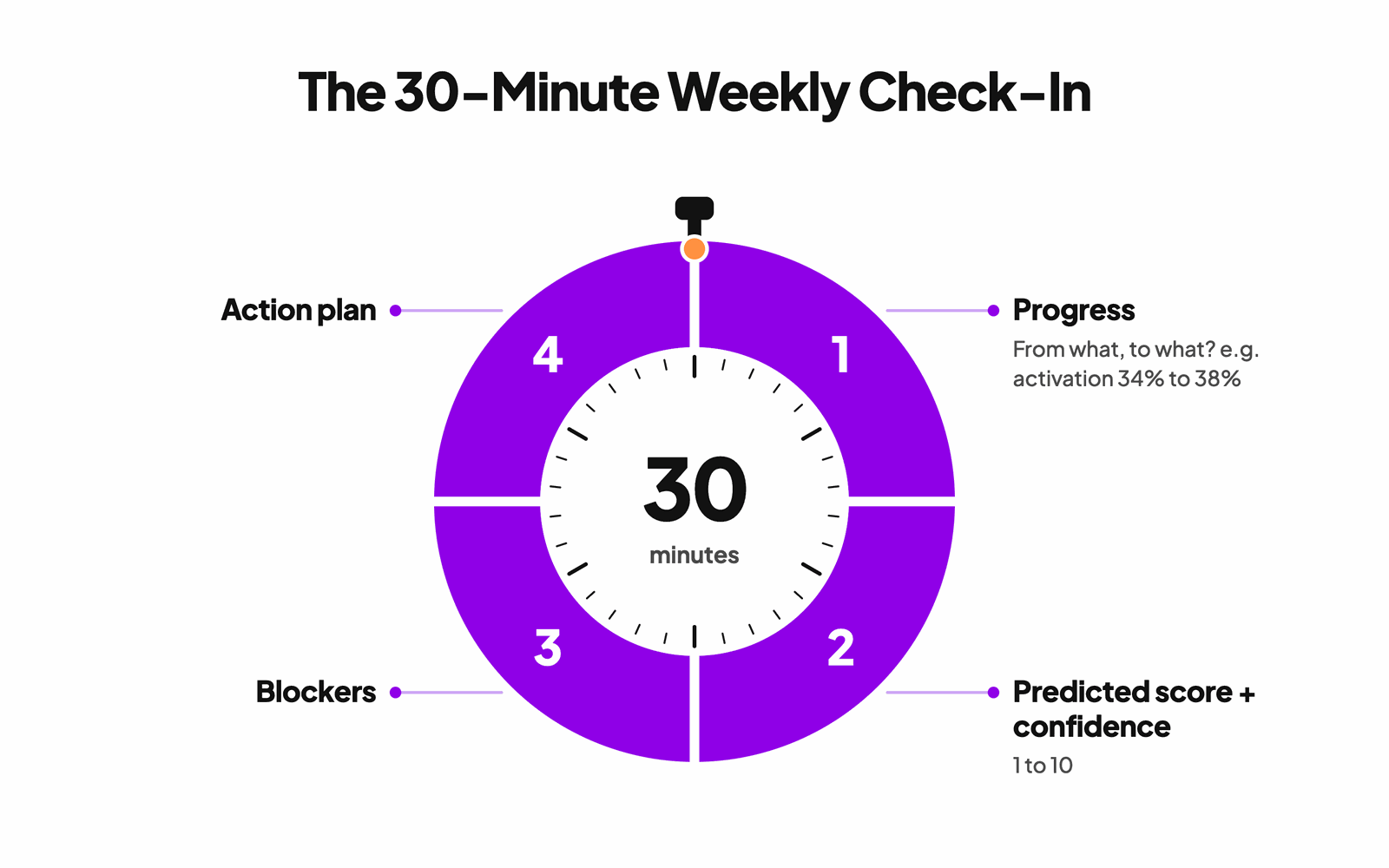
These steps fit a 30-minute meeting, and they work in OKR Leader or in a shared spreadsheet.
- Hold the check-in on the same day every week, and attach it to a meeting the team already has if you can.
- For each Key Result, ask “From what, to what?” The owner gives last week’s value next to this week’s, such as “repeat orders went from 24% to 26%,” and the story behind the number comes after.
- Ask each owner to rate their confidence from 1 to 10 that the Key Result will reach its target, and talk through any rating that dropped since last week.
- Agree on one action for every Key Result that’s slipping, with a name and a date, and open next week’s check-in by reviewing those actions.
A weekly check-in is one habit inside a bigger OKR practice. Well-written Key Results make it quick, and keeping OKR scores away from performance reviews keeps the numbers honest.
Free resources
Go deeper on tracking and scoring
Frequently asked questions
How often should we track OKR progress?
Every week. A weekly update keeps each Key Result in the conversation and gives the team about ten chances in a quarter to change course. Monthly updates leave only two or three, and by the second one the quarter is half gone.
What is a confidence rating?
It’s the owner’s estimate of how likely the Key Result is to reach its target by the end of the cycle. In the free course we use a 1 to 10 scale and start every Key Result at 5, a 50/50 chance. A rating that drops two weeks in a row is worth a conversation, even if the number still looks fine.
How do you score OKRs at the end of the quarter?
Give each Key Result a score from 0 to 1 based on how far it got toward the target. On a stretch target, 0.6 to 0.8 is a strong result. A team that scores 1.0 on everything is probably setting targets that are too safe.
Should OKR scores be part of performance reviews?
No. Once a score affects pay or promotion, people set targets they know they can hit, and the ambition drains out of the program. Use OKR scores to learn about the work, and handle individual performance through your normal review process.
What’s the difference between OKR tracking and KPI tracking?
KPIs are health metrics you watch all the time to confirm the business is running well, such as cash or churn. OKRs track a deliberate change you’re trying to make this cycle. Teams track both, and a KPI that starts to slip is a good candidate for next cycle’s OKRs.
Know where every Key Result stands this week
Start a free trial and run your next check-in in OKR Leader. Or take the free OKR Starter Course first and learn the weekly check-in step by step.