
TL;DR: KPIs vs OKRs is a false choice. KPIs are health indicators that tell you whether the business is stable. OKRs are change engines that drive focused work each quarter. Teams that use both well don’t argue about methodology. They use the dashboard to spot the problem and the OKR to fix it.
You’ve been tracking KPIs for years. Churn rate. Revenue. Customer satisfaction score. They live in a dashboard someone checks every Monday, and you’ve built your reporting rhythm around them.
Then someone mentions OKRs, and the first question that surfaces is: do I have to blow all of that up?
You don’t.
If you’re still figuring out how KPIs and OKRs differ in the first place, start there. This post assumes you’ve got the basics and want to know how to run both at once without chaos.
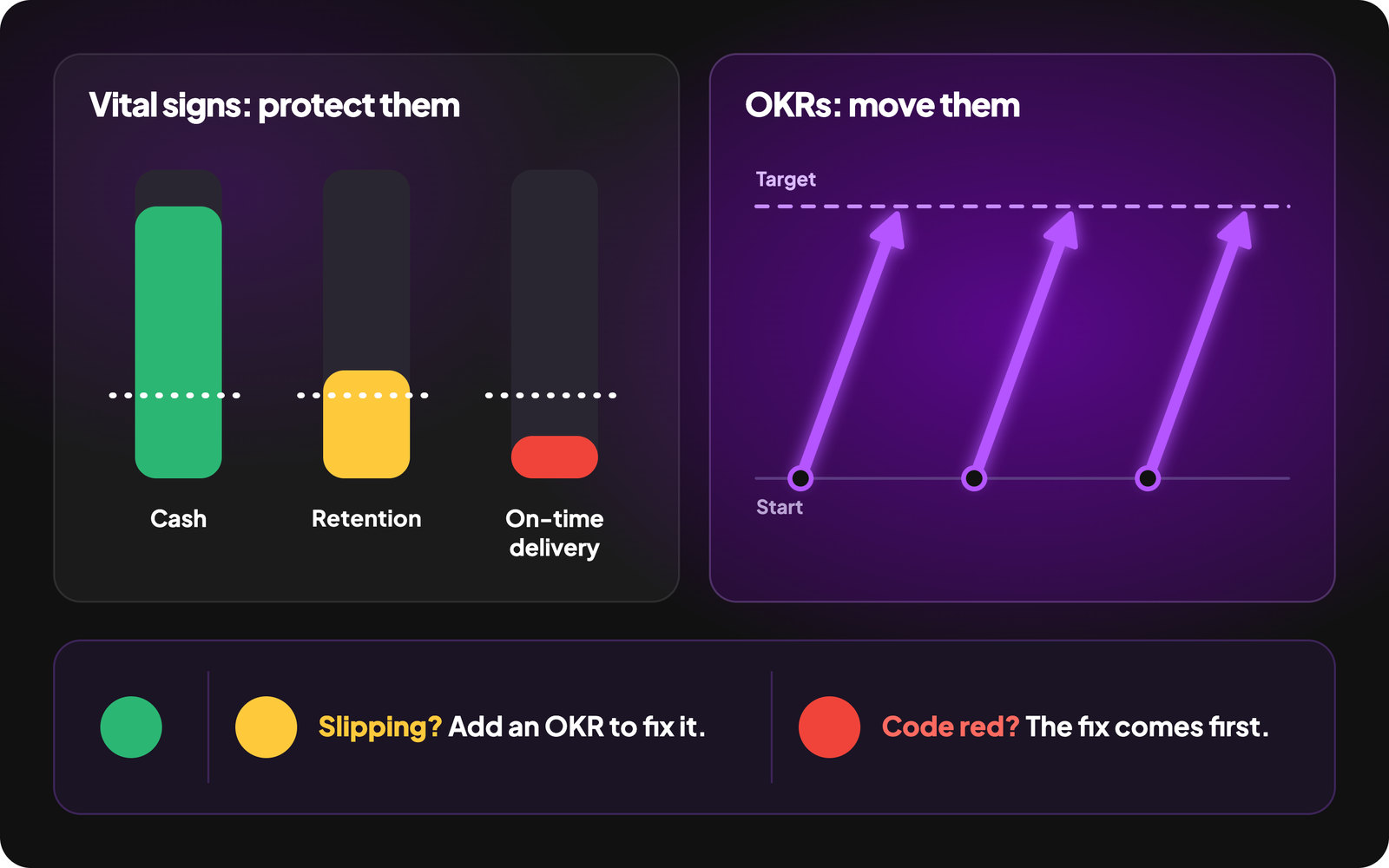
What’s the answer to KPIs vs OKRs? They’re not competing systems. KPIs measure the ongoing health of your business. They tell you whether things are stable, trending up, or heading somewhere you don’t want to go. OKRs (Objectives and Key Results) drive focused change. They define what you’re trying to shift this quarter and how you’ll know if you did. One watches. The other drives. The KPIs vs OKRs debate disappears the moment you stop treating them as alternatives.
Why the KPIs vs OKRs Debate Is the Wrong Frame
The methodology debate usually goes like this: someone reads a book on OKRs, pitches the leadership team, and the first objection is “we already have KPIs.” So the conversation becomes either/or.
That framing is wrong, and it wastes a lot of energy.
KPIs and OKRs answer fundamentally different questions. A KPI answers “how are we doing?” An OKR answers “what are we trying to change, and are we making progress?” Replacing one with the other doesn’t solve anything. Using both, for the right jobs, does. Google’s re:Work guide on OKRs makes this distinction explicit: OKRs aren’t a replacement for ongoing performance measurement. They’re a layer on top of it that focuses energy on what should change.
How Do KPIs vs OKRs Work Together in Practice?
The distinction worth burning in: KPIs tell you the state of your business. OKRs tell you what you’re trying to change about it this quarter. The classic definition of a KPI is “a measurable value that demonstrates how effectively a company is achieving key business objectives.” Notice what it doesn’t say: it doesn’t say “drives change.” That’s the OKR’s job.
A quick reference for the operational distinction:
| KPIs | OKRs | |
|---|---|---|
| Purpose | Monitor ongoing health | Drive focused, time-bound change |
| Time horizon | Continuous, week over week | Quarterly cycles |
| What they answer | Are we healthy? | What are we changing? |
For the full breakdown of what each does, when to use each, and how they’re structured differently, the Difference Between KPIs and OKRs explainer covers it in depth. This post assumes you’ve got that foundation and you’re ready to run both as a stack.
A KPIs vs OKRs Example: The Customer Satisfaction Quarter
Here’s a concrete example. Your customer satisfaction score sits at 72%. You track it every month on a dashboard. It’s a KPI.
Now your team decides that 72% is too low and you’re going to do something about it this quarter. You write an OKR:
Objective: Meaningfully improve the post-onboarding experience for new customers.
Key Result 1: Increase customer satisfaction score from 72% to 85% by end of Q3.
Key Result 2: Reduce average time-to-value from 14 days to 7 days.
Key Result 3: Achieve a 90% completion rate on the new onboarding sequence.
The KPI didn’t go away. You’re still tracking customer satisfaction score every month. But now you have an OKR that tells your team exactly what they’re doing about it and how they’ll know if they succeeded. The KPI is the signal. The OKR is the response. That’s the KPIs vs OKRs system in action: one diagnoses, the other drives.
How to Use KPIs vs OKRs Without Them Fighting Each Other
The dysfunction between KPIs and OKRs almost always traces back to one thing: no clear rule about which does what. Here are four rules that keep them from stepping on each other.
- Let KPIs inform which OKRs to set. Your KPI dashboard is a diagnostic tool. When a metric is healthy, you don’t write an OKR to maintain it. When it’s declining or stuck, that’s where an OKR earns its place. Use the dashboard to find the problem, then use an OKR to address it. Our OKR examples by department list the metrics eight different teams track, which gives you a starting point for the dashboard.
- Don’t duplicate the same thing in both systems. If “monthly recurring revenue” is a KPI you track weekly, you don’t also need it as a key result sitting in your OKR board. You can reference it as the context for an objective without making it live in two places. Duplication creates confusion about which number is the authoritative one.
- Don’t turn OKRs into KPIs mid-quarter. Once you’ve set an OKR, your job isn’t just to watch the number. The OKR exists because you’re doing something about it. If your customer satisfaction score doesn’t move in week four, the response isn’t to note it in the check-in and move on. It’s to look at what’s blocking the work and fix it. OKRs require action, not observation.
- Keep your KPI list short. A team running 5-8 KPIs that genuinely signal business health will outperform a team buried under 30 dashboard tiles. The rest are noise. A shorter, cleaner KPI list makes it much easier to see which ones need an OKR response.
This is the same principle behind a well-run weekly check-in: focus on what’s moving, not on what’s already healthy. And if you want to grab the OKR Leader Check-In Template, you can do that here.
The Real Problem Isn’t the Methodology
The teams I work with don’t actually have a KPIs vs OKRs problem. They have too many meetings about methodology and not enough clarity about which tool does which job.
KPIs are health indicators. OKRs are change engines. An org that uses both well isn’t running a complicated system. They’re just being precise about what each tool is for.
You don’t need to choose. You need to stop treating goal-setting like a zero-sum methodology debate and start running both for what they’re actually built to do.
Pick one KPI that’s been stuck. Write one OKR to move it. See what happens this quarter.
Frequently Asked Questions
How do you decide which KPI deserves an OKR this quarter?
The KPIs that earn an OKR are the ones where the metric is stuck or moving in the wrong direction, where you have a real hypothesis about what would change the trajectory, and where you’re willing to commit team capacity to testing that hypothesis this quarter. A healthy KPI doesn’t need an OKR. A declining one needs one only if you have a clear plan. The fastest way to dilute OKRs is to write one for every KPI on the dashboard. Pick the metrics that genuinely matter and where you have a path forward.
Can a KPI be a key result?
Sometimes, but not usually. A key result is a target movement of a metric over a specific cycle. If your KPI is “reduce churn from 8% to 5% by end of Q3,” that’s actually a key result wearing KPI clothing. The clean rule: if you’re trying to actively change the number this quarter, it’s a key result. If you’re tracking it ongoing without a target movement, it’s a KPI.
How many KPIs and OKRs should a team have?
For KPIs, fewer is almost always better. A team running 5-8 KPIs that genuinely signal business health will outperform a team buried under 30 dashboard tiles. For OKRs, the standard is 3-5 objectives per team per quarter, with 2-5 key results each. More than that and you’ve stopped focusing.
What happens to the OKR when the KPI it was tracking suddenly improves on its own?
Score the OKR and move on. If your churn rate dropped from 8% to 5% in week three because of a market change you didn’t drive, that’s a real outcome but not a credit to the team’s execution. Score honestly, retire the OKR if the work’s no longer needed, and free that capacity for the next priority. The bigger trap is keeping a stale OKR on the board because retiring it feels like admitting failure. The KPI told you the situation changed. The OKR’s job is done. The KPIs vs OKRs distinction works both ways: when conditions shift, so does which tool you reach for.
Book a Demo and see how OKR Leader connects your KPIs to the right OKRs without making your team manage two systems.