
Best overall free OKR software in 2026: Weekdone for small teams that need a real weekly check-in. Best zero-cost forever option: Google Sheets. Best for documentation-heavy strategy teams: Notion. Best free all-in-one workspace: ClickUp. Best lightweight visual board: Trello.
- Weekdone leads dedicated free OKR software in 2026 for small teams running weekly check-ins.
- Google Sheets remains the best free forever option when process stays simple and headcount stays low.
- Notion and ClickUp win when the team already lives inside those tools day to day.
- Free plans fray once hierarchy, history, and coaching-grade reporting matter.
- OKR Leader fits when free tools stop carrying a serious multi-team cycle.
Why free OKR software still stalls good programs
I keep seeing the same Tuesday morning in 2026. A VP opens last quarter's tracker, key results froze after week three, and the offsite slide is the only artifact leadership still trusts.
Free tools get an OKR program on the board. They rarely protect the weekly check-in, and that is where execution holds or collapses. Planning gets the attention. The check-in is the habit that decides whether the cycle produces movement.
If you are also weighing paid platforms beside free ones, start with the best 10 OKR software tools guide next to this list.
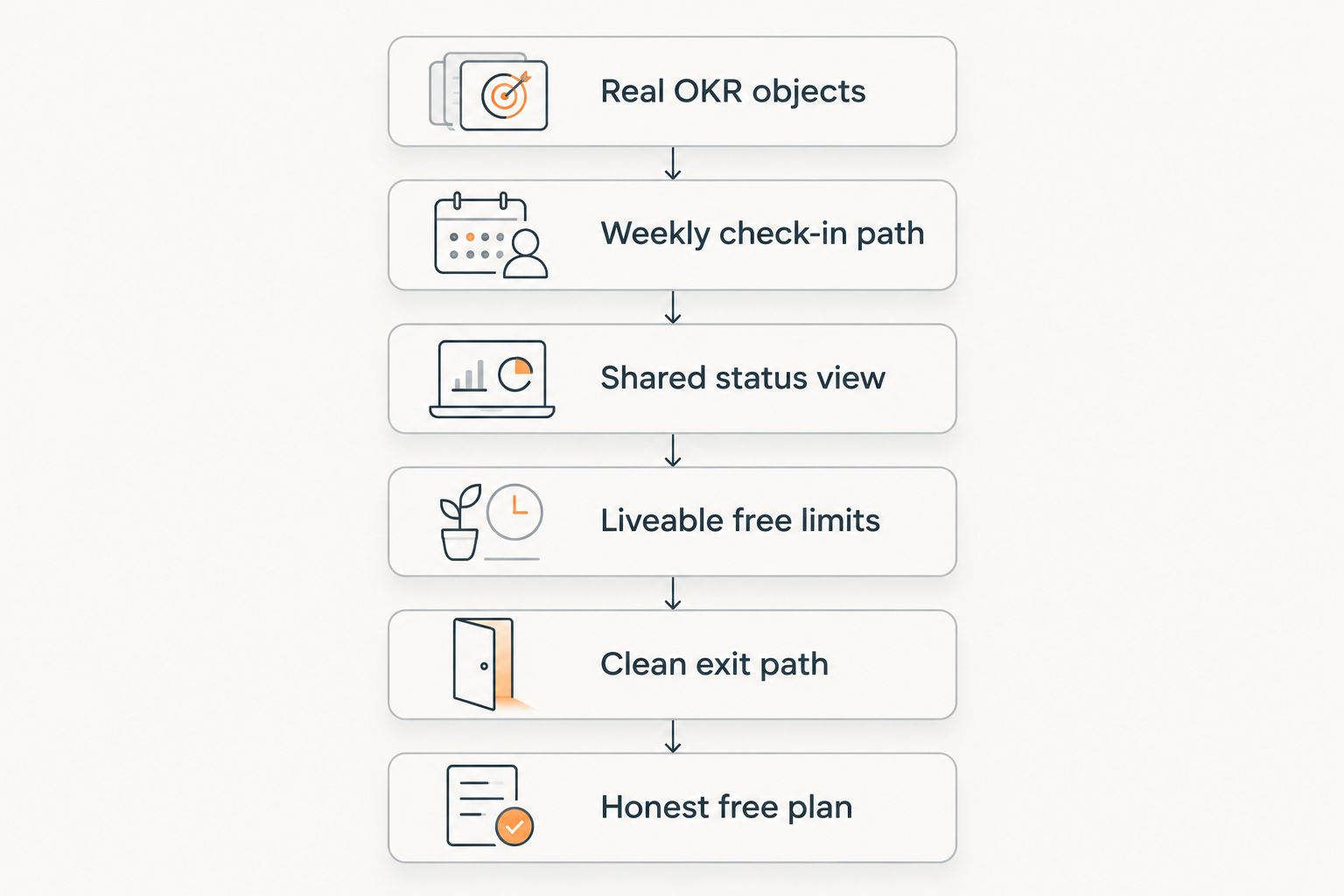
What makes the best free OKR software
Score every option against these six criteria before you pick a winner from the table.
- Real OKR objects. Objectives, Key Results, and a named cycle boundary, not a task list wearing strategy clothes.
- A weekly check-in path. A place to update progress, flag risk, and leave a note someone will read.
- Visibility without a scavenger hunt. One status view across people or teams.
- Limits a real team can finish a quarter inside. Seat caps and feature gates that still allow honest work through week twelve.
- An exit path. Export or clean migration when the free tier stops fitting.
- Honesty about free. An ongoing free plan, not a short trial sold as free software.
Free OKR software at a glance
| Tool | Best for | Standout feature | Key limitation |
|---|---|---|---|
| Weekdone | Small teams on a weekly OKR cadence | Native objectives, KRs, and check-ins | Free seat and feature caps |
| Google Sheets | Zero budget, simple single-team process | Full data control, endless templates | Manual rollups, easy neglect |
| Notion | Writing-heavy strategy teams | Docs and databases in one workspace | OKR structure is DIY |
| ClickUp | Ops consolidating work into one tool | Goals beside tasks and docs | Shallower OKR depth than dedicated tools |
| Trello | Lightweight visual tracking | Boards anyone already understands | Weak hierarchy and reporting |
1. Weekdone: best free OKR software for weekly check-ins
Weekdone is built around objectives, Key Results, and a recurring check-in rhythm. Teams write the quarter's bets, update progress on a fixed cadence, and keep status in one place instead of scattered chat threads.
For a director defending an OKR program to leadership, that check-in surface is the product. Spreadsheets can hold numbers. Weekdone pushes the weekly conversation that turns numbers into decisions.
Weekdone pros:
- OKR-native objects instead of generic tasks.
- Weekly check-in flow leadership can skim.
- Faster setup than building a system from blank docs.
- Clearer coaching conversations in week six, when drift usually starts.
Weekdone cons:
- Free tier caps seats and depth as the program grows.
- Larger multi-department trees outgrow it.
- Reporting stays lighter than full paid OKR suites.
Best for: Small teams (and coaches running a compact pilot) that want dedicated free OKR software with a real check-in habit in 2026.
Verdict: Buy if the free seat limit covers your pilot group and weekly updates are non-negotiable.
2. Google Sheets: best free OKR software when budget is zero
Google Sheets remains the default free OKR software for founders and department heads who refuse another vendor login. You own the schema, the formulas, and the history. Templates from coaches and operators cover objectives, Key Results, owners, and status colors in an afternoon.
Google's re:Work materials still shape how many teams describe objectives and Key Results on the sheet itself. The tool is free forever. The cost shows up as manual rollups and the discipline required to open it every week.
Google Sheets pros:
- True zero software cost.
- Total control over columns, permissions, and exports.
- Easy to share a single tab with leadership.
- No migration panic if you later move to a platform.
Google Sheets cons:
- No enforced check-in cadence.
- Cross-team rollups break without a dedicated owner.
- History and commentary get messy by month two.
- People stop updating when the sheet feels like homework.
Best for: Single teams under roughly company-small headcount, or a first cycle where the only goal is learning the rhythm.
Verdict: Buy for cycle one on a shoestring. Hold once three or more teams need a shared tree.
3. Notion: best free OKR software for documentation-heavy teams
Notion wins when strategy already lives in long-form pages, meeting notes, and linked databases. You can model objectives and Key Results as databases, relate them to projects, and keep the narrative beside the numbers.
The free plan works for many small companies. The OKR system quality depends entirely on the template you install and the habits you enforce. Notion will not scold anyone for skipping week four.
Notion pros:
- Flexible databases that match how your team already writes.
- Strong home for context, decisions, and KR evidence.
- Friendly for coaches who ship playbooks with the tracker.
- One workspace for strategy docs and status.
Notion cons:
- You build and maintain the OKR schema yourself.
- Rollup views need care or they go stale.
- Permissions and guest limits can frustrate cross-functional work.
- Easy to over-design the system and under-run the check-in.
Best for: Product, strategy, and content-heavy teams that already run planning inside Notion.
Verdict: Buy if Notion is already the system of record. Skip if the team wants OKR structure without a builder on staff.
4. ClickUp: best free OKR software for ops consolidating tools
ClickUp puts goals next to tasks, docs, and dashboards. Ops leaders who refuse a second login use the free plan to keep strategic bets in the same place as the weekly work.
You get enough structure to name objectives and track progress without standing up a separate OKR product. Depth is the trade. Dedicated OKR platforms still handle multi-level alignment and coaching views with less configuration.
ClickUp pros:
- Goals live beside the work that should move them.
- Free plan is usable for small companies consolidating stack sprawl.
- Dashboards help a busy director scan status fast.
- Less context switching than sheet-plus-PM-tool combos.
ClickUp cons:
- OKR modeling is thinner than purpose-built tools.
- Configuration debt grows if every team invents its own fields.
- Noise from tasks can drown the strategic layer.
- Enterprise-style hierarchy is awkward on free limits.
Best for: Ops and delivery teams standardizing on one workspace in 2026.
Verdict: Buy for consolidation. Hold if your main pain is cross-department OKR alignment, not task sprawl. Startup-stage buyers comparing options can also skim best OKR software for startups once free tiers feel tight.
5. Trello: best free OKR software for lightweight visual boards
Trello keeps OKRs visible as cards and lists. Some teams run one board per cycle: objectives as lists, Key Results as cards, labels for status, and a simple done column for closed work.
It is the fastest visual free OKR software for a squad that already thinks in boards. It is also the first to crack when you need rollups, history across quarters, or a leadership dashboard that does not require opening five boards.
Trello pros:
- Almost no training curve.
- Free plan is enough for a single-team board.
- Status is visible in a standup without extra software.
- Easy to archive a finished cycle board.
Trello cons:
- Weak multi-team hierarchy.
- Reporting is manual or add-on dependent.
- Easy for OKRs to become a card backlog.
- Hard to defend progress to leadership with board screenshots alone.
Best for: Small squads that want a visual free tracker and will accept manual reporting.
Verdict: Buy for a lightweight pilot. Skip for company-wide OKR programs.
How we ranked free OKR software in 2026
Ranking followed the six criteria above, with extra weight on weekly check-in support and whether a free plan can finish a full cycle without a silent upgrade wall. Dedicated OKR shape beat generic project features. Ongoing free access beat trials.
John Doerr's Measure What Matters still frames ambition and measurability for many leadership teams. That book does not pick your vendor. Your check-in habit and seat reality do.
We favored tools a VP of Ops can defend in a budget meeting: clear free boundaries, honest limits, and a path out when the program earns paid software.
Which free OKR software should you choose?
Default pick for a serious small-team pilot in 2026: Weekdone. It is the best free OKR software when the weekly check-in is the habit you are trying to install.
Choose Google Sheets when cash is the constraint and one disciplined owner will babysit the file. Choose Notion when writing and databases already anchor planning. Choose ClickUp when tool consolidation is the real project. Choose Trello when you need a board up this week and reporting can wait.
Free software starts the practice. It rarely carries multi-team hierarchy, coaching history, and leadership dashboards through year two. When those pressures show up, OKR Leader is built for cycle management, dashboards, and integrations around a live OKR program rather than a static tracker.
Adoption still beats polish at launch. A rough Weekdone cadence people open on Wednesday outperforms a beautiful sheet nobody touches.
Outgrew free OKR tools?
See cycle management, dashboards, and check-ins in OKR Leader.
FAQ
What is the best free OKR software in 2026?
Weekdone is the best free OKR software in 2026 for small teams that need native objectives, Key Results, and weekly check-ins. Google Sheets is the best free forever option when budget is zero and one owner keeps the file honest.
Is Google Sheets enough for OKRs?
Google Sheets is enough for a first cycle on a single team with a disciplined owner. It breaks down when several teams need shared rollups, enforced check-ins, and history leadership can trust without hunting tabs.
Is Notion good free OKR software?
Notion is strong free OKR software for teams that already plan in docs and databases. You must build the OKR schema and enforce the weekly update habit yourself.
Does free OKR software support weekly check-ins?
Weekdone supports weekly check-ins as a core workflow. Sheets, Notion, ClickUp, and Trello can hold updates, but the cadence depends on team discipline rather than product pressure.
When should a team leave free OKR tools?
Leave free OKR software when seat caps block real users, rollups need a full-time babysitter, or leadership cannot see status without a manual deck. That is usually after one or two messy cycles, not day one.
Is ClickUp free OKR software or a project tool?
ClickUp is a work hub with goals features that many teams use as free OKR software. It wins on consolidation. Dedicated OKR depth stays thinner than purpose-built platforms.
Can startups run OKRs only on free tools?
Startups can run OKRs on free tools for early cycles if objectives stay few and check-ins stay sacred. Scale, hierarchy, and coaching needs usually push teams toward paid OKR software as headcount and department count rise.
Should OKR scores tie to performance reviews on free tools?
No. Tying OKR scores to reviews pushes sandbagging on any tool, free or paid. Keep OKRs as the strategic bet layer and hold performance management as a separate system.
One last thing
The quiet failure mode in 2026 is not picking the wrong free OKR software. It is launching five objectives per team on a tool that cannot host an honest weekly check-in. Three focused objectives on Weekdone or a tightly owned sheet will beat a crowded board nobody reopened after the offsite. Worth trying that ceiling on your next cycle before you add another objective.
Related guides