
Six platforms show up on every "best goal setting software" search, and they solve the same problem four different ways: how do you keep three objectives visible past week six without the whole thing turning into a status report nobody reads. Best overall: OKR Leader. Best for HR-led teams: Lattice. Best for enterprise scale: Quantive. Best budget pick for small teams: Weekdone.
- OKR Leader wins goal setting software for teams running a dedicated OKR cadence with weekly check-ins built in.
- Lattice fits HR-led orgs that want goals and performance reviews in one system, at a cost to honest scoring.
- Quantive scales across many business units; Weekdone stays the lightest option for a single small team.
- Microsoft Viva Goals works best for teams already living inside Teams and Microsoft 365.
- None of these fix a team that skips the weekly check-in. The software only makes the habit visible in 2026.
The check-in habit decides more than the tool you pick
Most teams evaluating goal setting software in 2026 are really solving a habit problem and hoping a dashboard fixes it. It doesn't. Planning day gets the attention every quarter. The Tuesday morning check-in is where a good cycle either keeps moving or quietly stalls.
The six tools below handle cadence, cascading, and reporting differently enough that the right pick depends on what your team already does badly, not on which one has the nicer interface. A 12-person startup and a 400-person enterprise program need different things from the same category of software.
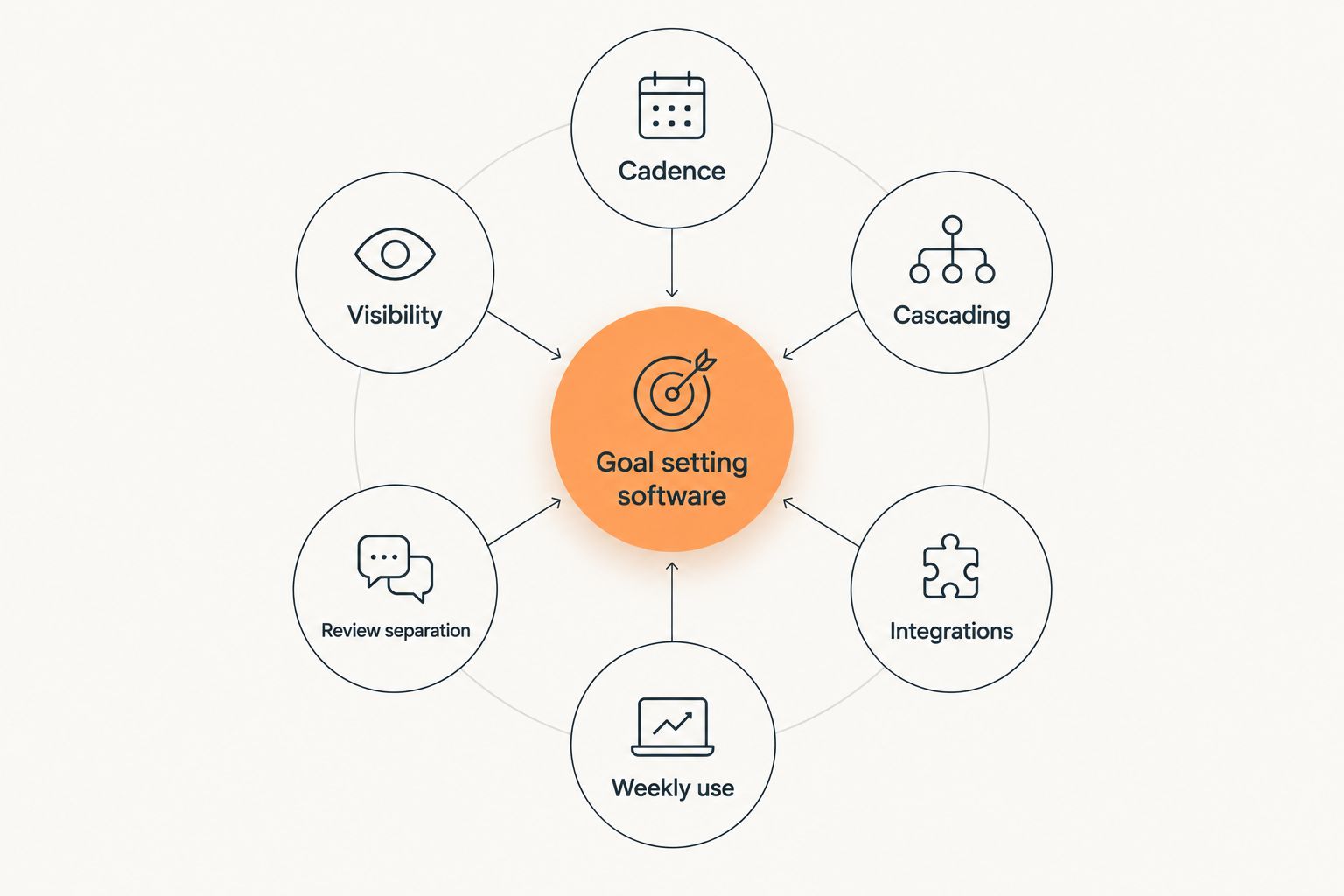
What separates goal setting software worth paying for
- Cadence support. The tool should prompt weekly check-ins, not just store quarterly plans.
- Visibility without exports. Dashboards that show real progress, not a spreadsheet dressed up in tabs.
- Cascading that doesn't force top-down goals. Teams need room to set local Key Results tied to a shared objective, not a copy-paste chain from the CEO.
- Separation from performance reviews. Scoring tied to pay pushes people toward safe targets instead of honest ones.
- Integrations with what teams already use. Slack, Teams, or whatever tracks the actual work.
- Evidence of use on a random Wednesday, not just during planning week.
Goal setting software compared at a glance
| Tool | Best for | Standout feature | Key limitation |
|---|---|---|---|
| OKR Leader | Teams running a dedicated OKR cadence | Cycle management built around the weekly check-in | Not built as a general project or task manager |
| Lattice | HR teams combining goals with reviews | Goals sit next to performance and engagement data | Tying scores to reviews invites sandbagged targets |
| Perdoo | Cascading strategy into team OKRs | Visual strategy map connects mission to objectives | Cascading everything can pull ownership upward |
| Quantive | Enterprise programs across business units | Reporting rollups built for exec-level views | Needs a dedicated admin to run well |
| Weekdone | Small teams wanting light tracking | Fast setup, minimal admin overhead | Thin cascading and reporting at scale |
| Microsoft Viva Goals | Teams standardized on Microsoft 365 | Lives inside Teams where work already happens | Feels secondary outside the Microsoft stack |
1. OKR Leader: best goal setting software for teams running a dedicated OKR cadence
OKR Leader is built around the part of an OKR program that actually decides whether it lasts: the weekly check-in. Cycle management handles the quarter transition instead of leaving it to a stale spreadsheet, and dashboards give leadership a real view of progress without someone manually rolling up numbers on Thursday night.
OKR Leader pros:
- Cycle management keeps quarter-to-quarter transitions from turning into a scramble
- Weekly check-ins are a core workflow, not a bolted-on reminder
- Dashboards reflect live progress instead of a snapshot from planning day
- Integrations connect to the tools teams already run work through
OKR Leader cons:
- Not designed to replace a task or project management tool alongside it
- Deliberately keeps goal scores separate from performance reviews, which is a limitation for teams that want one unified system
OKR Leader is best for: teams running a real OKR cadence who want the weekly check-in and cycle transitions handled inside the product.
Verdict: Buy.
2. Lattice: best for HR teams combining goals with performance reviews
Lattice puts goal tracking next to performance reviews and engagement surveys in one system. For HR-led organizations already running reviews on the platform, adding goals means one less tool to reconcile at review time.
Lattice pros:
- Goals, reviews, and engagement data live in the same system
- Useful for HR teams that already run performance cycles there
- Reduces the number of tools HR has to stitch together
Lattice cons:
- Connecting goal completion to review scores pushes people toward safer, less ambitious targets
- Goal-setting features read as secondary to the performance management suite
Lattice is best for: organizations that want goals and performance management in one place and have made peace with the tradeoff. Teams building an OKR software for HR teams shortlist should weigh this tradeoff directly.
Verdict: Hold for teams that want OKR scores kept separate from compensation.
3. Perdoo: best for cascading company strategy into team OKRs
Perdoo's strategy map is the differentiator: it draws a visual line from company mission down to team-level objectives, which helps leadership explain why a given Key Result exists.
Perdoo pros:
- Strategy map makes the connection between mission and OKRs visible
- Useful for organizations that need to justify objectives up the chain
- Dashboards track progress against the cascade
Perdoo cons:
- Heavy cascading can pull ownership toward the top instead of the team setting its own Key Results
- Collaboration features feel lighter than the strategy visuals suggest
Perdoo is best for: leadership teams that need to show, visually, how each objective ladders up to the company's strategy.
Verdict: Hold, worth a trial if cascading visibility is the priority.
4. Quantive: best for enterprise programs across many business units
Quantive (formerly Gtmhub) is built for OKR programs running across dozens of teams and multiple business units, with reporting designed for executive rollups rather than a single team's view.
Quantive pros:
- Reporting scales to many teams without turning into a manual roll-up job
- Integrations pull from enterprise data sources
- Built to support programs, not just single-team pilots
Quantive cons:
- Administration needs a dedicated owner, not a side task
- Overkill for a single department piloting OKRs for the first time
Quantive is best for: enterprise OKR programs running across many business units. The OKR software for enterprise teams breakdown covers what that setup actually takes.
Verdict: Buy for enterprise-scale programs, Skip for a single-team pilot.
5. Weekdone: best for small teams wanting light weekly tracking
Weekdone strips the category down to weekly status and goal tracking without much administrative overhead, which fits a small team that wants a habit, not a rollout project.
Weekdone pros:
- Fast to set up, light on training time
- Weekly check-in is the core loop, matching how small teams actually work
Weekdone cons:
- Cross-team cascading is thin once you're past a handful of teams
- Reporting doesn't hold up well for a larger org rollup
Weekdone is best for: small teams that want a lightweight way to track weekly progress against a handful of goals.
Verdict: Buy for small teams, Skip past roughly a few dozen employees.
6. Microsoft Viva Goals: best for teams standardized on Microsoft 365
Microsoft Viva Goals lives inside Teams, which means the goal-setting workflow shows up where the work already happens for organizations standardized on Microsoft 365.
Microsoft Viva Goals pros:
- Adoption is easier because it lives inside Teams
- Syncs with data already sitting in the Microsoft 365 environment
Microsoft Viva Goals cons:
- Feels like an add-on to Microsoft 365 rather than a dedicated OKR system
- Less useful for teams not already standardized on Microsoft's stack
Microsoft Viva Goals is best for: teams that want goal tracking inside Teams without introducing a separate tool.
Verdict: Hold, contingent entirely on whether your org already runs on Microsoft 365.
How the ranking works
Each tool was weighed against the six criteria above: cadence support, visibility, cascading behavior, separation from reviews, integrations, and whether it survives past planning week. OKR Leader ranks first because the weekly check-in, the habit that decides whether a cycle actually moves, is the core workflow rather than an add-on feature.
Which goal setting software should you choose
Pick OKR Leader if the goal is a real OKR cadence with weekly check-ins and clean cycle transitions in 2026. Pick Lattice if goals need to sit next to performance reviews you're already running. Pick Quantive if the program spans many business units and needs executive-level rollups. Pick Weekdone if the team is small and the priority is a light habit, not a rollout. Teams evaluating OKR software for startups should start smaller than the enterprise options above and add complexity only once the habit sticks.
See OKR Leader in action
Check how cycle management and weekly check-ins work before you commit.
FAQ
What’s the best goal setting software for teams in 2026?
OKR Leader is the strongest pick for teams running a dedicated OKR cadence in 2026 because cycle management and weekly check-ins are built into the core workflow, not added on later.
Is OKR software different from generic goal setting software?
OKR software structures goals around objectives and measurable Key Results with a fixed cycle, while generic goal setting software is often more flexible and less opinionated about cadence or scoring.
Should goal completion scores affect performance reviews?
Tying OKR scores to performance reviews tends to push people toward safer, easier-to-hit targets instead of ambitious ones, which is why OKRs and performance management work better as separate systems.
How many objectives should a team set per quarter?
Three to five objectives per team is common guidance, and it works best treated as a ceiling rather than a floor. Three focused objectives executed well beats six that get a shrug.
Is Microsoft Viva Goals good for teams outside the Microsoft ecosystem?
Not really. Viva Goals is strongest for teams already standardized on Microsoft 365 and Teams; outside that stack it feels like an add-on rather than a dedicated OKR tool.
What’s the best goal setting software for small teams?
Weekdone is the lightest option for a small team in 2026, with fast setup and a weekly check-in loop that doesn’t require heavy administration.
Does goal setting software work without a weekly check-in habit?
No. The software can prompt and track the habit, but a team that skips weekly check-ins will see objectives stall by week six regardless of which tool holds the data.
How long does it take to see results from a new goal setting tool?
Expect the first OKR cycle to be rough, with objectives that need rework and a cadence that hasn’t settled. The value compounds over several quarters, not one.
One last thing
The Google OKR model gets cited constantly, and it doesn't map to most companies evaluating goal setting software in 2026. Google built that model for a company running thousands of engineers with resources most teams don't have. Scale it down before adopting it wholesale, or the ambition in the framework will outpace what your team can actually execute.
Related guides