
Your OKR dashboard sits in one tab and Slack sits open in six. OKR Leader wins for teams that run their weekly check-in inside Slack and want the dashboard to catch up automatically. Quantive is the stronger pick for enterprise programs that need one Slack digest rolling up dozens of teams. Weekdone fits a small team that wants a lightweight weekly pulse in a channel and nothing heavier.
- OKR Leader is the strongest OKR software with Slack integration for weekly check-ins in 2026.
- Quantive fits enterprise OKR programs that need one Slack report across dozens of teams.
- Weekdone works for small teams that want a lightweight weekly Slack pulse, nothing heavier.
- Never let a Slack-posted Key Result score feed a performance review; it changes how people report.
The weekly check-in already happens in Slack, whether the tool knows it or not
Planning gets the attention every quarter. The weekly check-in is where a cycle actually gets executed, or quietly stalls into status updates nobody reads. Google's own guide to OKRs makes the same point: the cadence around the objective matters as much as the objective itself.
Most teams already run that cadence in Slack. The OKR tool that fits the check-in into the channel people are already in beats the one that asks for a separate login every Tuesday. OKR Leader was built around that assumption: cycle management and dashboards that stay current with what gets posted in Slack, not a parallel system someone has to remember to update.
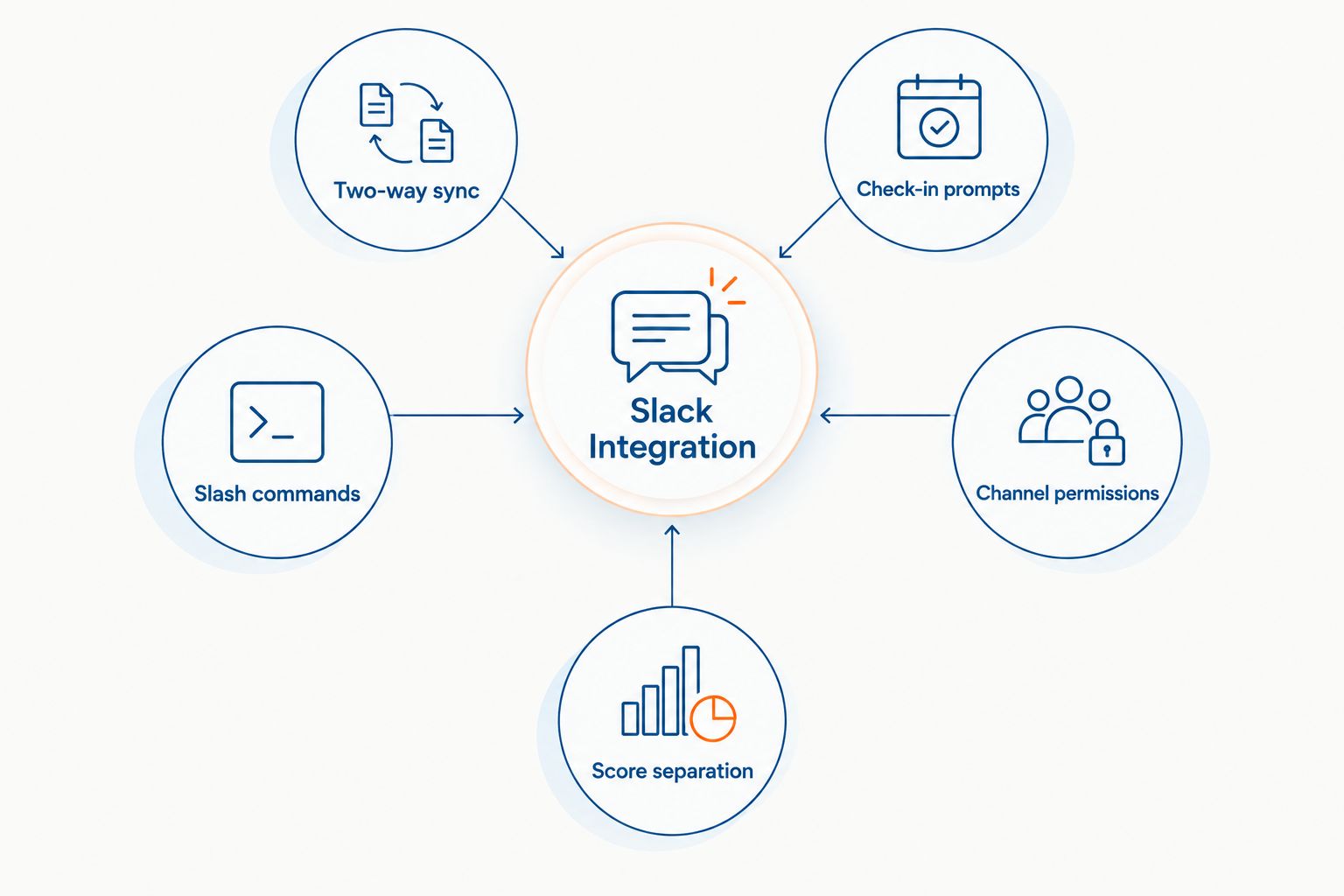
What decides whether a Slack integration holds up past the first month
- Two-way sync: an update posted in Slack writes back to the Key Result record everyone else sees, not just a notification that disappears.
- Check-in prompts land inside the channel on a schedule, so nobody waits on an email that never gets opened.
- A slash command or Workflow Builder step logs a Key Result update without leaving Slack.
- Channel-level permissions match who actually owns each Key Result, not a blanket "everyone can edit" setting.
- The score posted in Slack stays separate from performance review data.
- Messages read like a sentence a person wrote, not a raw link to a dashboard nobody opens.
At a glance: six OKR tools built for Slack in 2026
| Tool | Best for | Standout Slack feature | Main limitation |
|---|---|---|---|
| OKR Leader | Slack-run weekly check-ins | Posts Key Result prompts in-channel on your cadence | Smaller integration marketplace than Microsoft or Lattice |
| Quantive | Enterprise-scale Slack reporting | Rolls up status across business units into one digest | Setup needs a dedicated admin |
| Perdoo | Pairing OKRs with a strategy roadmap | Slack updates reference the roadmap item behind each objective | Slack integration sits behind higher plan tiers |
| Weekdone | Lightweight weekly Slack pulses | One-click weekly status post straight from Slack | Thin on cross-team dependency tracking |
| Lattice | HR teams already living in Slack | Combines check-ins with 1:1 and review prompts | Blurs OKR scoring with performance review data |
| Microsoft Viva Goals | Orgs split between Slack and Teams | Deep two-way sync, built Teams-first | Slack support trails the Teams experience |
1. OKR Leader: best OKR software for Slack-run weekly check-ins
OKR Leader manages the full cycle: objectives, Key Results, dashboards, and the check-in itself, with Slack as the surface where updates actually happen. The dashboard reflects what gets logged in the channel instead of asking a team to enter data twice.
OKR Leader pros:
- Posts Key Result check-in prompts directly in the Slack channel on the cadence you set.
- Cycle dashboards update from what gets logged in Slack, no duplicate entry.
- Built around three to five objectives per team, so the Slack digest stays short enough to read on a Tuesday morning.
OKR Leader cons:
- Younger integration marketplace than Microsoft or Lattice, so a few niche Slack workflows need a manual step.
- Keeps OKR scoring separate from performance reviews on purpose, which means teams that want the two linked need a separate process.
Best for: teams that run the whole check-in in Slack and want the dashboard to catch up automatically. Verdict: Buy.
2. Quantive: best OKR software for enterprise-scale Slack reporting
Quantive (formerly Gtmhub) aggregates OKR data across dozens of teams and business units into a single reporting layer, with Slack-posted updates feeding that rollup. If a program spans several departments and answers to a board, the depth pays off. Full setup breakdowns live in the top 10 OKR software tools comparison.
Quantive pros:
- Aggregates Slack-posted updates from many teams into one report leadership can scan.
- Handles multi-level objective hierarchies without turning the Slack digest into noise.
- Strong audit trail for programs reporting to a board or investor group.
Quantive cons:
- Configuration takes a dedicated admin and weeks of setup before the Slack layer feels usable.
- The reporting depth goes unused on a team under fifty people.
Best for: OKR software for enterprise teams running programs across multiple business units. Verdict: Buy for enterprise, Skip for a single team.
3. Perdoo: best OKR software for pairing OKRs with a strategy roadmap
Perdoo links each objective to a roadmap item, and Slack notifications reference which roadmap initiative moved. Strategy and ops teams presenting to leadership every quarter get a visible line from the roadmap to the Key Result.
Perdoo pros:
- Keeps strategy and OKRs visibly connected in one place.
- Slack notifications carry the roadmap context, so a manager doesn't need to ask which project the update refers to.
- Fits a team that already runs a roadmap tool and wants OKRs layered on top.
Perdoo cons:
- Slack integration and deeper reporting sit behind higher plan tiers.
- The roadmap layer adds setup work a smaller team may not need.
Best for: strategy teams that already manage a roadmap and want OKRs tied to it. Verdict: Hold, worth it once the roadmap layer earns its keep.
4. Weekdone: best OKR software for lightweight weekly Slack pulses
Weekdone runs on a simple weekly status model. A team posts progress from Slack in one step, with a light dashboard behind it for anyone who wants the summary view.
Weekdone pros:
- Fastest setup of the group, live in a channel within a day.
- No separate login most weeks, the check-in happens where the team already talks.
- Built for teams under twenty people, so the interface stays uncluttered.
Weekdone cons:
- Thin on cross-team dependency tracking once an objective touches three departments.
- Reporting depth caps out fast for anyone wanting historical trend data.
Best for: small teams that want a lightweight status pulse. Verdict: Buy for small teams, Skip past fifty people.
5. Lattice: best OKR software for HR teams already living in Slack
Lattice combines OKR check-ins with 1:1 notes and performance review prompts inside one Slack surface. HR-led teams that already use Lattice for reviews get one channel covering goals and people conversations.
Lattice pros:
- One Slack channel covers OKR check-ins, 1:1 prep, and review reminders.
- Familiar to HR teams already using Lattice for performance management.
- Good visibility for managers tracking both goals and people conversations.
Lattice cons:
- Blurs OKR scoring with performance review data, the fastest way to push people toward safe, achievable objectives over ambitious ones.
- Slack threads get busy when OKR content and HR content share the same channel.
Best for: HR-led teams that accept the tradeoff on keeping scoring honest. Verdict: Hold, only if separating OKR and review data isn't a priority for the program.
6. Microsoft Viva Goals: best OKR software for orgs split between Slack and Teams
Viva Goals runs deep two-way sync, built primarily for Microsoft Teams. Slack support exists but sits behind the Teams experience in maturity.
Viva Goals pros:
- Strong fit for organizations already deep in Microsoft 365.
- Two-way sync is mature on the Teams side.
- Enterprise-grade permissions and reporting.
Viva Goals cons:
- Slack integration feels like an add-on bolted onto a Teams-first product.
- A team running mostly on Slack hits rough edges Teams users never see.
Best for: organizations where Teams leads and Slack is secondary. Verdict: Skip if Slack is primary, Buy if Teams leads.
See OKR Leader in Slack
Check how weekly check-ins post directly into your team’s channel.
Two-way sync and honest scoring decided this ranking
Every tool on this list was checked against the same six criteria: two-way sync, in-channel check-in prompts, a slash command or workflow step, permissions matching ownership, separation from performance reviews, and readable Slack messages. Tools that treated Slack as a notification pipe rather than a working surface, like Viva Goals for Slack-first teams, ranked below tools built for the channel from the start.
“A Slack message that also feeds a performance review stops being an honest status update.”
The Slack App Directory lists dozens of tools claiming OKR integration; most only push one-way notifications. Check the Slack app listing for any tool before assuming it supports two-way sync.
Pick the tool that matches how your team already uses Slack
A team of eight that lives in one channel does not need Quantive's reporting depth. A program spanning six departments and a board update every quarter does not fit inside Weekdone's lightweight pulse. Distributed teams checking in from different time zones get the most out of Slack-native check-ins; the same logic applies to any OKR software for remote teams evaluation.
Default recommendation for 2026: OKR Leader, for the team that wants the weekly check-in to live in Slack and the dashboard to follow. Move to Quantive once the program crosses several business units, and treat Lattice's OKR-review blend as a real tradeoff, not a free feature.
FAQ
What is the best OKR software with Slack integration in 2026?
OKR Leader is the strongest fit for teams that run weekly check-ins directly in Slack, since the dashboard updates from what gets posted in the channel. Quantive is the better choice for enterprise programs spanning multiple business units.
Does Slack integration replace an OKR check-in meeting?
No. Slack integration moves the update into the channel, but a short weekly conversation about what’s off track still needs to happen. The tool removes the data entry step, not the discussion.
Should an OKR score posted in Slack affect a performance review?
Keep them separate. Tying a Slack-posted Key Result score to a performance review pushes people toward safe objectives and sandbagged progress instead of honest reporting.
Is Microsoft Viva Goals good for Slack-only teams?
Viva Goals is built Teams-first, and its Slack support trails behind that experience. A team running mostly on Slack will hit rough edges that Teams users don’t encounter.
What is the difference between OKR Leader and Weekdone?
OKR Leader runs full cycle management with Slack-native check-ins built in. Weekdone is a lighter weekly status tool suited to teams under twenty people that don’t need deep cross-team reporting.
Can a small team use enterprise OKR software like Quantive?
Technically yes, but the setup time and reporting depth go unused below fifty people. A lighter tool built for Slack-run check-ins fits a small team better.
Does Lattice combine OKRs with performance reviews?
Yes, Lattice runs OKR check-ins alongside 1:1 and review prompts in the same Slack surface. That convenience comes with the tradeoff of blending OKR scoring with review data.
The setting most teams forget to turn off
Before rolling out any OKR software with Slack integration in 2026, check whether a Key Result turning red also pings a manager through a review-linked automation. That single setting is why teams report a Key Result as "on track" three weeks running and then miss it entirely in week six. Turn it off first, then connect Slack.
Related guides