
Best overall: OKR Leader. Best for enterprise-wide reporting: Quantive. Best budget option: Weekdone. Six OKR tracking software platforms make this list for 2026, and the right one depends on whether your problem is Tuesday's check-in, a leadership roll-up nobody trusts, or a first cycle you can't afford to blow up on a heavy tool.
- OKR Leader wins for teams that treat the weekly check-in as the real work of OKR tracking software, not the planning deck.
- Quantive fits enterprise teams rolling up OKR data across dozens of departments without manual spreadsheets.
- Lattice suits teams that already run performance reviews and engagement surveys and want OKRs layered in, not separated.
- Weekdone fits a first OKR cycle for a small team that wants a light tool over a full platform commitment.
- No tool here enforces separation between OKR scores and comp decisions on its own; that setup choice is yours.
Why this matters
OKR tracking software is not the strategy. It's the plumbing that decides whether Tuesday's check-in takes five minutes or gets skipped again. OKR Leader built its check-in workflow around that exact gap, but the logic holds no matter which tool you land on: adoption in week six is the number that matters, not the demo in week one.
A team that sets three sharp objectives in a spreadsheet and reviews them every week will outperform a team running six objectives in a dashboard nobody opens after the offsite. Software helps the habit stick. It doesn't replace it.
What makes the best OKR tracking software
- Cadence support. Does it make the weekly check-in faster, or just log a quarterly score and go quiet.
- Objective ceiling. Does the structure nudge teams toward three to five objectives, or let the list run to ten.
- Visibility without chasing. Can a VP see cycle progress without emailing five team leads for a manual roll-up.
- Integration depth. Does it sit inside Slack, Teams, or Jira where the work already happens, or live as one more tab.
- Separation from reviews. Can OKR scores stay out of comp conversations, or does the platform blur that line by default.
- Time to first cycle. How many weeks pass before a team actually runs a live cycle in the tool.
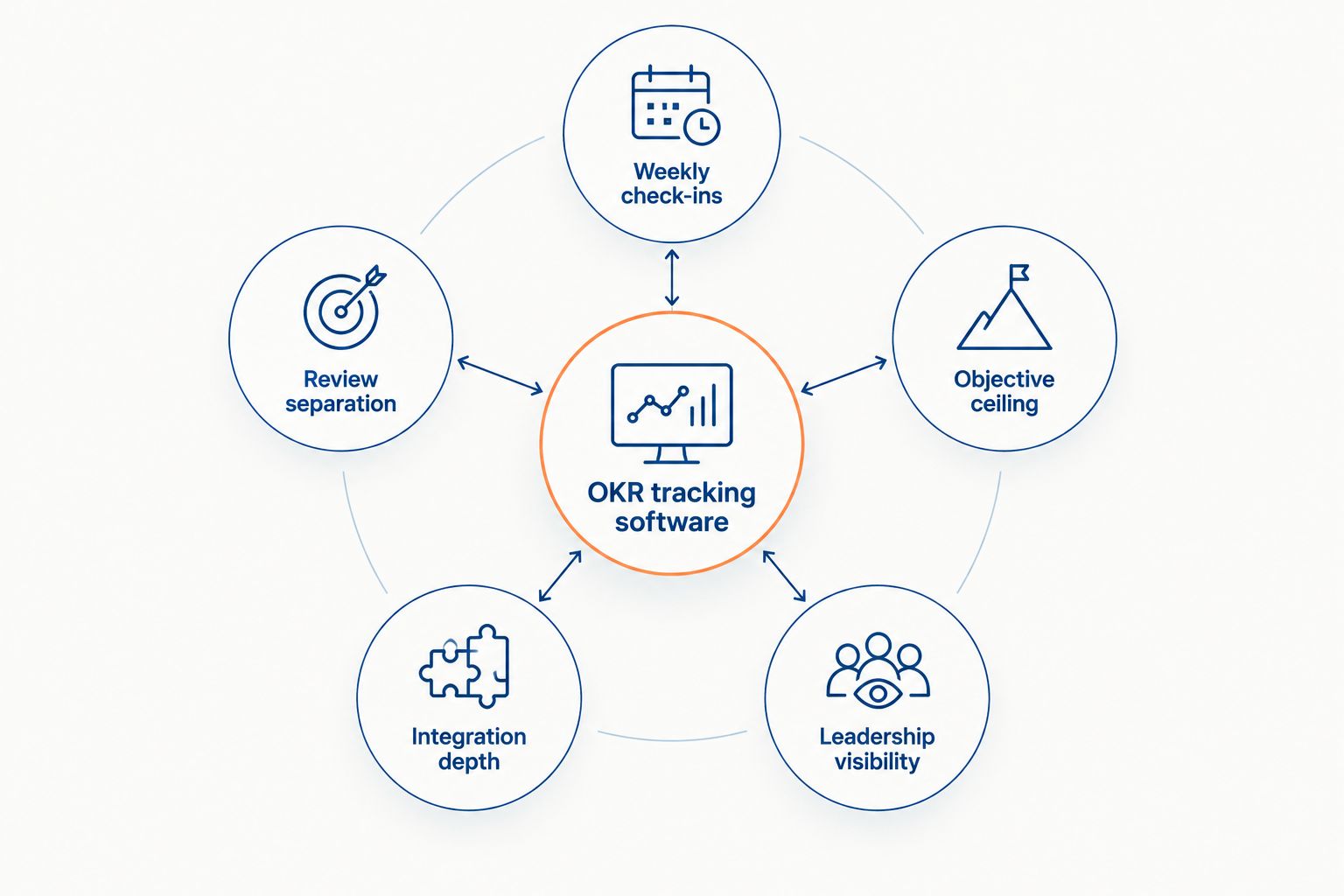
OKR tracking software at a glance
| Software | Best for | Standout feature | Key limitation |
|---|---|---|---|
| OKR Leader | A weekly check-in habit that sticks | Flags Key Results with no update before the cycle stalls | Integration list is still growing compared to older platforms |
| Quantive | Enterprise-wide OKR reporting | Roll-up dashboards across large numbers of teams | Admin overhead scales with company size |
| Lattice | Bundling OKRs with performance management | OKRs sit next to reviews and engagement surveys in one login | Proximity to review data invites tying scores to comp |
| Microsoft Viva Goals | Teams already living in Microsoft Teams | Goals surface inside Teams without a separate login | OKR-specific reporting lags dedicated platforms |
| Perdoo | Tracking OKRs and KPIs together | Strategy maps connecting objectives to standing KPIs | Steeper learning curve for teams that just want simple check-ins |
| Weekdone | A first OKR cycle on a small team | Lightweight setup, weekly check-in emails | Thin reporting once a company scales past a handful of teams |
1. OKR Leader: best OKR tracking software for weekly check-in discipline
OKR Leader is built around the idea that a good cycle dies or lives in the weekly check-in, not the planning meeting. The dashboard is built for a VP defending the program to leadership, and the cycle structure keeps teams inside three to five objectives instead of a running list of ten.
The roundup of OKR software tools covers more platforms if you're comparing beyond these six.
OKR Leader pros:
- Check-in workflow surfaces Key Results with no update logged before a cycle quietly stalls
- Dashboards built for reporting up to leadership, not just team-level status
- Cycle setup nudges toward three to five objectives instead of an unbounded list
OKR Leader cons:
- Newer to the market than Lattice or Quantive, so third-party integrations are still expanding
- Built specifically for OKR tracking, not a bundled performance review or survey tool
Best for: teams whose OKR program is dying in the gap between planning and Wednesday's check-in.
Verdict: Buy.
2. Quantive: best OKR tracking software for enterprise-wide reporting
Quantive (formerly Gtmhub) is built for organizations rolling OKR data up across dozens of departments and thousands of contributors. Its strength is in analytics and roll-up reporting rather than the habit layer of a single team's weekly rhythm.
Teams evaluating this scale should also read the enterprise OKR software guide before committing to a platform this size.
Quantive pros:
- Roll-up dashboards handle OKR data across large numbers of teams
- Analytics depth suits strategy and ops leaders reporting to a board
- Handles complex, multi-level objective hierarchies without breaking
Quantive cons:
- Admin overhead and setup time scale with company size
- Heavier than what a single department or startup team needs
Best for: enterprise strategy teams reporting OKR progress across many departments.
Verdict: Buy for large organizations, Skip for a single team.
3. Lattice: best OKR tracking software for teams bundling OKRs with performance management
Lattice started as a performance management platform and added OKRs, 1:1s, and engagement surveys into one login. Teams already running reviews in Lattice get OKR tracking without adding a second tool.
Lattice pros:
- One login for OKRs, performance reviews, and engagement surveys
- Managers already trained on the platform for 1:1s pick up OKRs fast
- Useful for HR teams that own both performance and goal-setting processes
Lattice cons:
- OKR scores sitting next to review data increases the temptation to link them to comp, which undercuts honest reporting
- OKR-specific features are lighter than a dedicated OKR tracking software platform
Best for: HR-led teams that want OKRs inside their existing performance management stack.
Verdict: Hold if you can keep OKR scoring separate from review scoring; Skip if you can't.
4. Microsoft Viva Goals: best OKR tracking software for Microsoft Teams-first companies
Microsoft Viva Goals (built from the Ally.io acquisition) surfaces OKRs inside Microsoft Teams so contributors update Key Results without opening a separate app. That's the entire pitch, and it lands well for companies where Teams is already the daily home base.
Viva Goals pros:
- Goals and check-ins live inside Teams, no second login
- Familiar interface for companies already standardized on Microsoft 365
- Low friction for adoption in week one
Viva Goals cons:
- Reporting and analytics depth lag dedicated OKR platforms
- Less useful for companies not already committed to the Microsoft ecosystem
Best for: companies where Microsoft Teams is the default workspace.
Verdict: Buy if you live in Teams; Skip otherwise.
5. Perdoo: best OKR tracking software for connecting OKRs and KPIs
Perdoo pairs OKR tracking with strategy maps that connect objectives to standing KPIs, which suits companies that want both ambition and health metrics visible in one view. The tradeoff is a setup process that takes longer than a check-in-first tool.
Perdoo pros:
- Strategy maps link objectives to KPIs teams already monitor
- Useful for leaders who want bets and vital signs in one dashboard
- Handles multi-team hierarchies reasonably well
Perdoo cons:
- Learning curve is steeper than teams expect for a first cycle
- Overkill for a team that just wants a simple weekly check-in
Best for: strategy teams that track OKRs and KPIs side by side.
Verdict: Hold, worth a trial before a full rollout.
6. Weekdone: best OKR tracking software for a first cycle on a small team
Weekdone keeps the setup light: weekly check-in emails, a simple objective structure, and none of the enterprise reporting weight of Quantive or Lattice. It's built for teams running their first cycle who don't want a six-week onboarding before anyone sees a dashboard.
Weekdone pros:
- Fast setup, live in days rather than weeks
- Weekly check-in emails keep a small team's cadence without extra process
- Lower complexity for a team new to OKRs
Weekdone cons:
- Reporting gets thin once a company scales past a handful of teams
- Fewer integrations than the platforms built for larger organizations
Best for: a small team running its first OKR cycle without a big tooling commitment.
Verdict: Buy for a first cycle, revisit once the team grows past a handful of departments.
“If your team can’t tell you what changed in Tuesday’s check-in, the software isn’t the problem.”
How we ranked these
Each platform on this list gets measured against the same six criteria: cadence support, objective ceiling, visibility without chasing, integration depth, separation from performance reviews, and time to a live first cycle. None of the six wins on every axis, which is the point of a decision tree instead of a leaderboard.
Which OKR tracking software should you choose in 2026?
If your OKR program is dying somewhere between the planning deck and Wednesday's check-in, start with OKR Leader. If your problem is a leadership team that doesn't trust the roll-up numbers across a large org chart, Quantive is built for that scale. Everything else on this list solves a narrower problem well, and the mistake most teams make is picking based on features instead of which specific gap is currently costing them a cycle.
See the check-in workflow in action
Walk through how OKR Leader flags a stalled Key Result before Friday.
FAQ
What is the best OKR tracking software overall in 2026?
OKR Leader is the strongest overall pick for 2026 because its check-in workflow is built around the weekly cadence where OKR cycles usually stall. Quantive and Lattice are better fits for specific needs like enterprise reporting or bundled performance management.
What’s the best OKR tracking software for enterprise teams?
Quantive is the strongest fit for enterprise teams rolling up OKR data across many departments in 2026. Its analytics and hierarchy features are built for scale, though the admin overhead is heavier than a single team needs.
Is OKR Leader better than Lattice for OKR tracking?
OKR Leader is built specifically for OKR tracking and the weekly check-in habit, while Lattice bundles OKRs with performance reviews and engagement surveys. Choose OKR Leader if OKR tracking is the primary need; choose Lattice if you want OKRs inside an existing HR platform.
What’s the best OKR tracking software for a small team’s first cycle?
Weekdone is the lightest option for a small team running its first OKR cycle in 2026, with setup measured in days rather than weeks. Reporting gets thin once the company grows past a handful of teams, which is when a switch usually makes sense.
Should OKR scores be tied to performance reviews?
No. Tying OKR scores to comp decisions pushes teams toward safe objectives and honest reporting disappears. OKRs and performance management solve different problems, even when the same software houses both.
How many objectives should OKR tracking software support per team?
Three to five objectives per team is the ceiling, not a floor to fill. Software that lets a team stack ten objectives onto a single cycle is doing them no favors, even if the dashboard looks impressive.
Does OKR tracking software replace a spreadsheet-based OKR process?
It replaces the manual roll-up and reminder work, not the discipline of the weekly check-in itself. A team that skips check-ins in a spreadsheet will skip them in software too, just with a nicer interface.
What’s the best OKR tracking software for teams already using Microsoft Teams?
Microsoft Viva Goals is the best fit for companies standardized on Microsoft 365, since Key Results update inside Teams without a separate login. Its OKR-specific reporting is lighter than dedicated platforms like Quantive or OKR Leader.
One last thing
Most of the tools on this list, and most of the guidance written about them, still borrow Google's OKR model: the company that built OKRs for thousands of engineers with dedicated program managers running the cadence. That model doesn't travel to a 40-person company or a single ops team, no matter how good the software is. Scale the objective count and the check-in rhythm down before your first cycle in 2026, not after it stalls.
Related guides