
You started the quarter with a plan. A real one. Not a vague “grow revenue” declaration. An actual plan, with priorities, people, and a rough idea of what winning would look like.
And somehow, six weeks in, it’s not quite that plan anymore.
Sound familiar? Good. That means you’re paying attention.
Why does business strategy go off track in Q1? Strategy doesn’t fail in one dramatic moment. It drifts. Business strategy goes off track. Small decisions stack up, priorities shift in your head without making it to the team, and a client emergency pulls two people off the work that actually moves the business forward. Nobody flags it because everyone’s busy. By the time you notice, you’ve lost four weeks you won’t get back.
The fix isn’t a better plan. It’s a system that catches drift early, while there’s still time to correct it.
How Business Strategy Goes Off Track
Hint: it doesn’t happen overnight! There’s a specific failure mode that kills most small business strategies. It has nothing to do with bad planning.
It sneaks up on you.
You run a good kickoff. Everyone’s aligned. The priorities are clear. Two weeks in, a promising opportunity shows up and you say yes to it. Three weeks in, a key hire falls through and you adjust. Four weeks in, a big client needs more attention and your head of ops pivots to cover it.
None of those decisions are wrong on their own. Together, they add up to a different quarter than the one you planned.
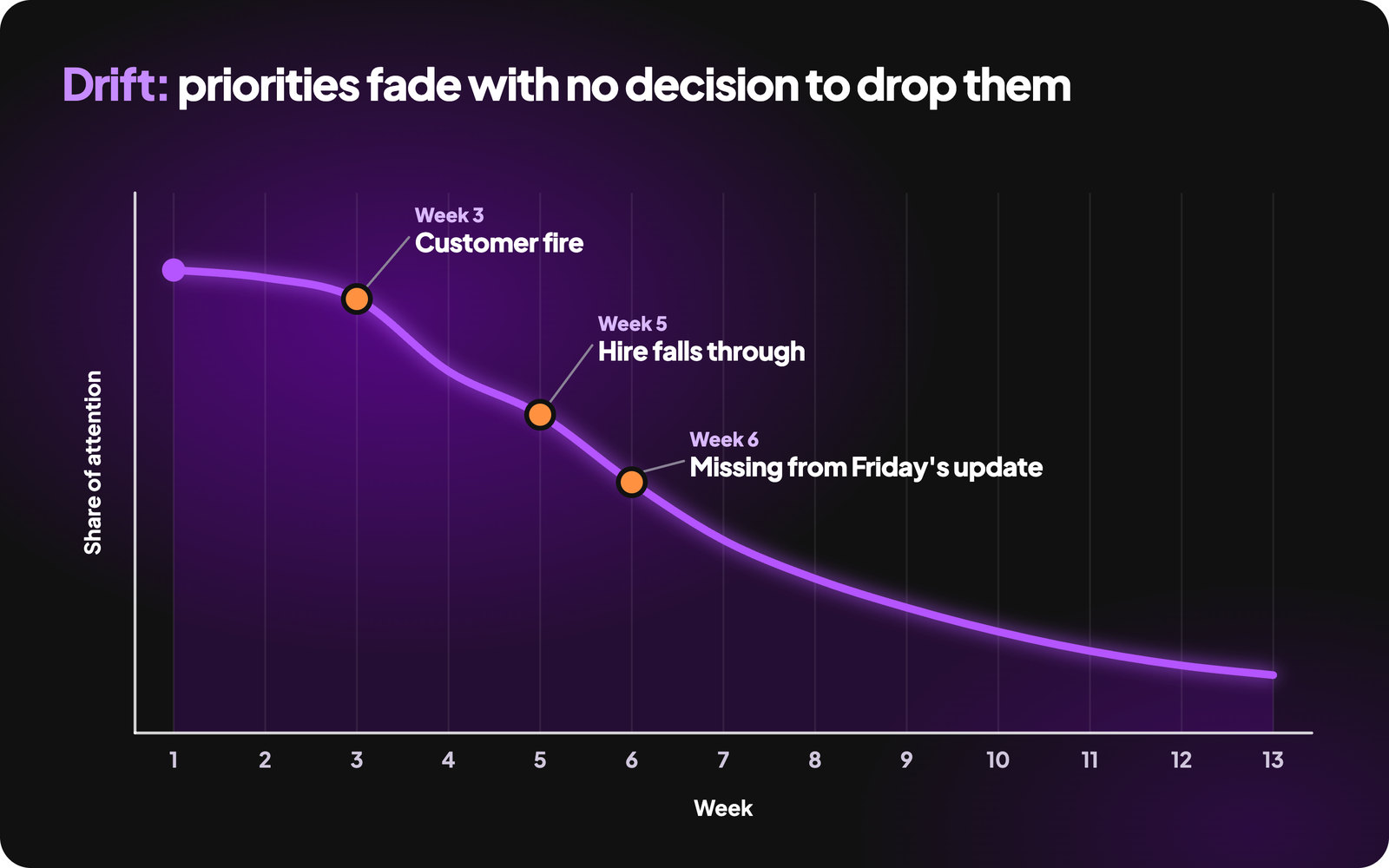
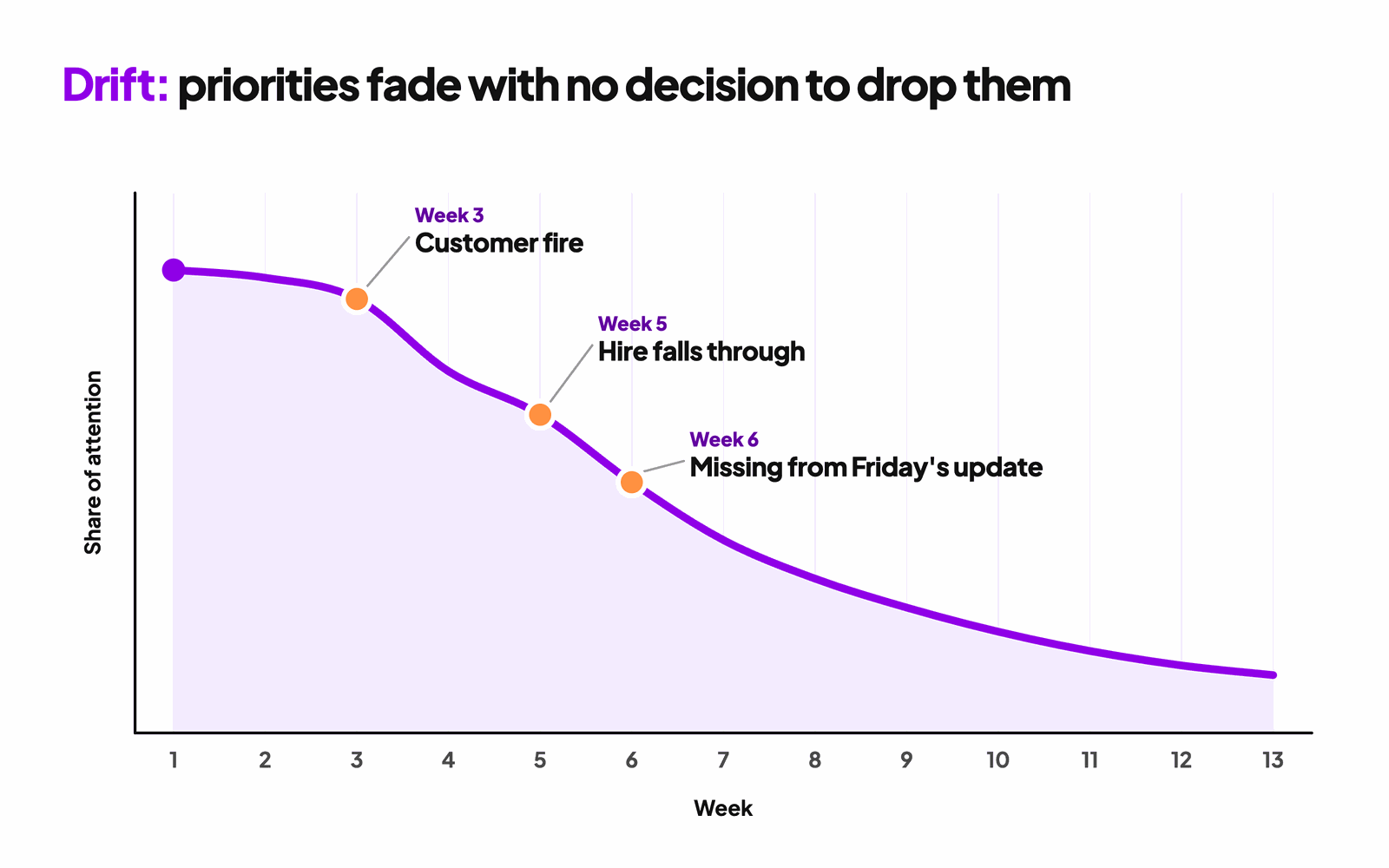
The problem isn’t the pivots. It’s that nobody names what’s happening while it’s happening. The strategy doesn’t get updated to reflect reality. It becomes irrelevant.
What Off-Track Strategy Looks Like Mid-Quarter
You probably recognize at least one of these.
- Two people are building something that turns out to duplicate work another team already finished.
- A priority that moved to the top of your mind three weeks ago still hasn’t made it to anyone else’s to-do list.
- Someone has been working hard all month on something that’s no longer in the top three things that matter.
- You’re asked how Q1 is tracking, and the honest answer is “fine?” but you’re not sure what “fine” is measured against.
These aren’t signs of a bad team. They’re signs of a team operating without enough signal to self-correct. Research from Harvard Business Review on strategy execution consistently lands on the same finding. The gap between planned strategy and realized strategy is rarely caused by bad planning. It’s caused by the quiet stacking of small decisions that nobody bothered to surface.
Why End-of-Quarter Reviews Catch It Too Late
The standard fix is the end-of-quarter review. You sit down in late March, look at where things landed, and figure out what went wrong.
That’s useful. But it’s the wrong moment.
By the time you’re reviewing Q1, you’ve already spent the quarter. The drift already happened. All you can do is learn from it for Q2 and try again. And most likely, if you’re not fixing the underlying cause of WHY your business strategy went off track in the first place, it will just happen again next quarter.
What you actually need is a system that surfaces drift while the quarter is still live, when you can do something about it. That’s exactly what a well-run OKR check-in does.
How OKR Check-Ins Become Your Early Warning System
A check-in is a short, structured conversation, not a status update. It answers three questions every week or two.
- Are we making real progress toward the things that matter most, or are we just busy?
- Has anything shifted that changes what winning this quarter looks like?
- Is there anything blocking the work that needs to be unblocked right now?
That’s it. Fifteen minutes, run consistently. Those three questions catch drift before it becomes a lost quarter.
The moment someone says “actually, I’ve been spending most of my time on X instead of Y,” that’s information you can act on. Not in the March review. Now. This week. Before another two weeks of the wrong work gets done.
This is the piece that most OKR rollouts miss. The planning session gets all the attention. The check-in is where execution actually happens. Or doesn’t. For the structure that turns those weekly conversations into real decisions, see How to Run a Check-In That’s Actually Worth Having.
What the Right Check-In Surfaces
A useful Q1 check-in catches drift early enough to fix it. The signals to watch for.
- A confidence score, a 0-to-1 read in 0.1 increments from the owner of each Key Result, that drops sharply between weeks. The number might still look fine. The owner’s read on whether the target is still in reach is the leading signal.
- A team member spending most of their time on work that doesn’t tie to a Key Result. That’s a quiet redirection of capacity that nobody named.
- A Key Result that’s been at the same value for three weeks. Either the work isn’t moving the number, or no work is happening on it. Either way, it’s a signal.
For a deeper look at the difference between reporting on OKRs and actually tracking progress, see our writeup on the distinction. The early-warning value of a check-in shows up only when the conversation is built around progress, not status.
The Five-Minute Q1 Audit
Run this against your current quarter.
- Did you write down a real plan in January, with priorities, owners, and measurable targets?
- Do you have a structured weekly or biweekly check-in on those priorities?
- If you asked your team today whether Q1 is on track, would you get an honest, specific answer?
- Have any of your January priorities been deprioritized without anyone updating the plan?
- Could you point to a moment in the last six weeks when the team made a decision to keep work on track that wouldn’t have happened without a check-in?
Three or fewer “yes” answers and your business strategy is probably already going off track this quarter. The good news. Most of the recovery is structural, not strategic.
When Business Strategy Goes Off Track, SMBs Have an Advantage
Catching drift early is your competitive advantage. Small teams move faster than large ones. That’s the advantage. But only when the direction is right.
A 15-person team that drifts for six weeks doesn’t have the resources to recover the way a 500-person org does. Every week spent on the wrong priority costs proportionally more.
The flip side. A 15-person team that catches drift in week three can correct in days. That speed, applied to the right priorities, is what makes small businesses genuinely competitive against bigger players with more runway and more people. Knowing why business strategy goes off track at small-team scale, and having the cadence to catch it early, is the structural advantage SMBs have over enterprises. John Doerr makes a related point throughout Measure What Matters. The framework’s value at small-company scale is in the speed of the loop, not the rigor of the planning.
You don’t need a perfect plan. You need a system that tells you when the plan is slipping before it costs you the quarter. For SMB-specific guidance on running OKRs without the corporate overhead, see our guide to implementing OKRs in small businesses.
That’s what OKR Leader is built for.
Start for Free and run your first check-in this week.
FAQs: When Business Strategy Goes Off Track
Why does business strategy go off track in Q1 specifically?
Q1 is when the quarterly cadence is being established for the year. The plan was set in January. The first six weeks are when small reactive decisions begin stacking up. Without a check-in cadence to surface those decisions, business strategy goes off track. By March, the divergence is too large to recover within the quarter.
What’s the earliest signal that strategy is drifting?
Capacity reallocation is the earliest signal that business strategy goes off track. When a team member starts spending most of their week on work that wasn’t in the original plan, that’s the first signal. The metrics will follow a few weeks later. The capacity shift comes first.
How often should an SMB run check-ins on strategy?
Weekly. Bi-weekly at the absolute minimum. Monthly is too long for an SMB cycle. Twelve weeks of silence followed by a quarterly retrospective is the most common SMB OKR failure pattern. A 15-minute weekly check-in is the smallest cadence that reliably catches drift while it’s still recoverable.
What if my team is too busy for another meeting?
The check-in is fifteen minutes. The cost of skipping it is several weeks of misdirected work per quarter. The math favors the meeting. Most SMB owners who try this discover that the time saved on undoing wrong work in March exceeds the time spent on check-ins for the entire quarter.
Can I run check-ins without formal OKRs?
Yes, though OKRs make the conversation sharper. The minimum viable version is a list of three to five priorities you committed to at the start of the quarter, owners assigned to each, and a weekly fifteen-minute review. The structure of OKRs adds measurable Key Results that turn “are we on track” into a specific question about what number moved this week, which is a stronger conversation. The cadence matters more than the format.
TL;DR
Business strategy starts to go off track. Small reactive decisions stack up. Capacity gets pulled toward urgent work. The plan you wrote in January becomes irrelevant by March. The fix isn’t a better plan. It’s a system that catches drift while there’s still time to correct it. A weekly fifteen-minute OKR check-in surfaces capacity reallocations and stalled progress in week three or four, when there’s still enough quarter left to recover. That’s the early-warning system most SMBs are missing. Run a check-in this week. The plan you set in January is already drifting somewhere. The question is whether you’ll find out in week six or in March.