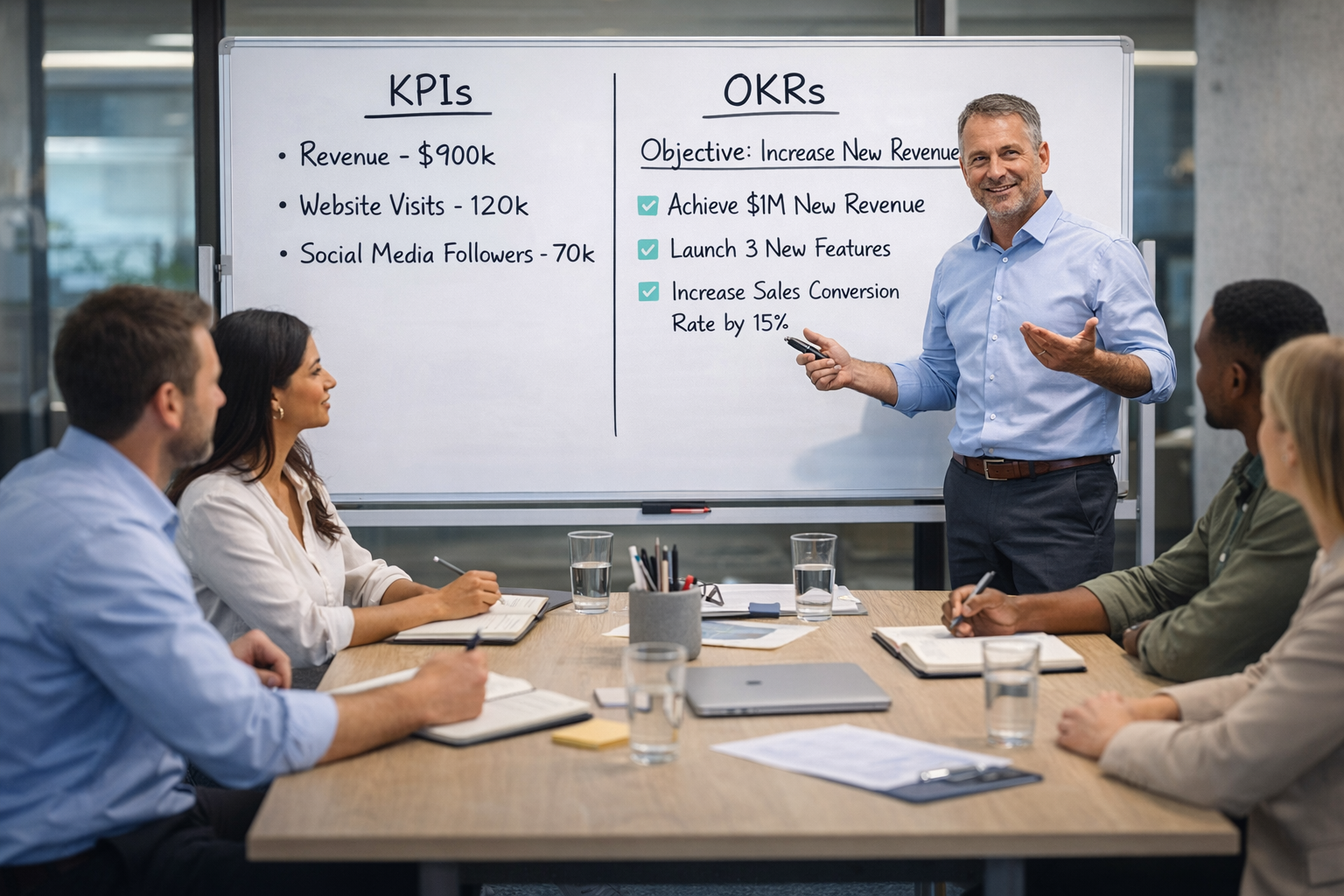
Customer retention rate is at 84%. Revenue is up 12% year over year. Net Promoter Score is 67. Are those KPIs? OKRs? Both? It’s a fair question, and most operations teams answer it wrong.
The confusion is so common that “KPIs vs OKRs” became its own debate genre. The debate misses the point. They aren’t competing frameworks. They measure fundamentally different things, and any organization mature enough to track performance seriously usually needs both.
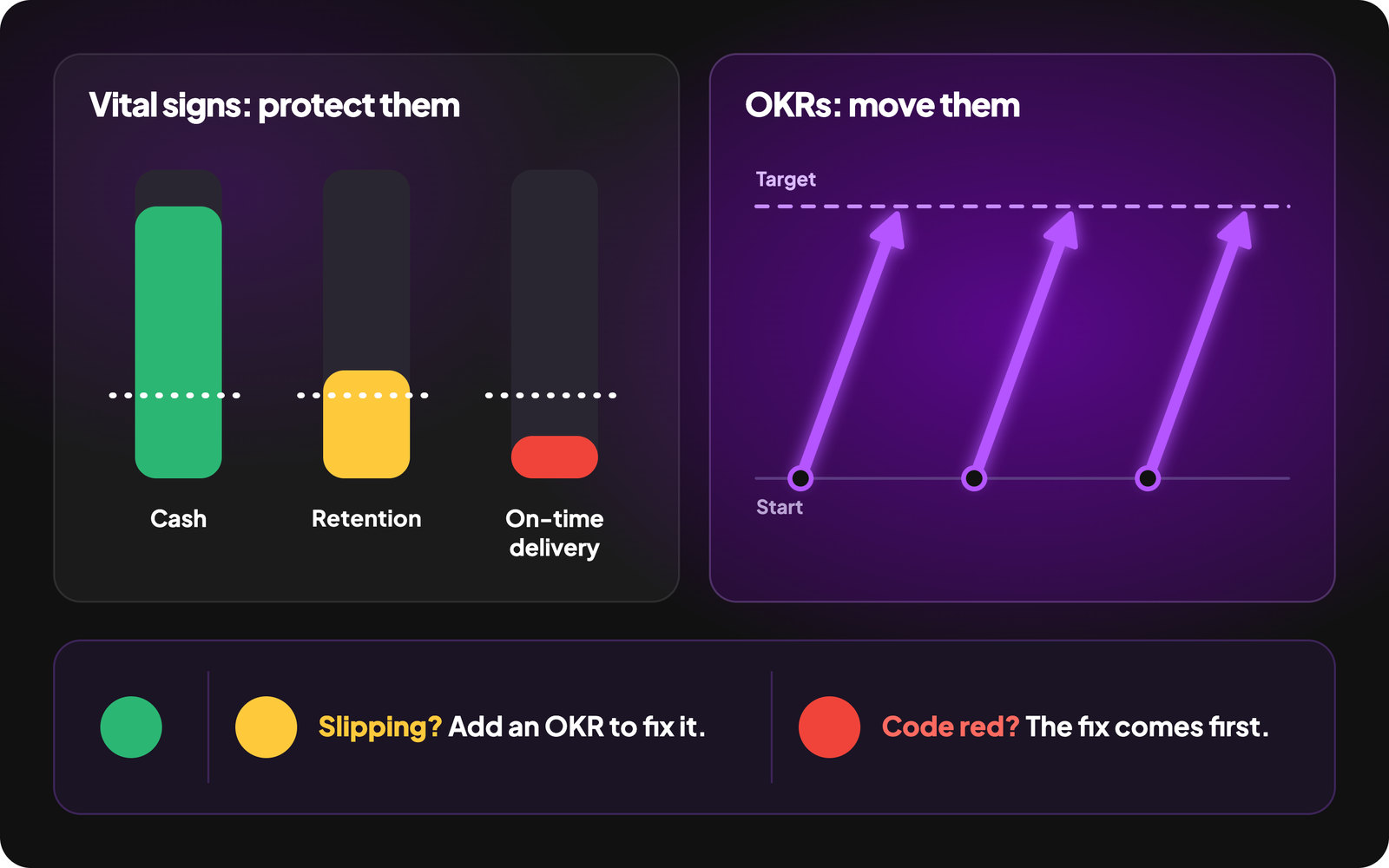
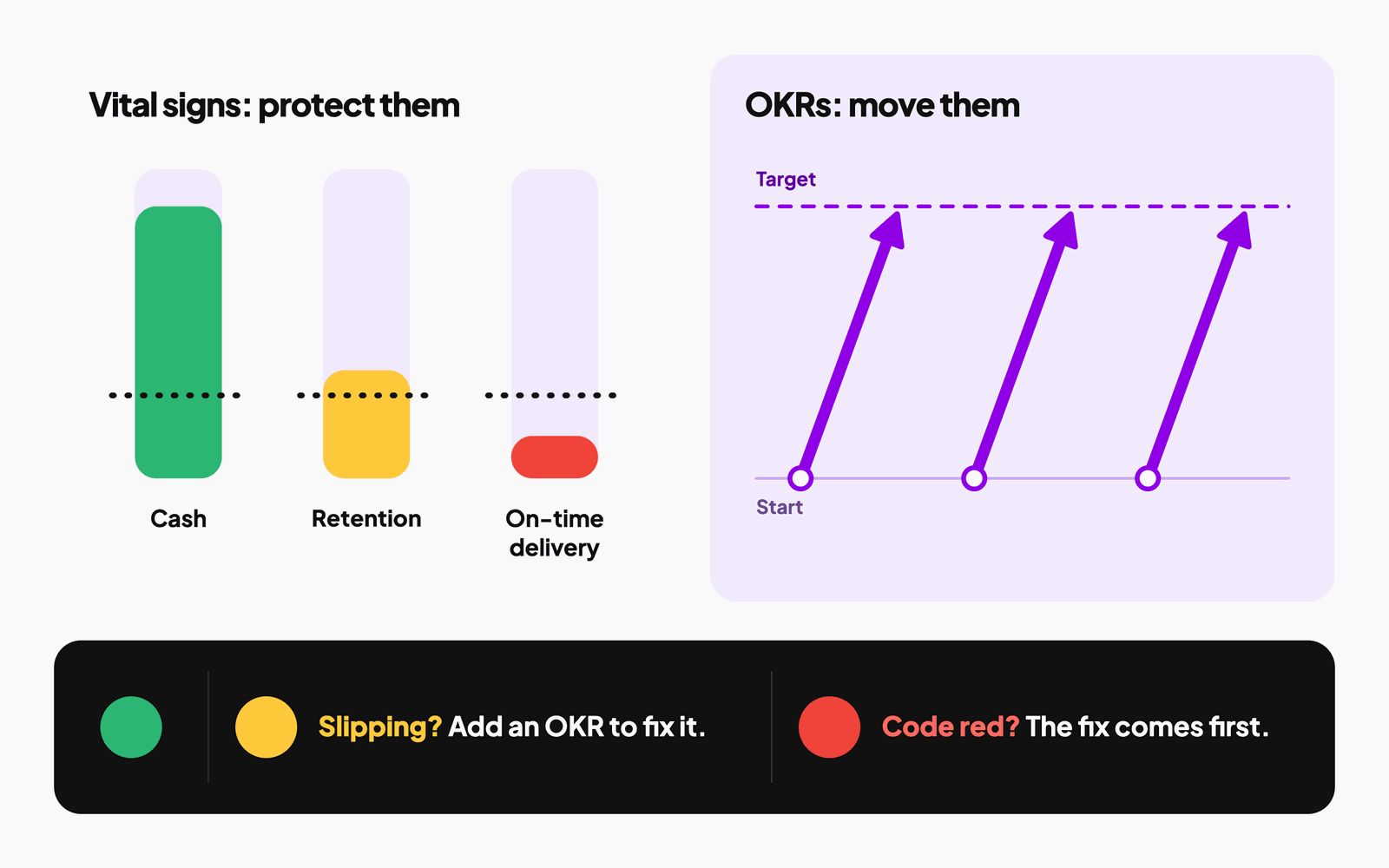
What’s the difference between KPIs and OKRs? KPIs (Key Performance Indicators) measure the ongoing health of your business. They tell you whether things are stable, trending up, or heading somewhere you don’t want to go. OKRs (Objectives and Key Results) drive focused change. They define what you’re trying to shift this quarter and how you’ll know whether you did. KPIs watch. OKRs steer. The healthiest performance systems run both, with a clear rule about which job each one is doing.
This guide walks through the difference between KPIs and OKRs in detail, when to use each, how they work together, and the most common mistakes teams make when they confuse one for the other.
What KPIs Actually Are
A KPI is a metric you track over time to monitor whether something important is healthy. It doesn’t have a deadline. It doesn’t have a “done.” It runs continuously, and the value is in the trend.
Examples of KPIs:
- Monthly recurring revenue (MRR)
- Customer churn rate
- Net Promoter Score
- Average deal size
- Website traffic
- Gross margin
- Employee engagement score
Three characteristics define a good KPI.
Stable. A KPI tracks the same thing the same way over long periods. The whole point is that you can compare this month to last month, and this year to last year, and see what’s actually changing.
Diagnostic. A KPI tells you whether something is going well or not. It doesn’t tell you what to do about it. It’s a sensor, not an instruction.
Function-bound. Most KPIs are owned by a function or a team. The CFO watches gross margin. The head of CS watches churn. The marketing lead watches site traffic. The KPI lives wherever the work that affects it lives.
KPIs are the dashboard of the business. When something is wrong, the dashboard is what tells you. The KPI itself doesn’t fix anything.
What OKRs Actually Are
An OKR is a structure for driving focused change inside a defined cycle, usually a quarter. The cycle is the part that matters most. OKRs have a start, a middle, and an end. They aren’t a permanent measurement. They’re a temporary commitment to move something specific.
The structure has two parts.
The Objective. A qualitative, inspiring statement of what you’re trying to accomplish in this cycle. “Build a retainer book that funds the year.” “Become the support experience customers reference when comparing platforms in our space.” Objectives don’t contain numbers. They name the destination.
Two to four Key Results. Measurable outcomes that prove the Objective was achieved. “Lift annual recurring revenue from $1.8M to $3M by Q3 close.” “Reach an NPS of 70 (up from 52) by quarter end.” Each Key Result is specific, time-bound, and verifiable.
OKRs are the change engine of the business. The framework, articulated by John Doerr in Measure What Matters, exists to push something forward that wouldn’t move on its own. When the cycle ends, you score the result, capture what you learned, and start again. For a deeper walk-through of how to write them, see our guide to writing effective OKRs.
The Difference Between KPIs and OKRs at a Glance
The cleanest way to see the difference is side by side.
| KPIs | OKRs | |
|---|---|---|
| Purpose | Monitor ongoing business health | Drive focused, time-bound change |
| Time horizon | Continuous, year over year | Quarterly cycles |
| Structure | Single metric or set of metrics | Qualitative Objective + measurable Key Results |
| What they answer | Are we healthy? Are we on track? | What are we changing? How far have we gotten? |
| What happens at the end | They keep running | You score them and set new ones |
| Ownership | Owned by a function | Owned by a person, with org-wide visibility |
| Ambition level | Realistic, achievable benchmarks | Stretch targets, 0.7 = “stretch achieved” |
| Misuse mode | Tracking too many, ignoring what matters | Treating them as KPIs and just watching the number |
The distinction worth burning in: KPIs tell you the state of your business. OKRs tell you what you’re trying to change about it this quarter.
When to Use KPIs
Use KPIs when the goal is monitoring something stable that needs to stay stable, or watching something move slowly over time so you can detect trends.
Operational health. Anything in the day-to-day running of the business that needs to stay within an acceptable range. Uptime, error rates, support ticket volume, inventory turnover.
Financial signals. Revenue, margin, cash position, customer acquisition cost. These don’t change much quarter over quarter, but the trend matters.
Long-running engagement signals. Net Promoter Score, retention, employee engagement. These are slow-moving metrics where the year-over-year picture is what tells you whether the business is improving.
Industry benchmarks. Anything you compare against external standards. Conversion rates against industry medians. Salary against market data.
KPIs work best when there are not too many of them. A dashboard with 30 KPIs is mostly noise. Five to ten KPIs that genuinely indicate business health, refreshed regularly, are the right shape.
When to Use OKRs
Use OKRs when something needs to change, and you want to commit to changing it within a specific cycle.
Strategic shifts. A new market entry, a product line launch, a major repositioning. Anything that requires the business to do something it wasn’t doing before.
Recovering metrics. When a KPI has slipped and the team has decided to pull it back. The KPI keeps running. The OKR commits the team to a specific recovery target with a deadline.
Stretch ambitions. A goal that requires the team to figure out something they don’t yet know how to do. OKRs are designed for this. A 0.7 score (out of 1.0) on a Key Result is “stretch achieved,” rather than the failure it would be on a KPI.
Cross-functional initiatives. Work that depends on multiple teams pulling in the same direction. OKRs make the shared target visible across functions in a way that team-level KPIs don’t.
OKRs work best when there are very few of them. The OKR Leader brand POV is that most orgs set too many. Three Objectives per team per cycle is the ceiling, not the floor.
How KPIs and OKRs Work Together
The most useful way to think about the relationship between KPIs and OKRs: KPIs tell you which OKRs to set.
A KPI dashboard is a diagnostic tool. When everything is healthy, you don’t write an OKR to maintain it. When something is declining or stuck, that’s where an OKR earns its place. Use the dashboard to find the problem. Use the OKR to address it.
Concrete example. Your customer satisfaction score (a KPI) sits at 72%. You track it monthly. The number has held steady for three quarters. Leadership decides 72% is too low and you’re going to do something about it.
You write an OKR.
Objective. Become the support experience customers reference when comparing platforms in our space.
Key Results.
- Lift CSAT from 72% to 85% by Q3 close.
- Reduce average time-to-resolution from 14 hours to 5 hours by Q3 close.
- Achieve a 90% completion rate on the new onboarding sequence by end of August.
The KPI didn’t go away. You’re still tracking CSAT every month on the dashboard. But now you have an OKR that tells your team specifically what they’re doing about it and how they’ll know whether they succeeded. The KPI is the signal. The OKR is the response.
When the cycle ends and the OKR is scored, the work shifts. The OKR closes. The KPI keeps running. If CSAT stays at 85% for the next two quarters, the OKR did its job and the KPI confirms it.
For a deeper read on running both systems together without them undermining each other, see our guide on using KPIs and OKRs in parallel.
Common Misconceptions About the Difference Between KPIs and OKRs
Four patterns that show up across organizations trying to figure out where each tool fits.
“KPIs and OKRs are interchangeable.” They aren’t. KPIs monitor stable performance. OKRs drive specific change. Treating them as the same thing produces dashboards full of “OKRs” that are really just static targets nobody is doing anything specific about.
“You have to pick one.” You don’t. The strongest performance systems use both, with a clear rule about which job each one is doing. KPIs are health indicators. OKRs are change engines. Either alone is half a system.
“OKRs are just KPIs with more structure.” They aren’t. The structural difference is real, but the deeper distinction is that OKRs are time-bound commitments to move something. A KPI can sit on a dashboard for years and just exist. An OKR has a deadline and an end-of-cycle score.
“If we set good KPIs, we don’t need OKRs.” This is the most expensive misconception. Healthy KPIs across the board often mean a business is steady but not changing. The KPIs say everything is fine. The business stalls because no specific transformation is being driven. OKRs are what create the change that good KPIs eventually reflect.
The Real Test: How to Know Which One a Metric Should Be
When you can’t tell whether something belongs as a KPI or a Key Result, ask one question.
Are we trying to keep this number stable, or move it?
If the answer is “keep it stable,” it’s a KPI. The metric represents an ongoing healthy state. The job is to track it.
If the answer is “move it, in a specific direction, by a specific date,” it can be a Key Result. The metric represents a target outcome inside a cycle.
The same number can be both. CSAT can live on a KPI dashboard year-round and also be a Key Result in a specific quarter where the team is deliberately moving it. What changes isn’t the number. It’s whether you’ve committed to a specific change and a specific deadline.
If neither answer fits cleanly, the metric probably belongs nowhere. Most teams have at least a few of these, and cutting them tightens the whole performance system.
You Don’t Need a Methodology Debate. You Need Clarity About What Each Tool Is For.
Most organizations don’t have a KPIs vs OKRs problem. They have too many meetings about methodology and not enough discipline about which tool does which job.
KPIs are health indicators. OKRs are change engines. An organization that uses both well isn’t running a complicated system. It’s just being precise about what each tool exists to do.
Pick one KPI on your dashboard that’s stuck or declining. Write one OKR to move it. Run a real check-in cadence on that OKR for the next twelve weeks. See what changes.
Start for Free and run your first OKR cycle alongside the KPIs you already track.
FAQs: KPIs and OKRs
What is the main difference between KPIs and OKRs?
KPIs measure ongoing business health and run continuously. OKRs drive specific, time-bound change inside a defined cycle. KPIs answer “are we healthy?” OKRs answer “what are we changing, and how far have we gotten?” One watches. The other steers.
Can a metric be both a KPI and a Key Result?
Yes, in different contexts. CSAT can live on the KPI dashboard year-round (where the job is to monitor health) and simultaneously be a Key Result in a specific quarter where the team is deliberately moving it from 72% to 85%. The number is the same. The intent is different.
Should I replace my KPIs with OKRs?
No. They serve different purposes. Replacing KPIs with OKRs leaves you without continuous monitoring of business health. Replacing OKRs with KPIs leaves you without a structure for driving change. Run both, with a clear rule about which job each is doing.
How many KPIs should we track?
Five to ten that genuinely indicate business health. A dashboard with 30 KPIs is mostly noise. Aim for the smallest number that gives you confidence the core of the business is functioning, plus one or two leading indicators that warn you when something is starting to slip.
How many OKRs should we set?
Three Objectives per team per cycle is the ceiling, not the floor. Each Objective should have two to four Key Results. The OKR Leader brand POV is that most orgs set too many. If everything is a priority, nothing is.
Are KPIs better for some industries and OKRs for others?
No. The distinction is functional, not industry-specific. Every business has things to monitor (KPIs) and things to change (OKRs). The mix of where each tool gets emphasis varies by stage and strategy, but neither tool is exclusive to a particular industry.
How do leading and lagging indicators relate to KPIs and OKRs?
Both KPIs and OKRs use leading and lagging indicators. A KPI dashboard typically includes both. Lagging metrics (revenue, retention) confirm what already happened. Leading metrics (signups, qualified leads) predict what will happen next. OKRs use the same principle. A Key Result can be lagging (the outcome by quarter end) or leading (a weekly indicator the team uses to know whether they’re on pace).
Should OKR scores affect performance reviews?
No. Tying OKR scores to compensation produces sandbagging. People set safe, easily achievable targets so they don’t lose comp on a missed stretch goal. The framework loses the very thing it’s supposed to produce, which is honest visibility into ambitious goals. Keep OKRs and performance management as separate systems.
TL;DR
The difference between KPIs and OKRs comes down to purpose. KPIs monitor ongoing business health and run continuously. OKRs drive specific change inside a defined cycle, usually a quarter. KPIs are diagnostic. They tell you what’s true. OKRs are directional. They commit you to changing something specific and measure whether you did. The strongest performance systems use both, with a clear rule about which job each is doing. Use KPIs to monitor. Use OKRs to move. The same metric can be both, depending on whether you’re trying to keep it stable or shift it.