
“We rolled out OKRs six months ago. Frameworks, software, training. And here we are. Misaligned teams. Frustrated leaders. Goals that read more like wishful thinking than strategy.”
Recognize that?
The story shows up in companies pre-rollout, mid-rollout, and a full year past a launch that slowly faded out. Details change. The pattern doesn’t.
Why do OKRs fail? Most OKR programs don’t fail because the framework is broken. They fail because of five quiet, structural problems that erode execution from the inside: standardization gaps, isolation from real workflows, fake alignment, weak accountability, and key results that measure activity instead of impact. Spot them early and they’re surprisingly fixable. Miss them and even the best-designed program fades by Q3.
Here’s the part nobody puts on the kickoff slide: the framework rarely fails on its own. The conditions around it do. We call those conditions the Silent Killers, because they’re so embedded in how teams already work that nobody flags them until the quarter is already off.
Below, we’ll walk through all five reasons why OKRs fail. Real examples. Direct fixes. A short checklist at the end so you can audit your own rollout in under thirty minutes.
Whether you’re planning your first OKR cycle, mid-flight on a rollout that’s drifting, or trying to revive a program that didn’t stick, this guide names what to look for and what to do about it.
Why OKRs Fail: The 5 Silent Killers at a Glance
Before we go deep, here’s the short version. These are the five reasons why OKRs fail in practice, no matter how good the design looked on day one.
- Lack of standardization turns flexibility into chaos.
- Isolation from existing systems makes OKRs a side quest instead of how work gets done.
- Alignment theater creates the look of cohesion without the substance.
- Weak accountability loops let ownership evaporate within weeks.
- Task-based key results reward activity instead of measuring impact.
Each one chips away at momentum. Stack two or three together and the program is finished by mid-cycle and it becomes painfully clear why OKRs fail, despite everyone’s best intentions. Below is the full breakdown, what causes each one, and what to do.
Silent Killer #1: Lack of Standardization
When “Everyone’s Way” Becomes “No Way”
Marketing sets quarterly OKRs. Engineering prefers monthly cycles. Sales writes revenue-based key results, Product writes engagement metrics. The CEO wants moonshots. Team leads write conservative numbers they know they can hit.
Welcome to the standardization nightmare. The polite name is “flexibility.” The honest name is chaos.
This is one of the most common reasons why OKRs fail in mid-sized and enterprise rollouts: every team is technically running OKRs, but no two teams are running them the same way.
It usually starts with good intent. Different departments have different needs, so leadership lets each team “customize” the approach. On the surface, reasonable. In practice, it creates three compounding problems.
Inconsistent formats. Some objectives read like mission statements. Others read like task lists. Key results swing between vague aspirations and step-by-step project plans. Nobody can compare anything.
Timeline mismatches. Cross-functional initiatives need a shared cadence. When teams operate on different cycles, dependencies break, planning sessions don’t line up, and the quarterly review becomes a Frankenstein of partial data.
Scoring confusion. A 0.7 on one team is a stretch. A 0.7 on another is sandbagging. Without a shared definition of done, you can’t tell which.
Where Misalignment Actually Hurts
A real example, lightly disguised. A tech company’s Product team set: “Launch game-changing user features.” Engineering set: “Maintain 99.99% system stability.” When the major release was ready, Engineering pushed back, citing stability risks. Both teams hit their OKRs. The company lost a quarter.
Lack of standardization doesn’t just look messy. It produces:
- Duplicated work across departments
- Resource conflicts that nobody owns resolving
- Strategy execution delays that show up as “communication problems”
- A quarterly review that’s mostly explanations
The Fix: Build a Simple Standard
You don’t need a manual. You need one page that everyone uses.
Define your core components.
- Objective format: “[Action verb] + [desired outcome] + [time frame].” Qualitative. No embedded numbers.
- Key result format: “[Metric] from [X] to [Y] by [Date].” Quantitative. Measurable.
- Scoring: 0.0 to 1.0 with shared definitions. 0.7 is the target. 1.0 means you didn’t aim high enough.
Set universal timelines. One organization-wide cycle. One review cadence. One synchronized planning window. If a team genuinely needs a different rhythm, that’s a documented exception, not a default.
Use clear levels.
- Company: 2 to 3 annual objectives
- Department: 3 to 5 quarterly objectives
- Team: 2 to 3 quarterly objectives
A two-week sprint is usually enough to get this in place. Week one, draft the templates and review with stakeholders. Week two, distribute, train, and adjust. Don’t let perfect be the enemy of useful. The goal is a shared language, not a rulebook.
Pro tip: Build a one-page reference that answers six questions for your organization. What makes a good objective? What makes a good key result? How do we handle key results without a baseline? How do we score progress? When do we review? Who needs to align with whom? That single page becomes your OKR operating system.
Standardization isn’t rigidity. It’s the difference between everyone driving on the same side of the road and a four-way collision at every intersection.
Silent Killer #2: Isolation from Existing Systems
When OKRs Become an Island, Not a Bridge
OKRs are set. They’re clear, ambitious, color-coded in the platform. But something’s off. Nobody references them in sprint planning. The product roadmap doesn’t mention them. Quarterly reviews? Crickets.
This is the second-biggest reason OKRs fail at scale: they live in a tool, not in the work.
When OKRs aren’t woven into the systems where decisions actually happen, they go theoretical fast. Teams default back to KPIs, sprint tickets, or whatever ran the place before. The OKR doc becomes a bookmark nobody opens. Strategy drifts. Momentum dies. Six months later someone in leadership asks why the rollout “didn’t take.”
This isn’t a tooling problem in the software sense. It’s a thinking problem. If your team still treats OKRs as “extra work,” you haven’t yet integrated them into how the business runs.
The Fix: Bake OKRs Into the Operating Rhythm
The test is simple. If something is genuinely important, it shows up in the workflow where work happens. If it doesn’t, it won’t get done.
Tie OKRs into planning. Sprint planning, quarterly priorities, budget conversations. If a team sets a Q3 OKR but their actual sprint backlog has nothing connected to it, the OKR isn’t real.
Embed in existing reviews. OKR progress should be a standing item in leadership check-ins, ops meetings, team retros. Not a separate calendar invite. A line on the agenda you already have.
Connect to the tools people already use. Slack reminders. Tickets in Jira or Linear. Dashboards in Notion. Wherever the team lives, the OKRs need to be visible there too. The fewer clicks between “I’m doing the work” and “this is the OKR it ladders into,” the better.
Clarify the link to performance. OKRs influence performance conversations indirectly. They show what was prioritized, what was delivered, and what was learned. They are not a stick. Tying scores directly to compensation breaks the system. People sandbag, and the data stops being honest.
Pro tip: The “One Workflow Rule.” If a strategic priority isn’t visible in the same place where work gets tracked and decisions get made, it isn’t a priority. It’s a wish.
If your OKRs aren’t already showing up in the workflows your team uses every week, that’s where to start. Our OKR Revival Guide walks through exactly how to embed OKRs into the rhythms you already have, so they stop being a side document and start driving execution.
Silent Killer #3: Alignment Theater
When Everyone Says They’re Aligned, But No One’s Moving Together
On paper, alignment looks great. Every team has OKRs. There’s a slick alignment map. The CEO’s objectives cascade beautifully into team-level goals.
In practice? Teams step on each other’s toes. Resources get double-booked. Priorities collide mid-quarter like rush hour at a four-way stop.
This is alignment theater. Teams attend the planning sessions, nod through the strategy deck, link OKRs in the platform, and nothing actually changes about how work gets done. All signal. No substance.
It happens because the appearance of alignment is much easier to produce than the reality of it. Real alignment requires hard conversations and real trade-offs. It requires someone saying “if you’re doing that, we can’t do this.” Most orgs skip those conversations and ship a chart instead.
The result is one of the more expensive ways OKRs fail:
- Departments duplicate effort without realizing it
- Competing initiatives launch the same week
- Cross-functional teams blame each other for blockers
- Leaders are “aligned” in language but not in execution
The Fix: Earn Alignment Through Conversation, Not Cascades
Alignment isn’t a top-down dictation. It’s a side-to-side negotiation. Here’s how to actually do it.
Drop the waterfall mindset. OKRs should start with directional clarity from leadership. Then they need to move horizontally before they’re finalized. Cross-team conversations come before signoff, not after.
Use shared OKRs where it matters. For genuinely cross-functional priorities, write one OKR with co-owners from multiple teams. No opt-out, no finger-pointing, one shared scoreboard.
Time the planning right. Run cross-team planning before each function locks their OKRs in. This is where dependencies and conflicts surface early, while there’s still time to resolve them.
Make misalignment visible during the cycle. OKR reviews should ask two questions, not one. “What’s progressing?” matters. So does “What’s getting blocked, and by whom?” Friction is information.
Pro tip: Ask every team lead one brutal question at planning: “Who else depends on you to hit their OKRs, and how are you making sure you’re not derailing them?” If they can’t answer, you don’t have alignment. You have parallel play in matching jerseys.
Silent Killer #4: Weak Accountability Loops
When Everyone Owns It, No One Owns It
You’ve heard the lines.
“We thought Marketing was handling that.”
“Engineering assumed Product would lead.”
“We’re all responsible for that one.”
Translation: nobody is, and the key result is circling the drain.
Weak accountability is one of the quietest ways OKRs fail, because the chart still looks fine. There are names next to objectives. Teams nod along in check-ins. But no real follow-through. No urgency. No pressure to actually move the number. Just vibes.
You can spot it by the symptoms:
- Key results drifting untouched for weeks
- Check-ins that are status updates, not problem-solving sessions
- Teams hitting 60% and calling it a win because “we tried”
- Everyone claiming ownership and nobody driving outcomes
This is one of the main reasons why OKRs fail. It happens because OKRs often get treated as team homework, not mission-critical work. Without explicit ownership, the program slides into background noise. Nice to have. Easy to ignore.
The Fix: Make Accountability Explicit, Visible, and Weekly
Accountability inside an OKR program isn’t punishment. It’s ownership with support. Done well, it’s the engine that keeps the cycle alive.
Assign one driver to every key result. One name. One person responsible for progress, updates, and risk-flagging. They don’t have to do all the work, but they own moving the number.
Run real weekly check-ins, not status theater. Three questions are enough.
- What’s the current score, and what changed since last week?
- What’s working and what’s stuck?
- What’s the next move, and what do you need to make it happen?
Use a simple status system. Green, yellow, red. Visible to everyone. If something’s red, the owner brings a plan to turn it around. Red isn’t a failure signal. It’s a request for help, surfaced early enough to do something about it.
Reward radical candor. Create air cover for “we’re behind, here’s why” without it becoming a blame meeting. Honesty is the prerequisite for course correction. If teams hide bad news until the quarterly review, the OKR program is already done.
Pro tip: When a key result owner says “we’re stuck,” the leader’s job isn’t to apply pressure. It’s to ask “what do you need to move this forward?” and then go get it for them. That’s the whole game.
If accountability is what’s broken in your current rollout, that’s a fixable problem. The OKR Revival Guide covers ownership patterns, weekly check-in structure, and the operating rhythm that makes radical candor safe enough to actually use.
Silent Killer #5: Task-Based Key Results
When “Done” Doesn’t Mean Progress
Common trap. Your team finishes every key result. Every box checked. Slides green across the board. And nothing meaningful actually changed. The product didn’t improve. Customers aren’t happier. Revenue didn’t move.
Welcome to task-based key results. They feel productive. They look productive. They aren’t.
This is one of the most subtle reasons OKRs fail, because the scoreboard says you won.
The illusion of progress. Tasks are easy to track. “Launch the campaign.” “Update the dashboard.” “Hold five customer interviews.” Output without outcome. The work happened, but you can’t tell whether any of it worked.
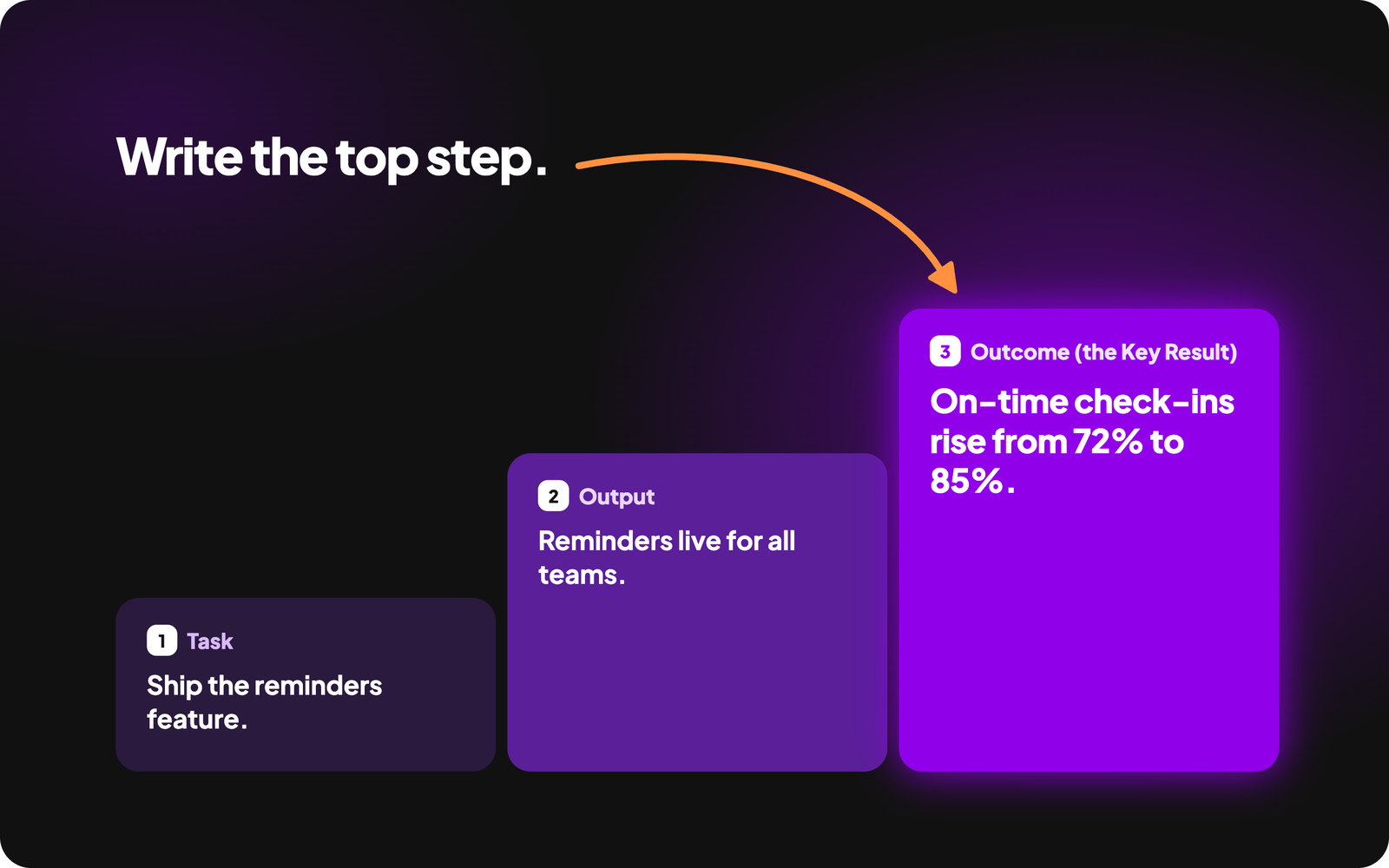
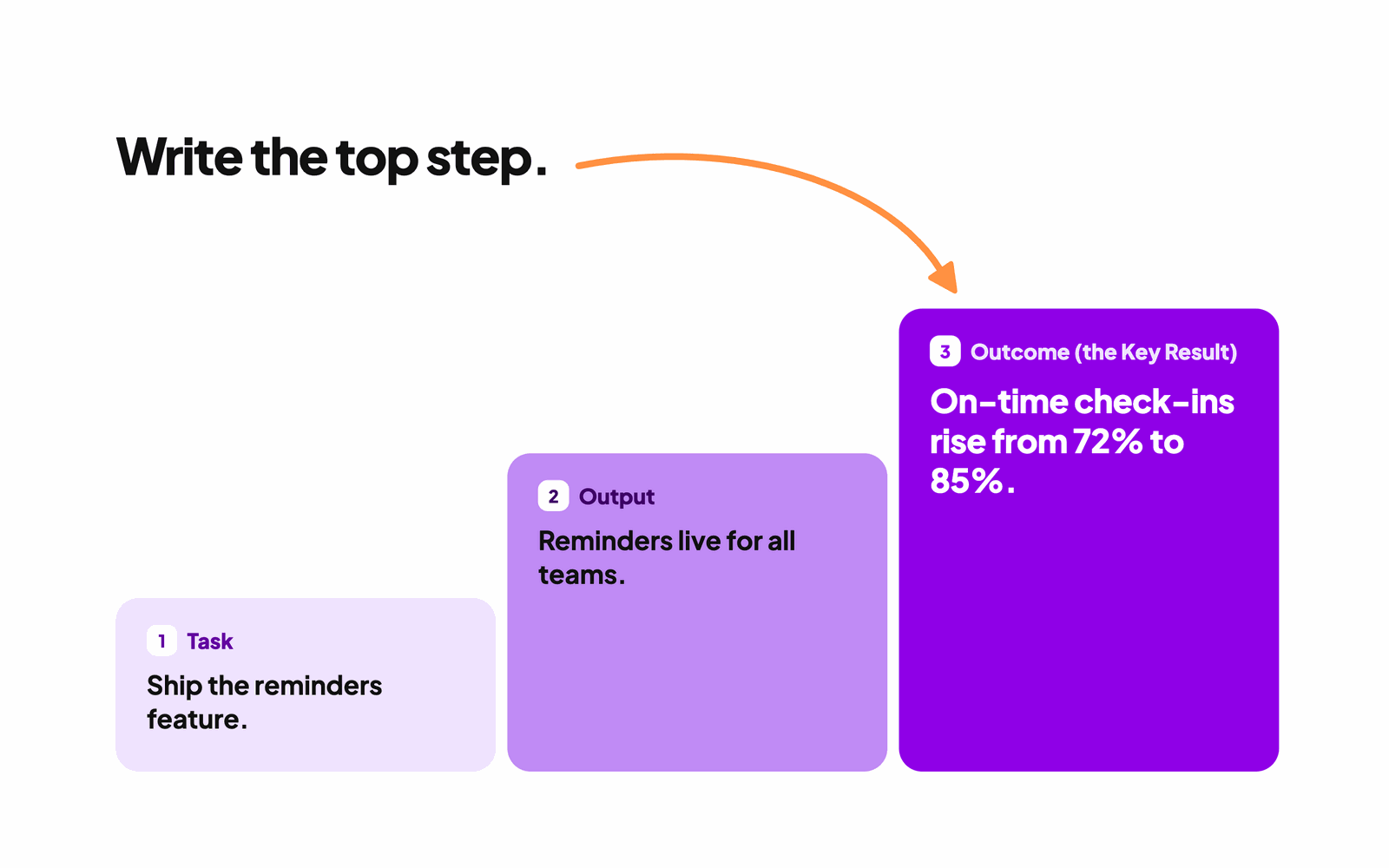
Task-based KRs kill momentum because:
- They reward activity over impact.
- They hide whether the strategy is actually working.
- They train teams to aim for completion instead of change.
This shows up because measuring outcomes is genuinely harder than measuring tasks. It takes baseline data, a hypothesis about what will move, and the discipline to write KRs around the change you’re trying to create. Most teams default to whatever’s easiest to count.
The Fix: Outcomes, Not Outputs
Pull every KR through this lens before you ship the cycle.
Ask the magic question. “If we complete this key result, what will be different?” If the answer is “we’ll have done the thing,” it’s a task, not a key result. Rewrite it.
Start with the impact, then work backward. What change are you trying to create? More qualified pipeline? Higher activation rate? Better retention? Build the KR from there. The activity that produces the change is a project, not a key result.
Use metrics where you can. Use milestones only where you must. Some launches are legitimately the outcome (think SOC 2 readiness, or a regulatory certification). For everything else, pair the milestone with the impact metric it’s supposed to produce. “Launch v2” plus “lift activation from 22% to 35% within 60 days of launch” is stronger than either alone.
Train the difference into the team. Run a short workshop using your own examples. Show the activity-shaped version. Show the outcome-shaped version. Make people feel the difference, not just hear about it. According to John Doerr’s Measure What Matters, a clearly written outcome-based key result is the single most leverage-rich element of a working OKR system. Most teams underinvest in this skill.
Pro tip: A great key result should feel a little uncomfortable to write. It should force you to commit to a number you’re not yet sure how to hit. That’s the job. If your KRs feel safe, your strategy probably is too.
How to Diagnose and Fix Why Your OKRs Are Failing
Use this short audit. Score each statement honestly. Yes/No.
- Every team in the org uses the same OKR template, scoring scale, and cycle length.
- OKRs show up in our regular planning, sprint, and review meetings, not just in their own dedicated meeting.
- Cross-functional priorities have a single shared OKR with named co-owners.
- Every key result has one named driver and a green/yellow/red status updated weekly.
- If our team completed every action implied by our key results, the intended outcome would actually happen.
Three or fewer “yes” answers means at least one silent killer is active in your program. That’s not a reason to scrap OKRs. It’s a reason to retool the conditions around them.
The companies that make OKRs stick aren’t the ones with the prettiest framework. They’re the ones where the operating rhythm, the tooling, and the ownership are all set up to support the framework instead of fighting it.
Wrapping It Up
Five silent killers, in order of how often they show up:
- Lack of standardization turns flexibility into chaos.
- Isolation from existing systems makes OKRs an island.
- Alignment theater produces the look of cohesion without the substance.
- Weak accountability loops let ownership evaporate by week three.
- Task-based key results reward activity instead of impact.
Each one chips away at momentum. Stack two or three and the program is done by mid-cycle. Now you know what to look for, you can do something about it before the next review.
If your rollout is already drifting, you’re not in unfamiliar territory. The patterns that explain why OKRs fail are well-known. They’re also fixable. Our OKR Revival Guide is built for exactly this moment, the one where you can see the program slipping and need a clear path to bring it back. Free, immediately useful, no roadshow required.
Good intentions don’t scale. Execution does. Let’s move.
Download the OKR Revival Guide →
FAQs: Why OKRs Fail
Why do most OKR implementations fail?
Most OKR implementations fail not because the framework is flawed, but because of hidden execution problems. Inconsistent standards, weak accountability, isolation from real workflows, and task-based key results erode the program from the inside. Without addressing these, even well-written OKRs fall flat by the end of the first cycle.
How do I make OKRs actually work for my team?
Start by avoiding the 5 main reasons why OKRs fail and instead start standardizing how OKRs are written and scored across teams, embed them into existing planning and review meetings instead of creating new ones, name a clear owner for every key result, and rewrite any KR that measures activity rather than outcome. The fix usually isn’t more goals. It’s the right goals, run with discipline.
What’s the difference between task-based and outcome-based key results?
A task-based key result measures activity (“Launch the campaign,” “Hold five interviews”). An outcome-based key result measures the change the activity is supposed to produce (“Lift demo requests from 80 to 200 per month by end of Q3”). If checking the box doesn’t create measurable change, it isn’t a real key result.
How do I fix OKRs that aren’t driving progress?
Audit them against five questions. Are they written in a consistent format? Are they connected to the workflows where work actually happens? Does each key result have one named driver? Are they reviewed weekly with green/yellow/red status? Do they measure outcomes instead of activity? Anywhere the answer is no, you’ve found the problem.
What are the biggest mistakes companies make with OKRs?
Letting every team customize the format until nothing is comparable. Setting goals in a vacuum, disconnected from the real work calendar. Confusing activity with progress. Failing to review and adjust mid-cycle. Treating OKRs as a “set and forget” exercise instead of a living tool. Each of these is a textbook example of why OKRs fail in practice even when the design looked solid on paper.
Can OKRs work for cross-functional teams?
Yes, but only if you build them with those teams, not for them. Shared OKRs with named co-owners and open cross-functional planning before the cycle starts are the single biggest predictors of cross-functional success. Without those, you will see why OKRs fail because you’ll get parallel teams running parallel goals that compete for the same resources.
How are OKRs different from KPIs?
KPIs track the ongoing health of the business. OKRs drive change. KPIs tell you what’s true today. OKRs tell you what should be different by the end of the quarter. The strongest teams use both, with OKRs pulling the strategy forward and KPIs monitoring the pulse underneath. For more on this distinction, see Harvard Business Review’s coverage of goal-setting in modern organizations.
TL;DR
OKRs don’t fail because the framework is broken. They fail because the conditions around them are. The five silent killers, lack of standardization, isolation from existing systems, alignment theater, weak accountability, and task-based key results, do most of the damage. Spot them, fix them, and your OKR program starts producing real outcomes instead of decorative quarterly reports. If you’ve launched OKRs and stalled, this is the diagnostic to run first. If you haven’t launched yet, this is the list of traps to avoid.