

Company OKR Examples: One Sample Business From Strategy to Team OKRs
Sample business profile
Company OKR Examples: One Sample Business From Strategy to Team OKRs
These company OKR examples follow one business from its strategy all the way down to a linked OKR for every department. The business is Tidewell, and we made it up. It has about 80 people, a real-feeling set of problems, and one quarter to plan. Every number in its Key Results is written as X and Y, so you can picture your own values in their place.
The short answer
How do company OKRs connect to team OKRs?
In good company OKR examples, the company OKRs turn the year’s strategic priorities into the few changes the whole business is chasing this quarter. Each team then writes its own OKR and links it to at least one of six anchors: a strategic priority, another team’s objective, a team strength, an external opportunity, a team weakness or an external threat.
At Tidewell that plays out three ways:
- Four teams support Company Objective 1. Marketing, Sales, Product and Operations each own part of winning larger shops and making the switch easy.
- Finance supports Company Objective 2. Its OKR gives leaders the numbers to grow profit per employee.
- Three teams link straight to the SWOT. Customer Success, Engineering and HR each fix a weakness or defend against a threat the leadership team named.
The sample business
Meet Tidewell, a made-up company with real-world problems
Tidewell sells scheduling, dispatch and invoicing software to plumbing, heating and electrical businesses. Its customers are owners who used to run the day from a whiteboard and a phone that never stopped ringing.
The business at the start of the quarter looks like this:
- About 80 people across eight departments, with a three-person leadership team.
- Six years old, profitable most months, and growing through subscriptions priced per technician.
- Customers across Canada and the United States, from one-truck shops to businesses with 50 technicians.
- The founders want profitable growth from here, and they’d like the plan to pay for itself without another round of investment.

Tidewell, its people and its situation are invented to show how company OKR examples fit together. Any resemblance to a real business is a coincidence.
Where it starts
Tidewell’s strategy for the year
The leadership team wrote one sentence for each layer of the strategy. Every OKR further down this page traces back to these.
Give trades business owners their evenings back.
Every small trades business in North America runs its day from one screen.
- Fix it for the customer first.
- Do what you said you’d do.
- Keep it simple for the technician in the field.
Under that sit three strategic priorities for the year. These are the long-horizon anchors that company OKR examples like Tidewell’s link back to. Google’s guide to setting goals with OKRs describes the same top-down starting point.
Win the mid-size shop
Mid-size shops, with 15 to 50 technicians, stay longer and pay more per account. Tidewell wants them to make up a bigger share of new customers.
Grow profit per employee
Revenue has grown with headcount for three years. The founders want profit to grow faster than the team does.
Make switching to Tidewell the easiest move a shop makes all year
Larger shops put off switching because moving their jobs, customers and price lists feels risky. Every week of setup is a reason to wait.
Protect these first
The health metrics Tidewell protects every quarter
Before writing a single OKR, the leadership team listed the vital signs that have to stay healthy while everyone chases change. These aren’t OKRs. Leaving them out of the company OKR examples below keeps the list short. Each one has a range, and a metric only becomes an OKR when it starts slipping out of that range.
- Dispatch board uptime stays at or above X%, because technicians can’t see their next job when it’s down.
- Months of cash runway stay above X, so the plan never depends on a lucky quarter.
- Support first-response time stays under X minutes during business hours.
- Gross revenue retention stays at or above X%.
- Payroll and invoices go out on time every cycle, with no exceptions.
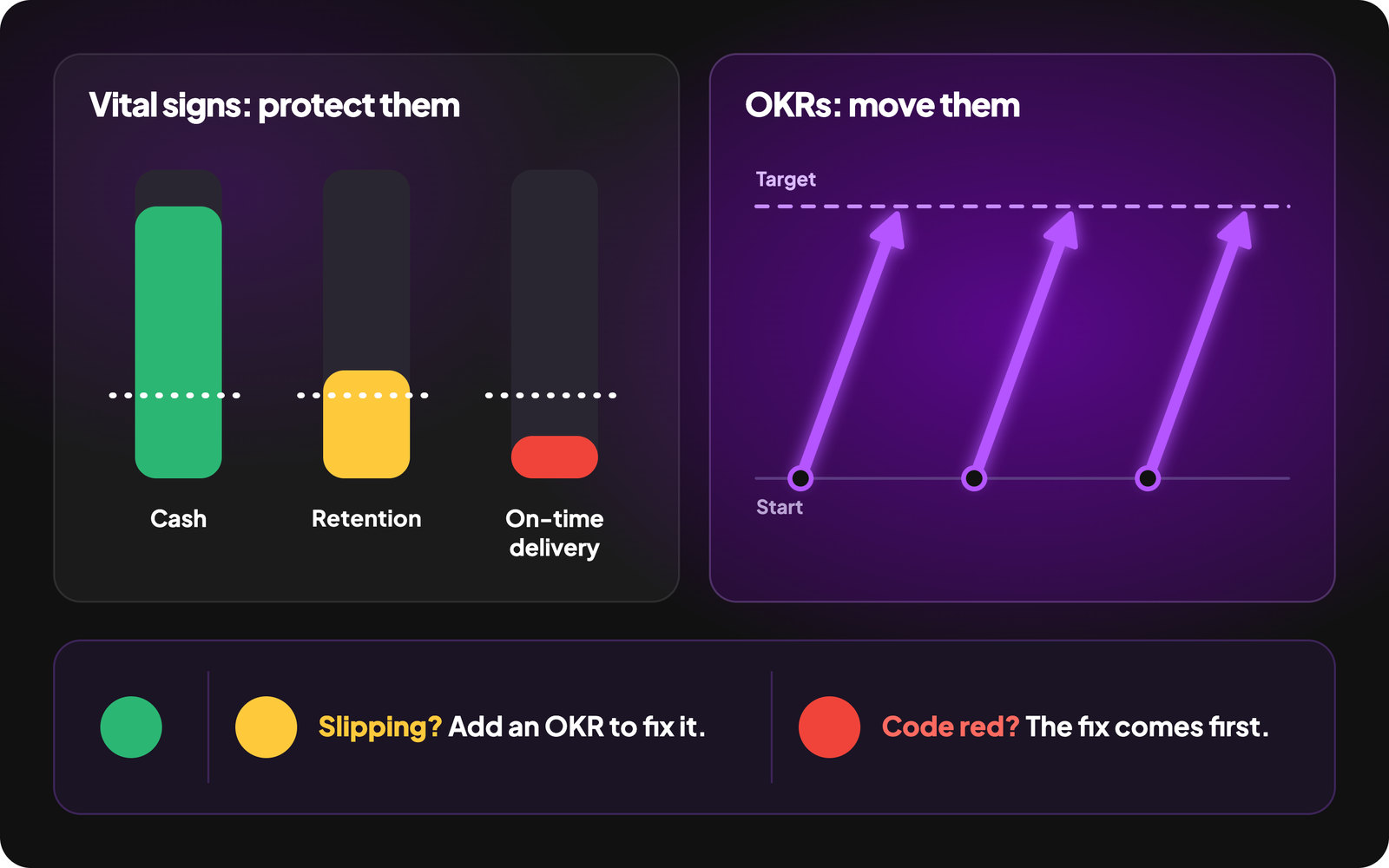
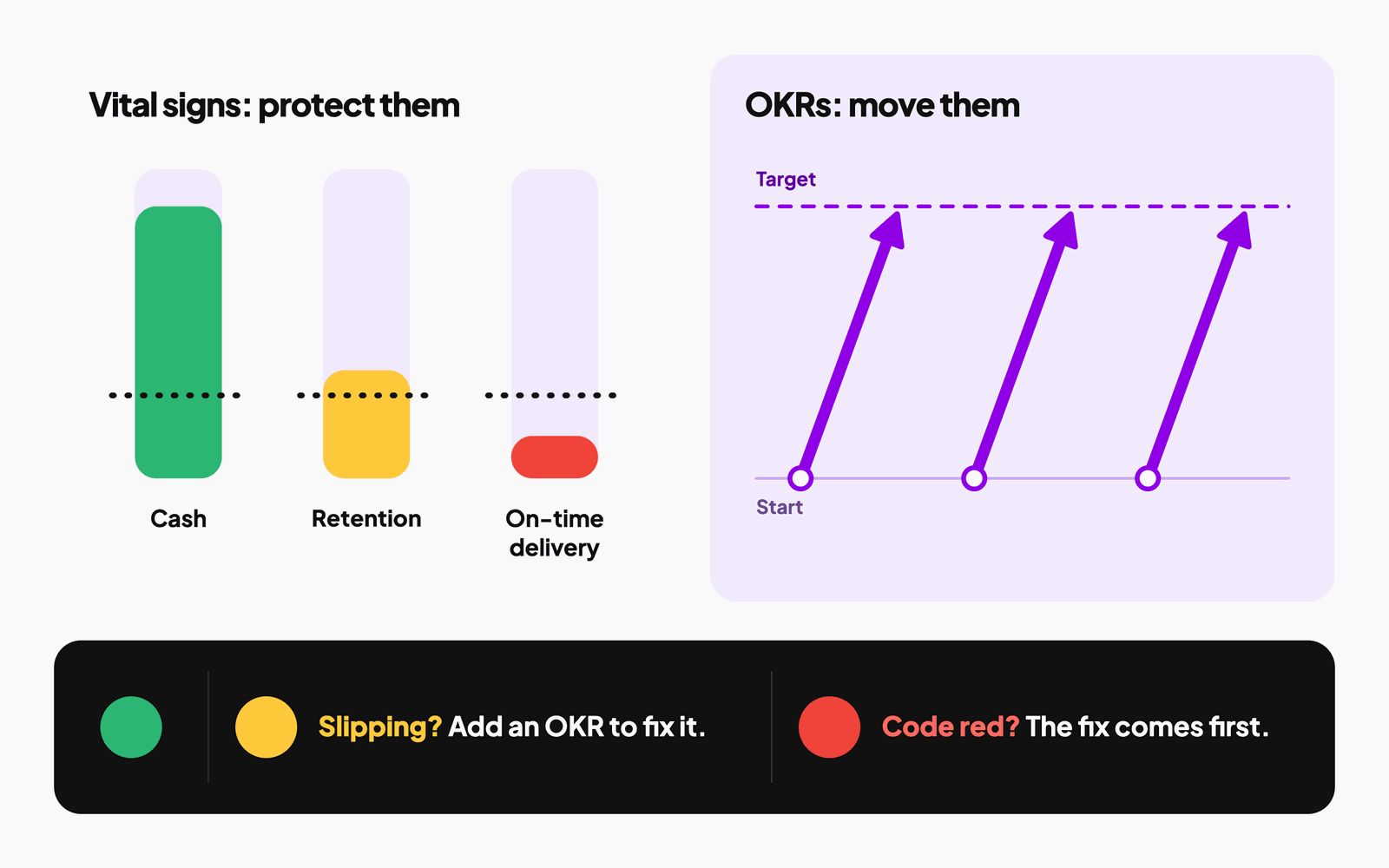
One of these slipped last quarter. Gross revenue retention dipped into the yellow because small shops were cancelling in their first three months. That became Customer Success’s OKR for this quarter, linked to a team weakness. You’ll find it in the department OKRs below.
The agile anchors
Tidewell’s SWOT for this quarter
Strategy changes once a year. A SWOT can change every quarter, which makes it the place to catch what’s new. The leadership team ran this one in a single meeting with every department head in the room. Each quadrant matches one of the agile anchors that company OKR examples can link to.
Strengths (leverage a team strength)
- Technicians rate the mobile app highly in the app stores.
- The support team answers fast, and customers mention it by name in reviews.
- Tidewell already connects to the two accounting tools its customers use most.
Weaknesses (mitigate a team weakness)
- Larger shops take weeks to go live because their data needs cleaning first.
- Small shops cancel in their first 90 days more than they did a year ago.
- Reports are too thin for an owner running 30 technicians.
- Releases are slow because too much testing is done by hand.
- The month-end close takes long enough that leaders see last month’s numbers halfway through this one.
Opportunities (capture an external opportunity)
- A larger competitor announced it will retire its older desktop product, and its customers need somewhere to go.
- Two regional trade associations asked about a member discount.
Threats (defend against an external threat)
- A well-funded competitor launched a free plan for one-truck shops.
- Senior engineers are getting harder to hire in Tidewell’s city.
Step 1: the company level
Tidewell’s company OKRs for the quarter
These are the two company OKR examples everything else hangs from. The leadership team kept the company level to two Objectives, each with three Key Results. Every Key Result starts with an action verb, names the metric, gives a from X to Y and ends on a deadline.
ObjectiveBecome the first choice for mid-size trades businesses
- Increase new mid-size customers from X to Y per quarter by the end of Q2
- Raise net revenue retention among mid-size customers from X% to Y% by the end of Q2
- Reduce the median time for a mid-size customer to go live from X to Y days by the end of Q2
Links toStrategic priority 1 (win the mid-size shop) and strategic priority 3 (make switching the easiest move a shop makes all year).
ObjectiveGrow profit as fast as we grow the team
- Increase profit per employee from X to Y by the end of Q2
- Raise gross margin from X% to Y% by the end of Q2
- Hold headcount growth at or below X% while revenue grows through the end of Q2
Links toStrategic priority 2 (grow profit per employee).
Step 2: the team level
Company OKR examples for every department
These department-level company OKR examples are where the strategy turns into each team’s weekly work. Each department head wrote one Objective with the people who will carry it, then named the anchor it links to. One Objective per team kept the quarter focused. A bigger team could carry two, and five is the ceiling for anyone. Several of these OKRs link to more than one anchor, which makes them easier to defend when a new idea competes for the same time.
ObjectiveFill the pipeline with mid-size shops that are ready to switch
- Increase demo requests from mid-size shops from X to Y per month by the end of Q2
- Raise the share of marketing leads that sales accepts from X% to Y% by the end of Q2
- Grow pipeline value sourced by marketing from X to Y by the end of Q2
Links toAnchor 1, strategic priority 1, and anchor 2, because it feeds the Sales OKR next to it.
ObjectiveWin over the shops leaving the retiring desktop product before they settle somewhere else
- Increase new customers who switched from the retiring product from X to Y by the end of Q2
- Raise the win rate on switching opportunities from X% to Y% by the end of Q2
- Reduce the sales cycle on switching opportunities from X to Y days by the end of Q2
Links toAnchor 4, the competitor’s retiring product, and anchor 2, because these wins count toward Company Key Result 1.
ObjectiveHelp small shops reach their first win in their first three months
- Reduce cancellations in the first 90 days among shops with 1 to 4 technicians from X% to Y% by the end of Q2
- Increase the share of new customers who dispatch their first job in the app within 7 days from X% to Y% by the end of Q2
- Grow the share of small shops sending invoices from the app in their first 30 days from X% to Y% by the end of Q2
Links toAnchor 5, early cancellations. It also brings a slipping health metric, gross revenue retention, back into its range.
ObjectiveGive owners of larger shops the reports they need to run the business
- Raise the share of mid-size accounts that open a report each week from X% to Y% by the end of Q2
- Reduce deals lost because of missing reports from X to Y per quarter by the end of Q2
- Increase the reporting satisfaction score among mid-size owners from X to Y out of 5 by the end of Q2
Links toAnchor 5, thin reporting, and anchor 2, because better reports support Company Key Result 2 on retention.
ObjectiveGet improvements to customers faster without breaking a technician’s day
- Grow deploys to production from X to Y per week by the end of Q2
- Reduce the change failure rate from X% to Y% by the end of Q2
- Hold dispatch board uptime at or above X% through the end of Q2
Links toAnchor 5, slow releases, and anchor 2, because Product’s reports reach customers sooner. The third Key Result keeps a health metric in range while the team speeds up.
ObjectiveGet mid-size shops live fast enough that switching feels easy
- Reduce the median time for a mid-size customer to go live from X to Y days by the end of Q2
- Increase the share of mid-size customers who go live without a data cleanup ticket from X% to Y% by the end of Q2
- Raise onboarding satisfaction among mid-size customers from X to Y out of 5 by the end of Q2
Links toAnchor 2, because its first Key Result is Company Key Result 3, and anchor 3, the support team’s speed, which the onboarding team builds on.
ObjectiveHire the senior engineers we need in a tight local market
- Reduce time to fill senior engineering roles from X to Y days by the end of Q2
- Raise the offer acceptance rate for senior engineering roles from X% to Y% by the end of Q2
- Increase the share of senior engineering hires who come from referrals from X% to Y% by the end of Q2
Links toAnchor 6, the hiring market. Engineering’s OKR depends on these hires, so HR and Engineering review progress together every week.
ObjectiveGive leaders the numbers to grow profit every month
- Reduce the month-end close from X to Y business days by the end of Q2
- Increase the share of department heads who review budget against actuals each month from X% to Y% by the end of Q2
- Determine the current gross margin for each customer size by the end of Q2
Links toAnchor 1, strategic priority 2, and anchor 5, the slow close. The third Key Result is a baseline, so next quarter it can become a from X to Y target.
Keeping the links alive
Where Tidewell’s teams depend on each other
Linking every OKR at setup is the first half of the job. The second half happens every week, when teams that depend on each other check whether the handoffs are still working. Tidewell’s leadership team named four dependencies up front so nobody would find out about a stall in week ten. Company OKR examples rarely show this part, and it’s the part where a stalled handoff costs the most.
Marketing feeds Sales
Demo requests from mid-size shops become the switching opportunities that Sales is trying to win. Both teams look at the same weekly pipeline number in their check-ins.
Engineering carries Product
Product’s reporting work only reaches customers when Engineering can release it. Faster, safer releases are what make the Product OKR possible this quarter.
HR supports Engineering
Every month a senior role sits open slows Engineering down. The two teams share one dashboard for open roles and time to fill.
Operations owns a company Key Result
The median time to go live appears in both Operations’ OKR and Company Objective 1, so the leadership team reviews it every week. Our guide to cross-team alignment covers how to run that rhythm.
What didn’t make the cut
What Tidewell chose to leave out this quarter
The leadership team started with 23 ideas and finished with ten OKRs. They scored every idea with the OKR prioritization matrix and parked anything that scored low on ease or on the assets the team already had.
Three ideas they parked, and why:
- A free plan to answer the competitor’s. It scored high on impact, but Tidewell didn’t have the support capacity to serve thousands of free accounts. They watch new sign-ups from one-truck shops as a health metric instead, and will revisit it next quarter.
- A redesign of the mobile app. Technicians already rate the app highly, so the impact score came in low.
- Moving into landscaping businesses. It’s a promising market, and nobody on the team knows it yet. They added it to next year’s strategy discussion.
Saying no to good ideas is part of how company OKR examples like these stay focused. Christina Wodtke’s Radical Focus makes the same case for a short list of goals, and it’s worth reading before your next planning day.
Go deeper by team
Metrics and more OKR examples for each department
Each of Tidewell’s teams picked one OKR from a much longer list. These pages hold the full metric lists and nine sample OKR sets per department, so you can build your own company OKR examples one team at a time.
Frequently asked questions
Is Tidewell a real company?
No. Tidewell is a made-up business we built to show how company OKR examples connect from strategy to every team. Its people, numbers and situation are invented.
How many company-level OKRs should a business set?
One to four Objectives per cycle, never more than five, each with two to five Key Results. Tidewell set two at the company level so every department could see where its own OKR fits.
Does every department need an OKR that supports a company Objective?
No. Every team OKR needs at least one anchor, and a company Objective is only one of six. In these company OKR examples, Tidewell’s Customer Success, Engineering and HR teams linked straight to weaknesses and threats from the SWOT.
What’s the difference between a company OKR and a team OKR?
The leadership team owns a company OKR, which names a change the whole business is chasing this cycle. A team OKR names the change one team will make, and it links to a company OKR or to another anchor such as a team weakness.
Should health metrics be written as OKRs?
Only when one slips. Tidewell protects metrics like uptime and cash runway with a range, and turned retention into an OKR when it dipped into the yellow. Our guide on KPIs vs OKRs goes deeper.
Map your own company OKRs before planning day
Start a free trial and turn these company OKR examples into your own, with every team’s OKR linked to the strategy in one place. Or take the free OKR Starter Course and learn to write them first.