
You’ve been told OKRs are simple. Then you sit down to write one, and what comes out reads somewhere between a task list and a vague aspiration. Most teams have lived this. The framework is straightforward on paper. The discipline of writing OKRs that actually drive outcomes is harder than the framework makes it look.
This guide walks through how to write effective OKRs end to end. The steps, the structural rules, the common mistakes, and a checklist you can run any draft through before it ships.
What makes an OKR effective? An effective OKR has a qualitative, inspiring Objective paired with two to four measurable Key Results that are outcome-focused, time-bound, and challenging but achievable. The Objective answers “what do we want to accomplish.” The Key Results answer “how will we know we succeeded.” If your team could complete every action implied by the Key Results and the intended outcome still didn’t happen, the Key Results are written wrong.
The whole point of the framework is to translate strategy into execution. OKRs that are written badly do the opposite. They produce activity without progress, and they erode confidence in the framework by the third or fourth quarter.
What an OKR Actually Is (and What It Isn’t)
Before the steps, two definitions worth getting precise about. They look simple. The simplicity is what makes them easy to get wrong.
An Objective is qualitative. It names the destination. It answers the question “what are we trying to accomplish this cycle?” It does not contain a number. It does not name an activity. “Hit 1,000 paying customers” is not an Objective. The Objective behind that target is something like “Prove willingness to pay at meaningful scale.”
A Key Result is quantitative. It names a measurable outcome that will tell you whether the Objective was achieved. It contains a number, a percentage, or a verifiable state change. “Lift trial-to-paid conversion from 4% to 9% by Q3 close” is a Key Result. “Run more campaigns” is not.
A common third concept worth naming. Tasks or initiatives are activities the team will do to move the Key Results. They belong in your project tool, not in the OKR. The most frequent failure in writing effective OKRs is smuggling tasks into Key Results.
How to Write Effective OKRs: The Six-Step Process
Six steps. The order matters.
Step 1: Anchor to a Strategic Priority
Before you write a single Objective, name the strategic priority it’s meant to advance. Not the goal. The priority. The reason this work matters this quarter, not next quarter, not last quarter.
Two questions to pressure-test the anchor.
- Why does this matter right now?
- If we hit every target on this OKR and didn’t hit any of the others, would the company be in a meaningfully better position?
If the answers are “I’m not sure” and “probably not,” the OKR isn’t tied to a real priority. Re-anchor before continuing. Most weak OKRs trace back to a missing answer at this step.
Step 2: Write the Objective
A good Objective passes five tests.
- Qualitative. No numbers, percentages, or counts embedded.
- Specific. A reader who knows nothing about the team understands what’s being attempted.
- Meaningful. Tied to a strategic priority, not a routine operational metric.
- Action-oriented. Implies forward movement within the cycle, not maintenance.
- Inspiring. The team feels pulled toward it rather than burdened by it.
Hard stops. Don’t write “Ship X” or “Launch Y” as an Objective. Those are activities. The Objective is the outcome the launch is supposed to create. Don’t embed a target number. Numbers belong in Key Results. Don’t write something so passive it could be true while nothing actually changed.
Example.
- Weak: “Maintain customer satisfaction.”
- Stronger: “Become the support experience customers reference when comparing tools in our space.”
Step 3: Write the Key Results
Key Results turn the Objective into something measurable. The standard structure works for most cases.
Move [metric] from [current value] to [target value] by [deadline].
Each Key Result should pass four tests.
- Measurable. A number, percentage, or definitive state change anyone could verify with data.
- Outcome-focused. Measures the impact of the work, not the work itself.
- Time-bound. Tied explicitly to the cycle end date.
- Challenging but achievable. Stretches the team without crossing into fantasy.
The activity-vs-outcome test. If every team member completed 100% of the listed activity and the intended outcome still didn’t happen, the Key Result is activity-shaped. Rewrite it.
Common reframes.
| Activity-shaped (weak) | Outcome-shaped (strong) |
|---|---|
| Publish 12 blog posts | Rank on page one of Google for six target keywords |
| Sign 10 design partners | 10 design partner orgs actively running OKRs weekly |
| Send customer satisfaction surveys | Reach a Net Promoter Score of 40 |
| Hire three engineers | Grow release throughput from two to five deploys per week |
| Launch the mobile app | 1,000 mobile app sign-ups in first 30 days post-launch |
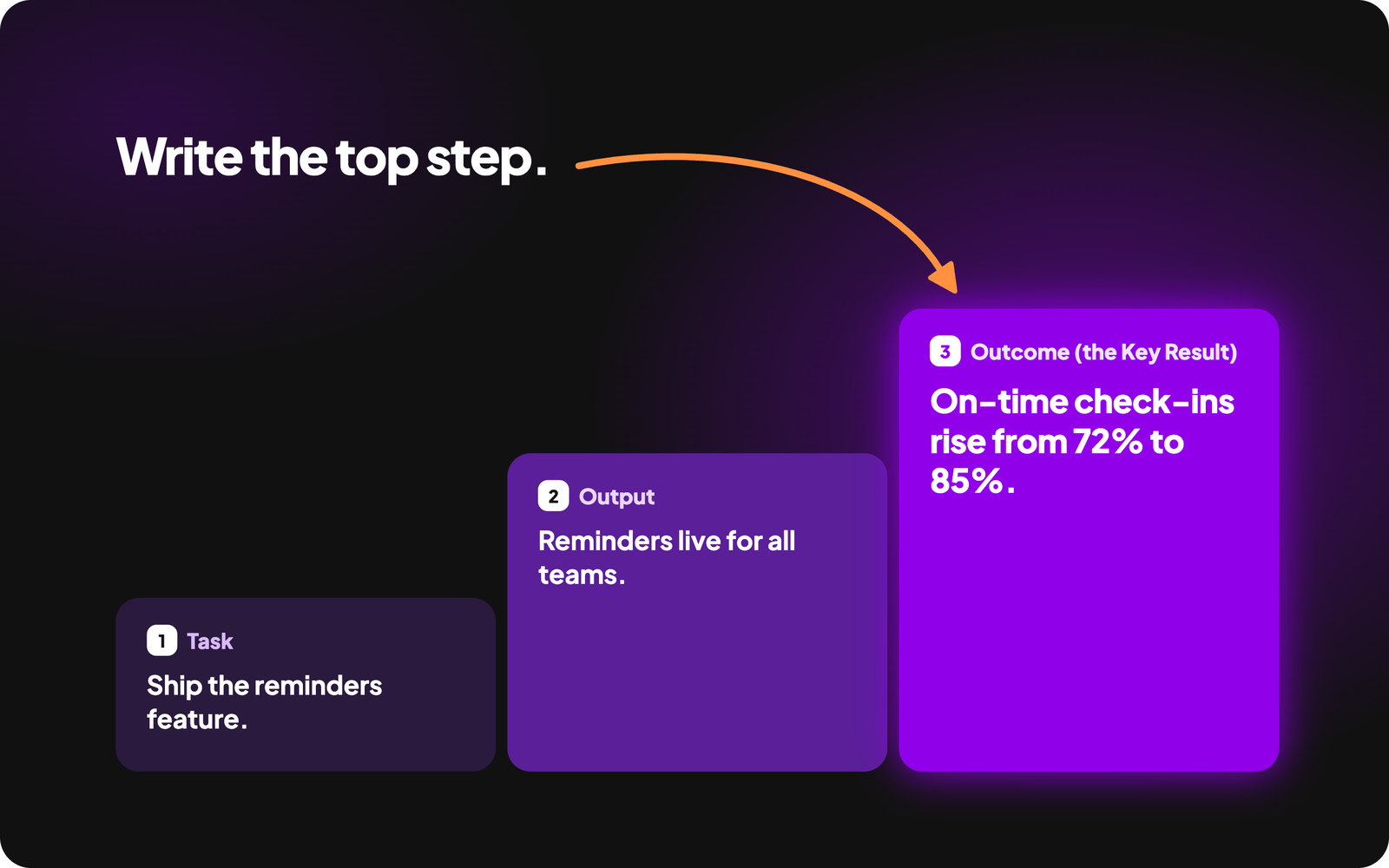
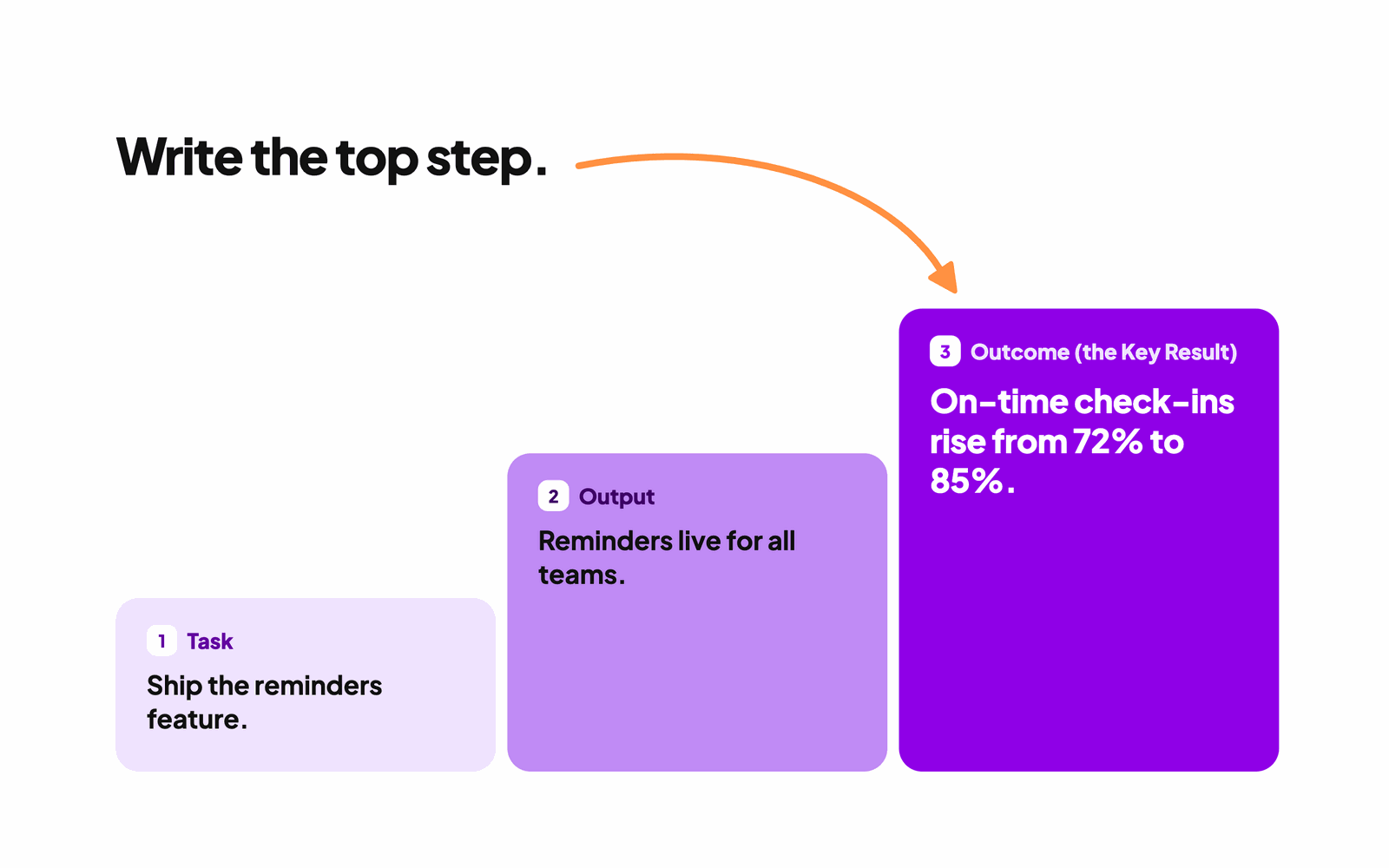
How many Key Results. Two to five per Objective. Three is the default. More dilutes focus.
Step 4: Assign Ownership
Every Key Result gets one named owner. Not a team. One person, accountable for moving the number, flagging risks, and bringing decisions to the check-in. They don’t have to do all the work. They own the result.
Cross-functional Objectives are an exception worth naming. When a Key Result genuinely requires multiple teams, write it as a shared Key Result with named co-owners. Two names max. More than that and the ownership evaporates.
Ownership also starts before the Key Result gets written. Teams that wrote their own key results care about hitting them in a way that teams handed key results from above don’t. The Department Head deep dive on writing OKRs your team will actually care about goes deeper on the co-authorship question.
One brand POV worth flagging here. Don’t tie OKR scores to performance reviews or compensation. When people know their score affects their comp, they sandbag. They set safe targets they’re sure they can hit. The data stops being honest, and the framework loses the very thing it’s supposed to produce. OKRs and performance management are different tools for different purposes.
Step 5: Run Weekly Check-Ins
OKRs are not a quarterly artifact. They’re a weekly operating cadence. The planning session sets the direction. The check-in is where execution actually happens.
A useful weekly check-in pairs three things on every Key Result.
- The metric. Where the number is now and how it moved this week.
- The confidence. A 0-to-1 confidence score in 0.1 increments from the owner on whether the target is still in reach.
- The decision. What changes this week based on the metric and the confidence read. A priority shift, an unblock, a tradeoff.
If the meeting ends without a decision, you ran a status meeting, not a check-in. Run a real one in the format we’ve outlined separately.
Step 6: Score, Learn, and Reset
At the end of the cycle, score each Key Result against where you landed. The OKR Leader scoring scale is 0 to 1 in 0.1 increments. A 1.0 means you fully hit the target. A 0.7 is the typical “stretch achieved” mark. Anything consistently above 0.9 across the team is a sign your targets weren’t ambitious enough. John Doerr makes the same point in Measure What Matters. The right stretch is uncomfortable to commit to and uncomfortable to land.
The score itself isn’t the deliverable. The deliverable is the lesson. After scoring, run a short retrospective with three questions.
- What worked, and is it repeatable?
- What didn’t move the way we expected, and what did we learn about why?
- What changes about how we write or run OKRs next cycle?
Carry the answers into the next planning session. That’s the loop that compounds across cycles.
Examples of Effective OKRs
Two examples that pass the tests above.
Company-level OKR
Objective. Build the most credible product story in our category by the end of the year.
Key Results.
- Lift unaided brand recall in target buyer surveys from 18% to 35% by Q4 close.
- Generate 4,000 inbound qualified leads from organic content by year end (up from 1,200).
- Reach a 65% close rate on competitive deals where we’re directly evaluated against the market leader (up from 38%).
Team-level OKR (Marketing)
Objective. Make organic search the dominant channel for top-of-funnel demand.
Key Results.
- Lift monthly organic sessions from 22,000 to 60,000 by Q3 close.
- Convert 5% of organic visitors to product sign-ups (up from 1.8%).
- Rank in the top three positions on Google for our six priority keywords by Q3 close.
Notice what’s not in either example. No “publish X pieces of content.” No “launch the campaign.” No “improve the website.” Those are activities. The Key Results measure what those activities are supposed to produce. For more to work from, the OKR examples library holds nine complete sets for each of eight departments, along with the metrics each team tracks.
Common Mistakes to Avoid
Five patterns that show up across OKR rollouts. Most teams hit at least three of them in their first cycle.
1. Vague Objectives
“Improve customer service.” “Be more innovative.” “Deliver excellence.” These read like values statements, not Objectives. They produce no shared understanding of what’s being attempted, so different team members end up working toward different versions of the same goal.
Fix. Replace abstractions with specifics. “Become the support experience our top 20 accounts reference when comparing platforms” tells everyone what’s being attempted. “Improve customer service” tells nobody anything.
2. Activity-Shaped Key Results
Key Results that measure what the team will do, not what the work will produce. “Publish 12 blog posts.” “Run six webinars.” “Hire three salespeople.” These are activities. The number gets hit. The outcome may or may not happen. The framework rewards motion, not progress.
Fix. Run every draft Key Result through the activity-vs-outcome test. If completing the activity wouldn’t necessarily produce the intended change, rewrite it.
3. Too Many OKRs
Three to five Objectives per team per cycle is the ceiling, not the floor. Most teams treat OKRs like a backlog and end up with eight to twelve. By week six, attention is so diluted that nothing meaningful is moving on any of them.
Fix. Cut hard. If everything is a priority, nothing is. Three focused Objectives executed well beats eight that get shrugged at in the post-quarter review.
4. Lack of Real Alignment
OKRs at the team level that don’t ladder into anything at the company level. Or company OKRs that no team’s work is actually advancing. Either pattern produces what looks like alignment on paper and isn’t alignment in practice.
Fix. Run a simple check after planning. For every team-level Objective, name the company-level Objective it supports. For every company-level Objective, name the teams advancing it. If something doesn’t connect, rewrite or cut.
5. Set Once, Forget Until the Postmortem
OKRs that get written, filed, and reviewed only at quarter end. The cycle becomes a planning exercise with a delayed feedback loop. By the time the postmortem surfaces what went wrong, the quarter is already over.
Fix. A weekly check-in is the unit of execution. Pair the metric with a confidence score and a decision. Adjust priorities mid-cycle when the data demands it. Treat the OKRs as living rather than fixed.
The Pre-Publish Checklist
Run this against any OKR before it ships in your next cycle.
- Is the Objective qualitative, specific, meaningful, and action-oriented? No embedded numbers. No activities.
- Could someone complete every action implied by the Key Results and still miss the outcome? If yes, rewrite the Key Results.
- Is every Key Result measurable, with a clear starting value and target?
- Is every Key Result time-bound to the cycle end date?
- Are the targets challenging but plausible?
- Does the set respect the two-to-five Key Results per Objective rule?
- Does each Key Result have one named owner?
- Does each Objective ladder into a strategic priority you can name?
If any answer is “no,” fix it before the cycle starts. The cost of fixing a weak OKR before publication is minutes. The cost of fixing it mid-cycle is a quarter.
You Don’t Need Perfect OKRs. You Need Honest Ones.
Most OKR rollouts don’t fail because the framework is too complex. They fail because the OKRs were written to look good in the planning deck rather than to function as a steering mechanism for the quarter.
Honest OKRs are uncomfortable to write. The Objective forces you to name what actually matters. The Key Results force you to commit to numbers you’re not yet sure how to hit. The check-in forces you to update those numbers in front of your team every week. That discomfort is the framework working. Research from Harvard Business Review on goal-setting consistently lands on the same finding. Specific, ambitious goals tied to clear commitments outperform soft, easily achievable ones across nearly every measured outcome.
Run your next cycle through the steps above. Strip out the vague Objectives. Rewrite the activity-shaped Key Results. Cap the count. Name the owners. The cycle will close differently.
Start for Free to write, score, and run check-ins on your next set of OKRs in OKR Leader.
FAQs: Writing Effective OKRs
What is the difference between an Objective and a Key Result?
An Objective is qualitative. It names what the team is trying to accomplish in a cycle. “Make the support experience the strongest in our category.” A Key Result is quantitative. It names a measurable outcome that will indicate the Objective was achieved. “Lift CSAT from 78% to 92% by Q3 close.” Objectives describe the destination. Key Results describe how you’ll know you arrived.
How many Key Results should I have per Objective?
Two to five. Three is the default for most teams. Fewer than two and the Objective probably isn’t measurable in a balanced way. More than five and the team starts losing focus on which Key Results actually matter.
How do I tell if a Key Result is outcome-focused or activity-shaped?
Run the activity-vs-outcome test. If your team could complete every action implied by the Key Result and the intended outcome still might not happen, the Key Result is activity-shaped. “Publish 12 blog posts” is activity-shaped because publishing the posts doesn’t guarantee the traffic, leads, or rankings the posts were supposed to produce. “Lift organic sessions from 22,000 to 60,000 monthly” measures the actual outcome the work was supposed to create.
Should OKRs be tied to performance reviews?
No. When OKR scores influence compensation, people set safe, easily achievable targets. Sandbagging replaces ambition. The framework loses the very thing it’s supposed to produce, which is honest visibility on stretch goals. Keep OKRs and performance reviews as separate processes with different inputs.
How often should we review OKRs?
Weekly. Bi-weekly at the absolute minimum for slower-moving cycles. A monthly cadence is too long for most teams. Twelve weeks of silence followed by a quarterly retrospective is the most common pattern in failed rollouts. A 15-minute weekly check-in catches drift while there’s still time to do something about it.
What’s a stretch goal in OKR terms?
A target that requires the team to figure out something they don’t yet know how to do. The expected score on a true stretch Key Result is around 0.7, not 1.0. If your team consistently scores above 0.9 across the cycle, the targets weren’t ambitious enough. If the team scores below 0.4 consistently, the targets weren’t grounded. The right stretch sits in between.
Can OKRs be revised mid-cycle?
Yes, with discipline. Mid-cycle revisions are appropriate when the assumptions underlying the OKR have changed, not when the team is uncomfortable with their progress. A market shift, a strategic pivot, or a critical learning are valid reasons to rewrite. Falling behind on a target you committed to is not.
TL;DR
Effective OKRs share a structure. A qualitative, specific, action-oriented Objective. Two to five Key Results that are measurable, outcome-focused, time-bound, and challenging but plausible. One named owner per Key Result. Strategic priority anchor at the top. Weekly check-ins where each Key Result gets a metric, a 0-to-1 confidence score, and a decision. End-of-cycle scoring on a 0-to-1 scale, paired with a short retrospective. Most weak OKRs trace back to one of five patterns: vague Objectives, activity-shaped Key Results, too many of them, no real alignment, and set-and-forget execution. Run any draft through the eight-question pre-publish checklist before the cycle starts. The cycle closes differently when the OKRs were written to function rather than to look good.