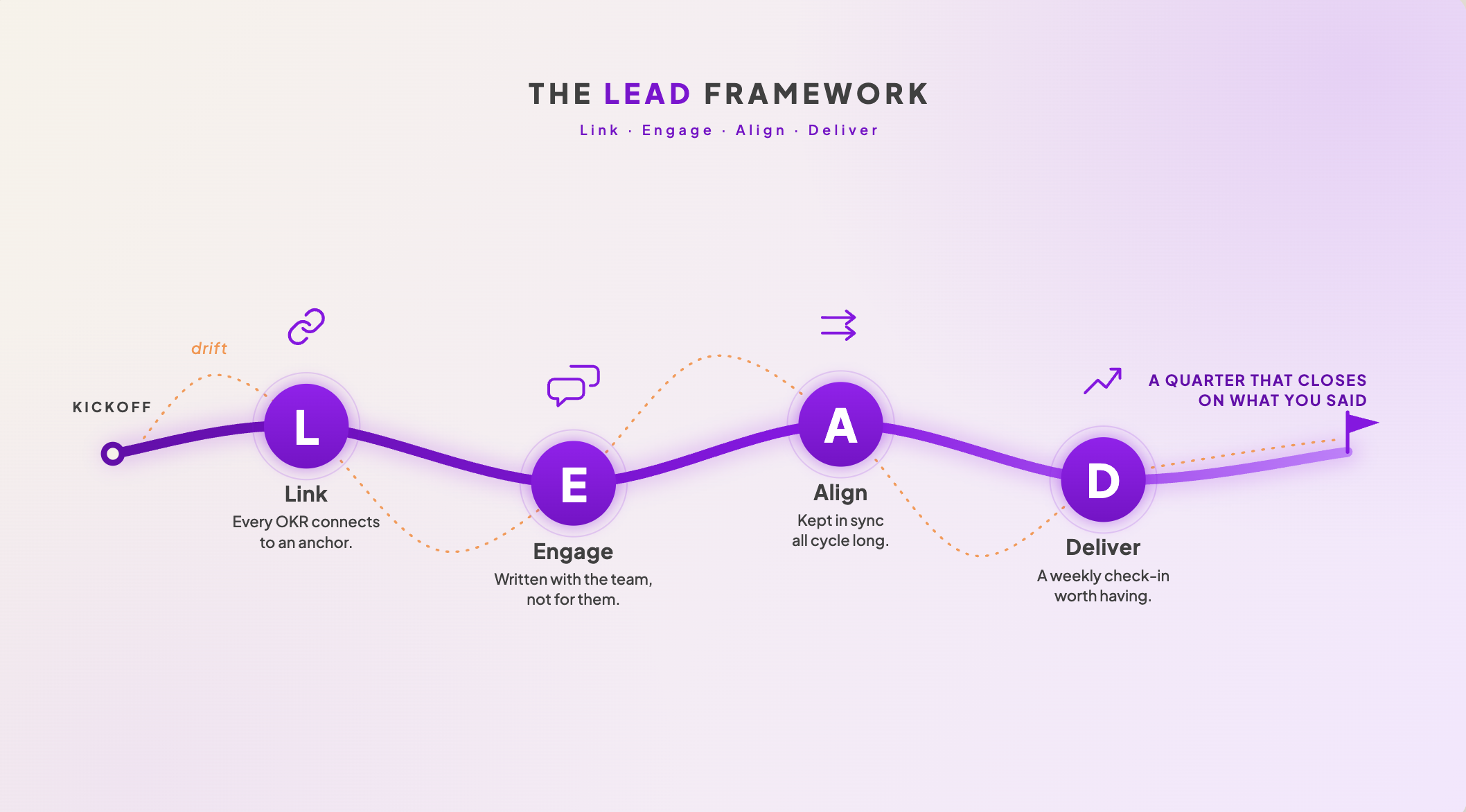
TL;DR. The LEAD framework is a four-pillar system for running OKRs that actually close the quarter: Link (every OKR connects to a real anchor), Engage (write OKRs with the team, not for them), Align (keep dependent teams in sync all cycle), and Deliver (run a weekly check-in worth having and score honestly). The drift usually shows up in the middle of the quarter, well after planning, and the four pillars are where you catch it before it costs you the quarter.
I have watched a lot of teams set three sharp priorities in January and lose one of them by March. It was rarely because anyone slacked off. A customer fire pulled focus. A key hire left. The quarter they planned in February stopped looking like the one they were living in March. That gap, between the goals on the slide and the work actually happening, is where most OKR programs come undone. The LEAD framework exists to close it.
When I read the OKRs Field Book by Ben Lamorte for the first time I learned a lot about how to set up a successful OKR rollout. And since then, I’ve had the opportunity to really refine my own approach while still incorporating many of the timeless principles discussed in Ben’s book.
What is the LEAD framework?
The LEAD framework is a four-pillar method for running OKRs – Link, Engage, Align, and Deliver. Each pillar names a specific point where OKR programs tend to slip, and a specific practice that keeps them on track. Link and Engage are about setting OKRs that are worth running. Align and Deliver are about keeping them alive once the cycle is underway. You can have brilliant OKRs and still lose the quarter if you only get the first half right.
Here is each pillar, what it asks of you, and the trap that catches teams who skip it.
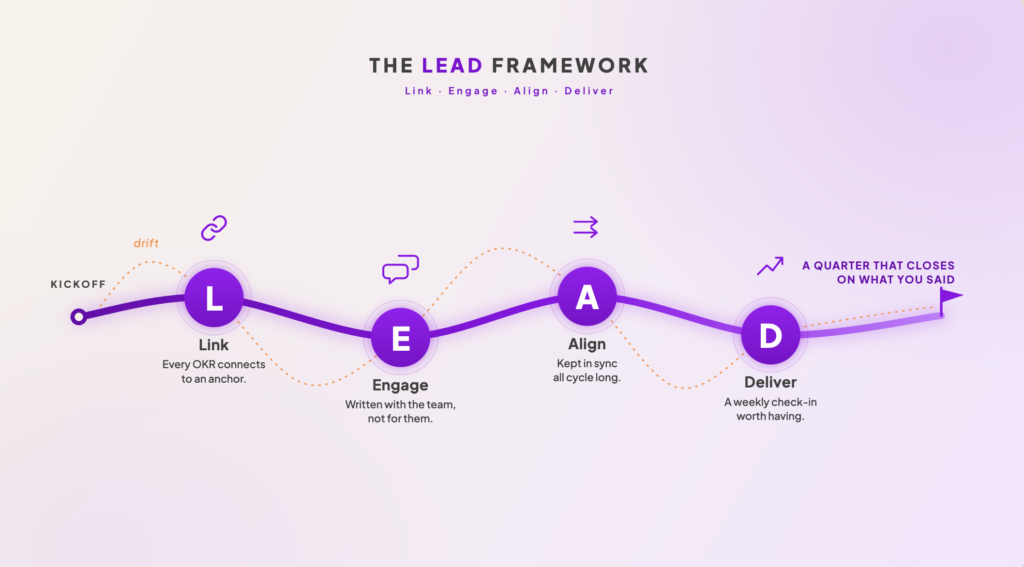
L: Link – if it does not connect to an anchor, it is not an OKR
Every OKR has to connect to at least one of six anchors. An OKR that links to nothing meaningful is well-formatted homework. Someone on the team should be able to name the anchor it links to, and why it matters right now.
The six anchors are:
- A strategic priority – something in the medium to long-range plan
- Another team’s objective – work you are enabling for someone else
- A team strength – an advantage worth pressing
- An external opportunity – a market opening worth chasing
- A team weakness – a gap worth closing
- An external threat – a risk worth defending against
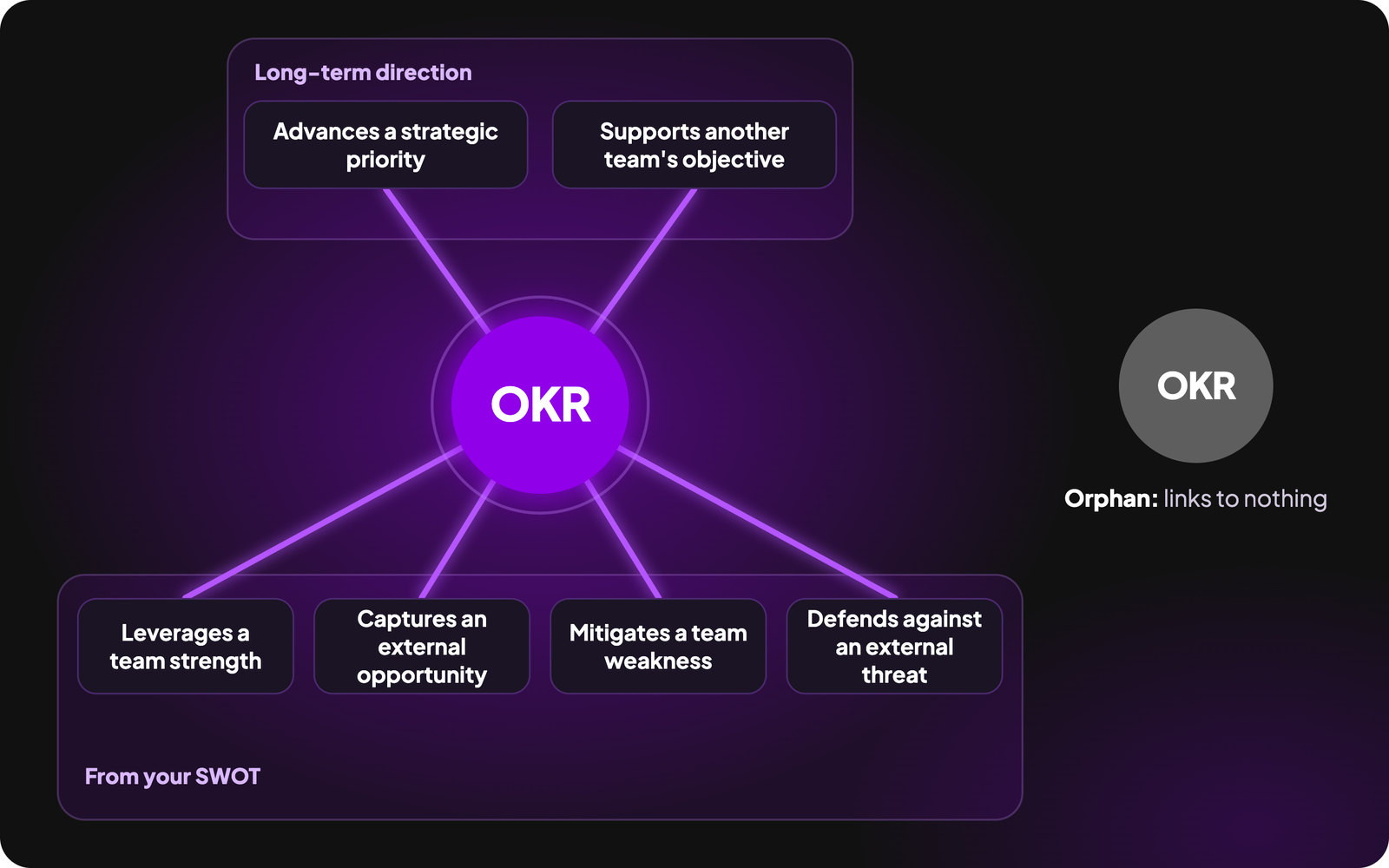
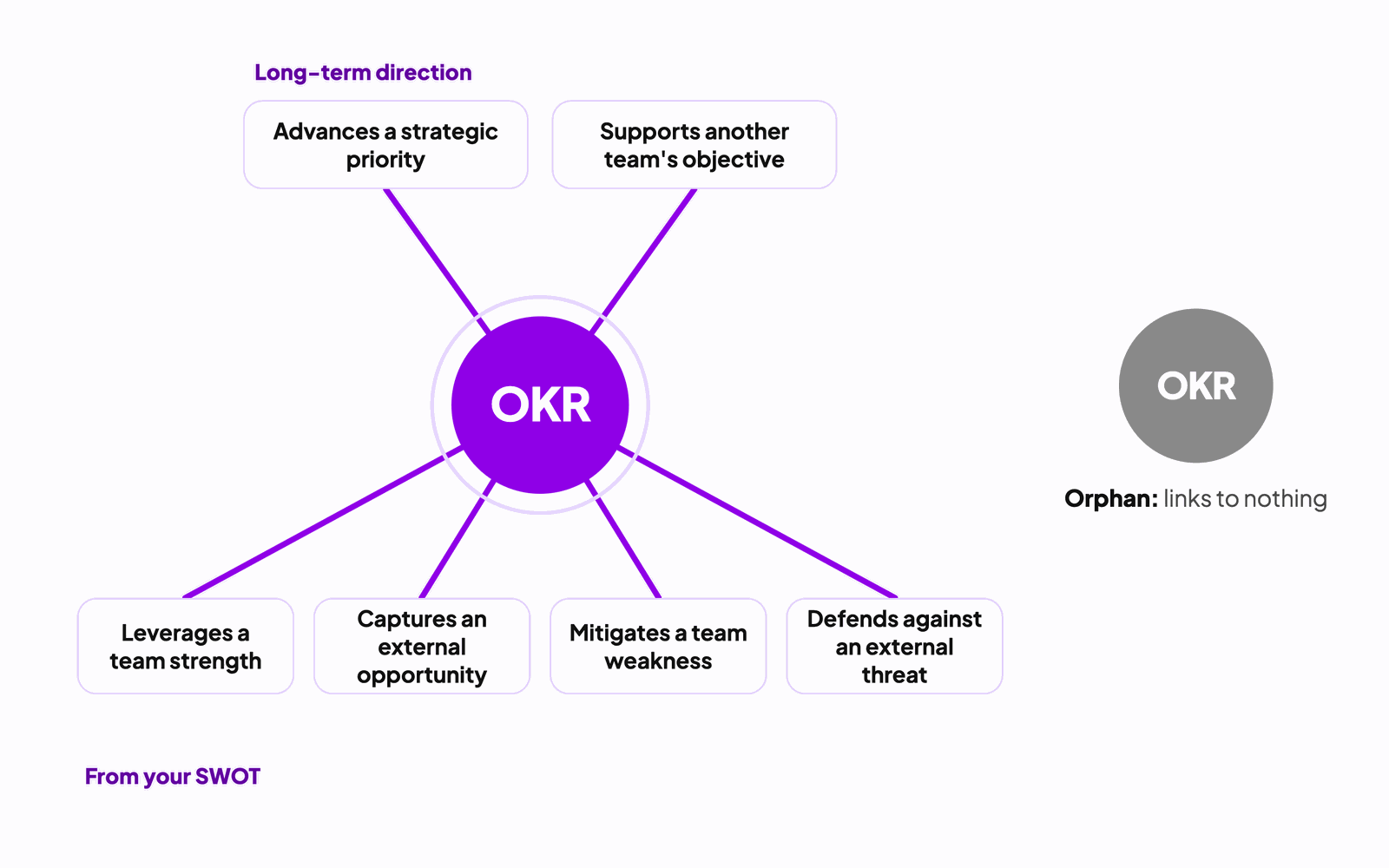
The first two are your long-horizon strategy. The other four come from a quick company or team SWOT, which is the agile layer that keeps you responsive in the stretch between full strategic-plan refreshes.
The practical move: before you approve an Objective, name the anchor it links to and say why now. If you cannot name one, it is not an Objective worth pursuing. Cut it or fix it. This takes one conversation and it is binary – the objective is either linked, or an orphan. The company OKR examples page runs this check across a whole sample business and names the anchor behind every team’s OKR.
The trap: laddering by decree. Handing objectives down from the top and calling it alignment. Teams write their own OKRs that link to a real anchor, and the “why now” comes from the people doing the work, not from a slide.
When a vital sign hits code red
There is one case worth calling out here, because it is where Link gets tested under pressure. A health metric is a vital sign you protect every cycle – cash position, churn, fulfillment time, uptime, defect rate. You are not trying to transform it this quarter. You are making sure it does not slip while you chase the things you are trying to transform.
When a health metric starts slipping, it becomes a candidate for an OKR, because a slipping vital sign is really a weakness surfacing in the data. That is anchor 5. The response scales with how bad it is:
- Yellow, slowly slipping: spin up an OKR to reverse the trend before it becomes a crisis. It sits alongside your strategy-driven OKRs rather than replacing them. Acting early, while the fix is still cheap, is usually the smarter moment.
- Red, code red: the anchor-5 OKR now takes precedence over everything else, including your strategy OKRs. A vital sign in crisis is a more urgent claim on the team’s attention than any stretch goal. You stabilize the core first, sometimes by promoting the fix into the single OKR that matters this cycle, sometimes by pausing OKRs for a cycle entirely. You do not put on blinders and chase moonshots while the business’s vital signs are flatlining.
This is the override that keeps the LEAD framework honest. Strategy leads, until the foundation is at risk – then the foundation wins.
E: Engage – write OKRs with the team, not for them
OKRs handed down do not survive contact with Tuesday morning. The people who own the OKR have to help write it. That is not a nicety. It is where the context lives – the team knows what is actually possible and what is actually broken, and that knowledge has to be in the room when the OKR gets set.
The practical move: in planning, teams propose the Key Results. Leadership pressure-tests them but does not dictate them. Disagreement in the room is a good sign. A team that cannot push back on an OKR will ignore it by week three.
The trap: tying OKR scores to performance reviews or compensation. It drives sandbagging, not ambition. OKRs and performance management are different tools, and bolting them together undermines both. If hitting your number depends on setting a soft one, people will set soft ones.
A: Align – alignment is a verb, not a one-time approval
Where Link is the connection made at setup, Align is keeping that connection alive. Alignment is not cascading and it is not a sign-off at planning. It is the ongoing work of keeping teams that depend on each other in sync through the whole cycle: surfacing where dependencies collide, keeping cross-team work visible, and holding a cadence that keeps the org coherent as things shift.
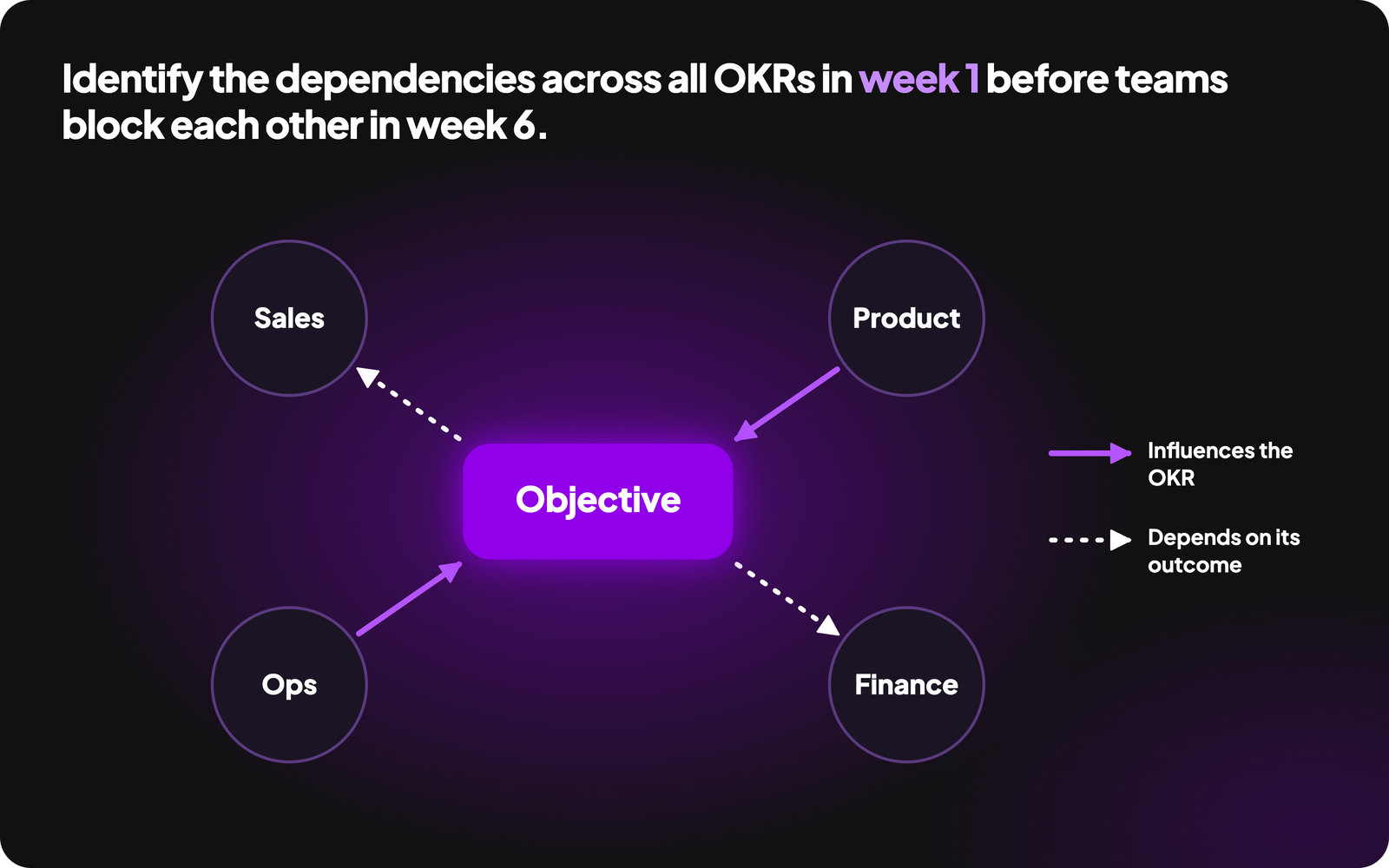
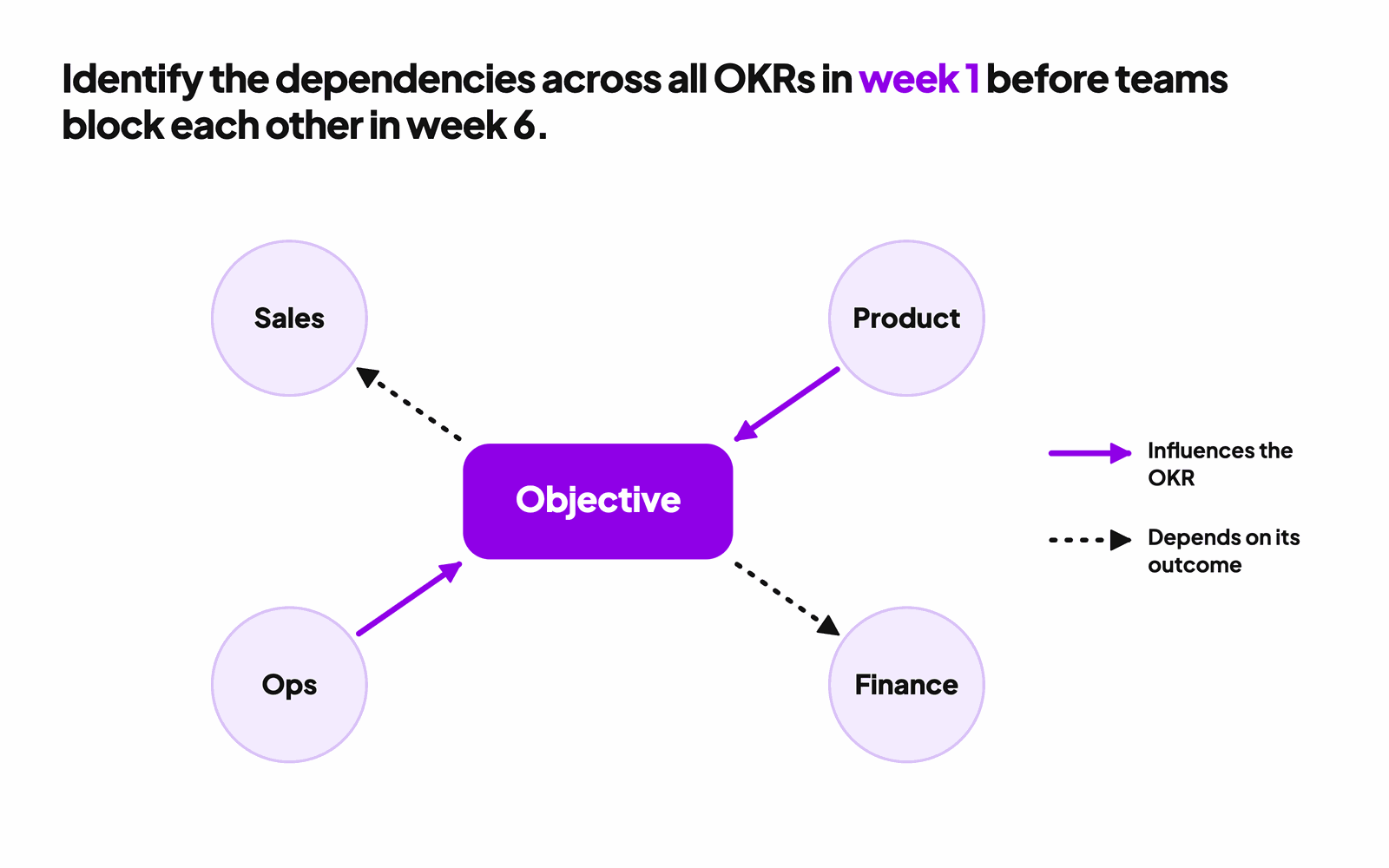
The practical move: every team’s OKRs are visible without anyone having to ask permission to see them. When strategy shifts mid-cycle, you adjust the affected OKRs out in the open. You do not pretend the originals still apply.
The trap: treating alignment as a one-time event. If the leadership team cannot name every team’s top objective without checking a document, the org is not aligned. It is decorated.
D: Deliver – Wednesday is where the quarter is decided
This is where OKR programs live or die. Plenty of teams set good OKRs. Far fewer run a weekly check-in that actually changes what happens next. Deliver is the bridge between strategy and execution: a check-in worth having, an honest score at the end, and action plans that move the dial in between.
The heart of the check-in is one question asked of every Key Result: “From what, to what?” Not “what did you do this week,” but what number moved, and from where to where. “Activation went from 34% to 38%,” not “we launched the new flow.” If a Key Result is at risk, the conversation turns to what changes this week to get it back on track.
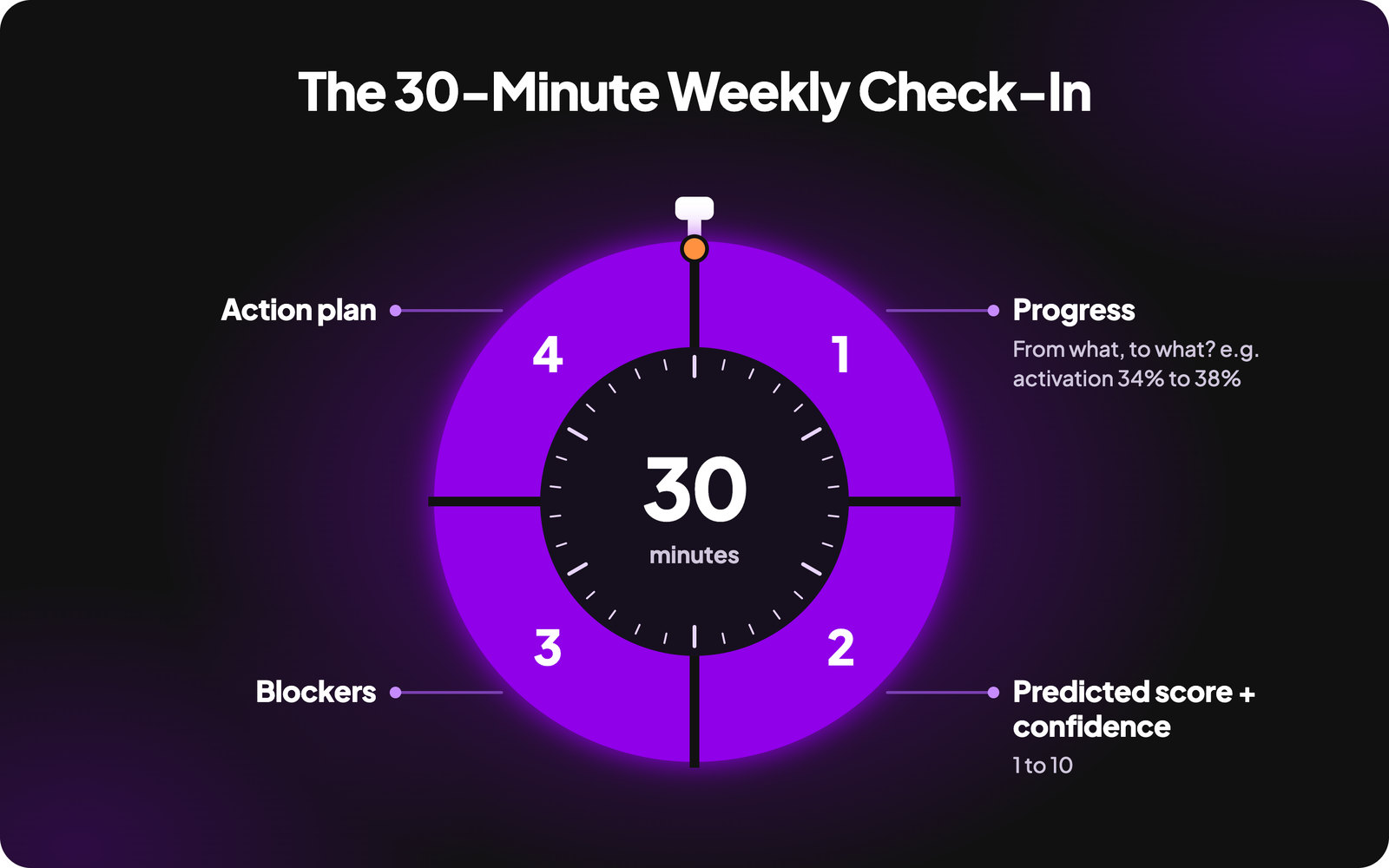
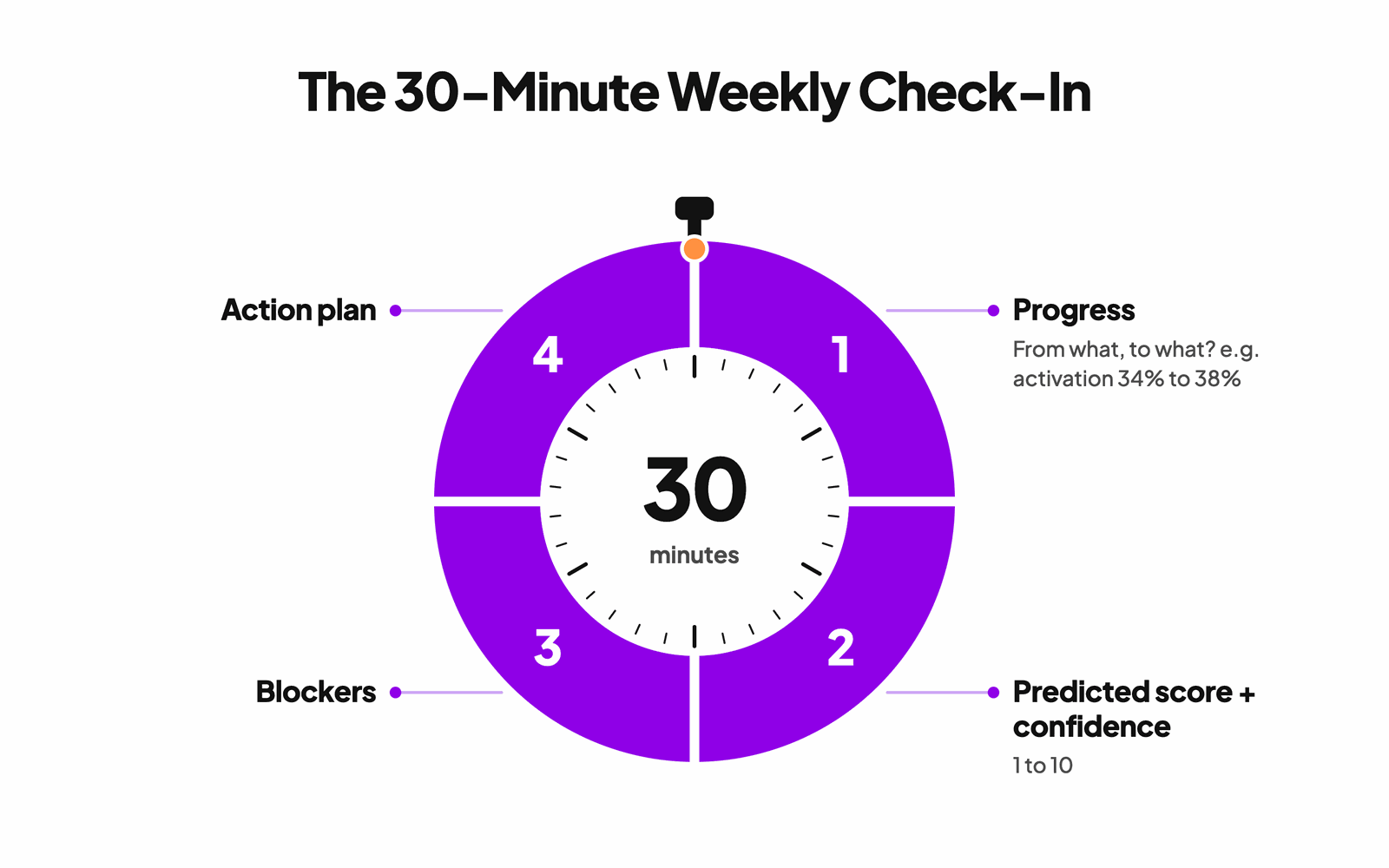
The practical move: hold the check-in weekly, keep it tight, and make every Key Result report its movement. End the cycle with an honest score. A sandbagged score gets named, not rewarded.
The trap: status-update theater. If the check-in does not change what the team does this week, it is not a check-in. It is a meeting with extra steps.
How to use the LEAD framework
You do not have to overhaul everything at once. The fastest way in:
- Find your weakest pillar. Most teams are stronger at setting OKRs (Link, Engage) than at sustaining them (Align, Deliver), but yours might be different. Be honest about where it slips.
- Fix one thing in that pillar before next week’s check-in. Pick the principle, the move, and the trap for your weakest pillar and change one behaviour.
- Re-check in a cycle. Drift is not a one-time fix. It is something you catch on a cadence.
If you want a structured read on which pillar is letting you down, the LEAD Toolkit is built for exactly that.
Find your weakest pillar
The LEAD Toolkit is built to help you work through all four pillars and see where your program is slipping. It is the fastest way to turn this post into something you can act on before next week’s check-in.
If you want a sharper read with a coach in the room, the OKR Alignment Audit takes the same lens to your team’s actual OKRs and shows you where the links are weak and where alignment is decorated rather than real.
Frequently asked questions
What does LEAD stand for?
Link, Engage, Align, Deliver. The four pillars of the LEAD framework, in the order you tend to need them across a cycle.
How is the LEAD framework different from how most teams run OKRs?
Most teams put their energy into writing OKRs at planning and then move on. The LEAD framework treats setting OKRs as only half the job. Align and Deliver are about the middle of the quarter, which is where programs actually drift.
What are the six anchors?
A strategic priority, another team’s objective, a team strength, an external opportunity, a team weakness, and an external threat. Every OKR must link to at least one of them. The first two come from your long-range strategy; the other four come from a team SWOT.
Does the LEAD framework replace KPIs?
No. KPIs are ongoing health metrics you protect; OKRs are focused changes you drive. The two work together. (More on that in our piece on the difference between KPIs and OKRs.)
Where do I start with the LEAD framework?
Find your weakest pillar with the LEAD Toolkit, then fix one behaviour in that pillar before your next weekly check-in.
The LEAD framework is not a heavier process. It is four checkpoints that catch the drift most teams only notice once the quarter is already gone. Start with the pillar that is letting you down, and change one thing this week.
Want to see what running LEAD looks like inside a tool built for it? Take a look at OKR Leader.