The LEAD Series | Episode 3 of 4: Align
One article for each pillar of the LEAD framework: Link, Engage, Align and Deliver.
TL;DR: OKR alignment is the practice of keeping teams whose goals depend on each other in sync for the whole cycle. Planning connects the goals once. The connections start drifting the first week a customer fire, a resignation or a strategy change hits one team and the other team hears about it late. Make every team’s OKRs visible, put one dependency question into the weekly check-in, and adjust affected OKRs in the open when the strategy moves.
Picture week seven of a quarter. Marketing’s key result depends on Product shipping a new onboarding step. Product moved that work down the list in week two, for a sensible reason, after a large customer escalation pulled two engineers onto a fix. Marketing learns about the change when their number stalls and somebody asks why.
Nobody hid anything. Both teams had good OKRs linked to a real priority, and each leader was doing the job they were hired to do. The dependency was written down in January and nobody looked at it again until it broke.
That is the gap the Align pillar of the LEAD framework exists to close. The cornerstone post walks through all four pillars. This post goes deep on Align, the one I see leadership teams skip most, because it only shows up after the planning offsite is over.
What is OKR alignment? OKR alignment is the ongoing work of keeping teams that depend on each other synchronized through the whole cycle. It covers surfacing where dependencies collide, keeping cross-team work visible to everyone, and adjusting OKRs openly when strategy shifts. The practice runs every week, for as long as the quarter runs.
OKR alignment starts after the planning offsite
Search for OKR alignment and you will find plenty of advice about cascading goals from the top down, or laddering each team objective to a company one. That work matters, and in LEAD it has its own pillar. We call it Link.
Link and Align are easy to blur, so here is how the two split:
| Link | Align | |
|---|---|---|
| The question | Does this OKR connect to something that matters? | Are the teams that depend on each other still in sync? |
| When it happens | Once, at setup | Every week of the cycle |
| What it produces | A named anchor for each OKR (or an Orphan to cut) | Collisions surfaced early, and adjustments made in the open |
| Grammar | A noun. The connection exists or it doesn’t. | A verb. Somebody has to keep doing it. |
| Example | “Our onboarding OKR supports Marketing’s activation objective.” | “Product and Marketing checked that dependency on Wednesday and it moved to week nine.” |
One of Link’s six anchors is “supports another team’s objective.” That anchor records the relationship at setup. OKR alignment is the habit of keeping that relationship current once the quarter starts pushing on it.
A dependency written into a planning deck in January is a snapshot. By March the snapshot is out of date, and the teams are still working from it.
A dependency written into a planning deck in January is a snapshot.
Why do cross-team dependencies break mid-quarter?
They break because every team is doing the reasonable thing for its own scorecard.
Research by Donald Sull, Rebecca Homkes and Charles Sull in Harvard Business Review found that only 9% of managers said they could rely on colleagues in other functions and units all the time, and about half said they could rely on them most of the time. The same study found alignment up and down the hierarchy held up better than coordination across it.
I don’t read that as a character problem. A VP of Sales is measured on sales, and the head of Engineering answers for what Engineering ships this quarter. When a customer fire lands, the leader who drops a cross-team commitment to deal with it is making a defensible choice, and the cost shows up on another team’s dashboard three weeks later.
When teams bring me in, this is one of the patterns I recognize fastest. The OKRs were written well and the anchors were real. What went missing was an owner for the gap between two teams’ goals once the quarter got busy, so each re-prioritization was made alone and discovered late.
Three conditions make it worse:
- The dependency lives in one person’s head. When the one director who remembers it goes on vacation, the connection goes with them.
- OKRs are visible only on request. If Marketing has to ask Product for access to their OKRs, Marketing will ask roughly once a quarter.
- Changes happen in private. A team adjusts a key result after a strategy shift and tells its own people. The teams downstream find out from the numbers.
What OKR alignment looks like week to week
OKR alignment runs on a few small, repeatable habits. None of them need a new meeting.
- Make every team’s OKRs visible without anyone asking. Put them in one place every team can open on any day. Visibility by default removes the social cost of checking on someone else’s work.
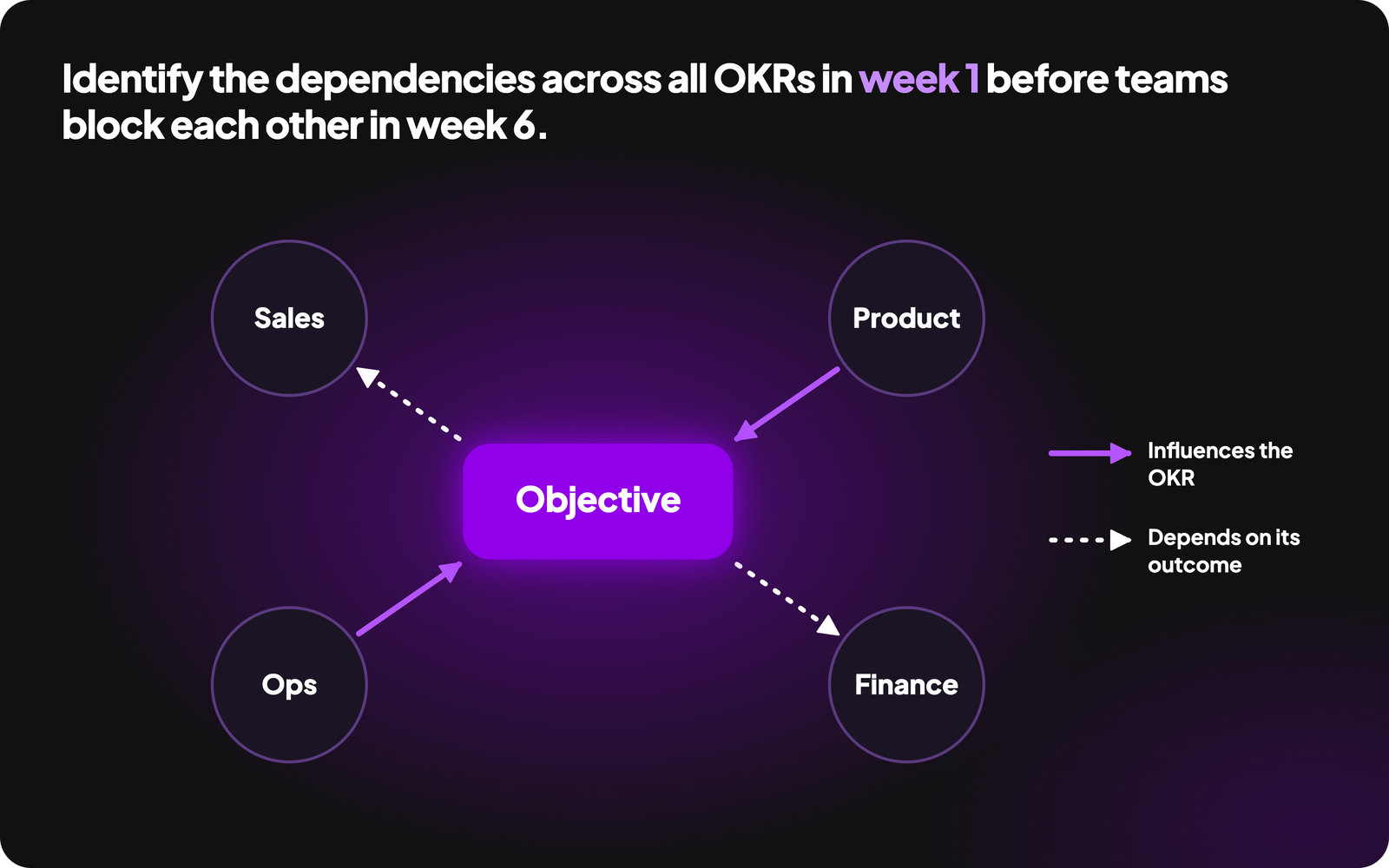
- Name each dependency with an owner on both sides. At setup, when an OKR supports another team’s objective, write down who on each team watches that connection. Two names turn “we should coordinate” into a commitment two specific people carry. Our sample business profile shows four named dependencies like this across a made-up company of about 80 people.
- Add one dependency question to the weekly check-in. Each team answers it in under a minute. If nothing changed, the answer takes five seconds.
- Take collisions to the leadership meeting that same week. A collision raised on Wednesday and decided by Friday costs a few days. The same collision discovered in week eleven costs the quarter.
- Adjust in the open when the strategy moves. Change the affected OKRs, say what changed and why, and tell the teams downstream before they find out from their dashboards.
The check-in question needs concrete wording or it drifts into a status update. A few versions that work:
- “Did anything change this week that another team is counting on?”
- “Is there a team we’re waiting on, and do they know we’re waiting?”
- “Did we drop or delay anything this week that shows up in someone else’s key result?”
Pick one and keep it the same every week. Repetition is what makes the answer fast, and a fast answer gets given honestly.
The OKR check-in template has a structure you can bolt this question onto if your team already runs a weekly check-in.
Early signs your OKR alignment is slipping
Drift between teams gives off signals weeks before a number stalls. These are the ones I listen for when a leadership team walks me through their quarter:
- A team explains a missed key result by pointing at another team, and the other team is hearing about it for the first time.
- Two teams report green on OKRs that depend on each other, while the shared customer outcome sits flat.
- Somebody says “I assumed they were still doing that” in a leadership meeting.
- A strategy change announced at an all-hands never shows up as an edited OKR anywhere.
- The only cross-team conversations about OKRs happen at quarterly planning and at the retro.
Any one of these is worth a question at the next check-in. Two or more in the same month tells me the dependencies were written down once and left alone.
None of them point to a bad team. They point to a system that relies on people remembering to tell each other things during the busiest weeks of the quarter. People are good at a lot of things, and remembering to send the update while a customer is escalating is not one of them.
When the strategy shifts mid-cycle
Strategy moves during a quarter. A competitor launches something close to your roadmap, or a large customer churns, or a board meeting reorders the priorities. The healthy response is to change the OKRs the shift affects. Keeping the original OKRs on the wall while everyone privately works on something else is the risky one.
Leaders keep stale OKRs up for understandable reasons. Rewriting goals mid-quarter can feel like admitting the plan was wrong, and nobody wants to reopen a negotiation that took three weeks in January. I get it.
The trouble is that stale OKRs cost you alignment twice. Teams stop trusting the OKRs as a picture of what matters. Dependencies built on the old OKRs also keep being honoured by one team after the other team has moved on.
A strategy shift handled in the open looks like this:
- The leadership team names what changed, in a sentence or two.
- Each affected team rewrites or retires its affected OKRs within the week.
- Every team with a dependency on a changed OKR gets told directly, by name.
- The next check-in confirms the new picture across teams.
That is a week of work, and it saves the cycle.
A leadership test for OKR alignment
Here is a test I use with leadership teams, and it takes about ten minutes.
Without opening a document, can each person in the room name every team’s top objective for the quarter?
An MIT Sloan Management Review study by Donald Sull, Charles Sull and James Yoder found that only 28% of executives and middle managers responsible for executing strategy could list three of their company’s strategic priorities. If the priorities themselves are hard to recall, the objectives of the team two floors down are harder still.
Then ask two follow-up questions:
- Which of those objectives depend on each other?
- When did the leaders of those teams last talk about that dependency?
Quick answers mean alignment is being practised. If the room goes looking for a spreadsheet, the org has decorated the planning deck and left the connections to chance.
The LEAD Self-Assessment inside the LEAD Toolkit scores your Align practice alongside the other three pillars, so you can see whether Align is the pillar costing you this quarter.
I want to be honest about one thing. Weekly dependency checks are one habit inside a much bigger discipline. OKR alignment also depends on leaders who make time for cross-team decisions, on a culture where raising a collision early is safe, and on OKRs that were linked to real anchors in the first place. A single question in the check-in will not carry a program by itself. It does make the gaps visible while there is still time to act on them.
Frequently asked questions
What is the difference between OKR alignment and cascading OKRs?
Cascading OKRs is a way of creating goals, where company objectives get broken down into team objectives at setup. OKR alignment is the ongoing practice of keeping teams that depend on each other in sync after setup. In the LEAD framework, connecting each OKR to something that matters belongs to the Link pillar, and keeping those connections current all quarter belongs to Align.
How often should teams review cross-team dependencies?
Review them every week, as part of the regular check-in. One question about what changed for other teams takes under a minute per team and catches collisions while they are still cheap to fix. A quarterly review of dependencies finds the same problems after the cycle has already absorbed the cost.
Who owns OKR alignment in an organization?
Each dependency needs a named person on both teams who watches it. Beyond that, the leadership team owns the decisions when two teams’ goals collide, because those decisions trade one function’s result against another’s. A chief of staff or a COO can help, but OKR alignment breaks down when it lives in one person’s calendar.
What should you do when two teams’ OKRs conflict?
Raise it at the next leadership meeting, in the same week you find it. Name the two OKRs, what each team would need to give up, and what the company priority says. Then decide, record the decision, and adjust the affected OKRs so both teams are working from the same picture.
LEAD Toolkit: Free Download
The LEAD Toolkit includes the full LEAD framework and the twenty-question LEAD Self-Assessment. It shows which of the four pillars (Link, Engage, Align, Deliver) is costing your OKR cycle the most, so you know where to start.
If you want one thing to try before next Wednesday, add the dependency question to your check-in and see which team answers it first.