
Your portfolio review is on Thursday, and the operating team is still reconciling the board deck with Tuesday’s progress updates. OKR software for private equity portfolio companies gives company leaders a shared place to manage strategic goals, review progress, and surface decisions that need sponsor support.
- OKR Leader suits operating teams seeking cycle management, dashboards, and integrations for strategic execution.
- Choose OKR software for private equity portfolio companies around weekly decisions and company ownership.
- Keep cash, churn, and quality visible alongside the value creation plan’s strategic bets.
- Pilot the operating cadence before extending portfolio reporting across companies.
For your 2026 evaluation, OKR Leader is an option for managing goal cycles, dashboards, and integrations. Start by agreeing how company leaders and operating partners will use those capabilities during an ordinary working week.
Why OKR software matters for private equity portfolio companies
A portfolio company’s management team has to connect its value creation plan with work that people can execute. The sponsor needs enough visibility to identify risks and provide support; department heads need priorities they can act on within their available capacity.
Those needs meet in the weekly review. Picture an illustrative Tuesday meeting: finance has updated the margin forecast, sales has changed its hiring assumptions, and operations is still working from the plan approved at the offsite. Everyone has a reasonable account of progress, yet the dependency between those accounts needs an owner.
Software provides a place to connect the goal, its evidence, the dependency, and the next action. Leadership still has to protect time for the work and respond when the team raises a problem.
OKR Leader is best for operating teams seeking OKR software with cycle management, dashboards, and integrations. Its fit for a portfolio-wide deployment depends on your access, reporting, and data requirements, which belong in the evaluation.
Treat the first cycle as a working draft. Expect objectives that need tightening, measures that need rework, and an unsettled cadence; the discipline develops over several quarters.
Build the operating model before choosing the reporting view
These six steps give a strategy or operations leader a practical sequence for evaluating software in 2026. Each step starts with work you can do in a document or spreadsheet, then identifies what to test in a platform.
Separate vital signs from strategic bets
Start with a shared document containing two sections: health metrics and strategic bets. Cash, churn, uptime, fulfillment, and quality belong among the vital signs you monitor and defend; the value creation plan supplies the changes you want to achieve during the cycle.
For example, a proposed bet might involve improving the economics of a customer segment. Finance and the commercial team would agree on the measure and its calculation before converting that proposal into a Key Result.
This separation gives the operating partner a useful question: does the company have the capacity to pursue the bet while protecting its health? A health metric in the red can justify pausing an OKR.
- Record each health metric’s owner and escalation threshold.
- Describe each strategic bet in language the management team uses.
- Identify the evidence needed to judge progress on each bet.
- Agree who can pause a bet when a health metric deteriorates.
Assign ownership at company and sponsor level
Use a spreadsheet to map each proposed objective to a company owner, a sponsor counterpart where needed, and any dependent team. Agree who updates progress and who resolves a blocked decision before selecting the software.
The CEO remains accountable for the company’s plan. An operating partner’s involvement needs a stated purpose, such as helping resolve a resource constraint or connecting expertise across the portfolio. That purpose should be visible to the company team.
At this stage, OKR Leader’s cycle management and dashboards become relevant to the evaluation. Test whether the working structure you have agreed can be represented in the software; verify your required access arrangements separately.
- Name one accountable company owner for each objective.
- State the sponsor counterpart’s responsibility for each shared dependency.
- Record which teams contribute evidence to each Key Result.
- Define who approves a material change to the cycle.
- Test the access each participant requires using a realistic evaluation scenario.
Narrow the cycle to work the team can resource
Draft the objectives in a document and ask each department head what work they would defer to make room. Three focused objectives are a useful ceiling for this exercise; six objectives deserve a hard capacity review.
A leadership team can approve an ambitious plan while leaving every existing commitment in place. Good intentions then collide with a full calendar, and the OKR owner becomes responsible for chasing updates across work nobody has time to advance.
For the 2026 cycle, record the resources beside each proposed objective. Software can organize the approved work, while the leadership team supplies protected time, people, and budget.
- Tie every proposed objective to a named strategic priority.
- State which existing work will be deferred or reduced.
- Confirm the people required to advance the objective.
- Include profit-aware measures where profitable growth is the aim.
- Reject sample OKRs until they have been checked against the company’s strategy and strengths.
Run a check-in that ends with an owned action
Begin with a recurring agenda in a shared document. Ask the owner to bring current evidence, describe the obstacle, and identify the decision or support required. Close each discussion by recording who will do what next.
There is a familiar uncomfortable moment when someone says a goal is on track, then explains that the underlying data has not arrived. Give that uncertainty a place in the record. Leadership needs the evidence gap visible so someone can resolve it.
OKR Leader provides dashboards and integrations. During evaluation, test the actual data sources you use and the path from a progress update to the next review; confirm integration coverage before committing to a workflow.
- Ask owners to update evidence before the meeting.
- Record the date and source of each progress measure.
- Give unresolved data gaps an owner.
- Assign an action when a dependency needs intervention.
- Revisit the previous meeting’s open actions before closing.
Design a sponsor view around decisions
Create a sample sponsor report manually before asking a vendor to demonstrate a dashboard. Include the strategic objective, current evidence, owner, obstacle, and assistance requested. A reader should understand what requires attention without contacting the person who assembled the slides.
For your 2026 software shortlist, test this report using a representative company scenario. Keep confidentiality and comparability separate: a consistent reporting structure still needs access rules suited to each company.
The following diagram summarizes the reporting elements to agree before the demonstration. Each element needs a shared definition so the company and sponsor read the same account of progress.
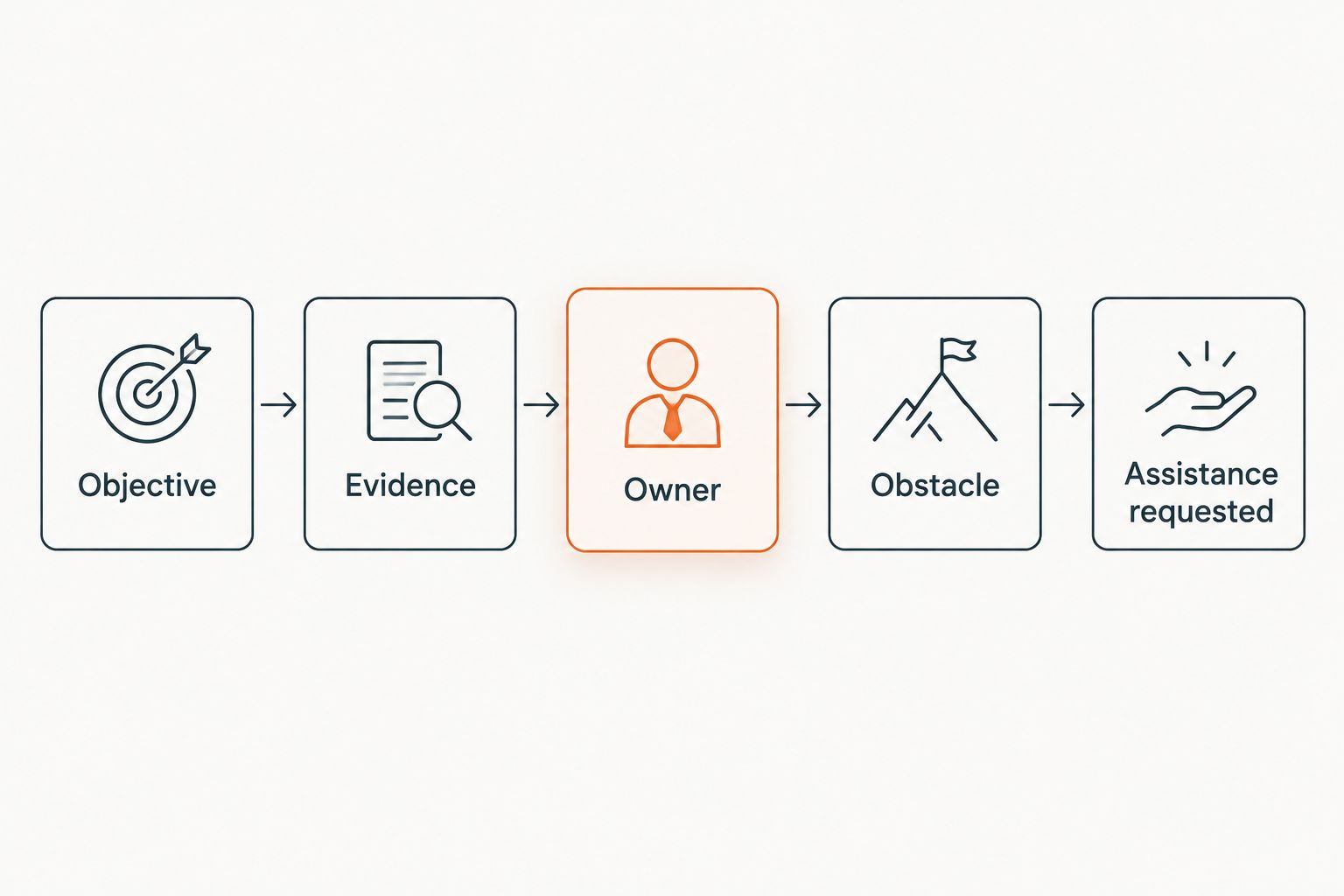
- Define the objective that each report covers.
- Agree how current evidence will be displayed.
- Keep the accountable company owner visible.
- Describe the obstacle in operational terms.
- State the assistance requested from the sponsor.
- Verify how confidential company information is restricted.
Pilot adoption before expanding across the portfolio
Run the agreed cadence with a bounded company team before extending it. A shared document is enough to test the agenda and ownership; a software pilot then tests whether the platform supports those habits with an acceptable update burden.
At launch, adoption is the measure to watch. Ask whether owners look at the goals during the week, whether managers use the evidence in decisions, and whether leadership responds to requests for support.
Keep the first 2026 pilot focused on those observable behaviors. An attractive dashboard has limited operational value when the people responsible for execution never reopen it.
- Choose a team with a leader who will protect the review cadence.
- Record whether owners update their goals during the week.
- Observe whether meetings produce assigned actions.
- Ask participants which updates require duplicate entry.
- Revise the workflow before adding another company.
Compare options against the job they need to do
Choose a working method by examining the reporting burden and the habits you need to sustain. The options below cover a manual starting point, task-centered coordination, and dedicated OKR software.
| Option | Best for | Practical advantage | Limitation to examine |
|---|---|---|---|
| Shared spreadsheet and document | A bounded pilot testing ownership and cadence. | The team can draft measures and meeting records using familiar tools. | Owners must maintain reporting structure, update discipline, and version control. |
| Existing project tracker | Teams coordinating the tasks that contribute to strategic goals. | Work assignments and delivery updates sit close to daily activity. | Task completion needs a separate connection to outcome evidence and cycle review. |
| OKR Leader | Operating teams seeking dedicated goal cycles, dashboards, and integrations. | The stated capabilities support setting, tracking, and executing strategic goals. | Portfolio access controls, consolidated reporting, and required integrations need verification. |
Use the same company scenario to assess every option. Give evaluators an objective, a disputed measure, a dependency, and a sponsor request. Ask them to demonstrate the next review from preparation through follow-up.
The manual route gives you direct control over the process, with maintenance work carried by the team. Dedicated software provides a structured environment, with configuration and adoption work still requiring owners.
For a 2026 procurement decision, document what the demonstration proves. A capability that matters to your operating model should have a recorded test result, an accountable evaluator, and a place in the implementation plan.
Avoid mistakes that create portfolio reporting work
Requiring identical objectives across companies
A shared reporting format can help the sponsor read progress consistently. Each company’s objectives still need to reflect its strategy, operating constraints, and strengths.
Ask company leaders to explain how each objective supports their value creation plan. If the explanation depends on a generic template, return to the plan and rewrite the objective together.
Scoring activity as evidence of profitable growth
A completed hiring plan or launched campaign records work performed. The strategic review also needs evidence of what changed in the business and how that change affected economics.
Agree the outcome measure with the relevant financial or operational owner. Where profit per employee fits the company’s strategy, define its calculation and interpretation before placing it in the reporting view.
Linking OKR scores to compensation
A score tied to pay gives participants a reason to protect the score. Ambitious goals and honest reporting need room for uncertainty, setbacks, and revisions supported by evidence.
Keep performance management and OKR review in distinct processes. State that separation during onboarding so managers know how to handle a missed goal in the weekly meeting.
Giving sponsor access without defining its purpose
Company leaders need to know what the sponsor will do with the information. Unspecified oversight leaves the team guessing whether a progress update will trigger assistance, challenge, or an additional reporting request.
Agree what prompts intervention and who initiates it. Include that agreement in the pilot, then ask participants whether the sponsor’s behavior matches it.
Approving the program without protecting its capacity
The strategy lead needs time to facilitate the cycle and support owners. Department heads need time to advance the goals, and leadership needs to repeat its support as other demands compete for attention.
Record those commitments with the launch plan. Review them when adoption slips; the discussion should include workloads and leadership behavior alongside software usability.
One last thing: test the Wednesday view
Before you extend the program, open the working record on Wednesday with a department head. Ask which objective changed their priorities that week and what happened to the last request for support.
That small review gives you a concrete adoption conversation. Keep improving the cadence over several quarters, with the founder’s or leadership team’s chosen destination guiding the strategic bets.
Related guides
FAQ
What’s the best OKR software for private equity portfolio companies?
The best choice fits the company’s review cadence and the sponsor’s access and reporting requirements. OKR Leader suits teams seeking cycle management, dashboards, and integrations; verify portfolio-specific requirements through a working demonstration.
Can a portfolio company start with a spreadsheet?
A spreadsheet can support a bounded pilot of ownership, measures, and weekly reviews. The team must maintain the records and evaluate whether that workload remains practical as reporting expands.
Should every portfolio company use the same OKRs?
Each portfolio company needs objectives grounded in its own strategy and constraints. A shared reporting structure can make progress easier to review while preserving company-specific goals.
What should operating partners see in an OKR dashboard?
Operating partners should see the objective, current evidence, accountable owner, obstacle, and assistance requested. Access to company information should follow agreed confidentiality rules and a defined intervention process.
How often should a portfolio company review its OKRs?
Use a weekly check-in to review evidence, dependencies, and actions. Keep the agenda focused enough for owners to sustain it, and use cycle reviews to revise the larger plan.
Should OKR scores affect executive bonuses?
Keep OKR scores separate from compensation decisions. Linking pay to scores encourages safe goal setting and makes honest progress reporting harder.
What should a portfolio company test before adopting OKR software in 2026?
Test goal ownership, update effort, dashboard interpretation, access requirements, and integration coverage using a realistic company scenario. Include an unresolved dependency so evaluators can examine how the next action gets recorded.
Can OKR software fix a struggling rollout?
Software supports a rollout when leaders resource the work and sustain the review habits. Expect the first cycle to need revisions, and investigate adoption, workload, and leadership behavior when progress stalls.
Worth trying this week: bring one live objective to your next operating review and agree who owns its next action.