
No: OKR software can supply evidence for performance reviews, while performance review software supports a separate process for assessing individual contribution, development and employment decisions. When leadership asks you to consolidate tools in 2026, the hidden work is preserving that review process and protecting honest OKR reporting when pay or promotion enters the conversation.
- Can OKR software replace performance reviews? No: strategic goal tracking supplies only part of an employee assessment.
- OKR Leader suits teams managing strategic goals through cycle management, dashboards and integrations.
- Keep OKR scores separate from compensation decisions so ambitious goals remain safe to discuss.
- Review contribution using evidence about results, judgment, collaboration and the conditions surrounding the work.
Can OKR software replace performance review software?
OKR software supports strategic execution; a performance review process assesses an employee’s contribution and development. A shared goal record helps both conversations, but each process needs its own rules, ownership and access decisions.
OKR Leader provides cycle management, dashboards and integrations for teams managing strategic goals. Those capabilities support an OKR program; evaluating an employee also requires evidence beyond goal progress.
| Question | OKR software | Performance review software |
|---|---|---|
| What work does it support? | Setting, tracking and executing strategic goals. | Documenting individual assessment and development. |
| What evidence belongs there? | Objective progress, Key Result updates and execution context. | Contribution, role expectations, feedback and development needs. |
| What is its strength? | A shared record of progress against strategic bets. | A structured record for employee review conversations. |
| What is its limitation? | Goal progress gives an incomplete view of individual performance. | A review record needs current evidence from the work itself. |
| What should you verify? | Whether the goal workflow supports honest updates and action. | Whether the review workflow supports your policy and confidentiality requirements. |
Capabilities vary by product. Evaluate the actual workflow before retiring either system, including who can see a record and how managers document their judgment.
A shared dashboard leaves assessment work with managers
Picture the review meeting where someone opens a dashboard and asks why an employee missed a target. The employee explains that another department changed the delivery date, and the manager starts searching through old messages.
You can recognize the problem immediately: a progress figure carries very little context on its own. Good teams encounter this because goals cross department boundaries and plans change after approval.
Your 2026 review process needs a way to preserve that context. Otherwise, the person conducting the review has to reconstruct it under pressure, with pay or promotion already on the table.
Keep strategic bets and employee assessment separate
Start by naming the work each process owns. Cash, churn, uptime, fulfillment and quality are health metrics to monitor and defend; OKRs hold the strategic bets you choose for the cycle.
An employee’s contribution spans both kinds of work. Someone who protects service quality during a difficult period deserves an assessment that captures that contribution, even when their strategic project loses time.
A useful boundary has three parts:
- Strategic goals: Record the outcome you are pursuing, progress against it and changes in the conditions surrounding it.
- Contribution evidence: Capture the employee’s actions, judgment and collaboration, including work outside the OKR set.
- Review judgment: Assess that evidence against role expectations and document the reasoning behind development or employment decisions.
Each part has a limitation. Goal records need context, contribution evidence needs specific examples, and review judgments need scrutiny for consistency.
Treat this separation as one habit inside a larger management discipline. Leaders still need to address workload, give feedback and protect time for the strategic work they approve.
Score-linked pay creates pressure to choose safer goals
When an OKR score affects compensation, employees have a reason to negotiate targets they can safely achieve. That pressure changes the goal-setting conversation before the cycle begins.
A manager can value an employee’s contribution while asking difficult questions about a missed outcome. The assessment should explain what the employee controlled, what changed and how they responded.
Keep the OKR score separate from the compensation formula. Use the underlying work as evidence, with room for judgment and explanation.
For example, consider a hypothetical expansion project whose assumptions change during the cycle. An employee identifies the problem, documents the evidence and recommends ending the project before further spending.
The review should examine that judgment and the handling of the work. A score alone cannot explain the value of that decision or the quality of its execution.
Managers need room to record uncomfortable updates
A weekly check-in becomes harder when every admission of risk feels like a future pay penalty. Employees need a credible explanation of how updates will be used.
Write that explanation into your 2026 review policy. Specify that a missed Key Result prompts examination of the evidence, and identify who is responsible for assessing individual contribution.
The policy also needs to survive a difficult conversation. If leaders praise early warnings in planning meetings and punish them during reviews, the written boundary loses credibility.
Move evidence into reviews through a defined handoff
A goal record becomes useful review evidence when a manager can understand the surrounding work. Agree on the handoff before the review deadline, while details are still available.
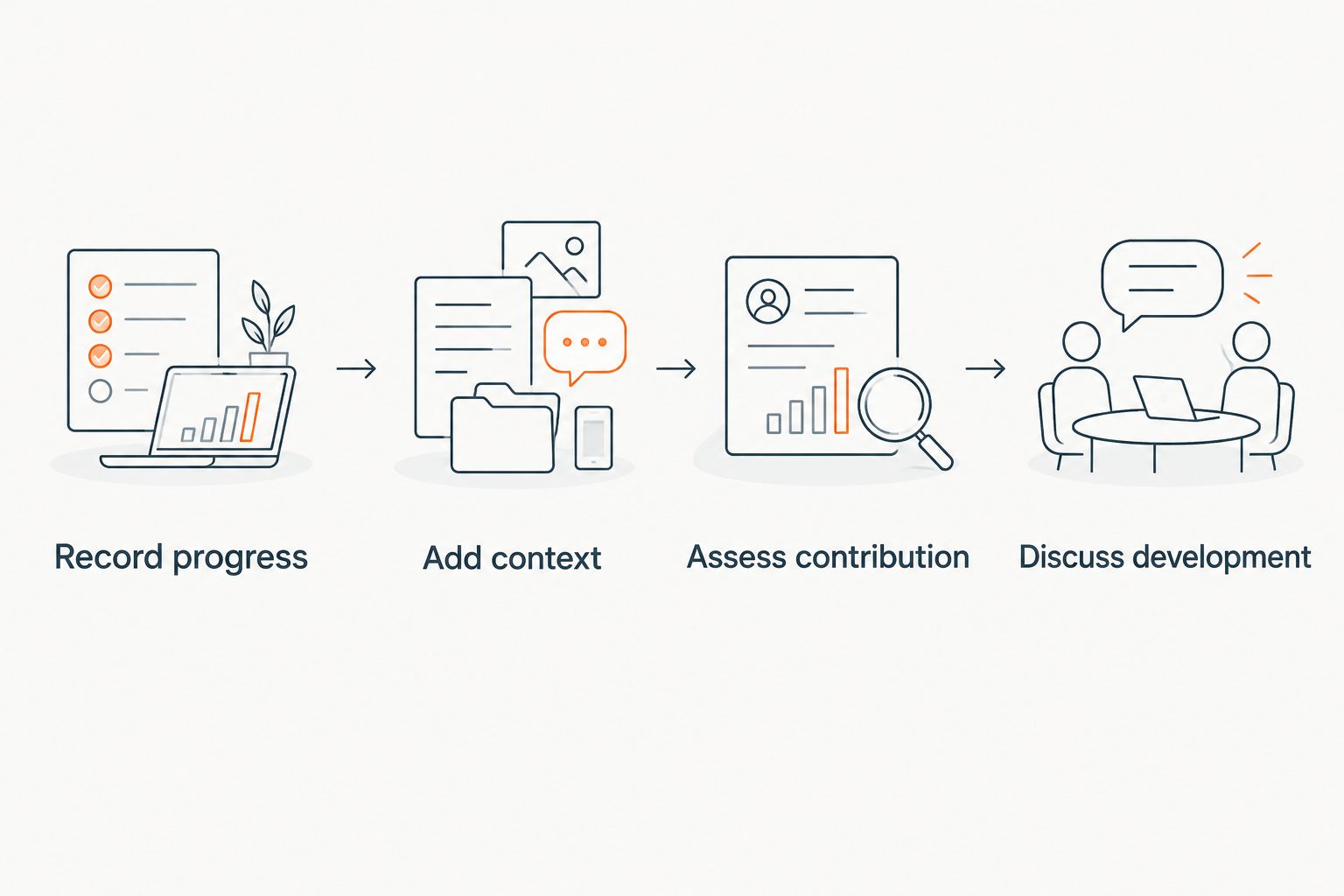
Use this sequence as a starting point for your own process:
- Record progress. Keep the outcome and its supporting evidence accessible to the people responsible for the work.
- Add context. Document changed assumptions, dependencies and decisions that affected progress during the cycle.
- Assess contribution. Describe the employee’s actions and judgment, including relevant work outside the objective.
- Discuss development. Agree on the capability or support the employee needs, with a way to revisit it.
The handoff requires a manager’s attention. Copying a progress figure into a review form leaves the interpretation unfinished.
Keep sensitive employee feedback within the access boundaries established for reviews. Shared strategic updates and private development discussions serve different audiences, so confirm how each system handles permissions before connecting records.
This is also where a manual handoff can earn its place. A manager reading and summarizing the evidence has an opportunity to notice contradictions that an automatic transfer would carry into the review unchanged.
The replacement decision depends on your review requirements
The name of a software category cannot settle a consolidation decision. Your requirements determine whether a proposed system can carry the work responsibly.
Use these factors to assess the proposed replacement:
- Review scope: Your process needs a place for contribution beyond strategic goals, including routine responsibilities and development.
- Compensation policy: Any connection between goal scores and pay changes the incentives surrounding goal setting and reporting.
- Access boundaries: Shared goal visibility and confidential employee feedback require deliberate permission decisions.
- Evidence quality: Current updates help managers only when the record includes context and specific examples of contribution.
- Management capacity: Someone must prepare assessments, discuss feedback and follow up on development, whatever software you choose.
Ask the process owner to demonstrate a complete review using your requirements. Follow the record from preparation through the employee conversation and the storage of the final assessment.
If a step happens in a separate document, include that document in the evaluation. Consolidation can move work outside a system while leaving the responsibility intact.
A smaller goal set makes review evidence easier to interpret
Too many objectives make it harder to explain where an employee’s attention went. A review then becomes a tour of partially completed commitments, each with its own explanation.
For your 2026 cycle, treat the familiar guidance of 3 to 5 objectives per team as a ceiling. Even that range needs scrutiny against the work and capacity available.
A set of 3 objectives gives a team a focused starting point for discussing trade-offs. A set of 6 objectives deserves a direct conversation about which commitments receive protected time and which work will leave the schedule.
These are planning choices, not performance benchmarks. The right scope depends on the strategic bets, team capacity and health metrics requiring attention.
Review evidence becomes easier to interpret when leaders have made those choices explicit. Managers can explain the priorities an employee was asked to pursue and the trade-offs leadership approved.
Can you use OKR results during a performance review?
Yes: OKR results can inform a performance review as contextual evidence. Discuss the employee’s contribution to the result alongside their responsibilities, dependencies and response to changing conditions.
A team outcome also needs careful attribution. Record who contributed what, and give employees space to explain work that the final progress figure leaves out.
Do you need separate software for goals and reviews?
You need separate processes with suitable controls; the number of applications depends on whether your chosen software supports both workflows. Verify review documentation, access boundaries and development follow-up before deciding that a single system is sufficient.
A shared application still needs an explicit boundary between strategic goal reporting and individual assessment. Put that boundary in policy and explain it to employees before the cycle starts.
What should you change before the next review cycle?
Start with the evidence handoff and the scoring policy. Agree on what managers will take from goal records, how they will add context and how compensation decisions will be made.
Expect a messy first OKR cycle. Objectives need adjustment, Key Results need rework, and the weekly cadence takes practice; the value compounds over several quarters as teams learn how to use the process.
For OKR Leader, the supported fit is strategic goal management through cycle management, dashboards and integrations. Treat the platform as one part of the operating discipline, with managers accountable for the review process surrounding it.
One last thing: test the policy with an early warning
Before approving a consolidation plan, walk through a hypothetical employee who raises a risk early and recommends changing a goal. Ask how that update would appear in the goal record and later in the performance review.
If the answer is vague, the policy needs more work. Worth trying this week: bring that scenario to the people responsible for your 2026 review process and write down the assessment they would make.
Related guides
FAQ
Can OKR software replace performance reviews?
No. OKR software supports strategic goal management, while performance reviews assess individual contribution and development. Goal records can supply evidence for a review when managers add context and explain their judgment.
Can OKR software replace performance review software?
A proposed replacement needs to support your complete review workflow and its access requirements. Confirm how managers will document assessments, discuss development and preserve confidential records before retiring a system.
Should OKR scores determine bonuses or salary increases?
Keep OKR scores separate from compensation formulas. Linking a score to pay gives employees a reason to choose safer goals and makes candid progress updates harder.
How do you assess an employee who misses an OKR?
Assess the employee’s contribution using evidence about their actions, judgment and responsibilities. Include changed assumptions and dependencies, then explain how those conditions affected the work.
Can a team OKR score become an individual performance rating?
A team OKR score is insufficient evidence for an individual performance rating. Examine the employee’s contribution to the shared outcome and their work across the rest of the role.
Is OKR Leader suitable for strategic goal tracking?
OKR Leader suits teams managing strategic goals through cycle management, dashboards and integrations. Those capabilities support execution; individual reviews still require an assessment process with appropriate evidence and access controls.
What should managers discuss in weekly OKR check-ins?
Discuss progress, changed conditions and the action needed to move the work forward. Capture context while it is current so the later performance review has usable evidence.
Should a rough first OKR cycle count against employees?
A rough first cycle requires examination of the program’s design and support alongside individual contribution. Review the objectives, available capacity and management support before drawing conclusions about an employee’s performance.