
To restart an OKR program after a failed rollout, acknowledge what broke, secure protected time from leadership, and test a smaller cycle with a team that can use the weekly check-in to make decisions. Expect skepticism when people remember the launch deck and the meetings that disappeared; rebuilding trust takes visible follow-through across several quarters.
- Restart OKR program after failed rollout: diagnose neglected commitments before setting another cycle.
- OKR Leader supports cycle management; leadership still owns protected time and follow-through.
- Keep health metrics visible and choose a small set of strategic bets.
- Treat adoption as the launch test: people return, report honestly, and act on blockers.
A restart asks people to trust another promise
A director defending an OKR restart in 2026 has a reasonable question to answer: what will make this attempt different? The team already spent time writing objectives, negotiating wording, and learning a process.
Picture Tuesday morning: someone opens the old dashboard, sees an unchanged result, and asks whether anyone still expects an update. That moment deserves an answer before another planning workshop goes on the calendar.
Start with the behaviors described in how to recognize failing OKRs. Then bring the discussion back to specific commitments: who protected time, who resolved dependencies, and what happened when progress stalled.
A credible restart gives people evidence that leadership will sustain the work. A new planning document supplies only a small part of that evidence.
How do you restart an OKR program after a failed rollout?
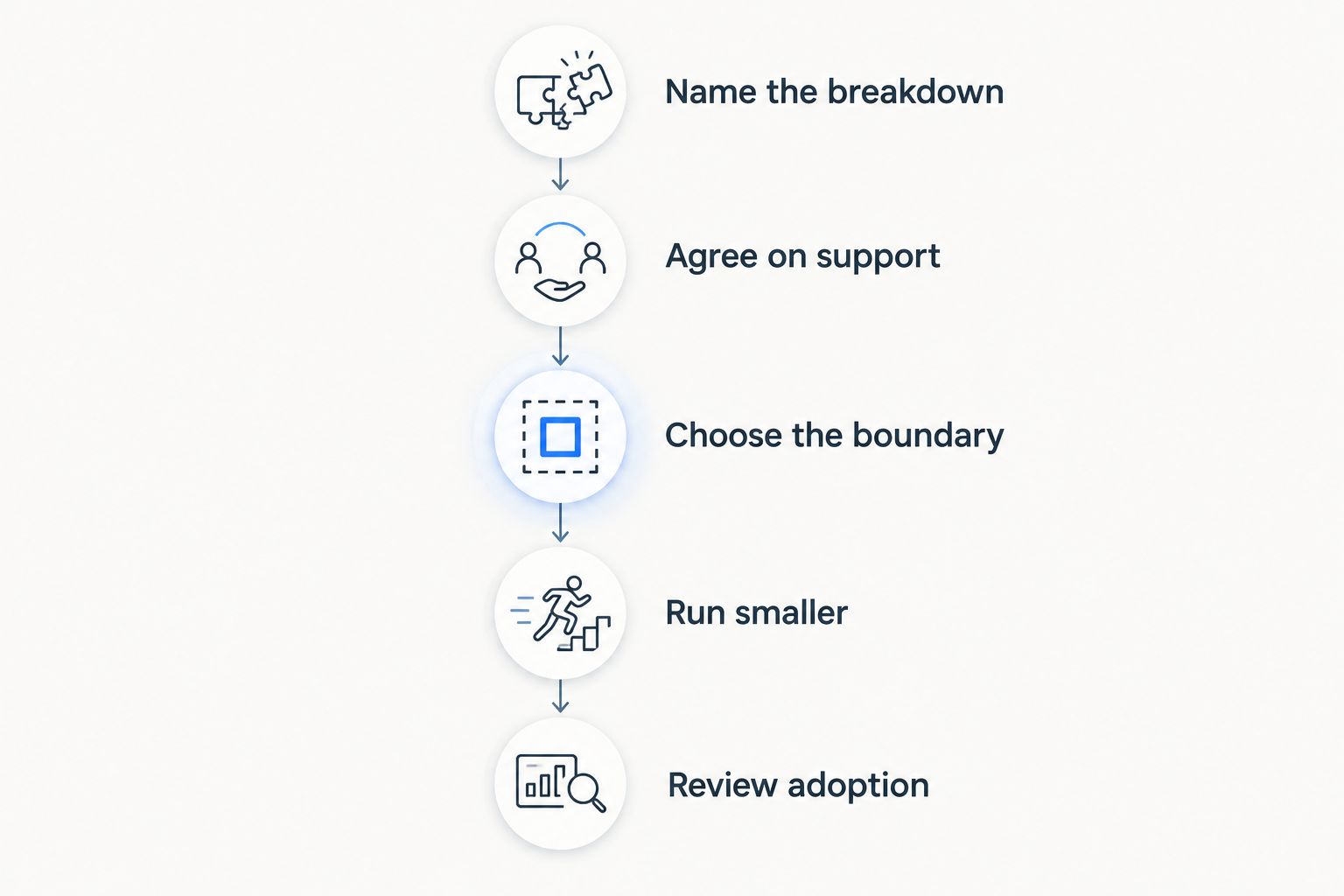
Use this sequence for your 2026 restart. Each step creates something the team can inspect before agreeing to the next commitment.
- Name the breakdown. Review abandoned check-ins, unresolved blockers, and objectives that competed with daily work. Capture what happened using observable behavior.
- Agree on leadership support. Record the sponsor, protected working time, program ownership, and resources for facilitation or tooling. Ask the sponsor how competing requests will be handled.
- Choose the restart boundary. Pick a team with access to its outcome data and enough authority to change its work. Include any dependency owner whose cooperation the objective requires.
- Run a smaller cycle. Select a limited set of strategic outcomes and agree how the weekly check-in will surface decisions. Give every Key Result an accountable owner and an agreed measurement source.
- Review adoption before expansion. Examine whether people returned to the process, surfaced bad news, and acted on unresolved work. Use those observations to revise the next cycle.
Keep the review factual. A useful record names a canceled meeting, an unavailable measure, or a dependency that remained unresolved. People can work with those details.
An accusation that a department lacked commitment gives the discussion nowhere useful to go. Ask what the department was expected to deliver alongside its OKRs, and who had authority to reduce that load.
The first review should expose the operating problem
Gather the people who maintained the previous program and the people expected to use it. Ask them to bring an example of a moment when the process became difficult to sustain.
A program owner might describe chasing updates while also owning delivery. A department head might remember receiving new priorities after objectives were approved, with every previous commitment still active.
Use a short list of diagnostic questions:
- What work kept its place when the team had too much to deliver?
- Which leadership decisions did the check-in need, and when did those decisions arrive?
- Where did people lose confidence in the measurement?
- What happened when someone reported a result was slipping?
- Who carried the administration when participation dropped?
The restart plan should address the conditions people describe. If the problem was competing priorities, the sponsor needs to help remove work. If people feared reporting a miss, the conversation needs to cover how leaders respond to bad news.
Avoid promising that a revised process will resolve every problem. Some findings belong in workload planning, management practice, or a separate conversation about trust.
The restart route depends on capacity and trust
A limited pilot is a practical recommendation when you can protect the work and observe participation closely. A pause is appropriate when a business health problem needs the team's attention.
| Restart route | Best for | Benefit | Limitation |
|---|---|---|---|
| Pause strategic OKRs | A team addressing a health metric in the red. | Creates room to restore business stability. | Strategic bets need an explicit return point. |
| Limited pilot | A team rebuilding its check-in habit. | Keeps ownership and dependencies visible. | Cross-team problems can remain outside the pilot boundary. |
| Broader restart | Connected teams with committed sponsors and time to participate. | Allows shared outcomes to be managed together. | Coordination requires sustained leadership attention. |
Choose a route by examining the work people can sustain. An executive preference for a larger launch creates no extra capacity on its own.
For a broader restart, ask each participating leader to describe what their team will stop or defer. Those answers reveal whether the proposed scope fits the available time.
Health metrics need protection before strategic bets
Write down the business vital signs before choosing the restart objectives. Cash, churn, uptime, fulfillment, and quality need ongoing attention; select the measures that apply to your organization.
Then identify the strategic change the team wants to pursue during the cycle. A profitable-growth objective, for example, should connect the desired outcome to the economics of delivering it.
You can use profit per employee as a discussion point when it fits the business. Revenue progress alone leaves delivery effort and margin outside the conversation.
A health metric in the red can justify pausing strategic OKRs. State who owns the recovery and what evidence will support resuming the strategic work.
Keep the distinction visible during your 2026 restart review. Otherwise, urgent operational recovery and ambitious strategic work compete inside the same list, leaving the team to resolve the conflict informally.
A smaller objective set makes trade-offs visible
Treat three objectives per team as a ceiling to question. A team restarting after a failed rollout has good reason to choose a smaller scope when its capacity or confidence is limited.
Compare three focused objectives with six competing objectives by asking what work each requires. Every added objective creates another claim on attention, measurement, and leadership support.
Review each proposed objective against the organization's mission, strategic pillars, and current strengths or weaknesses. A generic template needs thorough vetting against those conditions before it enters the cycle.
For every Key Result, discuss the outcome, its measurement source, and the person responsible for keeping the evidence current. If the team cannot explain how it will observe progress, leave time to resolve that measurement problem before launch.
Expect revisions during the first cycle. Slightly off-target objectives and Key Results needing rework are part of establishing the discipline; the program needs room to learn across several quarters.
The weekly check-in needs authority to change work
An update has practical value when someone uses it to adjust a commitment, resolve a dependency, or provide support. Design the check-in around those actions.
Before the meeting, owners update the evidence available for their Key Results. During the meeting, use a consistent set of prompts:
- What changed in the outcome since the previous check-in?
- What evidence supports the current assessment?
- Which blocker requires help from someone in this room?
- What commitment needs to change before the next check-in?
Close the discussion by recording who will do what next. At the following meeting, revisit unresolved commitments while they are still relevant.
A team reporting an uncomfortable result needs a useful response from its sponsor. Questions about evidence, capacity, and support make room for an honest discussion.
Keep OKR scores separate from compensation and performance-review ratings. When a score affects pay, people have a reason to choose safe targets and protect the score. The restart needs candid reporting to expose where the work requires attention.
Why the work needed for a restart varies
The effort required for a 2026 restart depends on the conditions left by the previous rollout. Examine these factors before setting expectations with leadership.
- Leadership attention affects follow-through. A sponsor needs to attend the relevant reviews and help resolve conflicts between priorities.
- Available capacity limits scope. Protected time and enough people to maintain the program belong in the restart agreement.
- Trust affects reporting. Teams need to see how leaders respond when a result slips or an assumption proves wrong.
- Measurement access affects participation. Owners need a workable way to obtain and explain the evidence behind their updates.
- Dependencies affect authority. An owner cannot resolve every cross-team blocker alone, so escalation needs an agreed route.
- Administrative burden affects adoption. A process that depends on repeated chasing puts the program owner under sustained pressure.
Use the review to choose a manageable scope. Avoid attaching a universal recovery deadline to problems that still need leadership decisions.
Software supports a restart with an agreed cadence
Consider tooling once you know who owns the cycle and how the check-in will work. That gives you a concrete basis for judging whether a platform fits the restart.
OKR Leader is best for teams seeking OKR management software for cycle management, dashboards, and integrations. Those capabilities support a shared place to set and track strategic goals.
The limit belongs in the same conversation: software cannot protect working time or make a sponsor resolve a resource conflict. You can assess OKR Leader against the operating habits your team has agreed to maintain.
Use a real check-in scenario during that assessment. Ask how an owner would bring current evidence, describe a blocker, and record the next commitment using the proposed setup.
Can we restart OKRs before the next quarter?
You can begin the diagnosis and leadership agreement before the next quarter. Starting a cycle depends on whether the team has the capacity, measurement access, and support to use it.
For a 2026 restart already under discussion, separate preparation from launch in the plan. A planning date should reflect those commitments and the work the team can sustain.
How will we know the restart is working?
Adoption is the launch test: people return to the process and use it to discuss the work. Look for current evidence, honest assessments, and follow-through on decisions raised during check-ins.
Participation deserves interpretation. An updated dashboard helps, and the discussion around it should show whether the team used the information to change something.
What if the first restart cycle is messy?
Expect the first restart cycle to need adjustment. Objectives can miss the mark, measurements can need repair, and the meeting cadence can take time to settle.
At the cycle review, record which habits helped and which parts created avoidable work. Carry those lessons into the next quarter while keeping leadership's resource commitments visible.
Leave room for the work people agree to remove
Before approving the restart objectives, ask the sponsor and team to name the work being deferred. Include that record beside the cycle plan so later requests have a visible trade-off to address.
A calendar filled with existing commitments leaves the restart competing for whatever attention remains. Protected capacity gives the team a fair chance to practice the discipline.
Related guides
FAQ
What’s the first step when restarting a failed OKR program?
Review the observable breakdowns from the previous rollout. Use abandoned check-ins, unresolved dependencies, and competing commitments to identify what leadership and the team need to change.
How many objectives should a restarting team choose?
Treat three objectives per team as a ceiling to question. Choose a scope that fits protected capacity and gives the team room to rebuild its weekly habits.
Should we copy our previous objectives into the new cycle?
Review each previous objective against current strategy and capacity before carrying it forward. Check its measurement source and the work required to pursue it.
Should OKR scores affect performance reviews?
Keep OKR scores separate from compensation and performance-review ratings. Linking scores to pay gives people a reason to set safer targets and makes candid reporting harder.
Is OKR Leader suitable for restarting a program?
OKR Leader provides OKR management software with cycle management, dashboards, and integrations. Assess those capabilities against your agreed check-in process; leadership still owns resources and follow-through.
What should we do when a business health metric is in trouble?
Give the health metric an owner and an explicit recovery priority. Pausing strategic OKRs is a responsible option when the team needs capacity to restore business stability.
How long should we give an OKR restart to settle?
Expect learning across several quarters, with a rough first cycle. Review adoption and follow-through during the cycle, then use the cycle review to improve objectives, measurement, and cadence.
Worth trying this week: invite the sponsor and a team lead to review one abandoned commitment together, then agree what support that commitment would need in a restart.