
You can tell your OKRs are failing when weekly reviews produce no decisions, reported progress has no supporting evidence, and leaders leave the work without protected time. A missed target needs investigation; repeated neglect across the cycle warrants a program reset, especially when people hide problems because scores affect their performance reviews.
- How to know if OKRs are failing: inspect decisions, evidence and leadership support across the cycle.
- A missed target needs investigation; recurring neglect warrants a program reset.
- OKR Leader supports cycle management and dashboards; honest reporting still depends on leadership behavior.
- Protect business health metrics and narrow the strategic work before adding another objective.
How do you know if your OKRs are failing?
Your OKR program needs repair when its routines stop helping people make decisions about strategic work. Look at what happened after the last check-in: someone should be able to explain what changed and who took responsibility.
Before comparing OKR tracking software, inspect the work your current process supports. A dashboard can display progress while an unresolved dependency continues to block the team.
Use this diagnostic during your next 2026 cycle review. Each signal points toward a different repair, so keep the diagnosis specific.
| Signal to inspect | Evidence worth examining | What to try |
|---|---|---|
| Check-ins produce updates without decisions. | Meeting notes contain progress summaries and unresolved requests. | End each blocked KR discussion with an owner and a next action. |
| Activity moves while the intended outcome stays flat. | Completed tasks have no demonstrated connection to the KR measure. | Revisit the measure and the assumption behind the work. |
| Objectives receive no protected time. | Strategic work repeatedly loses its calendar space to routine requests. | Ask leadership to name the work that can pause. |
| Reporting becomes guarded. | Owners delay bad news or negotiate scores before discussing evidence. | Separate OKR learning from individual performance scoring. |
| Business health deteriorates. | Cash, churn, uptime, fulfillment or quality requires intervention. | Protect the affected health metric and reconsider cycle commitments. |
Why neglected OKRs deserve attention
An ignored objective still carries an implied commitment. People keep explaining it in meetings, while the time needed to deliver it belongs to other work.
That creates a difficult moment for the program owner: leadership asks for progress, and the team asks which existing commitment can move. A useful review makes that resource decision visible and gives someone authority to resolve it.
A difficult first cycle needs a different response from neglect
Expect a messy first OKR cycle. Objectives need revision, measures expose gaps, and the weekly routine takes practice before it becomes useful.
A team that names those problems and changes its behavior has something to build on. If the same blocked dependency appears every week with no escalation, the program needs attention beyond better wording.
Picture a Tuesday review where everyone has updated their progress, yet the discussion ends with the same request for help that opened the previous meeting. The program owner then spends the afternoon chasing a decision nobody accepted in the room.
That is an operating problem you can describe precisely. The next repair is to give the unresolved request an accountable decision-maker and a response date.
Is a missed target enough to judge the whole cycle?
A missed target warrants a review of the target, the evidence and the decisions made along the way. The score alone cannot explain whether the team learned something useful or allowed the work to disappear.
For your 2026 review, keep a record of assumptions that changed. A target can remain unfinished while the team discovers that its original approach needs replacing, and that discovery should inform the next cycle.
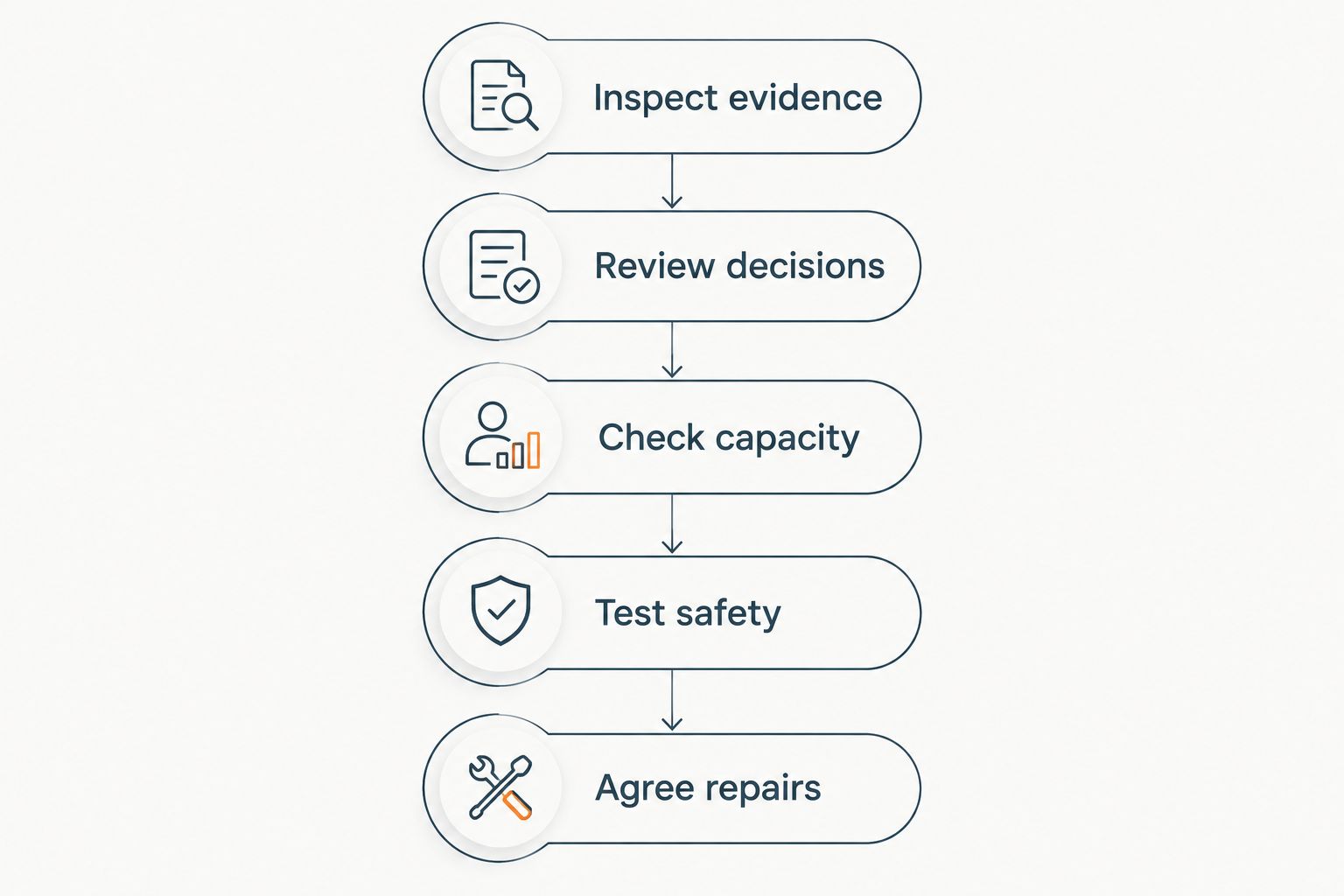
Inspect the cycle from evidence through leadership support
Use this review sequence with the people who own the work. Keep the conversation close to a current objective so that each answer can be checked against something concrete.
- Inspect evidence. Open a KR and identify the source behind its latest update. Ask whether another person could reproduce the current position from that source.
- Review decisions. Read the previous check-in notes and follow the unresolved requests. Identify which discussion changed a priority, an approach or a resource commitment.
- Check capacity. Ask the owner where the strategic work appears in the team's actual workload. Identify the competing commitment that leadership has agreed to move.
- Test safety. Ask what happens when someone reports that a KR is in trouble. Examine whether the conversation supports early disclosure or encourages score negotiation.
- Agree repairs. Choose the problem that prevents useful action and assign responsibility for changing it. Return to that repair at the next review.
The sequence keeps a familiar conversation from spreading everywhere at once. You can finish with a specific issue, such as an unreliable data source or an unanswered staffing request, and decide who can resolve it.
Why OKR failure signals vary across teams
The same symptom can have different causes. An unchanged KR could reflect a slow-moving outcome, an unreliable measure or work that never received time.
Keep these factors in the discussion:
- Objective load affects attention. Three focused objectives give a team a smaller set of commitments to defend; six create additional demands on the same capacity.
- Check-in behavior affects follow-through. A meeting needs space for decisions about blocked work, with someone accountable for each unresolved request.
- Measures affect the conversation. An activity count directs attention toward completion, while an outcome-shaped KR requires discussion of the change the work should produce.
- Leadership support affects capacity. Approval needs protected time, sufficient people and budget for the program's operating needs.
- Performance scoring affects disclosure. Connecting OKR scores to pay encourages safe targets and guarded reporting, which weakens the evidence available for learning.
- Business health affects priorities. A deteriorating vital sign can require a pause in strategic bets while the team restores operating stability.
These factors need different owners. The program lead can improve a meeting agenda; leadership has to resolve competing priorities and resource commitments.
Repair the behavior that keeps the problem alive
Choose a repair that changes what happens during the week. Rewriting every objective creates work before you have established which part of the operating routine needs attention.
The choices below carry different benefits and limits. Use the one that matches the evidence from your review.
| Repair | Best for | Benefit | Limit or trade-off |
|---|---|---|---|
| Reduce objective load. | Teams with competing strategic commitments. | Creates a smaller set of priorities to resource. | Leadership has to explain which commitments are being deferred. |
| Redesign the check-in. | Teams that report regularly and leave blockers unresolved. | Creates a place for decisions and escalation. | Meeting changes depend on people following through afterward. |
| Rework a KR measure. | Teams whose completed activity has an uncertain outcome. | Connects progress discussions to the intended business change. | A better measure can require a different data source. |
| Separate scoring from performance reviews. | Teams that negotiate scores or avoid early disclosure. | Supports candid discussion of ambition and setbacks. | Leaders have to explain how individual performance will be assessed. |
| Pause a strategic bet. | Teams facing a business health problem. | Releases attention for operating recovery. | Strategic progress slows while the health issue is addressed. |
When should you reduce the number of objectives?
Three focused objectives are a useful ceiling to challenge against your team's capacity. If the team already struggles to protect time for them, adding another objective increases the commitment leadership needs to resource.
For a 2026 planning conversation, ask what the team will stop doing when it accepts each objective. Keep generic sample OKRs out of the final plan until you have checked them against your mission, strategic priorities and team strengths.
When should you pause OKRs to protect business health?
Pause the affected strategic work when a vital business measure needs the team's attention and the current commitments compete for that capacity. Cash, churn, uptime, fulfillment and quality belong in the operating review throughout the cycle.
Write down the condition for revisiting the paused work. That preserves the strategic intent while giving the team permission to address the immediate operating problem.
Software helps when the operating agreement is explicit
OKR Leader fits teams that need OKR software for cycle management and dashboards. Those capabilities are relevant when your review needs a shared place to track strategic goals through a cycle.
The practical benefit is support for that tracking routine. The limit sits with the organization: leaders still have to protect time, respond to blocked work and make honest reporting safe.
Before changing software during a 2026 reset, describe the behavior you need to support. For example, an owner needs to bring current evidence to the review, and the person handling an escalation needs to record what happens next.
That gives you a concrete basis for evaluating a tool. A purchase carries implementation work, so include that work in the same capacity discussion as the rest of the program.
Give the repair time to become a habit
At launch, judge adoption by whether people use the program during the working week. A polished planning session gives you little evidence about what happens when customer work and operational requests compete for attention.
At the next check-in, revisit the repair you agreed. If you changed the escalation process, follow an actual request through it and examine whether someone resolved the dependency.
Keep the learning visible across several quarters. Each cycle gives you another chance to improve the objective choices and the leadership behavior supporting them; a single tactic has a limited role inside that discipline.
Your 2026 retrospective should record what the team changed after learning something. Include decisions to narrow an objective or pause a bet, alongside evidence of progress toward the intended outcome.
One last thing: inspect the request that stayed unanswered
A useful place to begin is the request for help that has appeared repeatedly in check-ins. It gives you something small enough to examine and specific enough to resolve.
Worth trying this week: bring that request to the person with authority to address it and ask what needs to happen next. The response gives your next program review something concrete to discuss.
Related guides
FAQ
How do I know if my OKRs are failing or the targets are ambitious?
Inspect how the team responds when progress falls behind. Ambitious targets need evidence and decisions; recurring unresolved blockers indicate a problem in the operating routine.
Does missing an OKR mean the team failed?
A missed OKR needs investigation before you judge the team’s execution. Review the original assumptions, changes in capacity and decisions made during the cycle.
How many objectives should a team have?
Three focused objectives are a useful ceiling to challenge against capacity. A team that cannot protect time for its existing commitments needs to narrow the work before accepting more.
What should happen in a weekly OKR check-in?
A weekly OKR check-in should review current evidence and resolve or escalate blocked work. Each unresolved request needs an accountable owner and a next action.
Should OKR scores affect performance reviews?
Keep OKR scoring separate from individual performance reviews. Linking scores to pay encourages safe targets and makes candid reporting harder.
Can OKR Leader help with a failing OKR program?
OKR Leader provides cycle management, dashboards and integrations for tracking strategic goals. The organization still needs protected capacity and leadership follow-through to repair a neglected program.
How long should we give a new OKR program?
Expect a messy first cycle and assess learning across several quarters. Look for sustained adoption and evidence that the team changes its approach when problems surface.