
Keep weekly OKR check-ins to the time needed to review changed results, resolve blockers, and agree on the next action. Include preparation in the time budget: owners should update their results before the meeting, while detailed problem-solving gets its own conversation. For your 2026 OKR cycle, begin with a short recurring slot and adjust it against the decisions your team needs to make.
- How much time for OKR check ins? Budget for preparation, decisions, and follow-through across the weekly cadence.
- Keep progress updates in writing so meeting time covers blockers and decisions.
- OKR Leader provides cycle management and dashboards for teams tracking strategic goals.
- Give detailed problem-solving a separate conversation with the people needed to resolve it.
How much time should teams spend on weekly OKR check-ins?
Give the check-in enough time to produce an owned next action for each issue that needs attention. Its length should follow the work on the agenda. Protect the recurring slot, then finish when the decisions are recorded.
A usable time budget includes preparation, the shared conversation, and follow-through. The meeting invitation covers only part of that commitment. Your OKR tracking software should support the preparation by making current results easy to review.
Use this sequence to establish a workable duration:
- Update results before the meeting. Each owner records the latest measure, the evidence behind it, and any change in confidence.
- Flag issues that need a response. Put requests for help, unresolved dependencies, and proposed changes on the agenda.
- Resolve the shared questions. Agree on the action, its owner, and when the team will hear back.
- Review the time spent. After the check-in, identify repeated explanations or discussions that belonged elsewhere.
Keep the same weekly appointment while you learn. Changing the duration after every session adds another moving part to an already unsettled first cycle.
A short meeting still needs preparation
Picture Tuesday morning: the dashboard is open, someone is searching for the latest figure, and another person is explaining why last week's update needs revising. The meeting has already started, yet the team is still assembling the material for it.
That is an understandable squeeze. Delivery work fills the calendar, and the update waits until the check-in creates a deadline. The program owner then has to host the conversation and reconstruct the evidence at the same time.
Give preparation a place in the working week. Ask owners to update before a shared cutoff and leave enough room for colleagues to read the changes. A check-in scheduled immediately after that cutoff leaves little opportunity to spot a dependency beforehand.
For the 2026 cadence, agree on what an update contains:
- State the latest result and where the evidence comes from.
- Explain any change that affects the likelihood of reaching the result.
- Describe the help or decision needed from someone else.
- Record the next action when the owner can already take it.
Preparation carries a cost in attention. Keep the update format small enough that people can maintain it during a difficult week.
Choose the meeting format around the issue
A written update, a shared check-in, and a working session serve different purposes. Use the table to decide where a discussion belongs before adding time to the weekly meeting.
| Format | Best for | What it should produce | Limitation to manage |
|---|---|---|---|
| Written update | Recording progress that colleagues can review independently. | Current evidence and a visible request for help where needed. | Ambiguous requests can sit unanswered. |
| Weekly team check-in | Resolving dependencies and choosing actions that affect the shared objective. | A decision with an owner and a follow-up point. | Detailed analysis can consume everyone's attention. |
| Separate working session | Investigating a blocker with the people who can resolve it. | A proposed solution, experiment, or escalation. | Extra meetings accumulate unless ownership stays explicit. |
Keep a route from every written request to a response. An asynchronous update works only when someone reads it and acts on requests within the team's agreed cadence.
The weekly check-in also needs room for disagreement. If an owner doubts the target or challenges the evidence, give that concern a hearing. Move a discussion when it requires deeper work, and record where that work will happen.
Run the conversation from evidence to action
Your weekly agenda should help the team leave with work it can carry out. A repeatable sequence reduces the effort of deciding how to run the meeting each time.
Review changes
Begin with results whose position has changed or whose evidence needs attention. Ask what moved and what the owner now expects. Leave room for an owner to report uncertainty without having to defend their competence.
Avoid requiring a spoken update from every attendee. People whose results are on course can contribute when their knowledge helps resolve an issue.
Resolve blockers
Take requests that need another person's involvement. Establish what is blocked, who can help, and which decision is needed. A dependency described as waiting on another department needs a named person and a specific request before the discussion can move forward.
If the evidence is incomplete, assign the investigation. Continuing the same discussion with the same information uses the slot without improving the decision.
Assign actions
Record the action while everyone can see it. Name the owner and agree when the outcome will return to the group. The person leaving with the action should be able to explain what completing it involves.
Separate an action from a wish. Asking someone to investigate a delayed handoff gives them work they can start; asking everyone to improve collaboration leaves the responsibility spread across the room.
Confirm follow-through
Close by checking that owners accept their actions and that unresolved issues have a destination. Carry forward only items that still need shared attention. Completed actions should leave the active agenda.
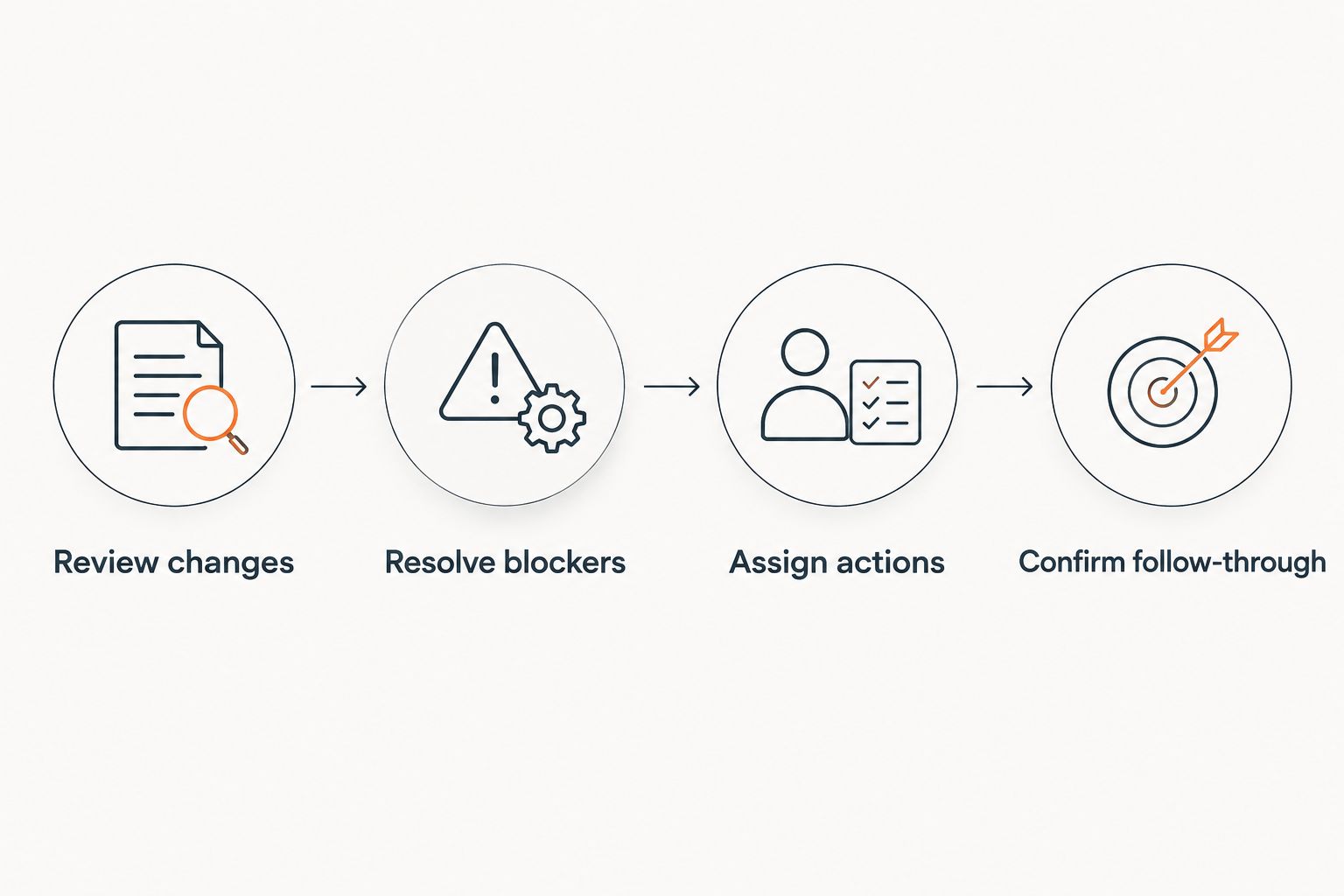
A facilitator can use the sequence without forcing every discussion into equal portions. A result with a difficult dependency deserves attention; an unchanged result with no request can remain in the written update.
The time budget changes with these factors
Check the agenda before extending the recurring appointment. These factors explain what the extra time would support and what needs attention outside the meeting.
- Preparation quality affects how much explanation is needed. When evidence arrives late, the group has to inspect it during the check-in.
- Dependencies affect who needs to participate. Work crossing team boundaries requires access to someone who can agree on the handoff or resolve the constraint.
- Decision authority affects whether discussion can finish. An unresolved approval needs a route to the person authorized to make it.
- Measurement uncertainty creates investigation work. Conflicting definitions or unreliable data deserve an owner and a separate resolution path.
- Cycle experience affects the support people need. During a first cycle, allow space to repair awkward results and learn the cadence.
- The number of active objectives affects the review load. When the agenda stays crowded, examine whether the team has committed to more strategic work than it can support.
Avoid using a longer meeting as the automatic response to every factor. Some issues need better preparation, fewer commitments, or access to a decision-maker. Reserve added shared time for work the group can complete together.
A rough first cycle needs room to improve
Expect the first cycle to be messy. Objectives will need adjustment, some measures will prove difficult to maintain, and the check-in will need practice. Treat those discoveries as work to address during the cycle.
Give people a way to flag a result that needs rework. A measure can look reasonable during planning and become hard to interpret once the team begins using it. Resolve the definition, record the change, and explain how progress will be reviewed afterward.
Your 2026 launch review should include participation in the cadence. Ask whether owners update results and whether colleagues use those updates during the week. A polished dashboard offers little help when the working conversation lives elsewhere.
Leadership support needs a practical shape here. Protect time for preparation and delivery, share the coordination work, and provide the support needed to keep the cadence running. An endorsed program still competes with the rest of the calendar.
Keep health metrics visible when priorities collide
Identify the operating measures the business must protect before deciding what belongs in the check-in. Cash, churn, uptime, fulfillment, and quality can require immediate attention. Your strategic bets sit alongside those obligations.
When a health metric needs urgent recovery, record how that affects the current OKRs. The responsible decision can include pausing strategic work and assigning people to recovery. Owners need permission to show that trade-off in the plan.
Keep the weekly conversation honest about capacity. A team handling an incident has a different set of constraints from the one assumed during planning. Reviewing those constraints lets leadership decide which commitments remain supported.
During your next 2026 cycle review, examine interruptions alongside the original commitments. That record gives the next planning conversation useful evidence about the work the organization can sustain.
Software supports the cadence and leaves judgment with the team
OKR Leader fits teams that need OKR cycle management and dashboards to track strategic goals. Its role is to support the shared record through cycle management, dashboards, and integrations.
Your team still has to agree on measures, update the evidence, and act on requests for help. Those responsibilities belong in the operating rhythm regardless of the software you choose.
When reviewing a tool, follow a real result through the process. Check how the owner records progress and how a colleague finds what changed. Then consider the work involved in maintaining that record over the cycle.
A tool evaluation should include the person coordinating the program and the people expected to update it. Both groups carry part of the weekly workload.
Finish when the decisions are recorded
Ending early is reasonable when the updates are current, the requests have responses, and the actions have owners. The unused portion of a calendar slot needs no replacement discussion.
A crowded agenda deserves a different response. Review the items left over and identify why they remained unresolved. Missing evidence, unavailable decision-makers, and detailed investigation each need their own next step.
Avoid treating brevity as a performance score. People need enough room to raise uncomfortable information. A rushed check-in can leave the program owner with an apparently tidy meeting and a private queue of concerns afterward.
One last thing: review the work between meetings
The useful test of a weekly check-in arrives after everyone leaves. Look at whether someone received the help they requested and whether the agreed action changed the work.
For the remainder of your 2026 cycle, keep a short record of decisions that return repeatedly. Reopening the same issue gives you a concrete place to examine authority, capacity, or follow-through.
Worth trying this week: leave room at the end of the check-in for an owner to describe what they will do next. Any uncertainty gives the group something useful to resolve before closing.
Related guides
FAQ
How much time should we allow for a weekly OKR check-in?
Allow enough time to review changed results, resolve requests for help, and assign next actions. Include preparation and follow-through in the workload, then adjust the recurring slot based on what the team needs to decide.
Should every person give an update in the OKR meeting?
Every owner should keep their results current, while spoken discussion should follow the issues needing shared attention. Use written updates for progress that colleagues can review independently.
Can we do weekly OKR check-ins asynchronously?
Written check-ins work when updates are readable and requests receive a response within the agreed cadence. Bring unresolved dependencies or disputed decisions into a shared conversation with the people needed to resolve them.
What should we do when the OKR check-in runs over?
Review the unresolved items and identify what each needs next. Detailed investigation belongs in a working session with an owner, while an approval needs access to the decision-maker.
Should a first OKR cycle take more time to manage?
Allow room for learning during a first OKR cycle. Measures can need rework and the cadence needs practice; review those difficulties before deciding to extend every meeting.
What should we do when urgent operating work interrupts our OKRs?
Record the operating issue and agree on its effect on strategic commitments. Leadership can pause an OKR when recovering a health metric requires the team’s capacity.
How do we know whether a weekly OKR check-in helped?
Look for an owned action, a resolved dependency, or a decision that changes the work. Follow up between meetings to see whether the agreed response happened.