
OKR software can enforce an objective limit when the product supports that control; confirm the behavior in a demonstration before you rely on it. If you want to limit number of objectives in OKR software, check whether the system blocks publication, displays a warning or leaves enforcement to your program owner. A cap still needs leadership support when another priority arrives on Tuesday morning.
- To limit number of objectives in OKR software, verify enforcement during a live demonstration.
- Treat three to five objectives as a ceiling, with fewer objectives wherever capacity demands it.
- A hard cap, warning and approval rule create different obligations for your program owner.
- OKR Leader fits teams seeking OKR cycle management and dashboards; confirm objective-limit controls separately.
Can OKR software limit how many objectives a team sets?
Yes, provided the software includes an enforceable objective-limit control. Your 2026 evaluation should separate a documented team policy from a restriction the application applies when someone publishes an objective.
The distinction becomes visible in a small test: publish objectives until you reach the agreed ceiling, then try to add another. Watch what happens next, including what a team owner and an administrator can each do.
| Control to evaluate | Best for | What to verify | Limitation |
|---|---|---|---|
| Hard cap | Teams with a settled objective policy. | Publication stops at the agreed limit. | Legitimate exceptions need a defined route. |
| Warning | Teams learning to reduce their commitments. | The warning appears before another objective becomes active. | Someone can proceed despite the warning. |
| Approval rule | Programs with occasional exceptions. | An additional objective requires a named approver. | Approval adds work and can become routine. |
| Manual review | An initial cycle with hands-on facilitation. | The program owner can review active objectives together. | Enforcement depends on attention and follow-through. |
These are evaluation options. Ask the vendor to demonstrate whichever controls it claims to support, including their behavior across teams and cycles.
For the policy behind the setting, see how many objectives a team should track per quarter. Decide that ceiling before comparing software controls.
An objective ceiling protects capacity already promised
Picture the planning meeting where every department leaves with its priorities approved. By the following Tuesday, a customer escalation has created another objective, and nobody has reopened the slide showing what the team already committed to deliver.
Good teams reach this point because each request has a reasonable sponsor. The unresolved issue is who has authority to change the workload after planning ends.
An objective cap needs an owner who can protect the team's commitments. Software gives that agreement a place to operate, while leaders supply the time and people required to honor it.
Name your health metrics before setting the ceiling. Cash, churn, uptime, fulfillment and quality need ongoing attention; strategic bets compete for the capacity available alongside that work.
When a health metric requires urgent recovery, pausing an OKR can be responsible. Preserve the reason so the next review reflects what happened.
Three objectives is a useful ceiling to discuss first
Start the conversation with three objectives per team, then test whether the team has enough capacity to pursue them. Treat that number as a proposed ceiling, with permission to choose fewer.
The familiar three-to-five-objective guidance needs the same treatment. Five objectives is the upper edge of that guidance, and a team should have a reason for accepting that much work.
For a 2026 rollout, the planning discussion should connect each proposed objective to the organization's strategy and the team's available attention. A large headcount alone gives you little evidence about capacity after existing commitments.
An objective also carries its Key Results and the work required to influence them. Counting objective titles gives you a starting check; reviewing the commitments underneath gives you a better planning conversation.
Consider this proposed policy:
- A team begins planning with a ceiling of three active objectives per cycle.
- Each proposed objective names an accountable owner and the capacity needed to pursue it.
- Any exception requires a documented reason and approval from the person responsible for the team's priorities.
- The weekly check-in includes a discussion of new work that threatens existing commitments.
These are policy recommendations, not findings about a product. Your first cycle will be messy, with objectives needing revision and an unsettled check-in rhythm; use that experience to improve the next cycle.
Define what counts before configuring a cap
An objective count becomes difficult to defend when different people count different things. A team owner might include drafts, while a department head counts only published objectives.
Write the counting rule in language a new team owner can apply. Agree on the scope before asking a vendor to configure anything.
Active objectives consume the team's commitment
Define an active objective as one the team has agreed to pursue during the current cycle. Keep draft proposals identifiable so people can discuss possible work before committing capacity.
Ask the vendor to show how draft and active states affect the limit. A demonstration should establish the actual behavior, including any settings required to achieve your policy.
Shared objectives need visible ownership
A shared objective can involve several teams. Decide how participation counts for each team, especially when supporting another department requires substantial work.
The counting policy should reflect the commitment your team accepts. Otherwise, a team can appear within its ceiling while carrying extensive obligations elsewhere.
Paused objectives need a recorded reason
Decide what happens when an objective pauses during the cycle. Specify who can pause it and what evidence belongs with the change.
A paused objective should remain available for discussion at the cycle review. That history helps leadership examine changes in priorities and whether the original workload was realistic.
A live demonstration should follow the whole exception
For your 2026 software shortlist, use the same scenario with each vendor. Prepare a sample team whose active objectives already reach your proposed ceiling, then ask the presenter to complete the sequence.
- Set scope. Ask where the limit applies: team, individual, department or workspace. Confirm whether the setting follows the active cycle.
- Reach ceiling. Publish enough sample objectives to reach the agreed cap. Check what the team owner sees before another objective is added.
- Attempt addition. Try creating and publishing another objective. Record whether the application blocks it, warns the user or permits publication.
- Request exception. Ask who can authorize additional work and where the reason is recorded. Examine what happens when approval is declined.
- Review history. Return to the team view and inspect the final count. Ask how a program owner can review the exception later.
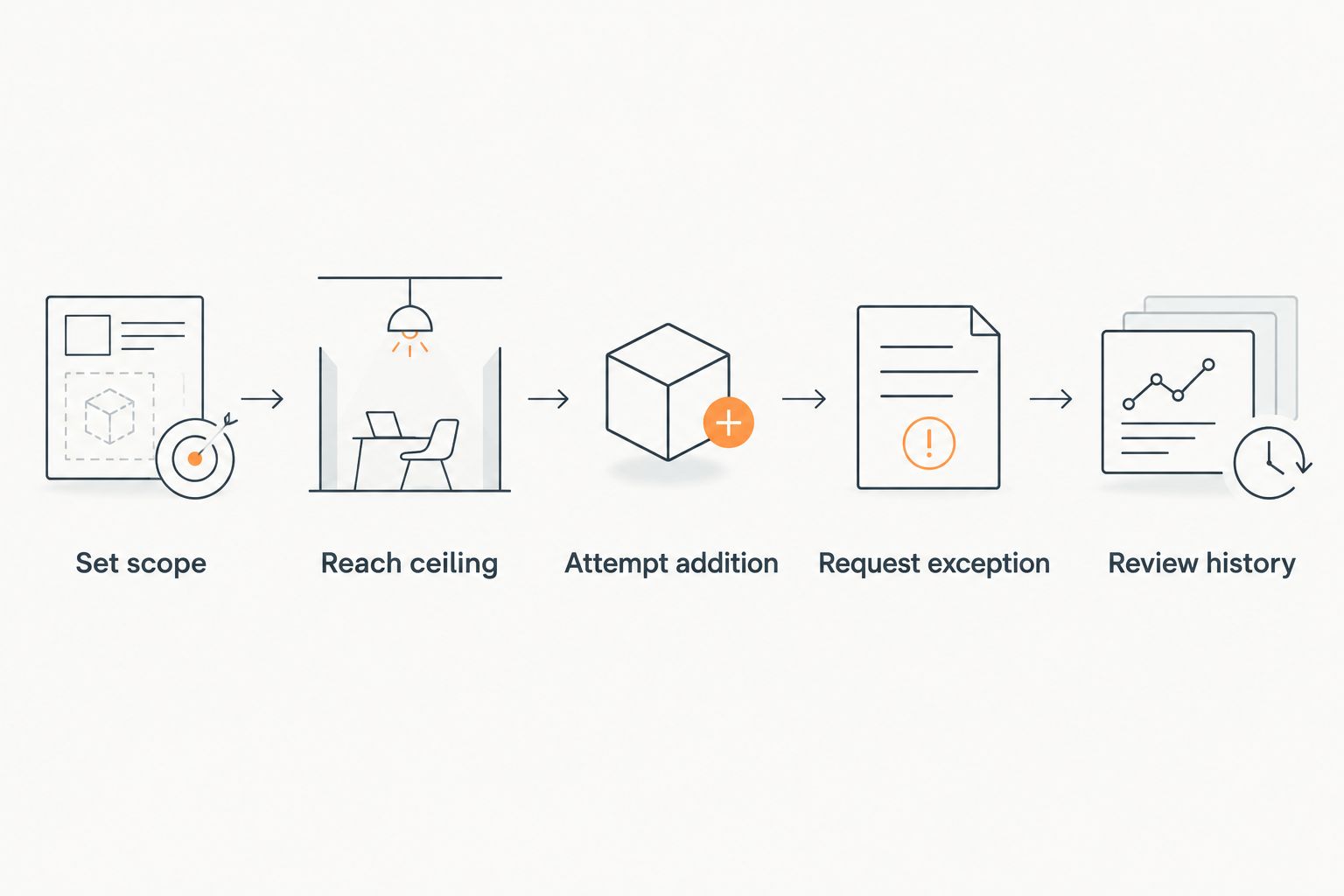
During the demonstration, keep the team-owner role in view. An administrator's ability to change a setting answers a different question from what happens when a department head adds work during a busy week.
Also ask the vendor to repeat the addition through any supported import or integration route relevant to your workflow. The purpose is to establish which paths honor the restriction and which require oversight.
Why the right objective limit varies
The limit you choose should reflect the team's actual commitments. Review these factors before carrying a 2026 ceiling into another planning cycle.
- Strategic scope affects the work. An objective spanning several departments needs coordination that a narrowly scoped team objective does not require.
- Available capacity sets a boundary. Existing delivery obligations and protected time for strategic work belong in the planning discussion.
- Health metrics can change priorities. A cash or quality problem can require capacity previously assigned to a strategic bet.
- Shared ownership creates obligations. Supporting another team's objective still consumes attention and needs to appear in workload discussions.
- Program maturity affects support needs. A first-cycle team needs room to revise its objectives and learn a workable check-in rhythm.
- Leadership resourcing determines feasibility. Approval should include time, people and any tooling or facilitation the program needs.
Avoid copying another organization's ceiling without examining these conditions. A policy earns its place when the team can explain how it protects the work leadership has approved.
A weekly check-in tests whether the ceiling is working
A small objective count can still hide an overloaded team. During the weekly check-in, discuss what moved, what needs a decision and which new requests threaten the agreed work.
You can recognize the uncomfortable moment: someone updates every progress field, then mentions a new executive request as the meeting ends. Leave room to examine that request while the people who own the priorities are present.
Try this question: which existing commitment changes if the team accepts this work? Record the answer with the affected objective so the next check-in starts from the revised agreement.
Keep OKR scores separate from compensation decisions. People need room to report difficult progress honestly, including when the team has accepted too much work.
At launch, watch whether people return to the program during the week. Adoption deserves attention before you spend another planning session refining a ceiling nobody consults.
Software supports the agreement your leaders maintain
OKR Leader fits teams that need OKR cycle management and dashboards. The platform provides OKR management software with integrations for setting, tracking and executing strategic goals.
An enforced objective cap is a separate requirement to confirm. Ask for the exact publication behavior and exception workflow before making either part of your selection criteria.
The same discipline applies to any OKR software evaluation. A dashboard can support a workload discussion, while leaders remain responsible for approving resources and resolving competing commitments.
For a 2026 purchase decision, write acceptance criteria in observable terms. A useful requirement specifies the role, action and expected response, such as what happens when a team owner attempts to publish beyond the agreed ceiling.
Related guides
- How many objectives should one person own at a time?
- How many Key Results should each objective have?
Leave room to retire an objective
A ceiling becomes easier to respect when the team has a legitimate way to retire work. Agree who can end an objective and how the reason will appear at the cycle review.
Expect the value of this discipline to build over several quarters. Worth trying this week: take an additional objective proposed in your next meeting and discuss the existing commitment it would change.
FAQ
Can OKR software automatically stop a team from adding too many objectives?
OKR software can stop publication when the product supports an enforced objective cap. Ask the vendor to demonstrate the restriction using the team-owner role and your intended cycle settings.
How many objectives should I let each team set?
Three objectives is a useful proposed ceiling to discuss with each team. Review capacity and strategic scope, and give the team permission to choose fewer; treat three-to-five-objective guidance as a ceiling.
Does OKR Leader enforce a maximum number of objectives?
Confirm objective-limit enforcement directly with OKR Leader before relying on it. Ask for a demonstration showing the publication restriction, relevant permissions and exception process.
Is a hard cap better than a warning for limiting objectives?
A hard cap fits an agreed policy that requires publication to stop at the ceiling. A warning fits a process where the team can proceed and the program owner reviews exceptions; each requires leadership follow-through.
Should drafts count toward the team’s objective limit?
Define the active-objective ceiling around work the team has committed to pursue. Keep draft proposals identifiable and verify how the software counts drafts before configuring the rule.
What should happen when leadership adds an objective mid-cycle?
The accountable leader should review capacity and document how the new objective changes existing commitments. Follow the agreed exception process and preserve the reason for the cycle review.
Will limiting objectives fix a struggling OKR program?
An objective limit supports focus within a larger operating discipline. Teams still need protected time, leadership attention and weekly discussions that lead to decisions; expect the first cycle to need revision.