
Start with three objectives per team per quarter, and treat the common three-to-five guidance as a ceiling. Each objective also needs protected work time and a weekly check-in that produces decisions; approving the count alone leaves the work unfunded. When the planning meeting ends with six objectives everyone cares about, choosing what waits is part of the leadership work.
- OKR Leader recommends three objectives per team per quarter as a starting ceiling, with capacity deciding the final count.
- Answer how many objectives per quarter by checking ownership, protected work time, and weekly check-in capacity.
- Keep health metrics visible alongside quarterly strategic bets, with explicit conditions for pausing those bets.
- Expect a messy first OKR cycle and judge launch progress by whether people use the program.
How many objectives should a team track per quarter?
Three focused objectives is the starting recommendation for a team. A shorter list is appropriate when the team cannot resource every objective on it. The count earns its place through the work your team can protect during the quarter.
For your 2026 planning, use the following table to challenge the draft before anyone commits. The quarterly planning software guide covers the tooling side of keeping that cycle visible.
| Proposed count | Best for | Benefit | Limitation and recommendation |
|---|---|---|---|
| Three objectives per team | A team establishing a focused quarterly program. | Creates a boundary for choosing strategic bets. | Still requires protected capacity for every objective. Use this as the starting ceiling. |
| Five objectives per team | A planning review testing the upper end of common guidance. | Makes the full set of proposed commitments visible. | Can preserve work that deserves to wait. Require a capacity case for every objective. |
| Six objectives per team | A draft awaiting prioritization. | Surfaces competing requests before approval. | Leaves the subtraction unresolved. Reduce the list before committing. |
These are planning recommendations, not measured performance thresholds. Your team still needs to test whether its selected objectives fit the people and time available.
A shorter list gives leadership a decision to defend
An objective becomes a claim on people's working week. Once the quarter begins, customer escalations and operational responsibilities continue, and the strategic work needs room beside them.
Picture Tuesday morning after the offsite. Someone opens the strategy slide, sees their name beside several objectives, and then returns to a calendar already filled with delivery meetings. Every objective sounded reasonable in the room; nobody agreed which existing commitments would move.
That is a resourcing problem a good planning process should surface. A team lead needs permission to show the capacity conflict before the quarter becomes a series of apologies.
For the 2026 planning conversation, bring the proposed objective count together with the work being removed or delayed. Leadership can then approve a commitment whose consequences are visible.
Three objectives per quarter: establish a working ceiling
Three objectives gives the team a starting boundary. Keep an objective only when you can name the outcome owner and protect time for the work. Ownership belongs with someone who can bring evidence and request help during the weekly check-in.
The benefit is a manageable planning constraint: the team has to choose which strategic bets deserve space. The limitation is that even three objectives can exceed capacity when the same people carry all the work.
Before approving the list, ask these questions:
- Does each objective connect to a strategic priority the team can explain?
- Can the people doing the work identify which existing commitments will change?
- Does each objective have an owner with access to the decisions it needs?
- Can the weekly check-in surface stalled progress and secure a response?
An objective that fails these checks needs rework or a later cycle. Keeping it in the deck does not provide the missing capacity.
Five objectives per quarter: require a capacity case
The common three-to-five recommendation needs careful handling. Treating five objectives as the expected destination invites teams to fill the available slots during planning.
A proposal with five objectives deserves an explicit review of shared people and dependencies. An owner beside every line is useful; the review also needs to show how those owners will get the work done.
The benefit of reviewing the upper limit is that competing priorities become visible. The drawback is the temptation to preserve every request because it already has a sponsor.
Ask the sponsor of each objective what work will leave the quarter if the objective enters. When several sponsors depend on the same team, resolve that conflict before approval. The team should enter the cycle with an agreed workload.
Six objectives per quarter: treat the list as a draft
Six objectives is a useful point to reopen prioritization. The draft has captured what people want; leadership still needs to choose what the team will pursue.
Read each objective alongside the company's strategic priorities. Look for objectives describing routine operations, separate objectives pursuing the same outcome, and work that another team must complete first.
The benefit of the larger draft is visibility into demand. Its limitation is that demand has reached the page before capacity has shaped the commitment.
A six-objective draft belongs in a prioritization conversation. Record deferred work with a reason and a condition for reconsideration, so stakeholders understand how it can return to the planning discussion.
The count changes with capacity and operating conditions
Your objective count for 2026 should reflect the conditions under which the team will execute. A headcount figure alone leaves too much hidden: the same people can be responsible for customer delivery, incident response, and the strategic bet.
Review these factors before the quarter starts:
- Protected time: Every approved objective needs room in the working week, with existing commitments adjusted accordingly.
- Shared ownership: When several objectives depend on the same people, review their combined workload before assigning dates.
- Dependencies: Work requiring another team's contribution needs an agreed commitment from that team.
- Health metrics: Cash, churn, uptime, fulfillment, and quality need continued monitoring and a response when performance deteriorates.
- Program adoption: A team learning the cadence needs space to revise objectives and settle the check-in habit.
- Leadership support: Sponsors need to approve staffing and budget, then repeat their support throughout the cycle.
These factors belong in the approval conversation. The people expected to deliver the objectives need to see the trade-offs before they agree to the quarter.
Separate health metrics from the quarter's strategic bets
Name your vital signs before selecting objectives. Cash and service reliability, for example, can require attention throughout the quarter regardless of which strategic bets leadership selects.
A health metric also needs a response condition. Agree what deterioration requires action, who responds, and which strategic work pauses when the response needs capacity.
| Work category | Best for | Benefit | Limitation to address |
|---|---|---|---|
| Health metrics | Protecting the operating conditions the business depends on. | Keeps ongoing responsibilities visible throughout the cycle. | A dashboard needs an agreed response when a metric moves outside acceptable conditions. |
| Quarterly objectives | Pursuing selected strategic bets. | Focuses attention on an outcome the team intends to change. | The work still competes for capacity with operating responsibilities. |
A paused objective can be a responsible decision when a vital sign needs urgent attention. Record why the work paused and agree how the team will reassess it. That preserves an honest account of the quarter.
Use the weekly check-in to test the commitment
The quarterly count becomes useful when people refer to it during the week. A check-in should help an owner explain what changed and secure a decision about the work ahead.
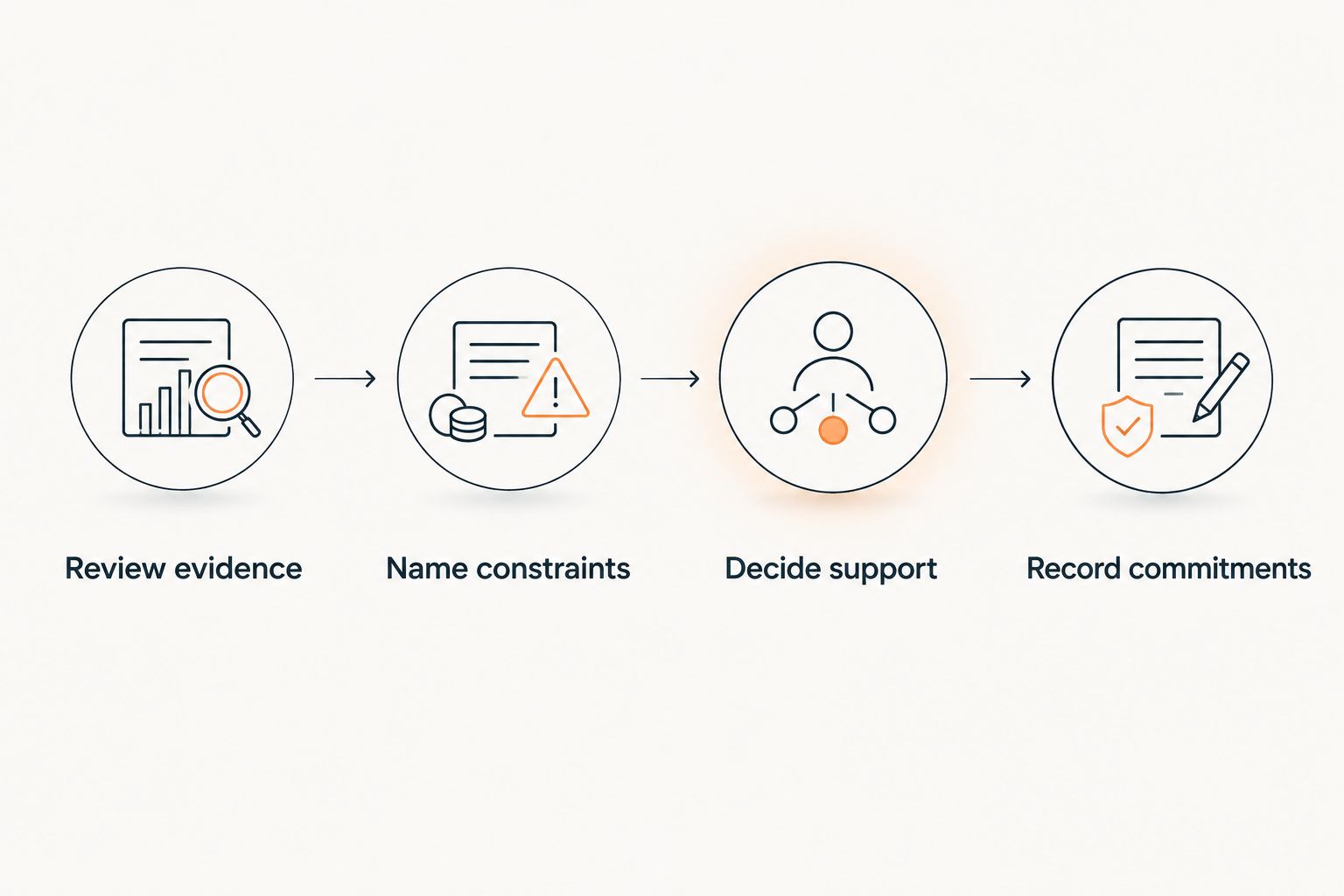
Use this sequence during your 2026 cycle:
- Review evidence. Bring the latest observation or measure supporting the progress update, including uncertainty that needs attention.
- Name constraints. Identify the dependency, capacity conflict, or operating issue affecting the objective.
- Decide support. Agree what help is needed and who has authority to provide it.
- Record commitments. Capture the agreed action where the team can find it before the next check-in.
The sequence is one habit inside the wider discipline of running the program. It depends on people reporting honestly and leaders responding when the evidence creates an uncomfortable conversation.
If the same unresolved constraint returns every week, put the resourcing decision back with the sponsor. Repeated updates cannot supply missing authority or working time.
OKR Leader is best for teams seeking OKR software to manage cycles and track strategic goals. Its cycle management, dashboards, and integrations support that work; protected capacity and leadership decisions remain responsibilities of the organization.
Can a team track fewer than three objectives?
Three objectives is a starting ceiling, and a shorter list is appropriate when capacity requires it. A team restarting after a difficult rollout can choose a smaller commitment while it establishes ownership and a usable weekly cadence.
Keep the decision explicit. Explain which strategic bet the team will pursue, what operational responsibilities remain, and which requests will wait for another planning conversation.
A shorter list still needs outcome evidence and leadership support. The objective count cannot compensate for an owner who lacks time to work on it.
Should every department have the same objective count?
Three objectives can serve as a shared planning ceiling without becoming a quota for every department. Each department needs to account for its delivery responsibilities and dependencies before approving its own list.
Compare commitments across teams during planning. A department with available capacity can still depend on a team whose quarter is already committed, and that dependency needs agreement before either side promises the outcome.
What should happen when a priority arrives mid-quarter?
Three approved objectives already represent a capacity commitment. When a new priority arrives, leadership needs to review the existing list and agree how the commitment changes.
Record the new priority and the work affected by it. Explain the change to the people responsible for delivery, including any objective that pauses or moves to another cycle.
This gives the team a current agreement to work from. The original planning document remains useful as a record of what changed during the quarter.
Expect the first cycle to need repairs
Your first cycle in 2026 deserves room for rework. Objectives can need revision, Key Results can expose measurement problems, and the weekly cadence can take time to settle.
At launch, adoption is the priority: do people return to the program during the working week? Review whether owners update progress and whether leaders respond to the issues those updates reveal.
Keep OKR scores separate from performance reviews. When a score affects pay, safe commitments become attractive and honest reporting becomes harder to sustain.
The value compounds over several quarters of practice. OKR Leader's software can support the cycle, while the organization builds the behavior that keeps it useful.
One last thing: name what will wait
Before approving the quarter, give deferred work a visible home. Include the reason it is waiting and the condition under which leadership will reconsider it.
That record helps a team lead explain a boundary when another request arrives. It also gives the requester a concrete answer they can discuss with the sponsor.
Worth trying this week: bring the proposed objectives and a list of work that will wait to the same planning conversation. Leave time for the people doing the work to challenge the capacity assumptions.
Related guides
FAQ
How many objectives per quarter should my team choose?
Start with three objectives per team per quarter as a ceiling. Reduce the list when the team cannot protect time and ownership for every objective.
Is five objectives too many for a team?
Five objectives requires an explicit capacity review. Check shared people, dependencies, and the work that will leave the quarter before approving the list.
What should we do if our draft has six objectives?
Six objectives should return to a prioritization conversation before approval. Review strategic relevance and record which work will wait.
Should routine operational work become a quarterly objective?
Monitor routine operating health through health metrics with agreed responses. Select quarterly objectives for strategic bets, while recognizing that deteriorating health metrics can require those bets to pause.
Can we change an objective during the quarter?
Yes, revise the commitment when priorities or operating conditions change. Record the reason and agree which existing work is affected.
Should OKR scores affect employee performance reviews?
Keep OKR scores separate from performance reviews. Connecting scores to pay encourages safe commitments and makes honest reporting harder.
Will OKR software solve a team having too many objectives?
Objective count requires a leadership decision about priorities and capacity. OKR Leader provides OKR cycle management, dashboards, and integrations; the organization still needs to resource the work and respond during check-ins.
What should we expect from our first OKR quarter?
Expect a messy first cycle with objectives needing revision and a cadence that takes time to settle. Focus on adoption at launch and build the discipline over several quarters.