
One person should own only the objectives they can actively advance and review each week; the right count depends on their workload and authority. For your 2026 plan, use 3 focused objectives as a team planning ceiling, then distribute ownership according to capacity, with protected time and support attached to each assignment.
- How many objectives should one person own? Assign ownership according to capacity, decision authority, and weekly attention.
- OKR Leader recommends treating 3 focused team objectives as a ceiling when allocating personal ownership.
- Count contributions and operational responsibilities before assigning another objective.
- Protect weekly check-ins and keep OKR scores separate from performance reviews.
Ownership needs room in the working week
An objective can look manageable on a planning slide while requiring decisions across several departments. The person named beside it needs enough time to notice stalled progress, resolve dependencies, and ask for help.
Picture Tuesday morning: the objective owner has a customer escalation, a hiring interview, and an unresolved dependency waiting for another department. The objective still has a name beside it. Its owner needs a realistic route to moving it forward.
For your 2026 planning discussion, review the person's existing commitments before adding ownership. A guide to OKR tracking software can support the tooling discussion once you have agreed who will maintain progress and act on it.
How many objectives should one person own at a time?
Assign the smallest set of objectives that gives someone responsibility for a strategic outcome they can influence. A personal allocation should fit inside the team's priorities and the person's actual working capacity.
OKR Leader's planning position favors 3 focused team objectives over 6 objectives that receive little attention. That recommendation applies to the team portfolio; individual ownership needs a separate capacity assessment.
Use this sequence when allocating objectives:
- Confirm the team's priorities. Agree which strategic bets deserve attention during the cycle, including their connection to profitable growth or another stated destination.
- Review existing responsibilities. Include operational work and contributions to other teams' objectives before assigning ownership.
- Check decision authority. Establish which choices the proposed owner can make and which require leadership support.
- Protect execution time. Agree what work will pause or leave the person's workload so the objective has room.
- Test the weekly commitment. Confirm that the owner can review evidence, raise obstacles, and follow through between check-ins.
An allocation that fails this test needs revision before the cycle begins. Moving a name between rows leaves the underlying capacity problem unresolved.
Ownership and contribution need different expectations
Someone can own an objective while relying on several colleagues to deliver work. The owner remains accountable for keeping the objective moving and making its condition visible.
A contributor needs a specific commitment and a route for raising difficulties. Recording that contribution helps you see workload that an ownership count misses.
| Responsibility | Best for | Benefit | Trade-off to manage |
|---|---|---|---|
| Objective ownership | Someone with authority and protected time to coordinate a strategic outcome. | A named person maintains attention and raises obstacles. | Ownership requires follow-through beyond reporting a score. |
| Objective contribution | Someone delivering defined work that supports an objective. | Several people can contribute relevant skills. | Contributions across teams can crowd the person's calendar. |
| Health metric monitoring | Someone responsible for protecting ongoing business performance. | Operational risks retain attention throughout the cycle. | Urgent operational problems compete with strategic work. |
The table gives you a workload conversation. Ask each person to describe what these responsibilities require during an ordinary week and during a difficult one.
Personal ownership varies with the work behind it
A raw count leaves out the effort required to keep an objective moving. Use these factors to decide whether an assignment fits:
- Available capacity determines what receives attention. Include customer commitments, management responsibilities, and recurring operational work in the discussion.
- Decision authority determines how progress happens. An owner needs access to someone who can resolve choices outside their remit.
- Dependencies create coordination work. Objectives involving several teams require time for agreements and follow-up.
- Leadership support affects execution. Protected time, sufficient people, and a budget for the program need explicit approval.
- Business health changes the workload. Cash, churn, uptime, fulfillment, and quality need continuing attention, including during an OKR cycle.
- Program maturity affects the support required. A first cycle needs room for rewriting Key Results and settling the check-in habit.
During your 2026 allocation review, ask which factor is putting the greatest pressure on each proposed owner. That answer gives you something specific to change.
For example, a dependency problem needs an agreement with another team. A capacity problem needs work removed, postponed, or reassigned. Giving both problems the same response leaves the owner carrying unresolved work into the cycle.
Separate strategic bets from business health
Name your health metrics before allocating strategic objectives. These are the measures you must defend continuously, such as cash and service quality.
Then identify the changes you want this cycle to achieve. An objective should have a place in that strategic discussion, with an owner who understands the intended outcome.
The distinction affects capacity directly. A department head responsible for stabilizing an operational problem already has a substantial commitment, even when that work sits outside the OKR list.
Pausing an objective is a responsible option when a health metric requires immediate attention. Make that change visible and agree what would allow strategic work to resume.
A useful planning conversation asks what success would require from the same person in both areas. If protecting ongoing performance already consumes their available attention, revise the proposed objective allocation.
This is also where profitable growth belongs in the discussion. An objective that increases revenue needs scrutiny of the work required to deliver it and the effect on profit. The owner needs access to the measures that reveal those consequences.
Use a capacity review before adding another objective
A capacity review should produce a decision about work. Bring the proposed owner's current responsibilities into the discussion and walk through the sequence below.
List commitments
Write down objective ownership alongside contributions to other objectives. Include operational responsibilities that compete for the same time.
Ask the person to explain where the work lands in their week. A commitment that has no place on the calendar deserves further discussion before approval.
Check authority
Ask which decisions the owner can make independently. Record the leadership support required for decisions involving another team's capacity or budget.
An objective spanning departments needs an agreed escalation route. The owner should know whom to approach when progress depends on a choice they cannot make.
Free capacity
Agree what will leave the workload when a new objective enters it. Options include pausing a lower-priority initiative or reassigning an existing commitment.
Keep that agreement visible. Otherwise, the person carries the new objective alongside work that everyone assumed would somehow continue.
Review weekly
Use the weekly check-in to examine progress and choose the next action. A stalled Key Result needs a discussion about evidence, obstacles, and the help required.
The owner should leave knowing what they will do before the next review. Leadership should leave knowing which support commitments belong to them.
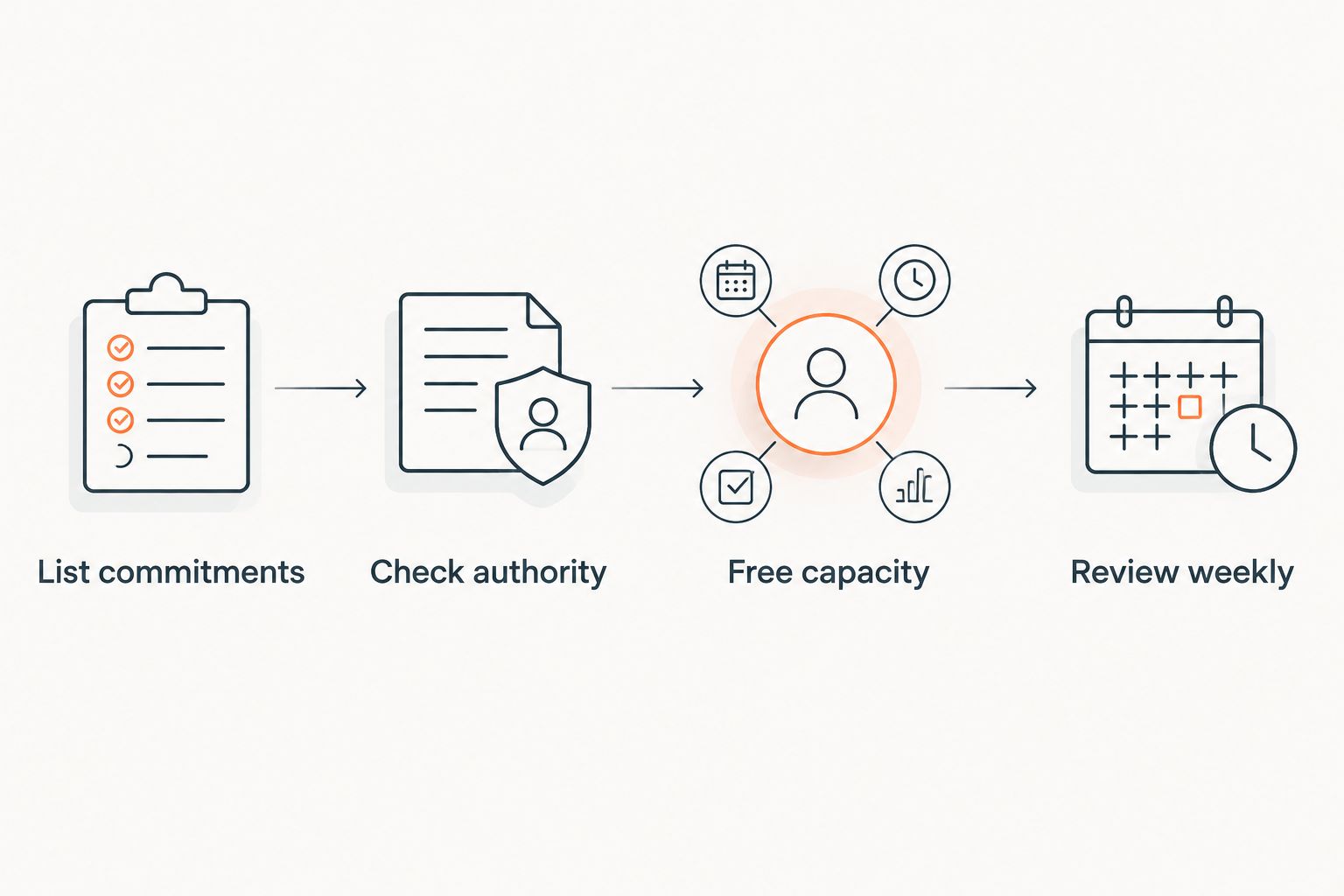
Use this sequence during your 2026 planning conversations and revisit it when responsibilities change. The review becomes useful through repeated decisions about capacity across the cycle.
A dashboard needs someone who acts on it
Software can hold the objective and its progress information in a shared place. The organization still needs an owner with time to act and leaders who respond when support is required.
OKR Leader is best suited to teams seeking OKR management software with cycle management, dashboards, and integrations. Its scope fits teams that want those activities supported in a platform; adoption and leadership follow-through remain ongoing responsibilities.
You can review OKR Leader when evaluating that fit. Before choosing software, agree who will maintain updates and what decisions the weekly check-in should produce.
Can one person own every objective on a team?
One person can be named across a team's objectives, but that allocation needs the same capacity and authority review as any other assignment. Examine whether the person can actively advance each outcome while supporting their existing responsibilities.
A leader who approves the entire portfolio also has responsibilities for resourcing and resolving conflicts. Discuss those commitments explicitly when deciding whether that leader should take operational ownership too.
Should everyone have an individual objective?
Give someone an individual objective when a distinct strategic outcome warrants their ownership and they have capacity to carry it. Contributions to team objectives can also give people a defined role in the cycle.
Requiring personal objectives across the organization creates an additional planning obligation. Check that each proposed objective connects to the strategy and receives attention during the working week.
Keep the first cycle small enough to learn from
Expect a messy first cycle. Some objectives will need adjustment, Key Results will need rework, and the check-in cadence will take practice.
During an early rollout, watch whether people use the program between planning meetings. A dashboard that gets opened on Wednesday gives you a better adoption conversation than a polished launch presentation.
For your 2026 rollout, protect time for that learning. Review ownership when the work reveals a capacity problem, and record the reason for changing the allocation so the next cycle starts with better judgment.
Keep OKR scores separate from pay and performance reviews. People need room to report difficulties honestly; attaching compensation to the score encourages safer commitments and makes the workload discussion harder.
The value develops over several quarters through repeated planning and follow-through. A smaller ownership allocation is one habit within that discipline, alongside leadership support and attention to business health.
One last thing: review the objectives someone helps deliver
Before assigning another objective, ask where the person is already contributing. A colleague who owns little on paper can still be carrying dependencies for several teams.
Bring those commitments into the same capacity discussion. Worth trying this week: invite an objective owner to show the work sitting behind their name, including the help they have promised elsewhere.
Related guides
FAQ
How many objectives should one person own?
Assign only the objectives the person has the capacity and authority to advance and review weekly. Use the team’s strategic priorities to set the portfolio, then assess personal workload before distributing ownership.
Does the guidance of 3 to 5 objectives apply to each employee?
The 3 to 5 objectives guidance referenced here concerns the team portfolio. Treat that range as a ceiling when planning, then allocate individual ownership according to capacity.
Is 3 objectives too many for one person?
Three objectives requires a capacity review before you assign them to one person. Examine operational responsibilities, contributions elsewhere, and the coordination each objective needs.
Can an objective have several people working on it?
An objective can have several contributors and a named owner responsible for maintaining progress. Agree what each contributor will deliver and how unresolved dependencies will reach the owner.
How often should an objective owner review progress?
Review progress weekly and use the check-in to agree the next action. The owner needs protected time between reviews to follow through and raise obstacles.
Should OKR ownership affect someone’s performance rating?
Keep OKR scores separate from performance ratings and pay. That separation supports honest reporting and gives people room to discuss difficulties without protecting a compensation-linked score.
What should I do when someone already owns too much?
Review the person’s full workload and agree which commitments to pause, reassign, or remove. Confirm leadership support for the remaining objectives and revisit capacity during weekly check-ins.