
Tuesday’s project board is current, yet the objective review still needs someone to explain what changed. Build your monday.com okr integration around a named owner and an agreed outcome measure, using the project board as evidence for the weekly OKR check-in.
- Start your monday.com okr integration with an owner-reviewed handoff before adding automation.
- OKR Leader suits teams managing strategic goals through OKR cycles and dashboards.
- Map project work to an outcome measure; a completed task alone cannot establish customer or business impact.
- Keep health metrics visible and give every strategic update a source and measurement date.
Project progress needs an outcome review
A launch checklist can be complete while customer adoption stays flat. Your monday.com board holds useful evidence about delivery; the objective review needs the outcome measure and a decision about the work ahead.
OKR Leader is best for teams that need OKR software to manage strategic goals through cycles and dashboards. Use OKR Leader as the goal-management layer in this workflow, with monday.com supporting project execution.
The sequence below describes an owner-reviewed handoff. Automated transfer belongs in the workflow only after you verify a supported connection and its behavior in your accounts. Treat this as your 2026 operating design, with any connector setup governed by its current documentation.
The awkward moment is familiar: someone asks why the objective is green, and the owner opens a board full of completed tasks. Good teams arrive there because delivery evidence is easier to collect than outcome evidence. A deliberate handoff gives the owner room to explain both.
Before you start: agree who can change the score
- Confirm access to the relevant monday.com board and permission to maintain the corresponding objective and Key Result in the destination workspace. Include the person responsible for the outcome measure.
- Bring the current cycle dates, the measurement source and an agreed definition of success. Separate health metrics, such as cash or service quality, from this cycle’s strategic bets.
- Resolve the measurement mismatch before setup: a project’s completion percentage and a Key Result’s outcome value answer different questions. Approve a calculation before any automated write reaches a live score.
Protect time for the owner’s review and identify a backup. A program supported by one person’s spare minutes becomes fragile when that person takes leave.
Expect a messy first cycle. Some objectives will need editing, and measurement definitions will need work; the value builds over several quarters as the review habit settles.
Choose the handoff your team can maintain
The two workflow variants share the same mapping and ownership rules. Their maintenance burden differs.
| Workflow | Best for | Advantage | Limitation |
|---|---|---|---|
| Owner-reviewed handoff | Teams establishing their measurement rules. | The owner checks evidence and explains changes before updating the KR. | Updates depend on protected review time. |
| Automated handoff after verification | Teams with a supported connection and a stable measurement rule. | A verified transfer can remove repeated data entry. | Permissions, mapping changes and failed transfers need ongoing attention. |
Start with the owner-reviewed handoff for the first 2026 cycle. Add automated transfer after the team can reproduce the same value from the agreed source and explain what the value represents.
Software helps organize the work. Leadership still has to protect time for it, resolve competing priorities and return to the objectives during the cycle.
Outcome mapping: give each project a strategic destination
Use a working document to define the relationship before changing either system. The labels below are suggested document headings, not application interface labels.
- Select the strategic bet. Choose one objective already approved for the cycle. Keep the initial workflow narrow enough that the owner can review every linked project.
- Identify the outcome measure. Record the baseline, target and measurement period for its KR. Include the source used to obtain the current value.
- List the supporting projects. Record which monday.com projects contribute to that outcome. Explain the expected contribution in a sentence.
- Assign the owner. Give one person responsibility for validating the measurement and maintaining the KR update. Record who covers that responsibility during absence.
- Set the review date. Agree when the evidence will be reviewed and when the next update is due. Use the same cycle boundaries throughout the mapping.
For a hypothetical onboarding objective, a project might deliver revised welcome messages. The outcome measure might track successful activation using your organization’s agreed definition. Completing the messages establishes that the deliverable exists; activation data establishes what happened afterward.
Keep the mapping small. Three objectives should be a ceiling to question, and adding another objective needs an explicit conversation about capacity.
Expected result: every selected project has a documented connection to a KR, with an owner and a measurement source that another person can locate.
Evidence handoff: make the update reproducible
Prepare one review record for each KR. This record can live in your working document; use destination fields only where your account supports the information you need to retain.
- Record the source. Identify the relevant board and the underlying outcome report. Include enough detail for the backup owner to find both.
- Record the observed value. Copy the outcome measurement using its agreed unit. Preserve the measurement date alongside the value.
- Check the calculation. Reproduce any percentage or aggregate from the source records. Define which records belong in the calculation and how missing observations are handled.
- Add the explanation. Describe the change in delivery evidence and the movement in the outcome measure. Record any uncertainty that affects interpretation.
- Review the destination update. Have the responsible owner check the value and context before entering the approved update through the destination’s supported editing process.
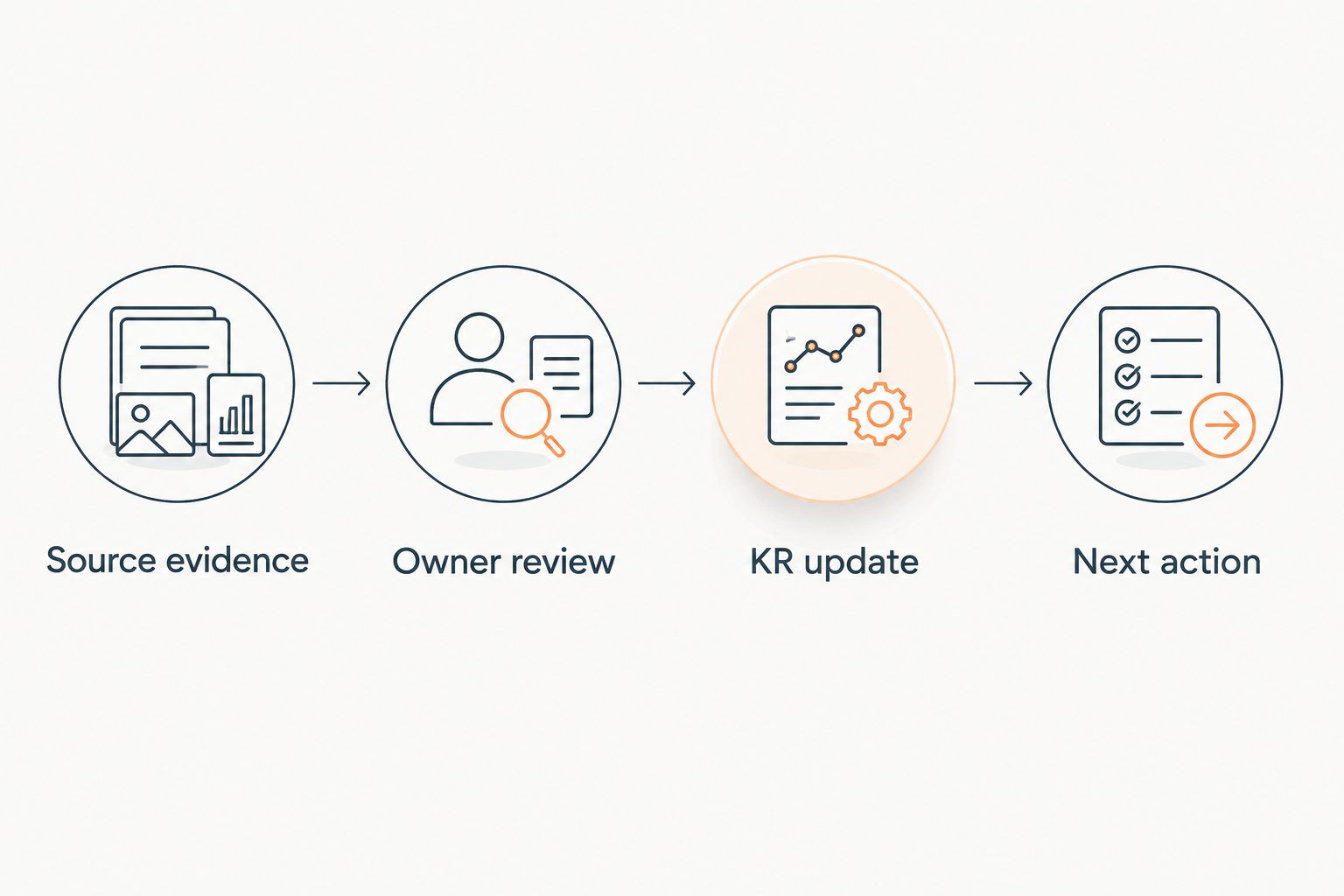
Use these review-record headings to keep the handoff readable:
- Source evidence: Identify where the measurement came from.
- Owner review: Record who checked the value and its interpretation.
- KR update: Retain the approved value with its measurement date.
- Next action: State the decision and who will carry it out.
A 2026 cycle label alone cannot establish freshness. A measurement collected before the latest release still describes the earlier period, even when someone enters it today.
Expected result: a second person can trace the update to its source and reproduce the value without asking the original owner to reconstruct it.
Weekly review: turn the evidence into a decision
The weekly check-in is where this workflow earns its place. A transfer that fills a dashboard still leaves the team responsible for deciding what to change.
- Reserve 15 minutes for a pilot review. Treat that duration as a starting schedule for one objective, then adjust it to the discussion the team needs.
- Read the measurement first. Confirm the observed value and its date. Ask the owner to explain any change in the definition or source.
- Inspect the project evidence. Review the work that supports the objective. Surface dependencies that the owner cannot resolve alone.
- Agree the next action. Write down the decision, responsible person and review date. Remove work from the plan when the evidence no longer supports its contribution.
- Check the health metrics. A serious cash, quality or service problem deserves explicit attention. Pausing a strategic bet can be the responsible choice while the team restores business health.
For your 2026 pilot, schedule a review after 2 weekly check-ins. Ask whether owners can find the source and whether the discussion produces decisions. That is a process check, not a claim about how quickly business results will arrive.
Keep OKR scoring separate from pay decisions. A person whose compensation depends on the score has a reason to choose safer targets or soften bad news, which damages the evidence this workflow needs.
Expected result: the check-in ends with an owned action and a date for reviewing it. The project board continues to support delivery, while the objective discussion stays connected to outcomes.
Updated measurements can use a verified automated handoff
A second variant becomes useful when the same approved measurement changes repeatedly and your accounts support a documented transfer route. Verify the route before designing around it.
- Confirm the connection. Check the current documentation or support guidance for the exact source, destination and action you need. Establish whether the route supports reading evidence, writing a value or both.
- Define the event. Specify what makes an update eligible for transfer. An approved outcome measurement is a suitable candidate when its definition and scope remain stable.
- Restrict the destination. Map the source to the intended KR and cycle. Give the connection only the access required for that action.
- Run 3 test updates. Use a changed value, a repeated value and a missing value. Compare each destination result with the written rule before enabling live use.
- Assign exception handling. Decide who checks failures and how the owner completes the handoff while the connection is unavailable.
Do not infer a native monday.com connector, two-way synchronization or particular automation controls from the existence of integrations in an OKR product. Each capability needs its own confirmation.
For a 2026 rollout, keep the approved manual process available as a fallback. Automation carries an ongoing maintenance obligation when board structures or access permissions change.
Troubleshooting: repair the source of the mismatch
A completed project changes the outcome score
Inspect the mapping rule. Remove any direct conversion from delivery status to an outcome value unless that relationship is explicitly part of the approved KR definition. Ask the owner to enter the measurement from its agreed source.
The dashboard shows a recent update with old evidence
Compare the measurement date with the entry date. Retain both in the review record and explain the reporting delay during the check-in. A newly entered observation still belongs to the period it measures.
Two projects contribute to the same measurement
Define the aggregation before combining values. Use a shared outcome source when both projects affect the same population, and document how overlapping records are handled. Summing project percentages does not establish a valid business outcome.
A transferred value appears twice or lands in another cycle
Pause automated writes and inspect the destination mapping. Check how repeated events are handled using the connection’s documented behavior, then repeat the test with a sample update. Resume only after the intended KR receives the expected value once.
The numbers are current and the meeting changes nothing
Review the meeting record for decisions and follow-through. Ask which dependency needs leadership help and which activity the team can remove. More frequent data entry will not resolve an unresolved priority conflict.
Extend the workflow after ownership holds
Add another objective when the existing handoff has a dependable owner and a usable source. Reuse the review discipline while adapting the measurement rule to the next strategic bet.
Avoid copying a generic OKR set into the workflow. Vet each objective against your mission and strategic priorities, including the team strengths or weaknesses the work addresses.
Related guides
- How much time should teams spend on weekly OKR check-ins?
- How many objectives should a team track per quarter?
One last thing: test the handoff during an absence
Ask the backup owner to reconstruct one update using the review record. The exercise exposes an undocumented measurement rule quickly, especially when the regular owner has been filling gaps from memory.
That is a useful test for an OKR Leader workflow before expanding it across departments. Worth trying this week with one objective and the person who would cover the next check-in.
FAQ
How do I set up a monday.com okr integration?
Begin by mapping a monday.com project to an approved objective and KR, then assign an owner to validate the outcome measurement. Establish an owner-reviewed handoff before adding a documented automated transfer.
Does OKR Leader have a native monday.com integration?
Confirm native monday.com connectivity directly with OKR Leader before planning automated setup. Verify the supported actions and transfer direction for your account; this guide describes an owner-reviewed workflow.
Can completed monday.com tasks update an OKR score?
Task completion can support a KR defined around that delivery measure. An outcome-based KR needs its agreed outcome measurement, such as adoption or quality, before the owner changes the score.
What is the best workflow for a first OKR cycle?
An owner-reviewed handoff is the recommended starting workflow when measurement rules are still being established. Keep the scope small and expect to revise objectives and review habits over several quarters.
Can I automate updates whenever a measurement changes?
Automate measurement updates only through a verified connection that supports the required destination action. Test changed, repeated and missing values, and retain an owner responsible for exceptions.
How often should the team review project-to-objective progress?
Use a weekly check-in as the starting cadence for reviewing evidence and deciding the next action. The underlying measurement schedule should follow the agreed source and record when each observation was collected.
Should OKR scores feed employee performance reviews?
Keep OKR scores separate from pay decisions. Linking compensation to the score creates an incentive to set safer targets and weakens honest reporting about strategic progress.