
Yes, OKR software can support a documented pause when a failing health metric needs the team's attention, provided the workflow preserves the goal's history and records who will authorize a restart. When Tuesday's check-in becomes a conversation about lost customers or service failures, the useful response is an explicit change in priorities, with protected time for recovery. A pause status alone leaves the staffing decision unresolved.
- Pause OKRs to fix failing health metric problems when recovery requires capacity committed to strategic goals.
- Keep the original target and record the pause reason, recovery owner, and restart conditions.
- OKR Leader supports OKR management; confirm pause controls and history handling before relying on them.
- Resume strategic work after reviewing recovery evidence and available capacity.
Can OKR software support pausing goals to fix a failing metric?
Yes, when the software supports an explicit record of the pause and the team changes its workload accordingly. Your 2026 operating rules should explain who can suspend an objective, how recovery gets reviewed, and what happens to its score.
Start by tracking health metrics separately from OKRs. Cash, churn, uptime, fulfillment, and quality are vital signs to protect; the OKRs describe this cycle's strategic bets.
Use this decision table when a health metric crosses an agreed intervention threshold. These are operating choices, and the software demonstration should show how each choice is recorded.
| Response | Best for | Benefit | Cost or limitation |
|---|---|---|---|
| Continue the objective | A contained issue with a staffed recovery plan | Preserves progress on the strategic bet. | Requires evidence that recovery has enough capacity. |
| Pause the objective | Recovery that needs people already assigned to the goal | Releases capacity and makes the trade-off visible. | Delays the strategic outcome and affects dependent work. |
| Revise the objective | A strategic assumption that has changed | Updates the commitment to match current conditions. | Requires a fresh agreement on scope and measurement. |
| Close the objective | A bet that leadership no longer intends to pursue | Removes an obsolete commitment from active planning. | Requires an explanation of unfinished work and consequences. |
A recovery discussion needs an owner with authority over resources. Otherwise, the objective can sit in a paused state while its tasks remain on everyone's calendar.
A failing vital sign can change the quarter's priorities
A team can have a credible strategic plan and still need to interrupt it. A customer issue becomes urgent, a delivery process breaks down, or cash pressure changes what the business can safely fund.
Picture the weekly meeting where everyone agrees that service quality needs attention. Then the original objectives stay active, the deadlines stay put, and the same people inherit the recovery work. Agreement has created another commitment.
A pause becomes useful when leadership names the work that will wait. That includes downstream commitments, reporting expectations, and any external promise that depends on the suspended goal.
For your 2026 cycle, distinguish a warning from a condition that requires intervention. The metric owner should explain the evidence, the likely business consequence, and the capacity needed to respond.
Software can make that discussion visible. Leadership still has to protect the time, provide enough people, and support the change repeatedly after the meeting ends.
Use a pause record that survives the next check-in
A workable pause has enough detail for someone outside the meeting to understand it. A short record attached to the objective keeps the decision accessible during recovery and at the cycle review.
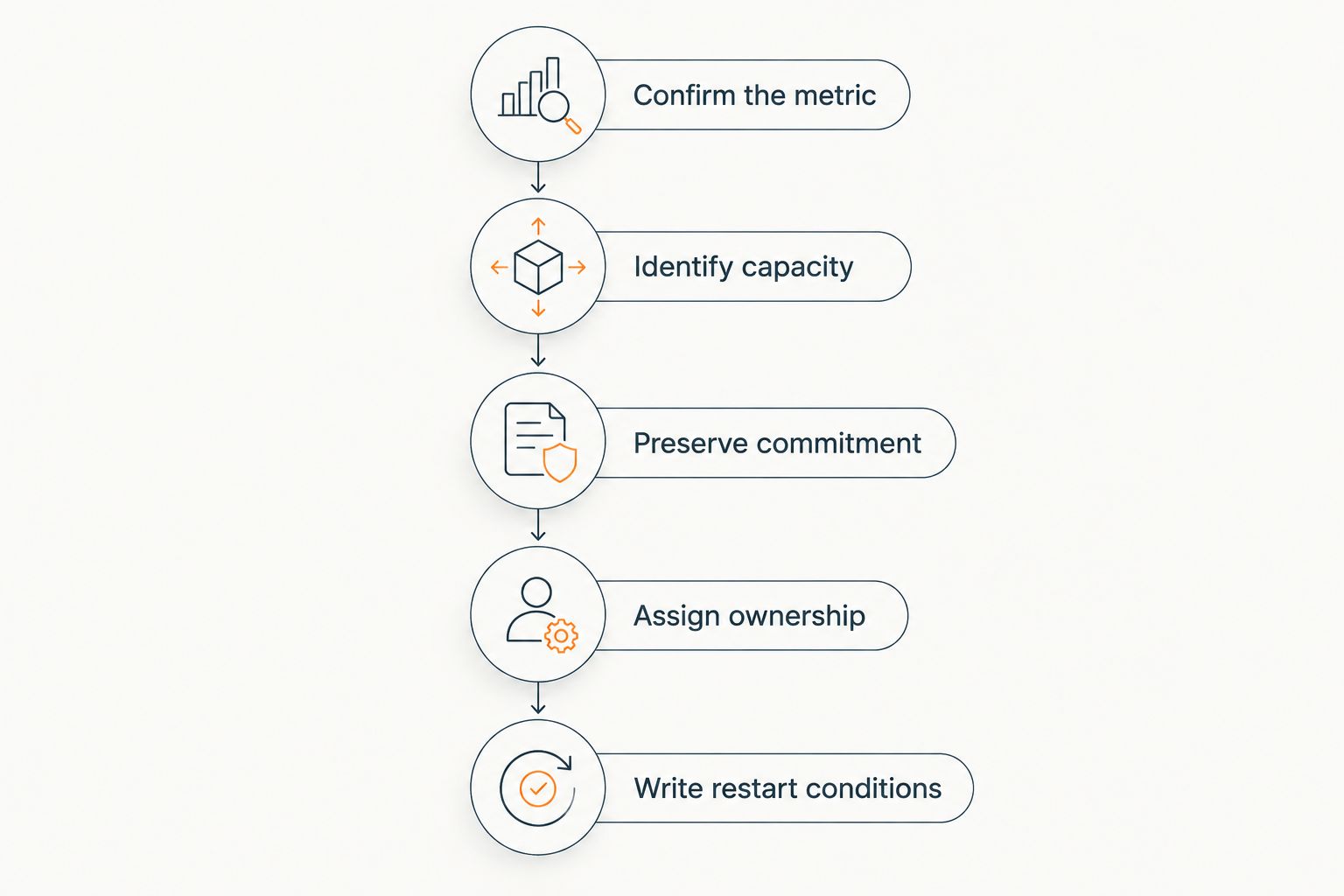
1. Confirm the metric and its consequence
Record the metric definition, its source, the latest observation, and the threshold your organization agreed to defend. Name the person responsible for checking that the data is current and comparable.
A metric crossing its threshold starts a discussion about intervention. The owner should establish whether the movement reflects a business problem, a reporting change, or an isolated event with a contained response.
For example, a change in how churn is calculated needs investigation before leadership reallocates the customer success team. No numerical threshold travels safely across businesses with different economics and customer relationships.
2. Identify the capacity conflict
List the recovery work and the people needed to carry it out. Compare that demand with the commitments attached to the affected objective.
The pause proposal should name what stops, who becomes available, and which dependencies need attention. A sentence such as “the implementation team will suspend the expansion experiment while resolving the fulfillment issue” gives the team something concrete to plan around.
Include work already underway. An objective can disappear from a dashboard while its meetings and requests continue consuming the same hours.
3. Preserve the original commitment
Keep the original objective, Key Results, targets, and recorded progress available. Add the pause reason and decision date so the cycle review can distinguish progress made before the interruption from work completed during recovery.
If the application has a dedicated pause state, test what it changes. Ask whether reminders continue, whether the objective appears in leadership reporting, and how the paused period affects scoring.
A documented convention can support the workflow when a native pause state is unavailable. Everyone who reads the dashboard needs to understand that convention.
4. Assign recovery ownership
Name a recovery owner who can coordinate the work and surface resource conflicts. Also identify the leader authorized to approve continued suspension or a restart.
The recovery update should cover the metric's condition, actions completed, unresolved obstacles, and the next decision needed. Keep strategic progress reporting separate enough that the team can discuss recovery honestly.
Leadership approval needs to include capacity. Endorsement with unchanged workloads leaves the owner negotiating the same trade-off throughout the week.
5. Write the restart conditions
Agree on the evidence needed to consider restarting the objective. Include a review date, the required metric condition, and a check that the recovery process can continue with the available staffing.
A review date creates a decision point; it carries no promise that recovery will be complete. At that review, leadership can continue the pause, revise the goal, close it, or authorize a restart.
Your 2026 pause record should make the next decision easy to find. Someone opening the objective on Wednesday should be able to see what happens next and who owns it.
The scope of a pause follows the recovery work
A failing health metric does not automatically require suspending every objective. Scope the interruption around the people, dependencies, and business exposure involved.
These factors belong in the discussion:
- Business exposure: Explain what the metric puts at risk, including customer commitments or the company's ability to operate.
- Shared capacity: Identify which recovery tasks need people already committed to strategic work.
- Dependencies: Show which other teams need to change their plans when an objective pauses.
- Recovery ownership: Establish whether the assigned owner has the authority and support to make progress.
- Evidence quality: Confirm that the metric definition and reporting support the proposed intervention.
- Strategic validity: Review whether the original objective still serves the company's direction after conditions change.
Protecting profitable growth can require slowing an expansion initiative while fixing fulfillment or customer retention. The decision should reflect the founder's intended destination and the economics of serving customers.
A pause also has a cost. Delayed learning, interrupted work, and dependent commitments deserve a place in the record so leadership can weigh them openly.
What should you check in an OKR software demonstration?
Bring a realistic scenario to the demonstration: an active objective has recorded progress, its owner is reassigned to recovery, and leadership needs to review the interruption later. Ask the vendor to show the complete sequence.
Your 2026 evaluation should cover these behaviors:
- The original target and previous updates remain accessible after a status change.
- The pause reason and responsible owner are visible to people reviewing the objective.
- Leadership can distinguish active commitments from suspended work.
- Reviewers can find the next review date and restart conditions.
- Dependent teams can understand how the interruption affects their commitments.
- The cycle review can explain how suspended objectives were treated in scoring.
These are evaluation criteria. Confirm each behavior in the application before building your operating process around it.
OKR Leader provides OKR management software with cycle management, dashboards, and integrations. OKR Leader is best for teams seeking a shared software workspace to manage strategic goals.
For this use case, OKR Leader's pause controls, history handling, and scoring behavior need confirmation during evaluation. The platform's role in organizing goals also leaves the resource decision with leadership, which must approve the time and staffing recovery requires.
How do you keep a paused objective from disappearing?
Keep a paused objective visible in the review process, with an owner and a next decision date. At each scheduled review, ask whether the recovery evidence supports continuing the pause or changing the plan.
An overdue review deserves attention even when the health metric remains under pressure. The team needs an updated agreement about workload and expectations.
For a first cycle, expect some untidy records and restart conditions that need revision. Objectives will need work, the check-in cadence will take practice, and the discipline develops over several quarters.
Adoption deserves attention at launch. If nobody opens the record between meetings, reduce the effort required to update it and check whether leaders use it when discussing priorities.
Should you change the original target after a pause?
Keep the original target available and record any approved revision alongside it. Leadership needs to understand both the initial commitment and the decision made after the interruption.
A revised target needs a reason tied to remaining capacity, changed conditions, or the strategic value of the work. Record who approved it and when the new commitment took effect.
Avoid tying the paused objective's score to pay or a performance review. That connection gives people a reason to hide disruption or negotiate safer targets, weakening the reporting needed to manage recovery.
What should happen when the health metric recovers?
Recovery should trigger a restart review that considers the evidence, available capacity, and the objective's continuing value. An improved reading is useful evidence, and the owner should also explain whether the underlying issue is contained.
Check the work waiting behind the pause. Customer commitments may have changed, another team may have moved on, or the original opportunity may no longer justify the effort.
When leadership approves a restart, update the workload agreement and communicate it to affected teams. Keep the interruption visible in the cycle history so the final review can explain what happened.
One last thing: make the displaced work visible
Before pausing an objective in your 2026 cycle, write down the commitment that will leave someone's working week. That detail tests whether the proposed pause creates usable capacity.
The uncomfortable part can arrive after leadership approves the pause: a stakeholder still expects the old deliverable on Friday. Give the objective owner explicit backing to explain the changed priority and renegotiate that commitment.
A software record helps that conversation, and repeated leadership support keeps the agreement credible after the urgency of the first meeting fades.
Related guides
FAQ
Can I pause OKRs to fix a failing health metric?
Yes, pause affected OKRs when recovery requires capacity committed to those goals. Record the reason, preserve the original commitment, and agree on recovery ownership and restart conditions.
Should every objective pause when a health metric turns red?
Pause scope should follow the recovery work and its capacity needs. Review the affected people and dependencies before deciding which objectives to suspend.
Does OKR Leader have a dedicated pause button?
A dedicated pause control needs confirmation during product evaluation. Ask OKR Leader to demonstrate status changes, retained history, reporting, and scoring behavior for an interrupted objective.
How long should an OKR stay paused?
An OKR should stay paused until leadership reviews the recovery evidence and available capacity. Set a review date when approving the pause and document the decision made at that review.
Should we delete a paused OKR?
Preserve a paused OKR’s original commitment and progress history for the cycle review. If leadership closes the objective, record the reason and explain what happens to unfinished work.
Should recovery become a new OKR?
Recovery needs an owner, a plan, and regular review. Decide separately whether there is a strategic improvement worth expressing as an OKR after addressing the immediate health issue.
Can we resume the goal as soon as the metric improves?
An improved metric should trigger a restart review. Confirm that recovery can hold, capacity is available, and the objective still supports the company’s direction before resuming work.
Worth trying this week: bring an at-risk health metric to the check-in and discuss which commitment would need to move if recovery required the team's time.