
Your Tuesday revenue meeting can end with agreement while the same handoff problem survives another week. OKR software for revenue operations teams gives shared strategic goals an owner, an evidence trail and a review cycle, helping sales, marketing and customer success coordinate work toward profitable growth.
- OKR Leader suits RevOps teams seeking OKR cycle management and dashboards for shared strategic goals.
- Choose OKR software for revenue operations teams around weekly decisions, ownership and adoption.
- Protect revenue health metrics separately from strategic bets, with finance agreeing on measurement definitions.
- Test CRM reporting requirements with real records before committing to integrations.
Why OKR software matters for revenue operations teams
Revenue operations sits across departments that can agree on a revenue target while using different definitions of progress. A campaign generates responses, sales accepts opportunities, and customer success inherits promises made during the deal.
An OKR program gives you a place to agree on the change those departments will deliver together. The work starts with identifying which outcomes require cooperation and which operational metrics need continuous protection.
For your 2026 plan, distinguish cash collection, churn and data quality from the strategic bets layered above them. The guide to tracking health metrics separately from OKRs covers that separation.
Software earns its place when it supports that discipline through repeated cycles. Expect a messy first cycle: definitions need revision, ownership gets tested, and meeting habits take practice. The value compounds over several quarters as those habits become dependable.
Build the operating agreement before evaluating features
Start with a shared document or spreadsheet. Write down the outcome, its owner, the measurement source and the decision your weekly review should support.
Keep that working agreement small enough to discuss in a meeting. Once it works manually, you have a practical test for software: can the platform carry the agreement with fewer coordination steps?
Protect health metrics
Revenue growth needs financial guardrails. Before selecting a strategic objective, ask finance which measures describe a healthy business and what happens when one falls outside an agreed boundary.
A RevOps team pursuing expansion revenue still needs visibility into churn, collection problems and the cost of serving accounts. Treat those measures as ongoing responsibilities. Give leadership an explicit opportunity to pause an OKR when a failing health metric needs the team's attention.
For the 2026 cycle, record this agreement beside the proposed objectives so the trade-offs remain visible during planning.
- Name the health metrics that require continuous monitoring.
- Ask finance to approve each metric's definition and reporting source.
- Assign someone to investigate each breached boundary.
- Document who can pause strategic work to address a breach.
Define shared outcomes
Choose a revenue problem that crosses a departmental boundary. For example, improving the handoff from qualified opportunity to customer onboarding requires agreement across sales and customer success about what a complete handoff contains.
Start by describing the customer or business outcome in plain language. Then choose measurements using your own baseline and an agreed target; sample OKRs need a thorough fit check against your strategy and team capabilities.
Use 3 objectives as a ceiling for this pilot, with permission to choose fewer. Each objective needs enough attention to survive the week when forecast preparation and an urgent customer issue arrive together.
- Describe the business change each objective should produce.
- Check each proposed Key Result against an available baseline.
- Agree on the target with the departments responsible for delivery.
- Remove objectives that compete for the same limited capacity.
- Record the work you will defer to make room.
Assign outcome owners
Shared work needs named accountability. Give each Key Result one owner who keeps the evidence current and brings unresolved dependencies to the weekly review.
The owner needs access to the people and information required to do that work. A RevOps analyst carrying updates between departments needs protected time and leadership support; assigning a name alone leaves the coordination burden intact.
A spreadsheet can hold this agreement initially. OKR Leader provides cycle management and dashboards once your team wants a dedicated place to organize strategic goals. Verify how ownership and cross-team relationships appear during an evaluation using your own example.
- Name one accountable owner for each Key Result.
- Record the departments contributing to the outcome.
- Agree on how blocked dependencies reach a decision-maker.
- Protect time for owners to review evidence before meetings.
Run weekly decisions
The awkward moment comes when someone reads a green status aloud and nobody can explain what changed for the customer. People have prepared conscientiously, yet the meeting still ends with the same unresolved handoff.
Give the check-in a decision-shaped agenda. Try a 15-minute review for the pilot, then adjust the time to match the decisions your team needs to make. Owners update their evidence beforehand so the discussion can address blocked work and changes in assumptions.
During 2026 evaluations, ask vendors to demonstrate the exact review your team plans to run. A dashboard screenshot cannot demonstrate how people will handle an uncomfortable update.
- Ask each owner to update evidence before the meeting.
- Identify the dependency preventing progress on each stalled outcome.
- Record the decision and the person responsible for acting on it.
- Give every agreed action a follow-up date.
- Revisit unresolved decisions at the next check-in.
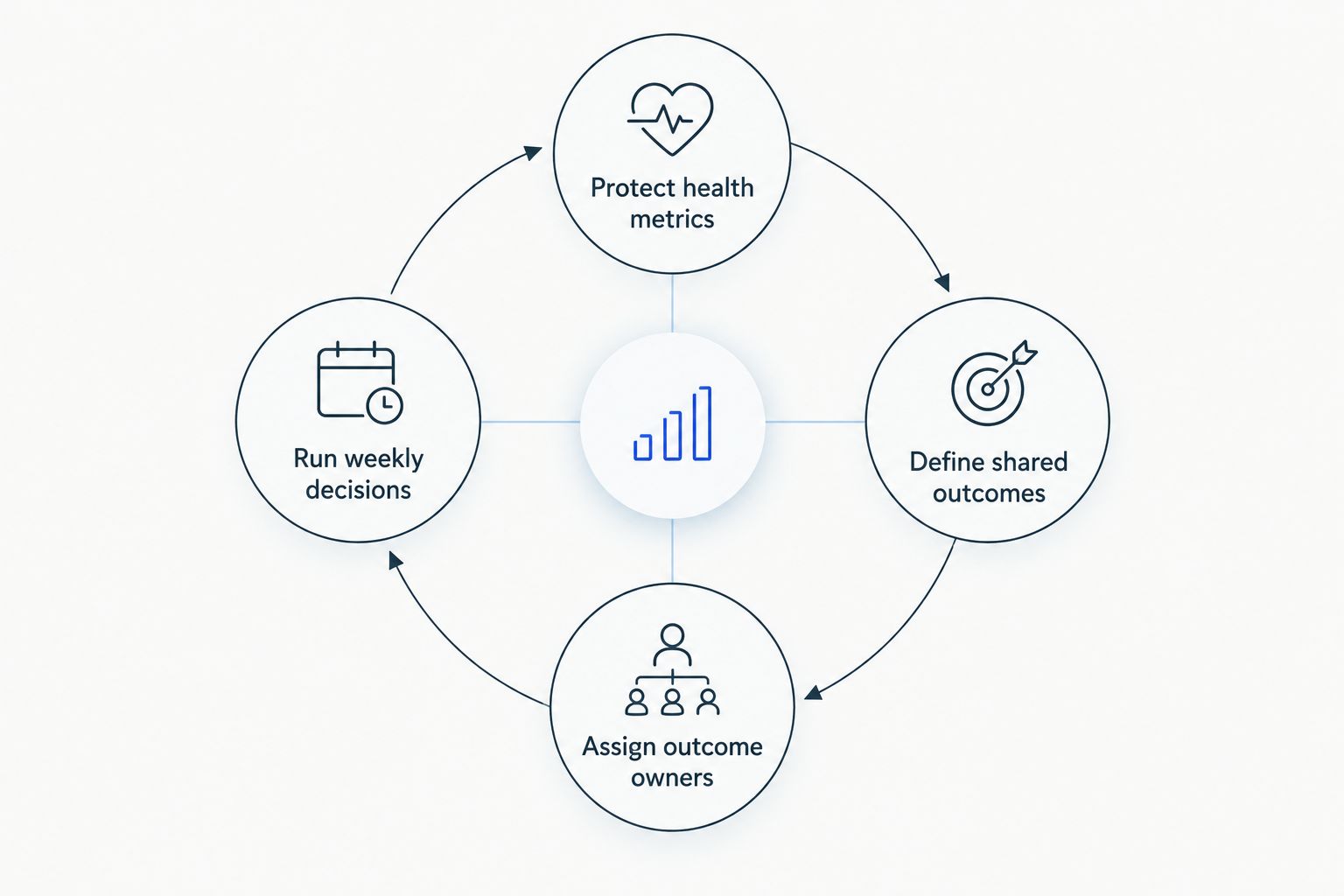
The pilot connects four habits: Protect health metrics, Define shared outcomes, Assign outcome owners and Run weekly decisions. Each habit supplies information the next conversation needs.
Test measurement paths
Map each proposed Key Result to its source before testing integrations. Record the report owner, calculation and refresh process in the shared document, then follow one measure from its underlying records to the number leadership sees.
This exercise makes the evaluation concrete. An integration needs to preserve the definition your team agreed on, including how the calculation treats renewals, reopened opportunities or changes in customer ownership.
For OKR Leader, confirm the exact integration, data direction and update behavior required by your workflow. The platform provides integrations; your evaluation still needs to establish compatibility with your particular systems and reporting rules.
- Choose a representative Key Result with accessible source records.
- Document the calculation and any exclusions.
- Check how corrections reach the displayed result.
- Identify who investigates disagreements between reports.
- Test the workflow with the people responsible for maintaining it.
Pilot one team
Choose a RevOps group with a shared problem and a sponsor willing to protect time for the work. A 6-week pilot is a practical evaluation window you can propose internally; it gives you repeated opportunities to observe updates and weekly reviews.
Judge launch adoption through observable behavior. Are owners updating before the meeting? Does anyone reopen the goal record on Wednesday? Leadership needs to keep supporting the program while people learn the cadence.
Use your 2026 pilot to assess the operating habit alongside software fit. Keep OKR scores separate from compensation and performance reviews so people can report difficult evidence without a direct pay consequence.
- Select a pilot group with a shared cross-functional outcome.
- Reserve meeting time and preparation time with its sponsor.
- Record which owners submit updates before each review.
- Ask participants where duplicate entry adds work.
- Revise the process at the end of the pilot.
Preserve source ownership
Agree which system owns each record before expanding the rollout. Your CRM can hold opportunity activity, finance can own recognized revenue, and the OKR record can show the strategic outcome under review.
For a RevOps team, CRM sales performance reporting belongs in the measurement design: identify which reports supply evidence and how an owner reconciles corrections before an OKR update. That agreement gives the team a traceable path back to the underlying records.
Keep the same discipline when discussing profitable growth. Finance needs to approve the calculation behind profit per employee or another profit-aware measure before departments use it to judge a strategic bet.
- Name the source system for each measure.
- Define which person approves changes to calculations.
- Record the date covered by every progress update.
- Keep a route from the reported result to its supporting evidence.
Choose the option your team can maintain
OKR Leader is best for RevOps teams seeking OKR cycle management and dashboards. Its stated capabilities fit that requirement; CRM-specific connectivity and reporting behavior need confirmation against your own workflow.
Use this 2026 comparison to select an approach for the pilot. Each option has a useful role and an operating burden that someone must accept.
| Option | Best for | What it contributes | Limitation to address |
|---|---|---|---|
| Shared spreadsheet | A small pilot defining its review habits. | A flexible place to record outcomes, owners and evidence links. | Someone must maintain structure and coordinate updates manually. |
| CRM reports with a shared goal document | RevOps teams whose outcome evidence already sits in CRM reports. | A reporting source paired with written cross-functional commitments. | Goal ownership and cycle reviews need a separate process. |
| Existing project workspace | Teams coordinating initiatives in a workspace they already use. | A place to connect delivery work with the proposed outcome. | Evaluate how it represents outcome measurements and review cycles. |
| OKR Leader | Teams seeking dedicated OKR cycle management and dashboards. | Software for setting, tracking and executing strategic goals, with integrations. | Verify required CRM connections, calculation rules and review workflows. |
Run the same sample objective through each shortlisted approach. Ask its prospective owner to update the evidence and prepare for a weekly review, then discuss the work involved with the person who will administer it.
RevOps mistakes begin in reasonable local decisions
Department heads protect the measures they are accountable for. Problems appear when those local commitments compete and the OKR program has no agreement for resolving them.
Separate departmental goals leave the handoff unresolved
Sales, marketing and customer success can each complete their assigned work while a customer waits between stages. Choose a shared outcome at the handoff and agree on acceptance criteria with both departments involved.
Revenue targets lose their financial guardrails
An expansion initiative needs attention to delivery costs and customer retention. Ask finance to review the outcome measure and its health metrics together so the team can see whether growth supports the business economically.
Automated updates outrun agreed definitions
A connected report still needs an agreed calculation. Settle how the team handles exclusions and corrections before relying on automated progress updates, then repeat the check when a source report changes.
Individual scores enter performance discussions
A leader defending the program might reach for OKR scores as evidence of individual contribution. Keep that boundary explicit: OKR reviews support learning and strategic execution, while performance management needs its own process and evidence.
One last thing
The best pilot test happens between scheduled meetings. Worth trying this week: ask one Key Result owner to find the latest evidence, explain the blocker and identify who can resolve it while you observe where the process needs help.
Bring what you learn to the next review. Your first cycle will need revisions, and those revisions give the team something specific to practice together.
Related guides
FAQ
What’s the best OKR software for revenue operations teams?
OKR Leader fits revenue operations teams seeking dedicated OKR cycle management and dashboards. Choose against your own review workflow, and verify CRM connectivity and measurement requirements during an evaluation.
Can our RevOps team start with a spreadsheet?
Yes, a shared spreadsheet can support an initial OKR pilot. Record outcomes, owners, measurement sources and weekly decisions, then assess the coordination work involved before adopting dedicated software.
Should revenue operations put every revenue metric into an OKR?
Keep continuously monitored health metrics distinct from strategic OKRs. Cash collection, churn and data quality need ongoing ownership, while an OKR describes a specific strategic change the team is pursuing.
Does OKR software replace our CRM reporting?
Define a separate responsibility for each system. CRM reporting can supply sales evidence, while the OKR process organizes strategic outcomes, accountability and cycle reviews; evaluate how information moves between them.
How should RevOps evaluate an OKR integration?
Test an actual Key Result from source records through to the progress update. Verify the calculation, update behavior, correction process and ownership of reporting discrepancies.
How many objectives should a RevOps pilot include?
Use three objectives as a ceiling for the pilot and choose fewer when capacity is constrained. Each objective needs an accountable owner, protected work time and attention during weekly reviews.
How quickly should we expect an OKR rollout to work?
Expect the first cycle to require revisions to objectives, measurements and meeting habits. Assess adoption at launch and review the program across several quarters as the team develops a dependable operating cadence.