
The board wants evidence of progress, and Tuesday’s leadership meeting still starts with someone rebuilding the numbers. Best overall for a dedicated OKR workflow: OKR Leader. Best for connecting goals to project delivery: Asana. Best for a document-led pilot: Notion. Best for a spreadsheet-led pilot: Microsoft Excel.
- OKR Leader is the best OKR software for venture-backed startups seeking dedicated cycle management and dashboards.
- Asana suits project-connected goals; Notion suits document-led planning; Microsoft Excel suits a spreadsheet-led pilot.
- Evaluate weekly check-ins and profitable growth alongside reporting requirements.
- Expect a messy first cycle, and protect time for adoption.
Your board report needs a working weekly routine
A venture-backed startup needs a way to connect its strategic bets with the work people can resource. Funding adds stakeholders to that conversation; your operating discipline still needs to fit your company.
For a 2026 shortlist, begin with the meeting where someone must explain a stalled outcome. Can the owner find the latest evidence, explain the blocker and request a decision while everyone is still in the room?
The familiar moment comes halfway through the meeting: someone opens the offsite presentation, then asks which version contains the current objectives. Good people have kept working. The shared record has fallen behind.
Software gives that record a home. Leadership still has to protect time for the work and respond when an owner raises a problem.
The best choice makes the weekly check-in usable
Use these criteria before comparing screens. Each one belongs in your evaluation because your program owner will have to defend the resulting workflow.
- Cycle management: You can set the planning period and preserve enough history to discuss what changed.
- Weekly updates: An owner can record progress, explain uncertainty and identify the next action during the working week.
- Leadership visibility: The reporting view answers the questions your leadership team asks about strategic outcomes.
- Work connections: Teams can explain how delivery work contributes to an outcome, including dependencies outside their department.
- Operating safeguards: Your process distinguishes strategic bets from health metrics and keeps OKR scores separate from compensation decisions.
- Administration: Someone can maintain the structure within the time your company has agreed to fund.
Treat these as demonstration tasks. A presentation about a feature leaves the practical question open: can your team use it with its own objectives?
The options at a glance serve different operating habits
This 2026 comparison ranks workflow fit. The options include a dedicated OKR platform and general-purpose software that can support an OKR process; their responsibilities differ.
| Rank and option | Best for | Standout capability | Main limitation or evaluation burden |
|---|---|---|---|
| 1. OKR Leader | A dedicated OKR program | Cycle management, dashboards and integrations | Your pilot must establish fit for the reporting and integration requirements you need. |
| 2. Asana | Connecting goals with project delivery | Goals alongside project and task management | Your team must define how completed work contributes to measurable outcomes. |
| 3. Notion | A document-led planning pilot | Pages and databases in a shared workspace | Your team designs and maintains the OKR structure. |
| 4. Microsoft Excel | A spreadsheet-led pilot | Formulas and tabular tracking | Your team owns the reporting model and update discipline. |
No option earns a recommendation through its feature count alone. Your selection should match the operating habit you can sustain when deadlines compete with check-ins.
1. OKR Leader: best OKR software for a dedicated program
OKR Leader provides OKR management software with cycle management, dashboards and integrations. That makes it the first option to evaluate when Strategy or Ops needs a dedicated place to set, track and execute strategic goals.
OKR Leader is best for venture-backed startups that want a dedicated OKR workflow with cycle management and dashboards. Your evaluation should use the objectives leadership already intends to fund, including one that depends on another team.
OKR Leader pros:
- Cycle management supports the planning periods around which your program runs.
- Dashboards provide a reporting capability to evaluate against leadership’s questions.
- Integrations give you a concrete area to assess against your existing systems.
OKR Leader cons and checks:
- Specific connector support and reporting requirements need confirmation during your evaluation.
- A dedicated platform adds a system for someone to administer and a routine for leaders to support.
Keep the demonstration grounded. Ask an owner to explain a stalled outcome using the dashboard, then show where the next action belongs. Check whether the view gives leadership enough context to respond.
Best for: A startup establishing a dedicated strategic-goal management process.
Verdict: Buy after a pilot confirms your required workflows.
2. Asana: best for connecting goals to project delivery
Asana combines project and task management with a Goals capability. It belongs on your shortlist when the practical problem is connecting strategic outcomes to the projects people are already delivering.
Bring a real delivery plan into the evaluation. Ask the project owner to explain which measurable outcome the work supports, then examine how that relationship appears to leadership.
Asana pros:
- Projects and tasks provide a place to organize delivery work.
- Goals provide a structure for connecting that work with broader objectives.
- A project-connected evaluation lets you examine dependencies alongside the intended outcome.
Asana cons:
- Task completion still requires interpretation before it becomes evidence of an outcome.
- Your team must define how goal updates and project updates fit into the weekly meeting.
A completed onboarding redesign, for example, records delivered work. Your Key Result needs evidence about the customer outcome you intended to change. The connection deserves an explicit owner.
During a 2026 evaluation, ask someone outside the project team to read the goal view and explain what needs attention. Their questions reveal where your reporting requires further work.
Best for: A startup that wants strategic goals closely connected with project execution.
Verdict: Buy when the project-to-outcome workflow passes your pilot.
3. Notion: best for a document-led planning pilot
Notion provides pages and databases that you can use to organize strategy notes, objectives and progress updates. It suits a pilot where the team wants planning discussions and the goal record in a shared workspace.
The flexibility comes with design responsibility. Someone must decide which fields belong in the database, how owners update progress and where decisions get recorded.
Notion pros:
- Pages give you room to keep strategic context beside the goal record.
- Databases let you structure objectives, owners and update fields.
- The workspace can hold planning notes and retrospective observations together.
Notion cons:
- Your team must build and maintain its own OKR conventions.
- Reporting quality depends on the database structure and the consistency of updates.
Start with your company’s strategic pillars and the decisions you need to make each week. A sample database deserves scrutiny before adoption: its example objectives need to fit your mission, resources and team strengths.
The test is a normal working Wednesday. Can an owner update the record quickly enough to keep using it, and can a colleague understand what changed?
Best for: A startup testing its planning and check-in habits through a document-led workspace.
Verdict: Hold expansion until the pilot demonstrates consistent use.
4. Microsoft Excel: best for a spreadsheet-led pilot
Microsoft Excel supports tabular tracking, formulas and charts. You can use a workbook to record objectives, owners, targets and progress while testing how your OKR process should run.
This option puts the design responsibility with your team. The person maintaining the workbook also owns its calculation logic and the structure leadership uses to interpret progress.
Microsoft Excel pros:
- Tables make the fields behind your tracking process visible.
- Formulas let you define calculations for the measures you choose.
- Charts provide a way to present selected progress data.
Microsoft Excel cons:
- Your team must maintain the formulas and reporting structure.
- A workbook requires an agreed process for ownership, updates and historical records.
Choose a specific review date for the pilot. At that review, examine how much preparation the workbook requires and whether colleagues can explain progress without its maintainer narrating every cell.
A spreadsheet-led pilot also exposes disagreements about measurement. Resolve those disagreements before carrying the same definitions into another system.
Best for: A startup testing its measurement model through a deliberately limited pilot.
Verdict: Hold as a pilot while you assess the ongoing administration.
A live working session reveals the workflow you will inherit
A 2026 software evaluation should include the meeting your program owner has to run. Use the same exercise for each shortlisted option so you can compare the work involved.
These are suggested pilot boundaries, not research benchmarks. Adjust them to fit the size of the group participating.
- Strategic bets: Choose up to 3 objectives for the participating team, with named owners and agreed measures.
- Health metrics: Identify the operating measures that need protection, such as cash, churn or service reliability.
- Weekly check-in: Run a 15-minute session in which owners explain changes and request help with blockers.
- Leadership response: Record who will act on a dependency, a resource conflict or a health metric in trouble.
- Cycle review: After 4 weeks, inspect update habits, preparation effort and decisions made from the record.
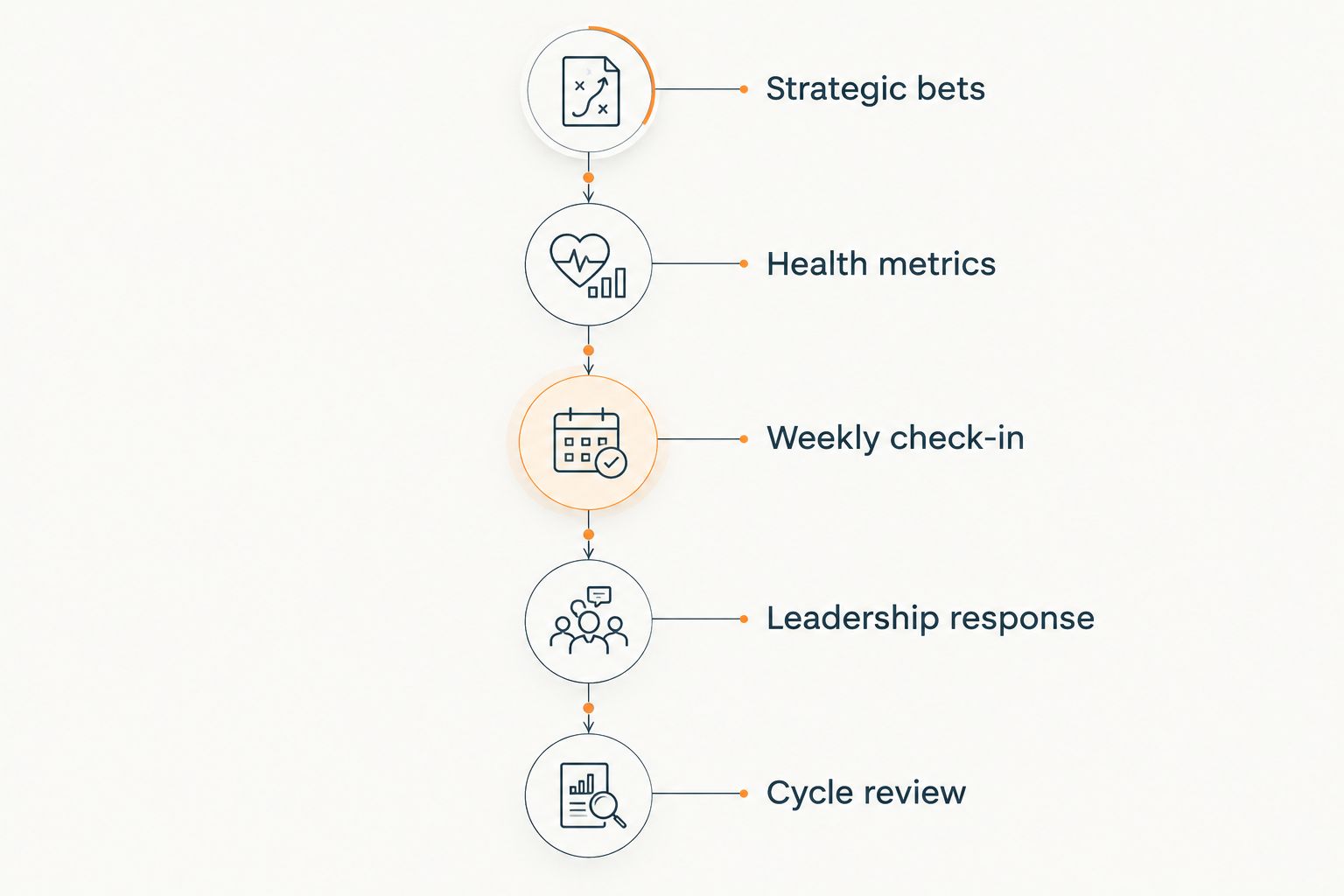
The limits make the evaluation manageable. Three objectives still require subtraction when the same people own delivery work, customer commitments and the pilot itself.
Expect a messy first cycle: objectives need edits, measures need rework and the cadence takes practice. Review the software alongside those habits over several quarters before treating either as settled.
Fund the routine alongside the software
Before approving a platform for 2026, name the person who will maintain the program and agree how much time the role requires. Leadership also needs to fund the work attached to the objectives.
A program owner cannot resolve a staffing conflict through a dashboard. When two teams depend on the same specialist, someone with authority has to change the plan or resource the work.
Agree how the company will respond when a health metric deteriorates. Cash or service reliability can require immediate attention, including a pause in strategic work.
Keep OKR scores separate from pay decisions. Owners need room to report an ambitious goal honestly, including the point where the original plan no longer fits the evidence.
The ranking follows the workflow each option serves
This ranking is an editorial assessment of operating fit, using the criteria above. It makes no claim of hands-on testing or measured performance differences between the products.
The dedicated platform comes first because the query concerns OKR software. Asana follows for project-connected goals, with Notion and Microsoft Excel serving distinct pilot formats.
For your final selection, bring the same goal set and meeting agenda to every evaluation. Record the steps required to update progress, explain a blocker and prepare the leadership view; those observations give your shortlist a defensible basis.
Choose the default your team can sustain
Start with OKR Leader when you need a dedicated OKR platform. Its stated cycle management, dashboards and integrations match the core workflow to evaluate.
Choose Asana when project-to-goal connections drive the purchase. Notion and Microsoft Excel suit bounded pilots with a named owner for the structure.
For a venture-backed startup, profitable growth belongs in the selection conversation. Ask whether the process helps leadership examine the resources consumed by a strategic bet and decide what deserves continued funding.
One last thing: test the update after the difficult week
During your pilot, include an objective that has encountered a real obstacle. Ask its owner to update the record before the next meeting, then observe whether leadership responds to the problem recorded there.
That exchange gives you evidence about adoption and support. Worth trying this week with one goal already on your leadership agenda.
Related guides
- How many objectives should a team track per quarter?
- How OKR software can structure the weekly check-in
FAQ
What’s the best OKR software for venture-backed startups in 2026?
OKR Leader is the first option to evaluate for a dedicated OKR workflow with cycle management, dashboards and integrations. Confirm your reporting needs and required connectors through a pilot using your own objectives.
Is Asana suitable for a startup’s OKR program?
Asana is suitable to evaluate when your priority is connecting goals with project delivery. Your team still needs agreed measures and a weekly process for interpreting progress toward outcomes.
Can we run our first OKR cycle in Notion?
Notion can support a document-led OKR pilot using pages and databases. Assign an owner to the structure and test whether colleagues can update and interpret it during an ordinary working week.
Can a venture-backed startup use Excel for OKRs?
Microsoft Excel can support a spreadsheet-led pilot through tables, formulas and charts. Your team owns the calculation logic, reporting structure and update process.
What should we test during an OKR software demo?
Test a complete check-in using your own objectives: update progress, explain a blocker and record the leadership response. Include an outcome that depends on another team so you can examine how the workflow handles dependencies.
Should OKR scores affect employee compensation?
Keep OKR scores separate from compensation decisions. Linking scores to pay gives owners an incentive to choose safer targets and complicates honest reporting about ambitious work.
How soon should we expect an OKR rollout to work?
Expect a messy first cycle and assess progress over several quarters. Examine update habits, the quality of decisions and whether leadership protects time for the work while the team improves its measures and cadence.