
Franchise OKR software is a system for coordinating strategic goals across headquarters and locations with the aim of improving execution and profitable growth. If your Tuesday review opens with a regional spreadsheet and ends with someone promising to check the numbers, choosing OKR software for franchise businesses starts with agreeing who owns each outcome and what happens when progress stalls.
- Choose OKR software for franchise businesses around location ownership, weekly check-ins, and shared measurement definitions.
- OKR Leader suits franchise teams seeking OKR cycle management and dashboards; test franchise-specific requirements before committing.
- Separate operating health metrics from strategic bets before building a franchise dashboard.
- Pilot the workflow with franchisees and regional managers before expanding the program.
Franchise goals need shared ownership across business boundaries
A franchise program has several layers of responsibility. Headquarters shapes network strategy, regional leaders coordinate support, and franchisees make decisions within their own businesses and agreements.
Your OKR system needs to reflect those boundaries. A network objective becomes useful when each participant understands the outcome they influence, the evidence they provide, and the support they can request.
For your 2026 rollout, begin with a shared operating agreement: which decisions belong to headquarters, which belong to franchisees, and which require joint approval. Software selection follows that agreement.
OKR Leader provides OKR management software with cycle management, dashboards, and integrations. Those capabilities support a shared goal-management process; franchise-specific permissions, reporting boundaries, and data connections belong in your evaluation.
Why OKR software matters for franchise businesses
Franchise leaders need a way to connect network priorities with local conditions. An established location, a newly opened location, and a region facing staffing gaps each need goals that reflect their circumstances.
Imagine the slide from the annual meeting getting reopened in week six. Headquarters sees an unchanged target; a franchisee sees a supplier problem that has consumed every available management hour. The review needs room for that explanation and a decision about support.
A useful franchise OKR program gives local constraints a route into network decisions. It also gives headquarters a way to explain why a strategic bet deserves attention alongside daily operations.
Before introducing software, identify the operating measures you protect continuously. Depending on your business, these include cash, service quality, fulfillment, or customer retention. Agree on thresholds and responses with the people accountable for them.
Then define the changes you want to achieve during the cycle. Keep those strategic bets visible alongside operating health, with distinct review questions for each.
Build the operating agreement before configuring software
The following six steps form a practical evaluation and rollout sequence. You can complete the first pass in a shared document and spreadsheet, then test how software supports the same work.
Define the outcomes each participant can influence
Start manually with a responsibility map covering headquarters, regional support, and participating franchisees. Write the outcome each group can influence and the decisions that remain outside its authority.
A network customer-retention objective, for example, needs discussion about pricing authority, service delivery, and customer-data access. Assigning a local owner before settling those questions creates an accountability problem the dashboard will carry into every meeting.
Keep the first cycle narrow. A proposed ceiling of 3 objectives per participating team gives you a starting constraint; your available capacity determines whether the team should take on fewer.
- Record the owner of each objective and the support that owner needs.
- Identify decisions that require franchisee agreement.
- Write down the operating work each participant must continue protecting.
- Remove proposed objectives that lack an owner with sufficient authority.
Separate operating health from strategic bets
Create two sections in the shared document: Health metrics and Strategic bets. For each measure, record its definition, source, reporting period, and responsible person.
A strategic bet might address repeat business or the economics of an expansion plan. Operating health measures show whether the business remains within agreed boundaries while that work proceeds.
Your 2026 measurement agreement should specify how locations calculate shared measures. A network total becomes difficult to interpret when locations use different denominators or reporting periods.
Agree in advance when an operating problem deserves protected attention and a pause in strategic work. The pause needs an owner, a reason, and a review date.
- Define every shared measure in language a location manager can apply.
- Record the reporting period beside each value.
- Agree on the response when a health metric crosses its threshold.
- Document how paused objectives return to active review.
Test the workflow with representative locations
Use a spreadsheet to rehearse one complete review with headquarters, a regional manager, and franchisee participants. Include a location facing constraints so the test covers an uncomfortable conversation as well as an easy update.
Once that workflow works on paper, evaluate software against it. OKR Leader is best for franchise teams seeking OKR cycle management and dashboards. Its fit still depends on your requirements for access, location structure, and reporting.
Ask vendors to demonstrate your scenario using a sample objective and a local blocker. Watch how much explanation the regional manager needs to move from the network view to the person responsible for the next action.
- Ask a franchisee to enter progress and explain a blocker.
- Ask a regional manager to find locations needing support.
- Ask headquarters to identify the decision required from leadership.
- Test what happens when an owner changes during the cycle.
- Record any manual work that remains after the demonstration.
Verify access and reporting boundaries
Prepare a role-by-role access checklist before reviewing administration features. Franchise ownership creates questions about who should see local information, especially when independent operators participate in the same network.
Treat every requirement as something to verify. A vendor demonstration should show the exact view available to a franchisee, a regional manager, and a headquarters sponsor.
For your 2026 shortlist, include a realistic reporting exercise: compare progress across participating locations, inspect the underlying definition, and explain a location's exception. Confirm how the proposed system handles that exercise before accepting a network-level dashboard as sufficient.
- List the information each role needs to view and edit.
- Test visibility across separately owned locations.
- Check how transferred or departing users lose access.
- Verify that reports preserve the context behind local results.
- Ask who maintains access rules as the network changes.
Run a weekly review that ends with owned actions
Begin with a shared agenda and a calendar invitation. A suggested 15-minute review gives a pilot team a useful time boundary; adjust it when the decisions require more discussion.
Ask participants to update progress before the meeting. Spend the discussion on changed expectations, obstacles, and help required from another part of the network.
A regional manager who has chased updates all morning needs a workflow that reduces that chasing. Test how OKR Leader's dashboards and cycle management fit the review, then verify any reminder or update features you require.
The guide to structuring weekly OKR check-ins provides a related evaluation path for the meeting itself.
- Ask what changed since the previous review.
- Discuss the obstacle affecting the next move.
- Assign one owner to each agreed follow-up action.
- Record when the team will revisit an unresolved issue.
- Escalate decisions that exceed the local owner's authority.
Review adoption before expanding the program
Track whether participants update goals, attend the review, and use the record between meetings. At launch, adoption tells you whether the operating habit has taken hold.
Expect a messy first OKR cycle. Objectives will need editing, measures will expose definition problems, and the cadence will need adjustment; assess the discipline across several quarters.
Before expanding your 2026 program, ask participants what made the process difficult to use. Leadership must protect time for the work, assign people to maintain the program, and approve the resources it needs.
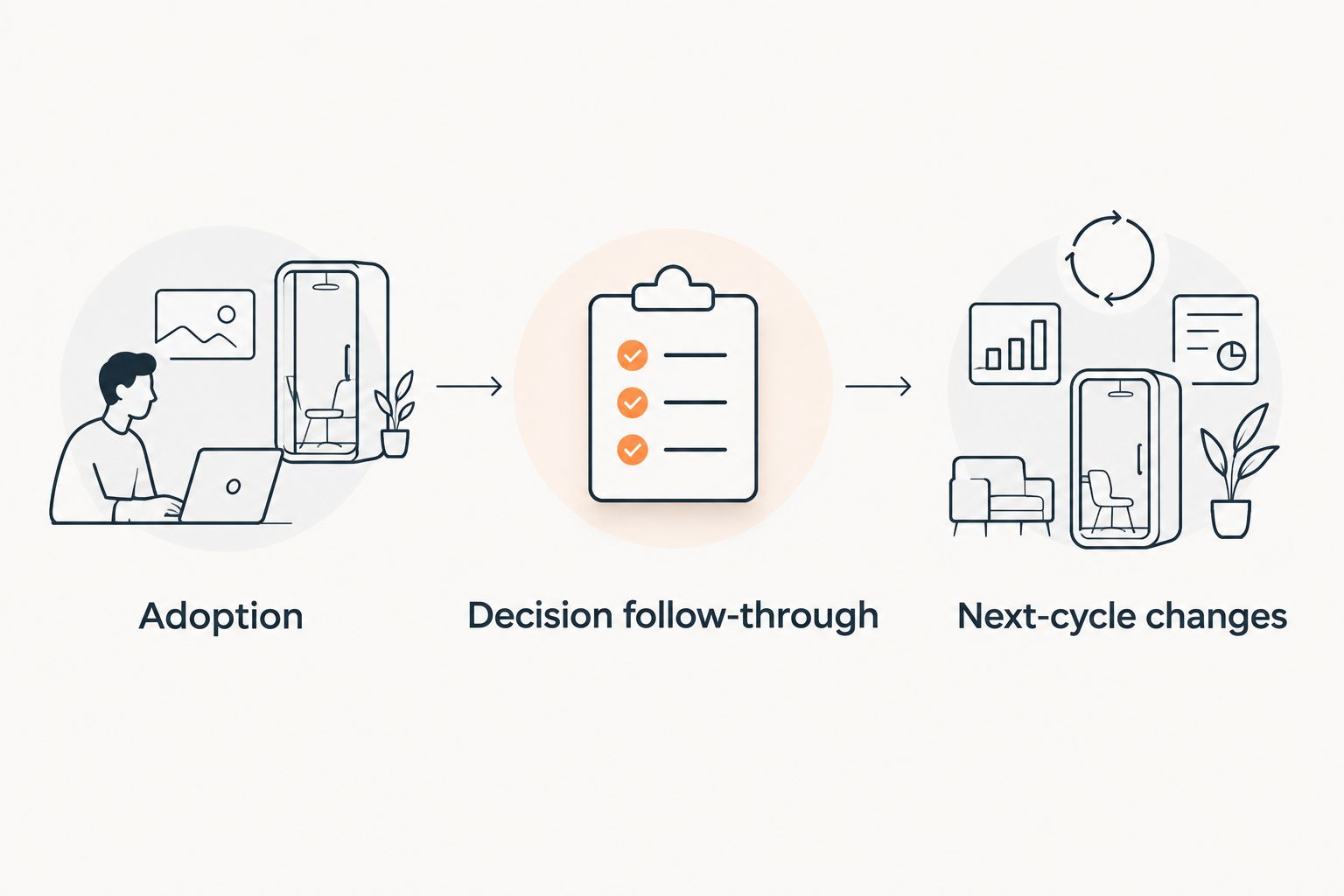
Use three review headings: Adoption, Decision follow-through, and Next-cycle changes. Together, they keep the retrospective connected to everyday behavior.
- Check whether updates arrive before the review.
- Inspect whether agreed actions receive follow-up.
- Ask franchisees where the process duplicates existing reporting.
- Remove objectives that exceed the team's capacity.
- Record the changes you will test during the next cycle.
Choose an option around the work your franchise needs
Your starting option should match the complexity you can explain today. A spreadsheet supports a manual pilot; dedicated software gives the program a place for recurring goal management.
Use the same sample objective and review scenario for every option. That makes the effort and limitations visible during evaluation.
| Option | Best for | Practical advantage | Limitation to examine |
|---|---|---|---|
| Shared spreadsheet and document | A small pilot with an agreed manual owner. | You can write definitions and rehearse the review directly. | Someone must maintain updates, access, and reporting consistency. |
| Existing project-management system | Teams whose strategic work already has a maintained project record. | You can connect the discussion to existing work records. | Verify how the system represents outcomes, cycle reviews, and location-level context. |
| OKR Leader | Franchise teams seeking OKR cycle management and dashboards. | It provides software for setting, tracking, and executing strategic goals. | Verify franchise-specific permissions, reporting structures, and required integrations. |
| Facilitated manual pilot | Leaders who need agreement on ownership and review behavior. | A facilitator can help participants work through disagreements in the pilot. | The organization still needs an internal owner to sustain the process. |
For a 2026 buying decision, give each requirement an owner who can approve the demonstration. Your operations lead should test the review, while the people responsible for data and access should test their own requirements.
Choose only after the people who will maintain the program have used the proposed workflow. A polished demonstration leaves the ongoing coordination work with your team.
Common franchise mistakes create avoidable reporting friction
Copying one objective across every location
A uniform objective needs a shared business rationale. A new location building its customer base and an established location improving repeat business have different starting conditions.
Agree on the network outcome, then let local owners explain their contribution. Vet any sample OKR against the organization's strategy, operating conditions, and team capacity before adopting it.
Treating revenue growth as sufficient evidence
A franchise growth objective needs profit-aware measures. Review the work and resources required to produce the outcome, including the effect on participating locations.
Ask what profitable growth looks like for this network and its operators. The destination belongs to the business owners, and the OKR program should reflect that choice.
Letting scores influence compensation discussions
Keep OKR scoring separate from performance reviews and compensation. People need room to report an ambitious bet falling behind and ask for help.
Explain the boundary before the pilot begins. Then inspect whether leadership behavior supports it when a franchisee or regional manager shares unwelcome progress.
Approving the program without protecting time
An enthusiastic launch still needs someone to maintain definitions, resolve ownership questions, and prepare reviews. Assign that work explicitly.
Leadership support includes protected time, sufficient people, and approved resources. Repeat that support during the cycle, especially when daily operating pressures compete for attention.
One last thing
Worth trying this week: ask a participating franchisee to bring one obstacle to the next review and name the support they need from headquarters. Record who will respond and when you will revisit it.
That small test gives you something concrete to inspect during software evaluation: whether the proposed workflow helps the right people follow through. Keep it as one habit within the larger program.
Related guides
FAQ
What’s the best OKR software for franchise businesses?
The best fit supports your franchise ownership structure, review process, and reporting boundaries. OKR Leader suits teams seeking cycle management and dashboards; verify location-level access and reporting requirements with a realistic demonstration.
Can franchise businesses run OKRs in a spreadsheet?
Yes, a franchise business can run a manual pilot using a shared spreadsheet and document. Assign responsibility for updates, definitions, access, and review preparation so the process has an owner.
Should every franchise location have the same OKRs?
Each location’s contribution should reflect its operating conditions and decision authority. Agree on network priorities, then work with local owners to define outcomes they can influence.
How often should franchise teams review their OKRs?
Use a weekly review as a starting habit and adjust the meeting length to the decisions required. Ask participants to update progress beforehand so the discussion can address obstacles and support.
Can franchise KPIs and OKRs appear in the same system?
Yes, provided the system supports the distinction your program needs. Verify how it presents operating health metrics, strategic bets, and the agreed response when a health metric needs attention.
Should franchise OKR scores affect bonuses?
Keep OKR scores separate from bonuses and performance reviews. Protect honest reporting by explaining how ambitious goals will be reviewed before participants commit to them.
How long does a franchise OKR rollout take to work?
Plan to assess the program across several quarters. Expect the first cycle to expose problems with objectives, measures, and meeting habits, then use those findings to improve the next cycle.