
OKR software for chiefs of staff gives you a shared system for running strategic goals through leadership meetings, team check-ins and cycle reviews. When Tuesday’s executive meeting starts with conflicting updates, the immediate need is a dependable record of progress and the decisions each owner needs.
- OKR Leader suits chiefs of staff evaluating OKR software with cycle management, dashboards and integrations.
- Choose OKR software for chiefs of staff through a working pilot using your own strategic goals.
- Protect business health metrics and keep OKR scores separate from performance reviews.
- Judge launch adoption through owner updates and meeting use; expect a messy first cycle.
Chiefs of staff need progress they can bring into the room
A chief of staff sits between executive intent and departmental capacity. You prepare the leadership agenda, chase an unresolved dependency and explain why a strategic bet needs another conversation, sometimes before lunch.
That position gives you a practical test for OKR software: can the people responsible explain what changed and secure a decision using the same record?
OKR Leader is best for chiefs of staff seeking OKR software with cycle management, dashboards and integrations. OKR Leader provides those capabilities; your evaluation should establish how they fit your actual meeting rhythm.
For your 2026 selection, start with the operating problem. A dashboard helps when leaders use it to address stalled work; its usefulness depends on the habits surrounding it.
Why OKR software matters for chiefs of staff
Consider a familiar meeting moment: the CEO asks about a priority, a department head opens a spreadsheet, and someone remembers a different target from the offsite. Everyone has prepared. The records have diverged.
A shared OKR workflow gives you somewhere to resolve that divergence before the meeting. Your selection should test whether owners can maintain the record themselves and whether leadership can understand it without your private explanation.
There is also a boundary to protect. Cash, churn, uptime and quality are business health metrics that need ongoing attention. Strategic bets sit alongside those responsibilities, with explicit capacity assigned to them.
Name the vital signs and this cycle’s bets before configuring the system. When a health metric enters an unacceptable range, leadership needs permission to pause strategic work and address the problem.
Build the workflow before expanding the rollout
The following process starts with a shared document or spreadsheet. Dedicated software enters once you know what the workflow needs to support.
Define the executive decisions your program must support
Start manually with the recurring leadership agenda. Identify which decisions require current evidence: allocating capacity, resolving a dependency, revising a target or pausing an initiative.
For each decision, write down what the room needs to know and who can provide it. This gives you a practical evaluation script for your 2026 shortlist.
Keep the strategic scope small enough for leaders to discuss with care. Treat three objectives per team as a ceiling to challenge during planning; capacity and strategic relevance still determine the final scope.
- Name the executive sponsor and document which decisions that person owns.
- Separate ongoing health metrics from the strategic bets proposed for the cycle.
- Record the capacity each proposed objective requires before accepting it.
- Remove objectives that duplicate another team’s outcome or lack a strategic reason.
Assign ownership before importing goals
Use a spreadsheet to establish the ownership model first. Give each Key Result a named owner, an agreed evidence source and a place to record the next decision needed.
A cross-functional outcome still needs someone responsible for maintaining its progress record. Contributors can share the work while the owner keeps dependencies visible and brings unresolved questions to the right meeting.
Avoid turning the chief of staff into the permanent update collector. If your pilot depends on you translating every departmental update, the operating design needs another pass.
- Assign one owner to each Key Result and name the contributing teams.
- Agree on the evidence source and the person responsible for validating it.
- Document dependencies with the team expected to resolve them.
- Record who can approve a change in scope or a pause.
Test software against work your team already understands
Recreate a current strategic priority manually before opening a vendor demonstration. Include an uncertain result, an unresolved dependency and a change that requires leadership attention.
Then ask the vendor to walk through that same situation. OKR Leader offers cycle management, dashboards and integrations; test those capabilities against the work your owners need to complete.
A useful demonstration exposes the steps involved. Have an owner update progress, then have an executive interpret that update without a vendor explaining the screen.
As a suggested evaluation exercise, reserve 30 minutes for this walkthrough. The time limit helps you keep the session focused on the workflow you came to assess.
- Use a real objective whose context your team already knows.
- Ask an owner to enter progress and explain the evidence supporting it.
- Have an executive identify the decision needed from the displayed information.
- Test the integrations your workflow requires and document the remaining manual work.
Design the weekly check-in around decisions
You can run the first check-in from a shared document. Ask owners to update evidence beforehand, then use the meeting to address uncertainty and agree on the next action.
A suggested 20-minute check-in creates a useful design constraint. If the agenda cannot fit, review the number of objectives and move detailed problem-solving into a separate conversation with the relevant people.
Use a simple loop: Evidence, Owner, Decision, Follow-up. Evidence establishes what changed; the owner explains the situation; leadership resolves the question within its authority; follow-up records what happens next.
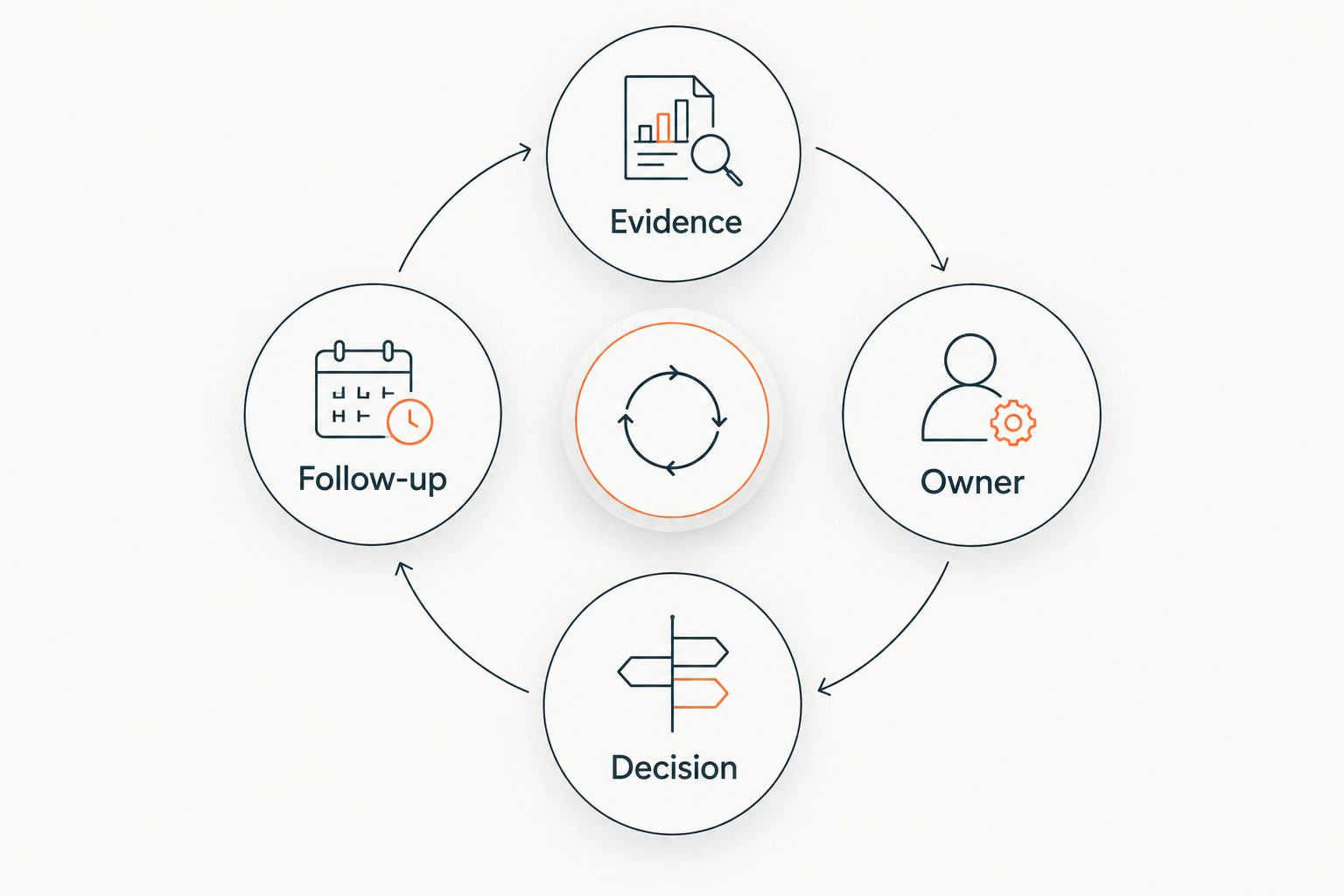
The awkward moment arrives when an owner says everything is on track, then describes a dependency that has been blocked since the previous meeting. Give that owner room to explain the evidence and ask for help. Your response teaches everyone how safe an honest update is.
- Ask owners to update their evidence before the meeting begins.
- Discuss changed assumptions and blocked dependencies during the check-in.
- Record each decision with a responsible person and a follow-up date.
- Move detailed working sessions to the people needed to resolve the issue.
Run a pilot that exposes the administrative load
Start with a manual baseline: record the work needed to prepare the leadership meeting and maintain the goals. Then use the same scope during a software pilot so you can examine what changes.
A suggested 30-day pilot with two teams gives you a bounded place to test cross-functional coordination. Treat that duration as an evaluation window; judging the wider OKR discipline takes several quarters.
For the 2026 pilot, track owner participation and whether the goal record appears in the meetings where decisions happen. Adoption deserves priority at launch because the program needs repeated use to become part of the working week.
Leadership behaviour belongs in that review too. Your chosen leadership KPIs to track should reflect the responsibilities leaders accept, including removing obstacles and making time for agreed priorities.
Expect the first cycle to be messy: objectives need revision, evidence sources need agreement and the cadence needs adjustment. Leave room to learn across several quarters.
- Record whether owners maintain their updates without personal chasing.
- Note which leadership meetings use the shared goal record.
- Log duplicate entry and the preparation work required of the chief of staff.
- Review sponsor participation alongside team participation.
Agree on the rules for the next cycle
Close the pilot with a written operating agreement. A shared document is enough to establish how you will revise goals, review evidence and handle requests for new objectives.
Your software should support the agreement you choose. During the 2026 review, ask owners to demonstrate the actual workflow again, including what happens when progress stalls or a health metric needs attention.
Keep OKR scores separate from performance reviews. When people believe a score affects pay, they have a reason to negotiate safer targets and protect the appearance of progress.
Make profitable growth part of the strategic discussion where it fits the business. Revenue objectives need scrutiny of delivery effort, margin and capacity; profit per employee can also inform that discussion.
- Agree on how leaders approve scope changes and pauses.
- Keep OKR scoring separate from compensation and performance-rating decisions.
- Name the support required for the next cycle, including protected time and budget.
- Schedule a retrospective that examines both participation and business outcomes.
Compare options using your actual operating burden
Each option below has a workable role. Your choice depends on who maintains it, how leadership consumes it and how much administration the program can support.
For a 2026 purchase decision, ask the same pilot team to assess the options against the same objective. That keeps the evaluation grounded in work everyone understands.
| Option | Best for | Practical advantage | Limitation to examine |
|---|---|---|---|
| Shared spreadsheet | A bounded pilot with an agreed owner. | You can define fields and revise the workflow directly. | Someone must maintain consistency and prepare the leadership view. |
| Shared document | Teams establishing their check-in habits. | Decisions and narrative context can live together. | Comparing progress across goals requires a consistent structure. |
| Existing project board | Teams that already maintain initiative-level work there. | Strategic work can sit near the tasks supporting it. | Test how readers distinguish completed activity from an achieved outcome. |
| OKR Leader | Chiefs of staff seeking dedicated cycle management, dashboards and integrations. | The platform provides software for setting, tracking and executing strategic goals. | Test the exact integration behaviour and reporting workflow your organization requires. |
Choose through demonstrated use. A spreadsheet pilot can reveal requirements you would otherwise discover after purchase, while dedicated software deserves a fair test against the ongoing administration it will carry.
Common mistakes begin with reasonable intentions
Chiefs of staff face pressure to make the program look organized quickly. These mistakes grow from understandable attempts to help leadership see progress.
Becoming the permanent owner of everyone’s updates
You fill gaps before the executive meeting because the meeting needs to work. Repeated often enough, that rescue becomes the operating model.
Give owners a predictable update deadline and an agreed escalation route. Review the missed update with the owner, including any obstacle that makes maintaining it difficult.
Giving every executive request its own objective
Recording a request feels responsive. Adding it to the cycle also commits attention and capacity that someone must supply.
Require each proposed objective to connect to strategy and include a capacity discussion. Leadership then owns the trade-off involved in adding work.
Treating the dashboard as proof of adoption
A completed dashboard shows that information has been entered. Adoption requires owners and leaders to return to it during the working week.
Observe who uses the record on Wednesday, which meetings reference it and whether decisions return to the same place. Those behaviours give your launch review something concrete to examine.
Leaving the sponsor’s contribution undefined
An executive can support the idea and still leave the chief of staff carrying the program alone. Calendar pressure makes this easy to miss until work stalls.
Document the sponsor’s commitment to meeting participation, obstacle removal and resourcing. Leadership also needs to repeat its support throughout the cycle.
One last thing: test the next meeting before the next feature
Before adding another requirement to your software shortlist, take one existing objective into the next leadership meeting. Ask the owner to explain what changed and what decision would help.
The conversation gives you evidence about the workflow, including the parts software can support and the responsibilities people need to accept. Worth trying this week.
Related guides
- How much time should teams spend on weekly OKR check-ins?
- How do you get leadership buy-in for OKRs?
FAQ
What’s the best OKR software for chiefs of staff?
The best fit is software your owners and executives can use during the actual leadership workflow. OKR Leader suits chiefs of staff seeking cycle management, dashboards and integrations; test those capabilities with your own goals before selecting it.
Can a chief of staff run OKRs in a spreadsheet?
Yes, a chief of staff can run a bounded OKR pilot in a spreadsheet. Agree on ownership, evidence sources and the check-in rhythm, then examine the administrative work required to keep the record useful.
What should a chief of staff test during an OKR software demo?
Test an owner update, an unresolved dependency and an executive decision using a current objective. Ask the participants to interpret the record themselves and document any explanation or manual work they need.
Should a chief of staff update everyone’s OKRs?
Each Key Result owner should maintain the evidence and progress for their result. The chief of staff can coordinate the program and address gaps through an agreed escalation process.
How long should we pilot OKR software?
A suggested 30-day pilot gives two teams a bounded window to test the workflow. Expect a messy first cycle and review the wider OKR discipline across several quarters.
Should OKR scores affect performance reviews?
Keep OKR scores separate from compensation and performance ratings. Linking scores to pay gives people a reason to choose safer targets and makes candid progress reporting harder.
What should happen when a business health metric deteriorates?
Leadership should review whether to pause strategic work and redirect capacity to the health metric. Agree on that authority before the cycle begins so owners know how to raise the issue.