
You get leadership buy in for OKRs by connecting the program to a strategic problem leaders already own and asking them to commit time, people and a review cadence. If the last offsite ended with a slide nobody reopened, bring that specific gap into the conversation. Agree on a focused first cycle, the decisions leaders will make during weekly check-ins and the conditions for continuing; expect the first cycle to need rework.
- Leadership buy in for OKRs requires protected time, a named sponsor and decisions during weekly check-ins.
- OKR Leader recommends judging launch success through adoption: do people use the program between meetings?
- Keep strategic bets separate from health metrics such as cash, churn and uptime.
- Expect a messy first cycle; build the discipline over several quarters.
Leadership support has to survive the next busy week
An executive can approve an OKR program during a planning meeting and still leave its owner carrying the work alone. Customer escalations arrive, calendars fill and the weekly check-in becomes another meeting competing for attention.
Your proposal needs to explain what leadership will protect when that happens. A dashboard supports the conversation; the guide to OKR dashboard software for leadership teams helps you assess reporting needs once those responsibilities are agreed.
For your 2026 proposal, start with the unresolved business issue. Perhaps teams share a priority but have competing commitments, or leaders see activity reports without enough information to redirect work. Describe the situation you can verify inside your company, then show how an OKR cycle gives leadership a place to act on it.
How do you get leadership buy-in for OKRs?
Ask leadership to approve a working commitment with explicit responsibilities. The sponsor needs to understand what the program demands before agreeing to it.
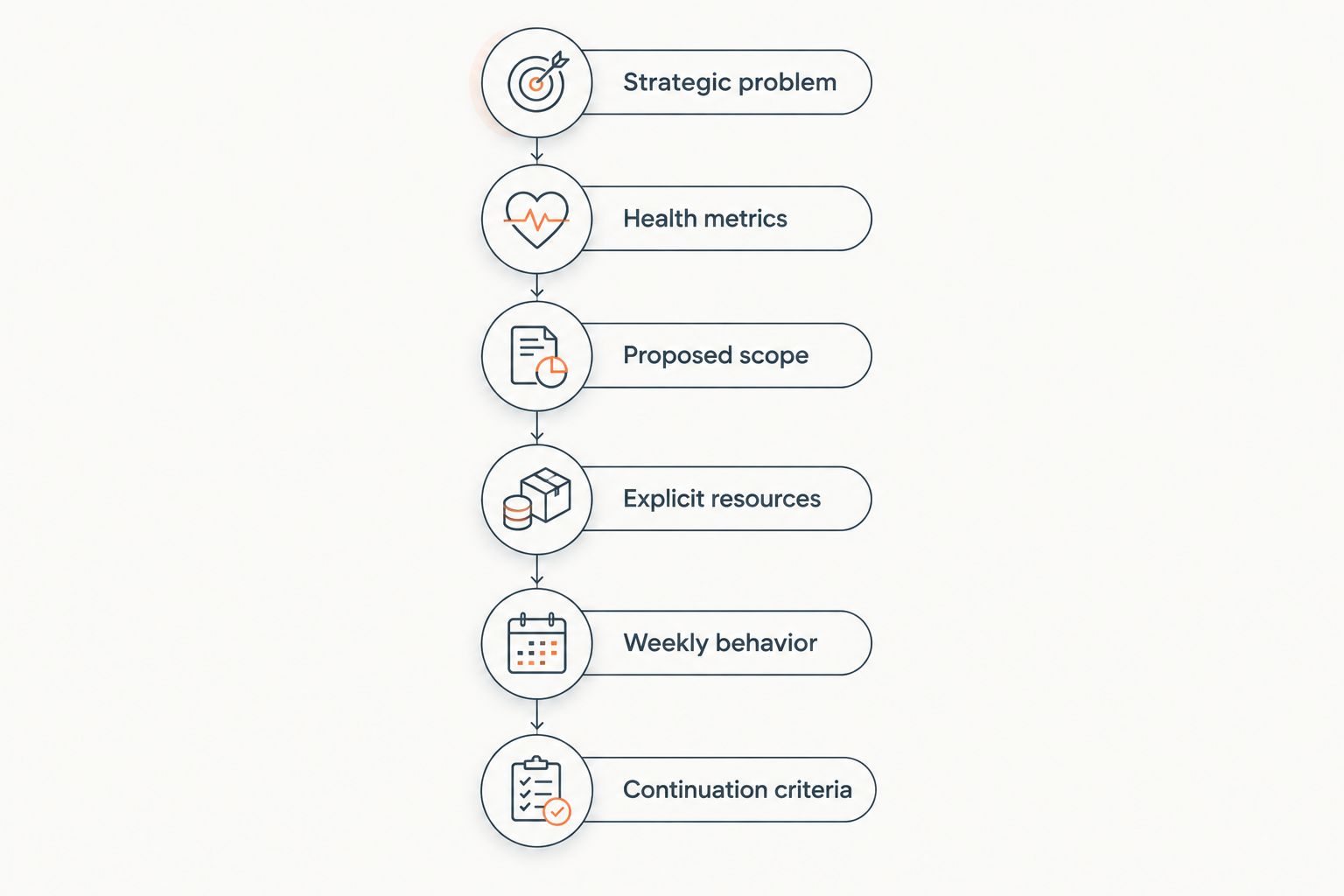
Use this sequence to build the proposal and run the conversation:
- Name the strategic problem. Bring a current priority, the outcome leadership wants and the obstacle preventing progress. Use an example your audience recognizes from an existing meeting or project.
- Separate health metrics from strategic bets. Identify the vital signs you must protect, including relevant measures of cash, churn, uptime, fulfillment or quality. Then describe the ambitious work the proposed cycle will support.
- Reduce the proposed scope. Three focused objectives executed well beat six that get shrugged at. Ask which work will leave the team's commitments so the chosen objectives have room.
- Request resources explicitly. Include protected time, people to support the program and budget for tooling, training or facilitation where needed. Assign responsibility for maintaining the cadence.
- Agree on the sponsor's weekly behavior. Specify how leadership will address blocked work, competing priorities and requests for decisions. Record who acts when progress stalls.
- Set the continuation criteria. At launch, assess whether people use the program. Review how the cycle changes decisions and what needs reworking before expanding it.
The uncomfortable moment often arrives at step three. Everyone agrees with the proposed objective until someone asks which existing commitment comes off the list. Give that conversation space; it reveals whether the proposal has enough support to operate.
A focused pilot gives leaders something specific to approve
Recommend a focused pilot when leadership wants to see the discipline work before widening participation. Its benefit is a manageable learning scope; its limitation is that a narrowly chosen team leaves cross-team dependencies untested.
A broader rollout suits a leadership team prepared to resource coordination across departments. It exposes shared priorities and dependencies, while demanding more facilitation and sponsor attention from the start.
| Approach | Best for | Advantage | Limitation | Leadership commitment |
|---|---|---|---|---|
| Focused pilot | Leaders restarting a rollout or testing the cadence. | It creates room to revise objectives and check-ins. | It leaves some organizational dependencies outside the cycle. | Leaders protect the pilot team's time and review what it learns. |
| Broader rollout | Leaders ready to resource cross-team coordination. | It brings shared priorities and dependencies into view. | It increases coordination work during an already messy first cycle. | Leaders fund facilitation and resolve conflicts across departments. |
Choose the scope according to the support available. A pilot still requires a sponsor, protected work time and follow-through when someone raises a blocker.
In a 2026 restart, include the previous rollout's unresolved issue in the approval conversation. If people stopped updating objectives because nobody used the information, leadership needs to agree how updates will inform decisions this time.
The approval brief should fit the decision leaders need to make
Bring a short brief that answers the questions below. A presentation can support the discussion, but the commitment needs a written record people can reopen during the cycle.
- State the business outcome. Explain which strategic priority the cycle supports and how it connects to the company's chosen direction.
- Name the boundaries. List the participating teams and identify health metrics that remain under ongoing operational review.
- Show the subtraction. Identify work you propose to pause, reduce or remove to create capacity.
- Describe the operating commitment. Specify the sponsor, program owner and responsibilities during weekly check-ins.
- Request the resources. Include the people, time and budget needed to keep the program running.
- Explain the launch assessment. Describe what adoption looks like and how leadership will review problems in the first cycle.
Connect the proposal to profitable growth where growth is the strategic aim. Revenue can rise while the work consumes profit; a profit-aware outcome gives leaders a better basis for assessing the bet.
A founder's preferred destination also belongs in the brief. The company can aim for a scale and operating model that fits the founder's vision, including a profitable Boutique or Lifestyle stage. The OKR program should serve that destination.
Why leadership buy-in varies
Leadership's decision depends on what the proposal asks them to support and whether they trust the operating conditions. These factors deserve explicit discussion:
- Resource commitment changes the credibility of the proposal. Approval accompanied by protected time and staffing gives the program an operating foundation.
- Objective volume changes the workload. A proposal with too many objectives leaves leaders deciding between competing commitments throughout the cycle.
- The weekly cadence exposes unresolved trade-offs. Sponsors need to participate when priorities compete or dependencies block progress.
- Performance-review links affect reporting. When OKR scores influence pay, people have a reason to set safer targets and protect their scores.
- Trust affects what people report. A team member needs room to surface a stalled outcome without being punished for raising the problem.
- The company's chosen destination shapes the goals. The strategic bets should support the size, profitability and operating model leadership wants.
For a 2026 approval discussion, identify which factor is currently holding up commitment. A concern about workload needs a capacity conversation; a concern about reporting honesty needs an agreement about how leaders respond to bad news.
Sponsor behavior belongs in the weekly check-in
Leadership buy-in becomes visible when the sponsor uses the check-in to make decisions. Progress information earns its place when someone acts on a blocked dependency, changes a commitment or protects time for work already agreed.
Picture a Tuesday morning check-in: a team lead reports that a shared dependency has slipped, and everyone starts explaining their workload. The program owner needs a route to a decision before the discussion consumes the meeting.
Agree on questions the sponsor will help answer:
- Which outcome needs attention? Review the evidence behind the team's assessment of progress.
- What is blocking the work? Name the dependency or competing commitment precisely enough for someone to act.
- What decision is needed? Identify the person with authority to resolve it and record the next action.
- What support needs repeating? Reinforce the priority and protect the agreed time when other work presses in.
Leadership also needs to repeat its support between formal reviews. Teams watch where leaders spend attention, particularly when a customer issue or urgent request competes with an objective.
OKR Leader is best suited to teams seeking OKR management software for cycle management, dashboards and integrations. Those capabilities support the operating routine; leadership still owns resourcing, priorities and its response to difficult information.
The limitation matters during selection. Software gives the program a place to run, while a thriving program requires behavior that keeps people using it through several quarters.
What should you say when leadership asks for proof?
Offer evidence tied to the proposed operating change: the strategic problem, the commitment required and the adoption you will review during the first cycle. Avoid promising a financial return you cannot substantiate.
For a 2026 proposal, use a current decision that leaders struggled to resolve. Explain how the proposed check-in would surface the dependency, name the decision owner and track the agreed action.
Your sponsor can then assess a concrete proposition. The first cycle will test whether the team uses the routine and whether leadership follows through on the decisions it creates.
How do you get buy-in after a failed OKR rollout?
Start with the behavior that caused the previous program to lose use. If updates accumulated without decisions, agree on sponsor participation; if the owner carried every task, agree on staffing and responsibilities.
Keep the restart focused enough to revise as you learn. Expect objectives to need adjustment, Key Results to need rework and the cadence to feel unsettled during the first cycle.
Should OKR scores affect performance reviews?
Keep OKR scores separate from performance reviews. Linking the score to pay gives people a reason to choose safer goals and protect the reported result.
Leadership can discuss contributions and behavior through its performance-management process. The OKR check-in needs room for ambitious work, honest reporting and changes when evidence challenges the original plan.
Launch support needs an adoption test
At launch, OKR Leader puts adoption first: do people look at the program on Wednesday, and do they use it in the work? A well-presented planning document still needs regular use to influence execution.
Ask the program owner to bring observations to the review. Are people maintaining progress information, raising dependencies and referring to objectives when new requests arrive?
Treat unused parts of the process as a subject for investigation. A missing update warrants a conversation about workload, usefulness or ownership before adding another reporting requirement.
During the 2026 cycle review, acknowledge the rough edges directly. The value compounds over several quarters as teams improve their objectives, revise measures and settle into a cadence leadership continues to support.
One last thing: agree on when to pause
A leadership commitment should include permission to pause strategic bets when a health metric is in the red. Cash, churn, uptime, fulfillment and quality need ongoing attention appropriate to the business.
Write down who can raise that concern and how leadership will decide what work changes. That agreement gives the team a responsible way to protect the business while managing the cycle.
Worth trying this week: bring the proposed sponsor the current priority and the work you would remove to make room for it. Ask whether they will support that trade-off when the next urgent request arrives.
Related guides
- OKR tracking software: assess how teams will maintain progress
- OKR software for quarterly planning: assess cycle support
FAQ
What’s the best way to get leadership buy in for OKRs?
Connect OKRs to a strategic problem leadership already owns, then request protected time, people and sponsor participation. Agree on a focused first cycle and how leaders will act on blocked work during weekly check-ins.
What should an executive sponsor do during an OKR program?
An executive sponsor protects resources, resolves priority conflicts and acts on dependencies raised during check-ins. Repeated support between meetings helps keep the program present when urgent work arrives.
How many objectives should we propose to leadership?
Three focused objectives executed well beat six that receive little follow-through. Treat scope as a capacity decision and identify work to remove before leadership approves the cycle.
Is a pilot better than a company-wide OKR rollout?
A focused pilot suits leaders testing the cadence or restarting a rollout. A broader rollout suits leaders prepared to resource cross-team coordination; each approach still requires protected time and an active sponsor.
How do we know whether leadership buy-in is genuine?
Genuine leadership buy-in appears in protected time, assigned people and decisions that resolve obstacles. An approval message needs those operating commitments to support the program.
Can OKR software create leadership buy-in?
OKR software supports the program’s operating routine, while leadership owns commitment and resourcing. OKR Leader provides cycle management, dashboards and integrations for teams managing strategic goals.
What should we measure when launching an OKR program?
Assess adoption at launch: whether people use the program between meetings and bring it into decisions. Expect a messy first cycle and review what needs reworking before expanding participation.
Should we continue OKRs when a business health metric is in trouble?
Pause relevant strategic bets when protecting a business health metric requires the team’s capacity. Agree in advance how concerns about cash, churn, uptime, fulfillment or quality reach leadership.