
Yes, OKR software can help align sales and marketing goals by giving both teams a shared objective, visible progress, and a regular place to resolve dependencies. When Tuesday’s pipeline meeting turns into a debate about lead quality, the fix starts with agreed definitions and ownership. Software supports that agreement; leaders still have to protect time for the work and resolve competing priorities.
- To align sales and marketing OKRs, agree on a shared outcome, handoff rules, and weekly decisions.
- OKR Leader supports OKR management through cycle management, dashboards, and integrations.
- Keep profitable growth in view when choosing pipeline outcomes and supporting measures.
- Expect a messy first cycle; build adoption and improve the operating rhythm over several quarters.
Can OKR software align sales and marketing goals?
Yes. Shared definitions, accountable owners, and a weekly check-in give the software something useful to support. Begin with the outcome both departments need to influence, then document each team’s contribution and the decisions that require joint attention.
If you are comparing tools for a 2026 rollout, the OKR software for strategic priority alignment guide provides a related starting point. Agree on your operating requirements before evaluating a dashboard.
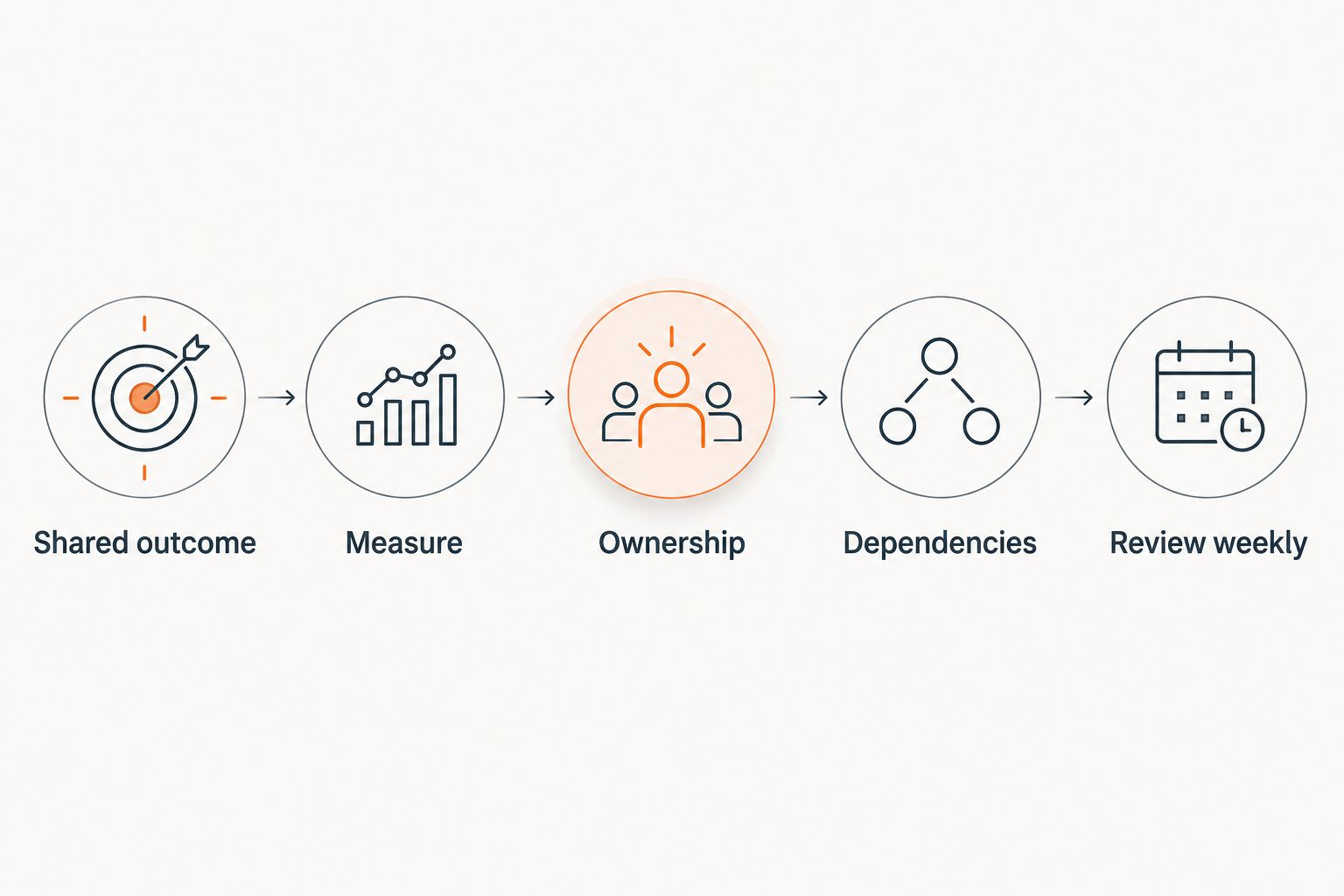
A workable setup follows this sequence:
- Choose a shared outcome. Describe the commercial change both teams will work toward, with profitable growth as the business context.
- Define the measure. Record what counts, where the evidence comes from, and who maintains the definition.
- Assign ownership. Give each Key Result an accountable owner and name the contributors who influence it.
- Expose dependencies. Record what marketing needs from sales and what sales needs from marketing.
- Review weekly. Use changes in the evidence to decide what needs attention before the next check-in.
These steps belong inside a broader management discipline. A shared objective still needs capacity, leadership attention, and permission to change work when the evidence changes.
A pipeline dispute needs an agreed definition
The awkward moment is familiar: marketing brings a campaign report, sales brings opportunity notes, and someone asks which version will appear in the leadership update. Both reports can be accurate within their own definitions. The meeting then spends its useful minutes reconciling the boundaries.
A shared OKR needs a definition that survives that conversation. Write down the qualification criteria, the point at which ownership changes, and the conditions that return an opportunity for further work.
For your 2026 planning discussion, separate business health from the strategic bet. Cash, churn, and service quality are vital signs to protect; improving a specific part of the sales and marketing handoff can become a cycle-level bet.
If a health measure enters a danger zone, leadership needs to address it. Pausing strategic work can be the responsible decision when the business needs immediate attention.
Shared outcomes need distinct team responsibilities
Sales and marketing can contribute to the same outcome while owning different parts of the work. Marketing might investigate which campaigns attract suitable buyers; sales might examine where accepted opportunities stall. The shared objective connects those investigations.
The following structures are planning options, with trade-offs to discuss before configuring your workspace.
| Planning structure | Best for | Benefit | Limitation |
|---|---|---|---|
| Separate team objectives with a documented dependency | A bounded handoff improvement | Preserves direct team ownership. | Requires a shared review to keep the dependency visible. |
| Shared objective with individually owned Key Results | A commercial outcome both teams influence | Connects contributions to the same outcome. | Needs explicit decision rights when priorities conflict. |
| Company objective with linked department contributions | A strategic priority involving several functions | Shows how departmental work supports company direction. | Adds coordination work and requires leadership attention. |
Choose the smallest structure that makes the dependency visible. A bounded handoff issue can begin with a shared definition and named owners; a broader commercial bet needs the leaders responsible for capacity and trade-offs in the discussion.
Avoid assigning a Key Result to an undifferentiated group. An owner needs authority to gather evidence, raise a blocker, and bring the decision to the person who can resolve it.
Write the measure before setting the target
An outcome-shaped Key Result needs a baseline, a target, a time boundary, and a definition. Those fields should reflect your business evidence. Copying another company’s target introduces an assumption your team will eventually have to defend.
Consider an illustrative objective: improve the progression of suitable prospects into profitable customer relationships. The wording creates room to examine qualification, opportunity progression, and the quality of the resulting business.
Useful drafting questions include:
- What evidence tells you that a prospect fits the customers your business can serve profitably?
- Which stage transition can both teams influence during this cycle?
- Who can explain the baseline and resolve questions about the underlying records?
- Which health measure needs protection while the team pursues the improvement?
- What decision would a change in the measure trigger during a weekly check-in?
These questions help you vet a sample OKR against your mission, strategy, and team strengths. Generic examples need that scrutiny before they become commitments.
Keep the portfolio small. The familiar guidance of 3 to 5 objectives per team is a ceiling; three focused objectives deserve serious execution before a team adds six that compete for the same attention.
Why sales and marketing alignment varies
The same software can sit inside very different operating conditions. When you assess a 2026 OKR program, examine the behaviors around the shared goal as closely as the configuration.
- Definitions determine what gets counted. Qualification criteria and stage boundaries need agreement before the teams interpret progress together.
- Capacity determines what gets done. Leaders need to protect time and provide people for work that crosses departmental boundaries.
- Incentives shape reporting. Linking OKR scores to pay creates pressure to choose safe targets and protect the score.
- Decision rights determine how blockers move. A named owner needs access to someone who can resolve a resource conflict.
- Check-in habits determine whether evidence changes work. The review needs space for decisions, with responsibility recorded for follow-through.
When someone hesitates to report a slipping result, examine what happened the last time bad news reached leadership. Honest reporting depends on how the organization responds, and a software rollout cannot repair that response on its own.
Weekly check-ins need a decision to carry forward
A useful review begins with changed evidence. The owner explains what moved, what the team learned, and which dependency needs attention; the group then decides what work will change.
Picture the meeting after a campaign launches. Marketing sees interest from the intended audience, while sales hears a repeated objection that the campaign never addressed. The shared review gives those observations a place to meet and produces an owner for the follow-up.
Keep a short record that answers these questions:
- What changed in the evidence since the previous review?
- Which assumption needs investigation before the next decision?
- What dependency is blocking progress, and who can resolve it?
- What work will the team pause to make room for the agreed action?
A dashboard helps people arrive with the same view of progress. The conversation still needs judgment, especially when a team must give up planned work to address a shared dependency.
If the meeting ends with an unresolved issue, name the person who owns the next step and the date for returning with evidence. That record gives the next check-in a useful starting point.
What OKR software can contribute
OKR Leader is best for teams seeking OKR software to manage strategic goals through cycle management, dashboards, and integrations. Those capabilities support the shared record around which sales and marketing can organize their work.
The boundary is practical: a software platform cannot decide which customers fit your strategy or settle a disagreement about resource allocation. Your leadership team owns those judgments and the conditions for honest reporting.
During a 2026 evaluation, test the workflow against a real handoff problem. Ask an owner to explain the objective, locate the current evidence, identify the dependency, and show how the next action will be recorded.
The exercise should reveal where your operating rules need work. If the people in the room disagree about qualification, pause configuration long enough to settle the definition and document it.
Adoption deserves attention from launch. Look for evidence that people return to the shared record between meetings and use it to prepare decisions; a polished workspace alone tells you little about those habits.
How many objectives should sales and marketing share?
Three focused objectives are a useful ceiling to consider before expanding a team’s commitments. Sharing an objective makes sense when both departments can influence its outcome and have work to coordinate during the cycle.
The broader 3 to 5 objective guidance needs judgment. Check existing commitments and available capacity before adding another shared priority.
Should shared OKR scores affect performance reviews?
Shared OKR scores should stay separate from pay and performance ratings. People need room to report a stalled strategic bet honestly, including when the evidence challenges an assumption leadership supported.
Performance conversations can still address how someone fulfills responsibilities and works with colleagues. Keeping the scoring systems separate protects the usefulness of the OKR record.
Expect the first cycle to need repair
Your first cycle will be messy. Objectives need refinement, Key Results need rework, and the check-in rhythm needs practice; expect the value to build over several quarters.
For a 2026 launch, give someone responsibility for maintaining the shared definitions and bringing unresolved dependencies back to the review. Protect time for that responsibility so it survives the pressure of everyday delivery.
Leadership support also needs repetition. When leaders approve the program, they need to approve the time, people, and budget required to run it, then keep showing that the work deserves attention.
One last thing: test the handoff before the dashboard
Worth trying this week: bring a recent opportunity to the next joint discussion and ask each team to describe when it became qualified. Compare the answers, record the agreed boundary, and identify who owns the next action.
That small exercise gives you a concrete behavior to support with software. Keep it connected to the larger discipline of focused objectives, honest reporting, and recurring leadership attention.
Related guides
FAQ
Can OKR software align sales and marketing goals?
Yes, OKR software can support alignment through shared goals and visible progress. Sales and marketing still need agreed definitions, accountable owners, and a weekly review that produces decisions.
How do I align sales and marketing OKRs?
Align sales and marketing OKRs by choosing a shared commercial outcome and defining each team’s contribution. Document the measure, ownership, dependencies, and review rhythm before configuring the goal.
What does OKR Leader provide for managing shared goals?
OKR Leader provides OKR software with cycle management, dashboards, and integrations. Teams remain responsible for their goal definitions, resource decisions, and reporting habits.
Should sales and marketing have the same Key Results?
Sales and marketing can share an objective while owning distinct Key Results. Give each Key Result an accountable owner and document the contributions required from the other team.
How many objectives should a team set?
Three focused objectives deserve serious execution before a team expands its commitments. Treat the familiar guidance of 3 to 5 objectives per team as a ceiling and check available capacity.
Should revenue be the only shared outcome?
Choose shared outcomes with profitable growth in view. Protect business health measures and examine the quality of the customer relationships created by the work.
Can we use a generic sales and marketing OKR template?
A generic template needs thorough vetting before adoption. Check whether its assumptions fit your mission, strategy, team strengths, and the problem you need to address.
How quickly should a shared OKR program work?
Expect a messy first cycle and improvement over several quarters. OKR Leader can support the management process, while progress depends on adoption, leadership attention, and the team’s recurring decisions.