
Use quarterly OKR cycles lasting 3 months for team execution, with a 12-month horizon for company direction in 2026. Keep weekly check-ins inside that cycle, and allow time for the review and planning work that comes with each reset. When Tuesday’s delivery problem takes over the meeting, a quarterly commitment gives you a place to return to the strategic work.
- Use quarterly OKR cycles for team execution and an annual horizon for company direction.
- Keep weekly check-ins focused on evidence, obstacles and decisions about the work.
- Carry a longer objective across quarters when its outcome still deserves the team’s capacity.
- OKR Leader suits teams seeking dedicated software for cycle management, dashboards and integrations.
How long should an OKR cycle last: quarterly or annual?
Start with quarterly team OKRs and review annual company objectives each quarter. These planning horizons serve different purposes, so choose the commitment you need at each level.
| Planning horizon | Best for | Advantage | Limitation |
|---|---|---|---|
| Quarterly: 3 months | Team-level strategic bets | Creates a scheduled opportunity to evaluate progress and redirect capacity. | Requires recurring planning and review time. |
| Annual: 12 months | Company direction and longer outcomes | Keeps a longer ambition visible across team cycles. | Needs interim reviews to keep assumptions current. |
OKR Leader is best for teams seeking dedicated software to manage OKR cycles. Its cycle management, dashboards and integrations support the process; leaders still have to protect capacity and act on what the reviews reveal.
Quarterly OKR cycles: 3 months for a focused commitment
A quarterly cycle gives your team a bounded commitment: choose the outcome, reserve capacity and examine the evidence before renewing it. Use this horizon when you can observe useful movement within the quarter and make decisions from it.
For a 2026 rollout, a calendar-quarter schedule is a practical starting proposal. Teams that depend on each other can plan against the same dates and discuss resource conflicts before committing.
The advantage is the review point. Every quarter, an owner has to explain what changed and whether the next stretch of work still deserves time.
The cost is recurring coordination. Planning consumes attention, and an overloaded team can spend its review preparing slides while the underlying obstacle stays unresolved.
Keep the objective count small enough for the weekly conversation to reach decisions. Treat any suggested objective count as a ceiling, and assess what your team can support alongside its existing responsibilities.
A quarterly reset should earn its place through a useful decision. That decision might be to continue the same objective, revise a measurement or release capacity from a bet that has lost its rationale.
Annual OKR cycles: 12 months for company direction
An annual horizon fits an outcome whose path spans several quarters. You can preserve the direction while teams choose the contribution they can make during the next cycle.
An annual 2026 objective might concern profitable growth, with quarterly commitments addressing a specific constraint on that ambition. Keep the relationship explicit: the team should be able to explain how its work contributes to the company outcome.
The advantage is continuity. Leaders can keep a longer strategic choice visible while learning from execution.
The limitation is distance from feedback. An annual target needs scheduled examination of its assumptions, ownership and measurement throughout the year.
Annual planning also creates a capacity question. If the company approves a longer ambition, leadership needs to approve the time and people required to pursue it, along with the support needed to run the program.
Review annual objectives every quarter, even when their wording stays the same. Continuing an objective is a fresh commitment of capacity and deserves an explicit discussion.
A weekly check-in gives either cycle a working rhythm
Your cycle length sets the review boundary. The weekly check-in gives people a recurring opportunity to respond while work is underway.
Picture the meeting in week six: the dashboard is open, an owner is describing completed tasks, and everyone knows the dependency is still stuck. A useful check-in makes room to discuss that dependency and agree who can resolve it.
Try a weekly rhythm for your 2026 program and keep the agenda attached to decisions:
- The owner updates the current measure and explains what the evidence supports.
- Participants identify an obstacle that needs help beyond the owner's control.
- Someone takes responsibility for the next action and its follow-up.
- Leadership resolves a capacity conflict that the team cannot settle alone.
A weekly rhythm requires preparation time and access to current information. When a measure updates slowly, use the meeting to examine work assumptions and dependencies, and record when fresh outcome evidence will arrive.
Protect honesty here. Keep OKR scoring separate from compensation and performance reviews so people can report uncertainty and disappointing progress without attaching those reports to pay.
Why the right OKR cycle length varies
Choose the cycle around how the work produces evidence and how your organization makes commitments. A familiar calendar is useful only when the operating rhythm supports it.
- Evidence timing affects the review. Identify when you can observe movement in the outcome and what evidence is available before that point.
- Dependencies affect commitment. Shared work needs compatible planning dates and a way to resolve conflicts between teams.
- Capacity limits the ambition. Strategic work competes with existing responsibilities, and leadership needs to approve the time it requires.
- Health metrics affect priority. Cash, churn, uptime, fulfillment and quality need protection; a metric in the red can justify pausing a strategic bet.
- Adoption affects the operating burden. During launch, examine whether people use the program between formal meetings before adding process.
- Trust affects reporting. If people avoid naming risks or changing an estimate, examine what happens when someone shares unwelcome information.
Each factor deserves discussion before the cycle begins. A calendar change alone leaves a blocked dependency or an unsafe reporting environment untouched.
Connect the annual direction to a quarterly decision
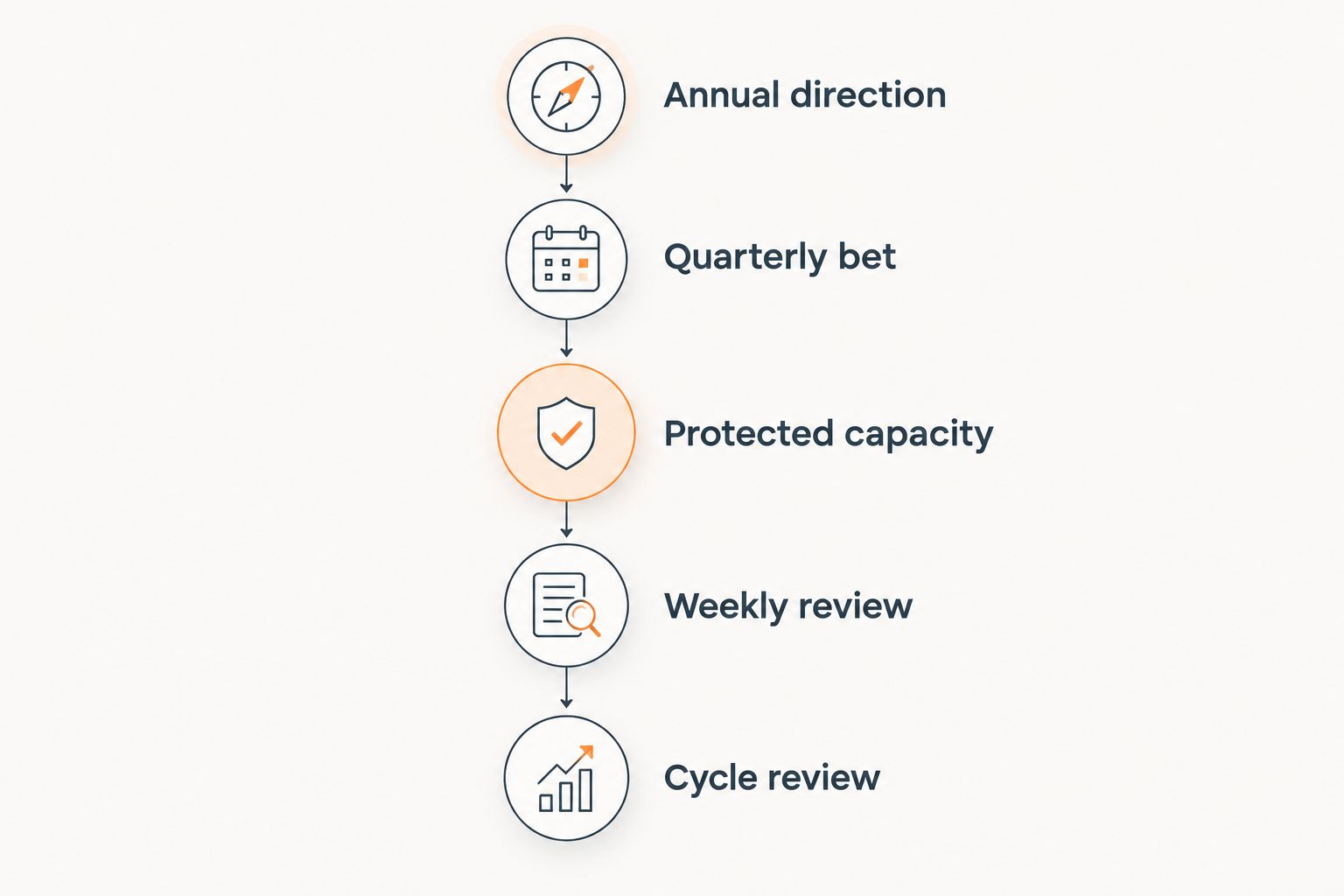
Start with the company outcome and work toward a commitment the team can support. This sequence gives the planning conversation somewhere concrete to finish.
- Annual direction. Describe the company outcome and the reason it deserves attention over the coming year. Include the founder's intended destination and the role of profitable growth where relevant.
- Quarterly bet. Select the contribution the team can pursue during the next quarter. Explain the assumption that makes the work worth funding.
- Protected capacity. Agree which people and time the work requires. Name existing commitments that constrain the plan and resolve conflicts before approval.
- Weekly review. Give the owner a recurring place to share evidence and request help. Record decisions so the next meeting can follow up.
- Cycle review. Evaluate the outcome and decide what deserves another commitment. Preserve useful learning when a bet ends.
The sequence works as a planning conversation, even if your first draft changes several times. Avoid copying a generic OKR set until you have checked its fit with your mission, strategic priorities and team strengths.
A useful planning record includes the objective, its measurement and the assumption behind the commitment. Add ownership and dependencies so the review can address what changed without reconstructing the original conversation.
Can an objective continue across several quarters?
A 3-month cycle can end while its objective continues. Keep the objective when the outcome still deserves attention, and renew the next quarter's commitment using current evidence.
Separate the parts that need a decision. The direction might remain valid while a measurement needs repair, a dependency needs escalation or the team needs a different scope of work.
Automatic rollover skips that discussion. At the review, ask what supports another commitment and what capacity the next quarter requires.
For a 2026 annual objective, record each quarterly decision in language a department head can explain. Someone joining the discussion later should understand why the work continued and what changed between cycles.
Should every team use the same OKR calendar?
A shared 3-month calendar is a useful starting point for teams with shared dependencies. It gives them a common boundary for planning and discussing capacity.
Allow a different horizon when the work requires it, and explain how the team will participate in company reviews. Shared review dates can keep dependent teams informed even when their delivery schedules differ.
Before making an exception, identify the practical benefit and the coordination cost. A team whose outcome develops slowly still needs a way to share evidence and request decisions during the company cycle.
Should a new OKR program start with annual goals?
Use a 12-month direction to frame the first quarterly commitment. Give the launch team a bounded cycle in which to learn how ownership, measurement and weekly reviews work in practice.
Expect a messy first cycle. Objectives will need editing, some measurements will need rework, and the meeting rhythm will take adjustment over several quarters.
At launch, look closely at adoption: do owners update the work, do teams consult it between meetings, and do leaders use it when allocating capacity? A polished scorecard offers little help when it sits unopened after planning.
Make the first review useful enough that people want to participate again. Leadership support needs repetition, protected time and practical help for the people running the program.
Keep the cycle review close to the evidence
Before closing a cycle, ask the owner to describe what happened to the outcome and what the team learned about its assumptions. Give incomplete evidence an honest explanation, including when the next observation is expected.
Use those findings to decide whether to continue, revise or end the commitment. When work continues, record what the next quarter is expected to contribute and who has approved the capacity.
The software has a supporting role. OKR Leader provides cycle management and dashboards, while the team remains responsible for the discussion and the follow-through.
One last thing: inspect the Wednesday habit
A useful test for your 2026 rollout is what happens between scheduled meetings. Can someone explain how the current objective affected a decision about their work this week?
That question invites an observable answer. It also gives the program owner something practical to discuss when leadership asks whether the effort is helping.
Worth trying this week: bring one current objective to the check-in and trace the next decision it requires. Keep the exercise small enough to repeat during the next cycle.
Related guides
FAQ
How long should OKR cycles last?
Use 3-month OKR cycles as a starting point for team execution, supported by a 12-month company direction. Review progress weekly and revisit the commitment at the end of each quarter.
Are quarterly or annual OKRs better?
Quarterly OKRs suit team-level commitments, while annual OKRs suit longer company outcomes. Connect them by identifying the contribution each team will pursue during the quarter.
How often should we check in on our OKRs?
Start with weekly OKR check-ins that examine evidence, obstacles and decisions about the work. When an outcome measure updates slowly, record when fresh evidence will arrive and discuss dependencies in the meantime.
Can we change an OKR during the quarter?
Change an OKR when evidence supports revisiting its outcome, measurement or scope. Document the reason and discuss the effect on capacity and dependent teams.
What should happen when an OKR is unfinished at quarter-end?
Review whether the unfinished outcome still deserves another commitment of capacity. Continue, revise or end the work using current evidence, and record the reason.
Does OKR software choose the right cycle length for us?
Your team chooses the cycle length based on evidence timing, dependencies and capacity. OKR Leader supports cycle management, dashboards and integrations; leaders and owners remain responsible for the operating decisions.
Should OKR scores affect performance reviews?
Keep OKR scores separate from compensation and performance reviews. Honest reporting requires room to disclose uncertainty, revise assumptions and discuss disappointing progress.