
Expect a rough first OKR cycle, with value building over several quarters as teams improve their objectives, reporting and weekly check-ins. Early evidence comes from people using the program to make decisions; business results depend on the strategic bet, the work completed and the time that outcome takes to change.
- How long to see results from OKRs? Expect a rough first cycle and value building over several quarters.
- OKR Leader recommends judging launch progress by adoption, including whether teams use their OKRs during the week.
- Weekly check-ins need to produce decisions about work, resources and obstacles.
- Assess business outcomes alongside cash, churn, quality and other health metrics.
Your first review needs evidence leaders can use
The offsite finished with enthusiasm. By Tuesday morning, customer escalations and delivery deadlines are competing with the priorities everyone approved, and you are preparing to explain whether the program is working.
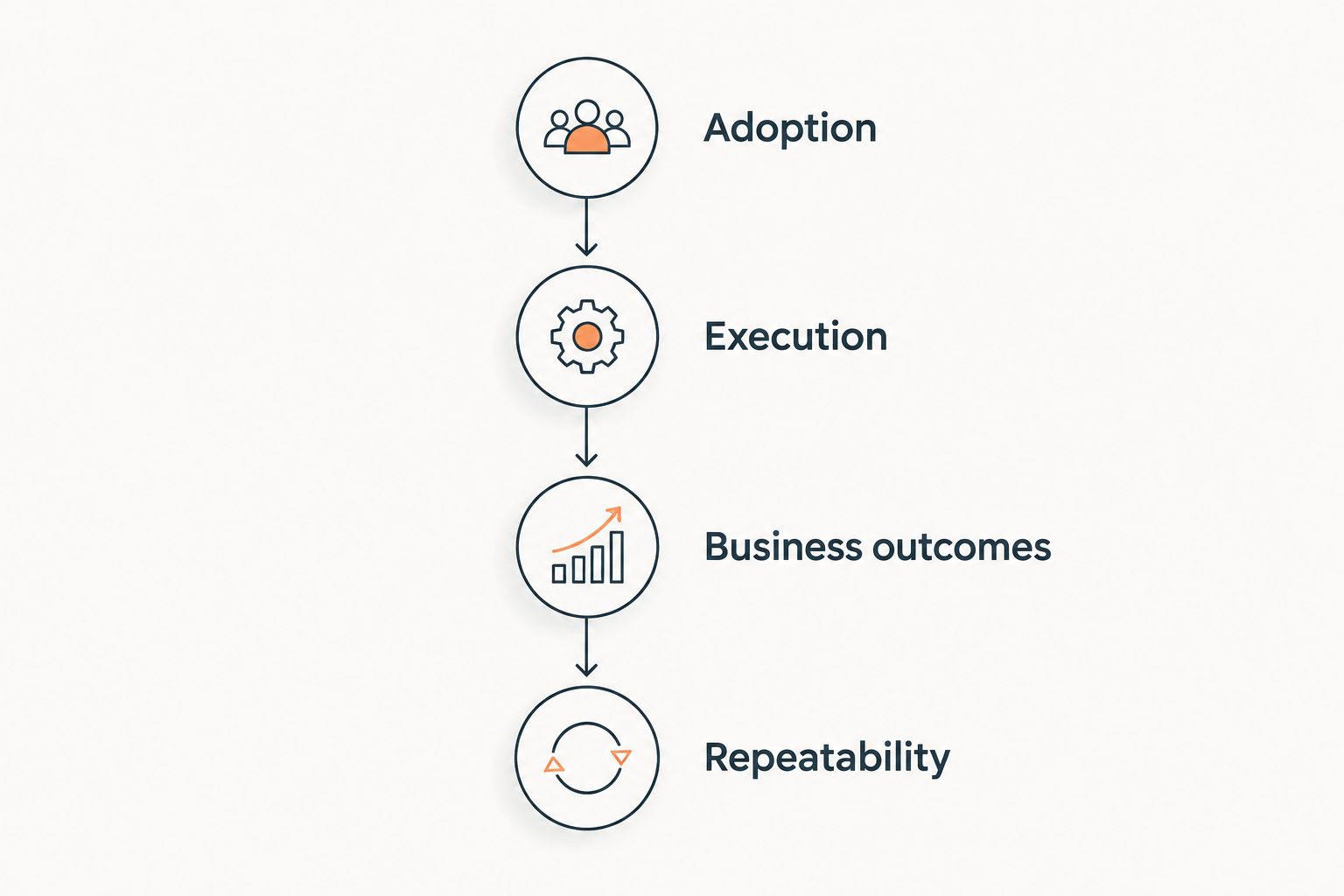
That pressure deserves a practical answer. Your 2026 review needs to separate adoption, changes in execution and movement in business outcomes, because each provides different evidence.
OKR Leader recommends starting with adoption at launch: do people look at their OKRs during the working week, and does that review influence what happens next? A score entered immediately before the leadership meeting tells you very little about that.
Give leadership an evidence ladder for the program. Agree on what you expect to observe during the cycle, what requires an end-of-cycle review and which outcomes need observation across several quarters.
How long does it take to see results from OKRs?
The first OKR cycle establishes how well your team can use the discipline. Expect objectives that need adjustment, Key Results that need reworking and a weekly cadence that takes practice; business value builds as those habits improve across several quarters.
Use this sequence to judge progress in your 2026 program. It is an evaluation sequence, with timing tied to your cycle and the outcome you chose.
| Evidence stage | When to examine it | What counts as progress | What it cannot establish |
|---|---|---|---|
| Adoption | During the first cycle. | Owners review objectives and update evidence during the working week. | Participation alone cannot establish business impact. |
| Execution | At weekly check-ins. | Teams resolve obstacles and change work in response to evidence. | A decision still needs follow-through. |
| Business outcomes | At the measurement interval appropriate to the result. | The selected outcome moves while relevant health metrics remain protected. | A changed metric alone cannot establish what caused the change. |
| Repeatability | Across several quarters. | Teams apply learning to later cycles and sustain useful habits. | A successful cycle cannot guarantee future results. |
A launch review can show healthy adoption while the business outcome is still developing. Equally, a rising business metric deserves examination when nobody uses the OKRs between reporting meetings.
First cycle: look for adoption and usable evidence
At launch, adoption is the first thing to establish. People need to know where their objectives live, who owns each result and how to raise a problem while there is still time to respond.
A useful review asks about observable behaviour. Did the owner examine the measure before the meeting, and did anyone use that information to change the work?
- Owners can locate their current objectives and explain the outcome they are pursuing.
- Updates include the source of the measure and the obstacle requiring attention.
- Team members use priorities when deciding which requests to accept.
- Leaders make time for the discussion and respond to requests for support.
Expect the first cycle to be messy. An objective that needs revision is useful evidence when the team explains what it learned and records the change.
Repeatedly changing a target without documenting the reason makes evaluation difficult. Keep the original intent visible so the end-of-cycle discussion can distinguish learning from a moving finish line.
Weekly check-ins: look for decisions that change the work
The weekly check-in is where a strategic intention meets the actual workload. A useful meeting ends with an owner who knows what happens next and a leader who understands which obstacle needs support.
Imagine the Tuesday update: a department reports that a dependency remains unresolved, then moves to the next slide. The number has been reported; the dependency still needs an owner and a decision.
For your 2026 cycle, give unresolved obstacles a place in the discussion. Ask what changed, what requires a response and who has authority to respond.
A full agenda can crowd out the uncomfortable conversation about capacity. Protect time for that conversation, especially when the same person owns delivery work and the OKR program itself.
Judge check-ins by the decisions they produce and the follow-through you can observe. A meeting that identifies an obstacle has started useful work; the next review needs to establish whether anyone addressed it.
Business outcomes: use the measurement window of the bet
The outcome you choose determines when business evidence becomes available. Your reporting calendar needs to reflect how that outcome is measured and how the work is expected to influence it.
Begin by recording the baseline, the source of the measure and the expected route from the work to the outcome. Agree on when to inspect the result before the cycle gets busy.
For profitable growth, review the economic consequences of progress. Revenue growth needs context from the work and resources required to produce it, and profit per employee can support that discussion.
Separate strategic bets from health metrics at the outset. Cash, churn, uptime, fulfillment and quality are vital signs to protect; an OKR is the ambitious work layered on top.
A health metric in the red deserves attention even when the strategic bet is attractive. Pausing the bet to restore operating health is a responsible option.
Several quarters: look for learning that survives a reset
Across several quarters, examine whether your team carries useful learning into the next cycle. An end-of-cycle retrospective earns its place when the next planning discussion reflects what happened.
Look for objectives that become more focused and Key Results that describe outcomes the team can measure. Check whether leaders continue protecting time and resources after launch enthusiasm has faded.
For a 2026 program review, compare the current operating habits with the habits present at launch. Record specific changes, such as a dependency receiving an owner or a department declining work that conflicts with its agreed objective.
A credible case for continuing OKRs combines adoption, execution evidence and business outcomes. Keep the evidence connected so leadership can see how the program supports the company's chosen direction.
Why the time to useful results varies
Your OKR program operates inside an existing company, with its own constraints and working relationships. These factors deserve attention when leadership asks why progress has stalled.
- Objective load affects focus. Treat 3 objectives as a ceiling to consider carefully. A team carrying 6 objectives needs to examine whether its capacity supports every commitment.
- Weekly check-in quality affects follow-through. A meeting needs space to resolve obstacles, assign ownership and revisit earlier decisions.
- Leadership resourcing affects execution. Endorsement needs protected time, sufficient people and budget for the tooling, training or facilitation the program requires.
- Trust affects reporting. Linking OKR scores to pay encourages safe targets and makes candid progress discussions harder. Keep OKRs and performance management separate.
- Measurement design affects interpretation. Outcome-shaped Key Results help you examine business change; activity measures show whether work happened.
- Operating health affects available attention. A cash, churn or quality problem can require the team to pause a strategic bet while it addresses the underlying issue.
The objective count is a planning guardrail, with the final choice grounded in your strategy and capacity. Each additional commitment needs a credible explanation of who will do the work.
When should we change an OKR that is not working?
During the first cycle, review an OKR when its assumptions, measurement or available capacity change. Document the reason so your team can assess the original intention at the end of the cycle.
Start with the diagnosis. A missing update needs a conversation about ownership or adoption; a result that remains flat despite completed work needs examination of the strategic bet.
Avoid treating every stalled metric as a writing problem. The team might need a dependency resolved, a resource commitment honored or an assumption tested.
How long should we keep a struggling OKR program?
Several quarters provide a useful horizon for examining how the discipline develops, provided leadership continues to support it and the team can show learning. Waiting needs an accompanying explanation of what will change in the next cycle.
Review the operating conditions before extending the program unchanged. If people hide setbacks because scores affect pay, or the owner lacks time to run the cadence, those conditions need attention.
A calendar alone cannot tell you whether to continue. Use the review to agree on the behaviour, support and evidence you need to see next.
Software supports a cadence your team can sustain
OKR Leader provides OKR management software with cycle management, dashboards and integrations. OKR Leader is a fit for strategy and operations leaders who need OKR cycle management and dashboards.
Those capabilities support the recurring work of running a program. Leaders still need to approve resources, make decisions when obstacles surface and create conditions for honest reporting.
Before selecting software, describe the working routine you need it to support. Include who updates progress, who reviews obstacles and how a decision reaches the people doing the work.
That gives you a practical way to evaluate fit. A dashboard serves the program when its information enters a conversation that changes what happens next.
Worth trying this week
Bring one current objective to the next check-in and follow its evidence from the latest update to the next action. Ask the owner which decision the update requires, then establish who can make it.
The exercise can expose a gap between reporting and follow-through. It also gives the team a small habit to practice while the wider discipline develops.
For the next leadership discussion in 2026, bring that example alongside your outcome measures. A specific account of an obstacle addressed helps leadership assess how the program is being used.
Related guides
FAQ
How long does it take to see results from OKRs?
Expect a rough first cycle, with value building over several quarters. Review adoption during launch, decisions during weekly check-ins and business outcomes at the measurement interval appropriate to each result.
What should we expect from our first OKR cycle?
Your first OKR cycle should establish working habits and expose what needs adjustment. Expect some objectives and Key Results to need reworking while the team settles into its check-in cadence.
Can we judge OKRs after one cycle?
One cycle gives you evidence about adoption, execution and the selected outcomes. Use that evidence to improve the next cycle; assess the discipline’s development across several quarters.
How many objectives should a team start with?
Treat 3 objectives as a ceiling to examine against your team’s capacity. Each objective needs a credible owner, protected time and a connection to the company’s strategy.
How often should we check progress on OKRs?
Use a weekly check-in to examine progress and resolve obstacles. Keep the measurement schedule for each business outcome tied to the way that outcome is measured.
Should OKR results affect performance reviews?
Keep OKR scores separate from performance reviews and pay. Scores tied to compensation encourage safe targets and make honest reporting harder.
Will OKR software make results happen sooner?
Software supports cycle management, reporting and access to progress information. It cannot establish trust, approve resources or make the leadership decisions that execution requires.
What should we do when business health gets worse during an OKR cycle?
Protect the affected health metric and assess whether the strategic bet needs to pause. Cash, churn, uptime, fulfillment and quality require attention throughout the cycle.