
Yes, OKRs and KPIs can work together in the same software when the system keeps ongoing business health and time-bound strategic bets distinct. A shared dashboard needs separate ownership, review rules, and responses for each; otherwise, Tuesday’s check-in can become another meeting spent explaining colors.
- Can OKRs and KPIs work together? Yes: shared software needs separate rules for business health and strategic bets.
- OKR Leader supports strategic goal management through cycle management, dashboards, and integrations.
- A KPI crossing its agreed threshold deserves attention even when the related OKR looks healthy.
- Evaluate shared dashboards through a real weekly check-in before committing your program.
Can OKRs and KPIs work together in the same software?
Yes. Keep the measurement connected and make the management rules explicit. A KPI tracks a condition you need to protect, such as cash, churn, uptime, fulfillment, or quality. An OKR organizes a strategic change you intend to achieve during a defined cycle.
A metric can appear in both views. Its role depends on the commitment attached to it: an operating threshold needs an agreed response, while a strategic target needs an owner and work that can move it.
For your 2026 software evaluation, the useful question is whether leadership can see both roles without confusing their consequences. These OKR dashboard software considerations for leadership teams provide a related starting point for evaluating the leadership view.
| Approach | Best for | Advantage | Limitation |
|---|---|---|---|
| KPI monitoring | Protecting ongoing business health. | Makes operating conditions visible. | A healthy dashboard can leave strategic progress unexplained. |
| OKR tracking | Managing a defined strategic bet. | Connects an intended outcome to cycle ownership. | A cycle score alone leaves ongoing operating risks unexplained. |
| Connected OKR and KPI views | Reviewing strategy alongside operating conditions. | Gives leaders context for resource decisions. | Requires explicit rules to prevent duplicated metrics and conflicting updates. |
The shared view earns its place when it helps someone make a decision. Putting every available metric on a screen adds review work, so each measure needs a reason to be there.
A shared dashboard needs a response behind every signal
Picture a Tuesday check-in. Customer churn has crossed the team’s agreed threshold, a strategic retention initiative still shows progress, and the discussion turns into a debate about which color belongs on the executive slide.
Everyone has a reasonable concern. The operations owner needs attention on current customer losses; the initiative owner needs the group to understand work already underway. A dashboard can hold both facts, provided the meeting has a rule for resolving the resource conflict.
That rule belongs in the operating agreement. A breached health threshold triggers investigation and an accountable response, including a decision about whether the strategic work should pause.
Your 2026 reporting setup should make that relationship visible before the meeting starts. Each person needs to know which condition requires intervention and who has authority to change the plan.
Connect the records through a deliberate review process
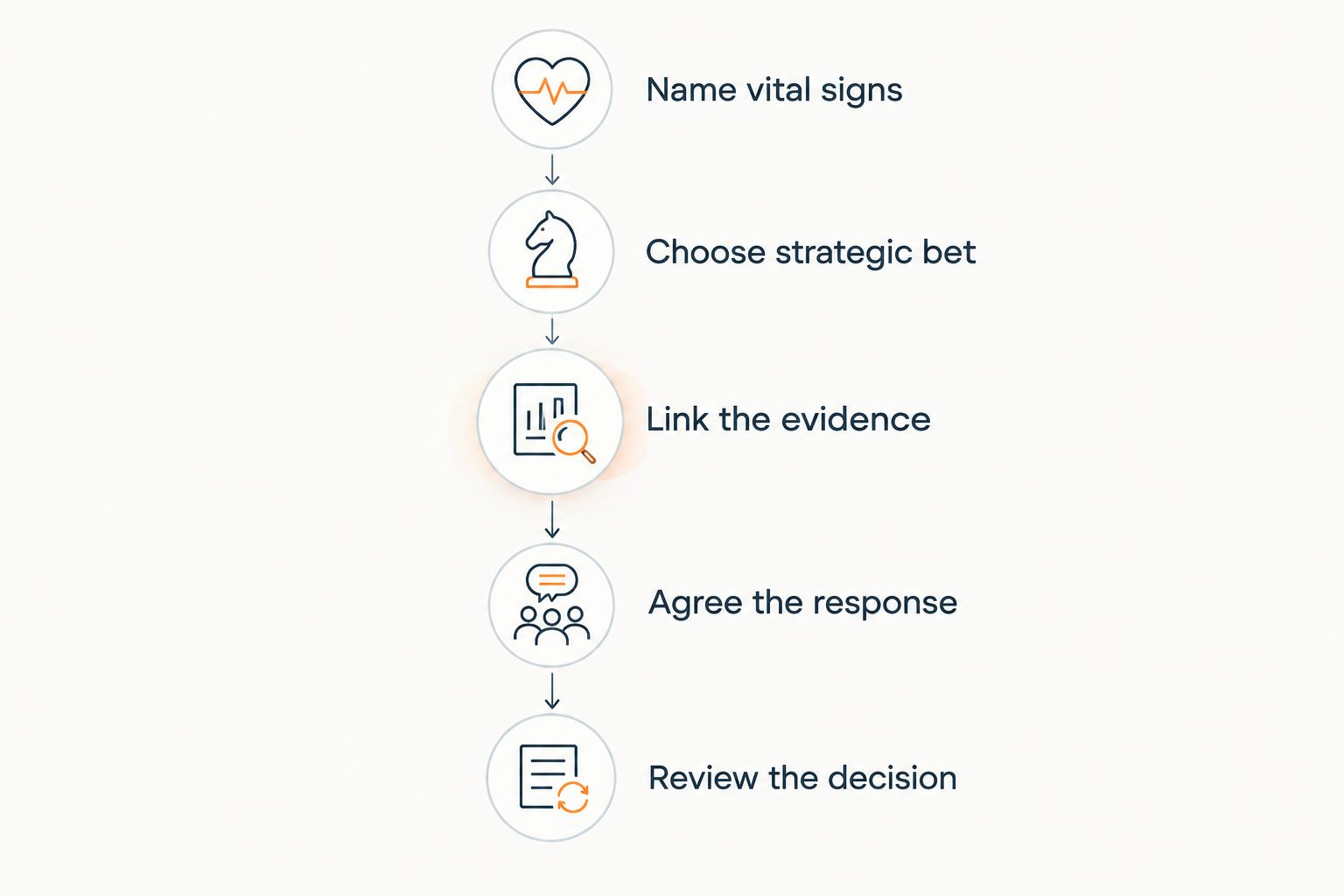
A shared system works through repeatable decisions. The sequence below is a proposed operating habit you can adapt to your existing cadence.
1. Name the vital signs
Start with the measures your organization must protect continuously. Cash, churn, uptime, fulfillment, and quality are examples; your business determines which belong in its operating review.
Give each selected measure a definition, a source, an accountable owner, and an agreed threshold. Document the action that follows a breach, including who can authorize extra capacity or pause planned work.
An owner should be able to explain what the metric includes without reconstructing a spreadsheet during the meeting. If departments calculate it differently, resolve that disagreement before connecting it to a strategic target.
2. Choose the strategic bet
Describe the change leadership wants to make during the cycle. Then test the proposed Key Results against that change and the resources available to pursue it.
Keep the set small enough to support real trade-offs. Every objective adds review work and a claim on people’s time; approving it should also mean approving the capacity it needs.
Generic examples need careful vetting against your mission, strategic priorities, and team strengths. A borrowed target can be grammatically perfect and still direct effort toward the wrong outcome.
3. Link the evidence
Connect a relevant KPI to a Key Result when the relationship helps the team understand progress. Preserve the underlying metric definition so updates remain consistent across views.
Write down the relationship in ordinary language. For example, a retention initiative might aim to change customer churn, while churn also remains an ongoing health measure with its own escalation rule.
Treat the expected relationship as something to examine. A completed initiative and an unchanged business metric deserve discussion about the assumption behind the work.
4. Agree the response
Decide what happens when a strategic target improves while an operating measure deteriorates. Name the person responsible for resolving competing demands on the same team.
Include permission to pause the OKR when business health requires it. That permission helps the owner report a problem early and gives leadership a concrete choice about resourcing.
For the 2026 cycle under review, record those choices beside the work. A decision hidden in meeting notes is difficult for someone joining the program halfway through the cycle to recover.
5. Review the decision
Use the check-in to examine changed conditions, blocked work, and decisions that need help. Updates should leave enough time for the group to address an obstacle.
Close each discussion with an owner and the next action. At the next review, revisit whether the action happened and whether the evidence changed.
The same metric can carry different commitments
A KPI can supply the measurement for a Key Result. Keep the metric’s definition stable while documenting the target and time boundary attached to the strategic commitment.
Customer retention illustrates the distinction. Your operating review can monitor retention continuously, while an OKR cycle focuses on improving a specific part of the customer experience expected to influence it.
The records need to answer different management questions. The operating record should explain whether current health requires action; the strategic record should explain what change the team is pursuing and how progress will be judged.
Use a shared source for the measurement wherever your system supports it. Separate manual updates create reconciliation work and leave the meeting arguing about whose figure is current.
Avoid turning every monitored KPI into a Key Result. Each proposed strategic commitment needs a reason to receive focused attention during this cycle, along with an explicit capacity decision.
What makes a combined setup harder to run?
The difficulty comes from the working agreements surrounding the metrics. These factors deserve a place in your evaluation:
- Metric definitions: Departments need an agreed calculation and scope before a shared figure can support decisions.
- Ownership: Every measure needs an accountable person, including when several teams contribute to the outcome.
- Review cadence: Operating alerts and cycle reviews need schedules that match the decisions they support.
- Resource conflicts: Leaders need a route for resolving competition between health recovery and strategic work.
- Reporting incentives: Connecting OKR scores to pay encourages safe targets and makes honest progress reporting harder.
- Leadership participation: The program needs protected time, sufficient people, and repeated leadership support to stay in use.
These agreements deserve attention during a 2026 rollout even when the software setup looks straightforward. A dashboard cannot allocate capacity or create permission to raise an uncomfortable problem.
Expect a messy first cycle. Definitions will need adjustment, some Key Results will need rework, and the review cadence will take practice; the value develops through repeated use across quarters.
Evaluate software with the check-in you already need
Bring a real operating measure and a real strategic commitment into the evaluation. Ask the people who own them to walk through an update, an exception, and a resource decision.
Use the following as acceptance criteria. They are questions for a demonstration, so they do not assume that any particular product supports the workflow.
- Can you identify the measurement source and the person accountable for its accuracy?
- Can you distinguish an operating threshold from a cycle target while viewing the same metric?
- Can someone see when the information was updated and understand the scope it covers?
- Can you connect the relevant strategic work without duplicating the underlying measurement?
- Can the reviewer find the latest decision and the person responsible for the next action?
- Can leadership understand a paused objective and the business-health issue that prompted it?
Watch what happens when the owner explains a problem. If the demonstration requires a separate document to recover the context, include that extra work in your assessment.
OKR Leader fits teams managing strategic goal cycles
OKR Leader is best for teams seeking OKR software to set, track, and execute strategic goals through cycle management, dashboards, and integrations. Those are the stated capabilities relevant to this workflow.
You can evaluate OKR Leader against your operating requirements using the same demonstration questions. Confirm how the product handles KPI definitions, threshold responses, and connections between operating measures and cycle targets before treating it as your shared system.
The benefit of OKR Leader’s stated feature set is support for strategic goal management across the cycle. The limitation of that description is scope: it does not establish how every KPI workflow behaves, and software still needs owners, protected time, and a dependable review habit.
Should every KPI become a Key Result?
No. Keep the ongoing health measures your business needs, then select strategic commitments according to the change you intend to pursue during the cycle.
A KPI deserves a role in an OKR when improving it supports a current strategic bet and the team has capacity to act. The remaining measures can stay in the operating review with their own thresholds and owners.
Should OKR scores influence performance reviews?
Keep OKR scores separate from compensation decisions. An owner needs room to report a difficult target honestly, including when evidence suggests the team should change its approach.
Discuss individual contribution through the relevant performance-management process. Explain the separation when the program launches so people understand how their reporting will be used.
One last thing: test the uncomfortable update
Before approving your 2026 setup, ask the team to walk through a situation where the KPI deteriorates and the strategic initiative still appears on track. Observe whether the system and meeting rules help the owner explain both facts.
That rehearsal exposes questions a polished dashboard leaves untouched: who gets involved, what work can pause, and how leadership records the trade-off. It is a useful habit inside the wider discipline of running the program.
Related guides
FAQ
Can OKRs and KPIs work together in one dashboard?
Yes, OKRs and KPIs can share a dashboard when operating health and strategic commitments have distinct review rules. Preserve metric definitions, ownership, and the response expected when a threshold is crossed.
Can the same metric be a KPI and a Key Result?
Yes, the same metric can support ongoing health monitoring and a time-bound strategic target. Document the target and cycle separately from the operating threshold so reviewers understand each commitment.
Do I need separate software for OKRs and KPIs?
Separate software is optional; the deciding factor is whether your chosen setup supports the required workflow. Test metric sourcing, ownership, cycle targets, and exception handling with the people who will use them.
What should we do when a KPI gets worse during an OKR cycle?
Investigate the deterioration and use the agreed escalation rule to decide what action needs capacity. Leadership should explicitly consider pausing strategic work when business health requires attention.
Should we turn all our KPIs into OKRs?
No, keep ongoing health measures in the operating review and select OKRs for the strategic changes receiving focused effort. Each objective needs capacity and a reason to belong in the current cycle.
Can a shared dashboard replace the weekly check-in?
A shared dashboard supplies information; the weekly check-in provides a place to resolve obstacles and resource conflicts. Keep the discussion centered on changed conditions, decisions, and accountable next actions.
What should we look for during our first combined cycle?
Look for regular use, consistent definitions, and evidence that reviews lead to action. Expect rework during the first cycle and use what you learn to improve the next one.
Worth trying this week: bring a disputed metric to the check-in and ask its owner to explain the threshold, the strategic target, and the decision needed. Leave room for the answer to change how the group runs the next review.