
Each objective should have the smallest set of Key Results that gives you credible evidence of success and can receive proper attention at every weekly check-in. For your 2026 cycle, give each proposed result a job: show progress toward the objective, cover a distinct outcome, and support a decision when progress stalls. The practical limit is your team's capacity to act on what it measures.
- How many Key Results per objective? Keep the smallest set that proves success and supports weekly decisions.
- Okrleader recommends checking outcome coverage, ownership, and review capacity before adding another Key Result.
- Keep business health metrics visible alongside your strategic bets, with explicit thresholds for intervention.
- Expect your first OKR cycle to need revision; useful habits develop over several quarters.
How many Key Results should each objective have?
Keep a Key Result when removing it would leave a material gap in your evidence of success. Combine overlapping results, move activities into the delivery plan, and keep routine health metrics visible in their own monitoring process.
The count follows from those choices. Starting with a quota invites a familiar planning-room problem: everyone agrees the objective is ready, then someone adds another result because there is still space on the slide.
Okrleader provides OKR software with cycle management, dashboards, and integrations. Those capabilities support the review process; your team still needs to decide which results deserve its attention.
| Proposed set | Best for | Advantage | Limitation |
|---|---|---|---|
| Lean set with distinct outcomes | A focused strategic bet | Gives each result room for discussion and action. | Can overlook part of the objective if coverage is incomplete. |
| Expanded set with distinct outcomes | An objective with several genuinely separate success conditions | Makes those conditions visible. | Requires enough ownership and review capacity for every result. |
| Set with overlapping measures | A draft that needs editing | Reveals where people are describing the same outcome differently. | Repeats evidence and adds review work. |
| Set dominated by activities | A delivery plan awaiting outcome measures | Shows the work people intend to undertake. | Provides weak evidence that the objective has been achieved. |
Use the table during drafting. A lean set earns its place through sufficient coverage; an expanded set earns its place through distinct evidence and available capacity.
Every added result creates an operating commitment
Picture a Tuesday check-in. Someone has updated a result, someone else is waiting for a dependency, and the person who understands the measure is in another meeting. The room has a dashboard open and a decision waiting.
Good teams reach this point because each addition looked reasonable during planning. A stakeholder wanted visibility, a department wanted its contribution represented, and an owner wanted to show the work behind the outcome.
Each request deserves a hearing. Each proposed Key Result also needs an owner, a usable source of evidence, and time for the work it implies.
For a 2026 rollout, judge the set by whether people return to it during the week. A polished planning document has limited value when nobody uses it to choose what happens next.
A focused objective needs complete evidence
A narrow objective can support a compact set when its success conditions are straightforward. Your test is whether the proposed results collectively describe the change you want to achieve.
Consider an illustrative objective about improving customer onboarding. Evidence might cover whether customers reach an agreed success milestone and whether that improvement remains sustainable for the team delivering it.
A task such as publishing onboarding materials belongs in the work plan. The team can complete that task while customers continue struggling to reach the milestone.
Ask these questions of each proposed result:
- Does this result demonstrate a change that matters to the objective?
- Can its owner explain the evidence and identify when it needs updating?
- Would an unexpected movement prompt a decision about the work?
- Does another result already provide substantially the same evidence?
A focused objective is ready when its evidence is sufficient and each result has a distinct purpose. Brevity alone cannot establish that.
A broad objective needs a boundary check
An objective can accumulate results because it contains several strategic bets. Before accepting the larger set, examine the objective's wording and the choices underneath it.
For example, an objective covering acquisition, onboarding, retention, and expansion asks several groups to make different changes. A shared commercial theme connects them, yet the proposed work still needs a manageable boundary.
Review the objective with the people accountable for execution. Ask which outcome deserves protected attention during this cycle and which work belongs elsewhere.
Splitting an objective carries a cost: your total program can become harder to maintain. Keep the overall objective set small enough that leadership can resource it and teams can remember what they have agreed to pursue.
The brand's position on focus applies here: treat guidance about objective counts as a ceiling. Adding objectives to accommodate every stakeholder's request preserves the original workload problem.
Why the right Key Result count varies
For a 2026 planning session, use these factors to explain why a proposed result belongs in the set. They make the discussion concrete when someone asks for another measure.
- Outcome coverage matters. Keep the evidence needed to establish whether the objective succeeded, including success conditions that another measure cannot represent.
- Ownership capacity matters. Every result needs someone with the time and authority to respond when progress changes.
- Data readiness matters. A measure needs an understood definition and an accessible source before it can support a useful discussion.
- Dependencies matter. Shared work needs explicit commitments from the teams contributing to the outcome.
- Review capacity matters. Protect enough check-in time to examine stalled results and agree on action.
These factors belong in the same conversation. A distinct outcome with unavailable data creates a measurement problem; a measurable outcome with no owner creates an accountability problem.
Adding a result also adds a claim about what the organization can support. Leadership endorsement needs to include protected time, people, and the resources required to run the program.
Edit the set before the cycle begins
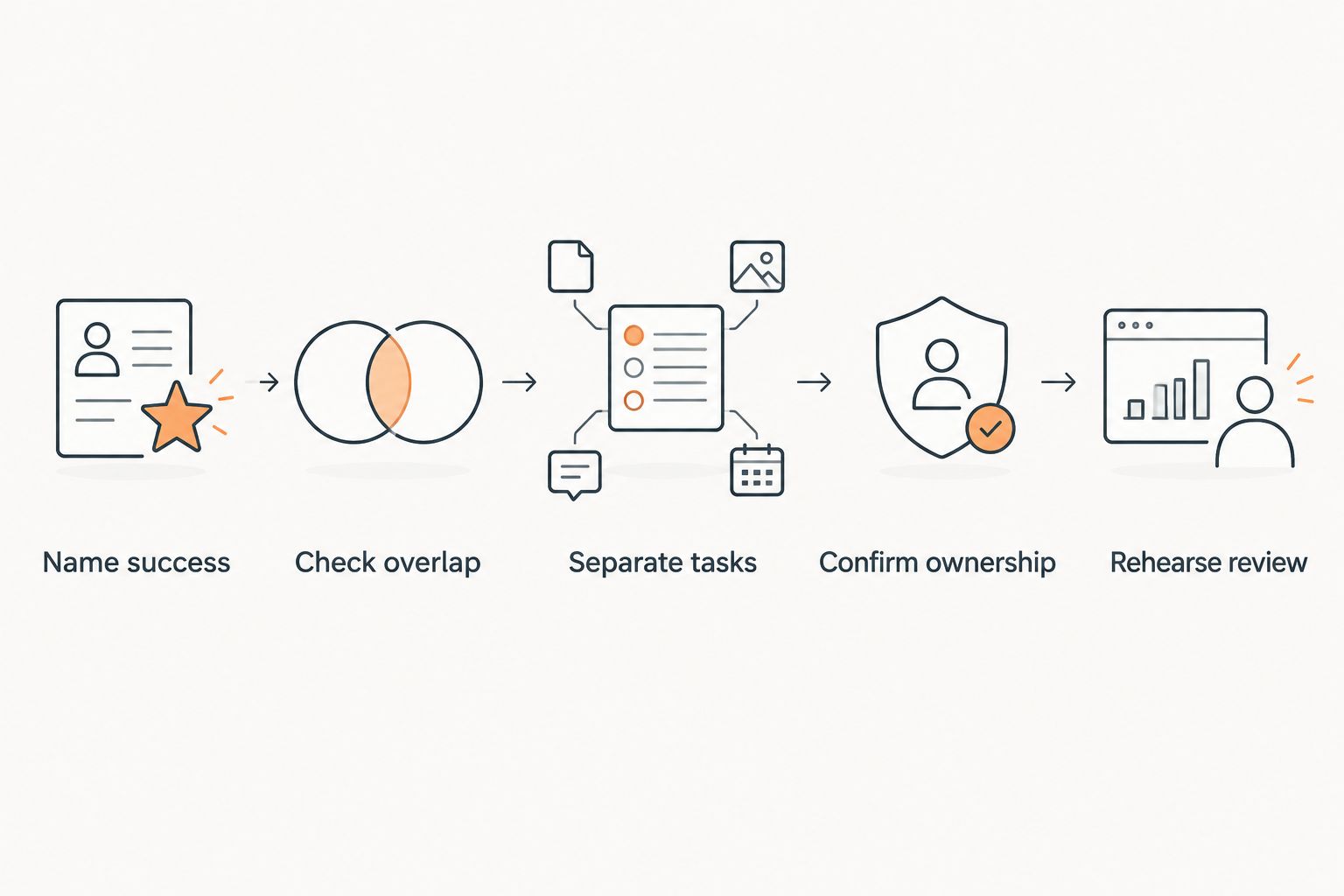
Use this sequence with a live draft. It works as a planning habit and as a repair exercise when an existing objective has become difficult to review.
- Name success. Describe the observable change that would make the objective successful, using language the responsible team understands.
- Check overlap. Read each proposed result alongside the others and identify repeated evidence or measures that move together for the same reason.
- Separate tasks. Place deliverables and activities in the delivery plan, with their own ownership and follow-through.
- Confirm ownership. Check that someone can explain each measure, maintain its evidence, and act on the findings.
- Rehearse review. Walk through a stalled result and discuss the decision your team would need to make.
The rehearsal deserves time. Ask what happens when a result remains unchanged, when its data arrives late, or when a dependency slips. A set that looks tidy in a document can still leave those situations unresolved.
Record what you remove and where the responsibility now sits. People need to know that a task moved into the delivery plan still has an owner, while a health metric remains under active monitoring.
Health metrics need their own protection
Distinguish your business's vital signs from the strategic bets in your OKR cycle. Cash, churn, uptime, fulfillment, and quality need ongoing attention wherever they apply to your organization.
An objective can target an improvement involving one of those measures. The underlying responsibility to protect business health continues throughout the cycle.
For example, a team pursuing profitable growth needs to understand the economic consequences of its choices. An acquisition measure alone leaves unanswered questions about the work required to serve those customers and the profit that work produces.
Write down which thresholds demand intervention and who is responsible. If a vital sign enters the red, pausing strategic work can be the responsible move.
This distinction helps keep the Key Result set focused while preserving operational accountability. Removing a measure from an objective must leave its monitoring responsibility intact.
Weekly check-ins expose an overloaded set
During your 2026 cycle, pay attention to what happens after an owner reports progress. A useful check-in gives the team space to examine a blockage, choose an adjustment, and establish who will follow through.
An overloaded agenda makes that discussion harder to protect. You reach the end with every number updated and the awkward dependency still unresolved.
Try discussing the result that needs a decision first. Give the owner room to explain what changed and what support the work requires.
Okrleader is a fit for teams seeking OKR cycle management and dashboards. Its software supports keeping the cycle and progress visible; leaders remain responsible for the trade-offs and commitments that follow.
Keep OKR scoring separate from pay and performance reviews. People need room to report an ambitious result honestly, including when the evidence suggests their original approach needs revision.
Can an objective have too few Key Results?
An objective has too few Key Results when its measures leave a material part of success untested. A compact set still needs enough evidence to prevent an incomplete view of performance.
Review the objective as a whole. If every result reaches its target, would the team reasonably agree that the objective succeeded?
If that answer requires an extra condition, examine the gap. The missing condition might belong in the result set, in a health guardrail, or in a more precise objective.
Should company and team objectives use the same count?
Company and team objectives should each carry the evidence their scope requires. A uniform quota creates extra measures when a team already has sufficient coverage and squeezes out evidence when another objective needs it.
Company-level work also needs explicit ownership across dependencies. Check that the contributing teams have agreed to the work before treating a shared result as committed.
Use consistent drafting standards across levels. Outcome coverage, available evidence, and review capacity remain useful tests wherever the objective sits.
Should you change the count during a cycle?
Change the set when you discover duplication, an unusable measure, or a genuine gap in the evidence. Document the reason so the team can distinguish a measurement repair from a change in ambition.
A result that is behind target deserves an honest discussion before any editing. Preserve the history and explain what the revised set will let you assess.
Expect a messy first OKR cycle. Objectives will need adjustment, some results will need reworking, and the review cadence will take practice; the value develops over several quarters of using and improving the discipline.
Worth trying this week
For your next 2026 check-in, take the objective with the longest result list and ask what evidence would disappear if you removed each result. Listen for a specific answer tied to success.
Keep the discussion open when the answer is uncertain. Someone may be protecting an obligation that needs a different home, or pointing to a part of the objective the team has not yet agreed on.
Okrleader's recommendation is to make this a recurring editing habit. The count becomes easier to defend when every retained result has a purpose the team can explain.
Related guides
- OKR tracking software covers tools for keeping progress visible through a cycle.
- OKR software for quarterly planning covers tools for organizing planning and cycle management.
FAQ
How many Key Results per objective should we choose?
Choose the smallest set that provides sufficient evidence of success and receives proper attention during weekly check-ins. Keep each result only when it covers a distinct outcome the objective needs.
Is it better to have fewer Key Results?
Fewer Key Results help when they remove duplication and preserve complete evidence of success. Check for gaps before treating a shorter list as an improvement.
How do I know whether we have too many Key Results?
Your set needs editing when results overlap, describe activities, or exceed your capacity to review and act. Check the purpose and ownership of each result before accepting the full set.
Should routine KPIs become Key Results?
Routine health metrics need ongoing monitoring, with explicit ownership and intervention thresholds. A strategic improvement involving one of those metrics can belong in an OKR while the underlying health responsibility continues.
Can we remove a Key Result halfway through the quarter?
You can remove a result when there is a documented reason, such as duplicate evidence or an unusable measure. Preserve its history and discuss the implications with the people responsible for the objective.
Should every team use the same number of Key Results?
Each team should use the evidence its objective requires and its review capacity supports. Apply consistent standards for outcome coverage and ownership across teams.
Will OKR software tell us the right number of Key Results?
Your team needs to judge outcome coverage and execution capacity. Software can support cycle management and progress visibility, while the decisions about scope and resources remain with the people running the program.