
Yes, OKR software can help you adapt the Google OKR model for small teams by keeping objectives focused, making progress visible, and supporting a weekly review. When the planning session has produced more commitments than the team can carry, the first fix is agreeing what gets time; software then helps maintain those agreements.
- To adapt Google OKR model for small teams, reduce objectives and protect a weekly check-in.
- OKR Leader supports teams that need cycle management and dashboards for strategic goals.
- Keep health metrics visible alongside strategic bets, with a named owner for each.
- Expect a messy first cycle; assess adoption before expanding the program.
Can OKR software adapt the Google OKR model for a smaller team?
Software supports the operating routine you choose. Your team still needs to decide which outcomes deserve attention, who owns them, and what work will leave the calendar.
For a 2026 rollout, use this sequence:
- Choose the strategic bet. Name the change the business needs and explain how it supports the founder’s destination, including profitable growth where relevant.
- Check capacity. Agree which existing commitments will pause so the objective has room to move.
- Assign ownership. Give each Key Result an owner who can explain progress and request help.
- Review weekly. Discuss evidence, obstacles, and the next action while there is time to respond.
- Review the cycle. Keep what people used, revise weak measures, and carry those lessons into the next quarter.
The guide to how many objectives a team should track per quarter helps with the first capacity conversation. Three focused objectives executed well beat six that people shrug at; treat the objective count as a ceiling you can lower.
A smaller team needs a routine it can sustain
Google’s model comes from an organization with thousands of engineers and deep resources. A smaller company needs a version that fits its available attention and staffing.
Picture Tuesday morning: a customer escalation needs an answer, someone is covering an absence, and the quarterly planning slide is still sitting in a folder. The director responsible for OKRs has a reasonable question: where does this work fit today?
That question deserves an answer before another reporting requirement appears. Leadership needs to protect time for the strategic work and support the person coordinating the cycle.
For your 2026 program, write down the minimum routine people can maintain during a difficult week. Include a place to update progress, a recurring discussion, and a route for getting help when an owner is blocked.
The weekly check-in earns its place when it changes what happens next. A useful review ends with an action someone can carry into the working week.
Choose a tracking approach that fits your coordination needs
A shared document and dedicated OKR software are both workable approaches. Their usefulness depends on how much coordination your team needs and how consistently people maintain the record.
| Approach | Best for | What it supports | Trade-off |
|---|---|---|---|
| Shared document or spreadsheet | A team testing a small, manageable OKR routine | Recording objectives, owners, measures, and review notes in a shared place | Someone must maintain structure and keep updates together. |
| Dedicated OKR software | Teams needing cycle management and dashboards across strategic goals | Organizing goals and making progress available for review | Setup and ongoing use require protected attention; leadership still owns priorities. |
A document is a reasonable starting point when everyone can find the current version and explain what changed. Dedicated software becomes useful when maintaining the record starts consuming attention that belongs in the discussion.
During a 2026 evaluation, ask the team to walk through an ordinary review. Watch where people search for evidence, repeat updates, or lose track of ownership.
That exercise gives you buying criteria tied to actual work. A long feature checklist leaves the harder question unanswered: will people use this during the week?
Keep health metrics visible before choosing ambitious work
Cash, churn, uptime, fulfillment, and quality are health metrics the business needs to defend. An OKR cycle adds strategic bets to that operating responsibility.
Before agreeing an objective, name which vital signs need attention and who monitors them. A health metric in the red deserves an explicit leadership response, including a decision about whether strategic work should pause.
For example, a team pursuing profitable growth needs to understand how extra work affects delivery capacity. Revenue progress deserves to be read alongside the effort and expense required to produce it.
Write the distinction into your planning record:
- Health metrics: State what the business must protect and who responds when performance deteriorates.
- Strategic bets: Describe the change this cycle is intended to achieve and the evidence that will show progress.
- Capacity: Record the work people have permission to pause so the strategic bet receives attention.
This separation helps the weekly discussion stay useful. An urgent operating problem gets a response, while the team can still see what has happened to the strategic commitment.
Build the weekly review around evidence and action
A check-in needs enough structure to make a decision possible. Each owner should be able to explain what changed, what the evidence says, and where help is needed.
Use this review sequence as a starting habit:
- Read the evidence. Open the current measure and confirm that everyone understands what it covers.
- Name the obstacle. Describe the dependency, capacity issue, or assumption affecting progress.
- Agree the action. Record what happens next and who owns it.
- Check the capacity. Confirm that the agreed work fits alongside current commitments.
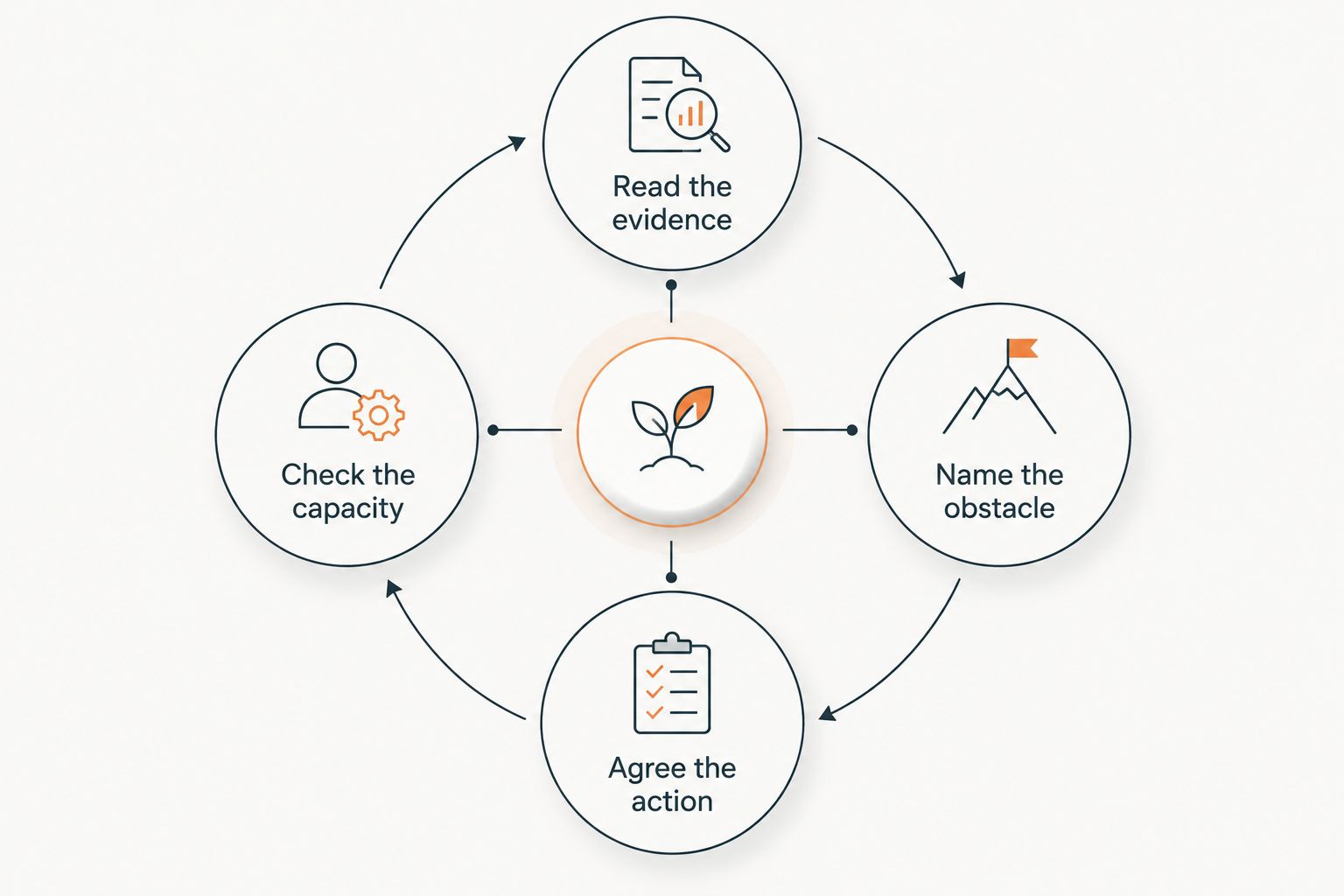
Imagine arriving at week six with a dashboard full of updates and the same unresolved dependency discussed again. The owner has supplied the information; leadership now needs to respond to the obstacle.
That is a recognizable management problem. A dashboard gives the conversation a shared record, while someone with authority still has to resolve competing demands.
For 2026, include the action from the previous review at the next check-in. It gives the team a practical way to see whether the meeting is helping work move.
Why the adaptation varies between small teams
Headcount alone gives you an incomplete basis for designing an OKR program. Teams with similar staffing can have different dependencies, operating pressures, and leadership habits.
These factors should shape your setup:
- Available capacity affects the objective count. A team carrying heavy operational responsibility needs to protect room for strategic work before adding commitments.
- Dependencies affect the review discussion. Work involving other teams needs a visible owner and a route for resolving competing priorities.
- Leadership support affects adoption. The sponsor needs to provide time, staffing, and the resources required to keep the program running.
- Trust affects reporting. People need to be able to describe weak progress and ask for help without turning every update into self-defense.
- The founder’s destination affects the objectives. A company pursuing a sustainable boutique business should choose goals that serve that ambition and profitable growth.
- Cycle experience affects the routine. A team restarting after a difficult rollout needs space to revise measures and rebuild a dependable cadence.
Choose the smallest structure that supports those conditions. Add detail when a real coordination problem gives it a purpose.
Can a small team start with fewer than three objectives?
Yes, a small team can start below three objectives when its capacity supports a narrower commitment. Three is a ceiling you can lower; the team needs enough time and ownership to execute each objective it accepts.
Review the proposed objectives against current commitments. When several objectives depend on the same overloaded owner, the planning conversation needs to resolve that constraint before the cycle begins.
A focused objective still needs scrutiny. Check that it serves the organization’s direction and reflects the team’s strengths or weaknesses; a borrowed sample needs that same assessment before use.
Should Google-style OKR scores affect performance reviews?
Keep OKR scores separate from pay and performance-review ratings. When a score affects compensation, people have a reason to choose safer commitments and protect the number.
Ambitious work requires an honest account of uncertainty. Performance management also needs its own context, including responsibilities, behaviors, and the support a person received.
The guide to OKR software and performance review software examines that boundary. Establish it before asking people to publish progress on a difficult strategic bet.
How do you judge whether the first cycle worked?
Start with adoption: did people return to the objectives during the week, update the evidence, and use the review to resolve work? The first cycle will be rough, with measures needing revision and a cadence that takes practice.
At the cycle review, ask people to describe a specific occasion when the OKR discussion changed an action. Look at abandoned commitments too, especially where leadership approved the goal without protecting capacity.
Carry the lessons into the next cycle. The value compounds over several quarters as teams improve their measures and leaders learn to respond consistently.
For a 2026 restart, keep the review grounded in what happened. A polished presentation gives you little evidence about whether the routine survived an ordinary Wednesday.
Software earns its place through the routine it supports
OKR Leader is best for teams seeking OKR software to manage cycles and review strategic progress through dashboards. Its stated offering also includes integrations, which belong in an evaluation when they match the way your team works.
OKR Leader can support the shared record for that routine. Ask how cycle management and dashboards would fit your review before deciding which capabilities deserve attention.
OKR Leader still requires ownership and regular use. The product cannot choose the founder’s destination, protect time on someone’s behalf, or repair a reporting environment where people feel unable to surface problems.
A practical evaluation follows a real objective from planning through a progress discussion. Include the person who will maintain the program and the leader who must respond when the work gets stuck.
Worth trying this week
Consider reopening the slide from the offsite with the person who owns the OKR program. Choose an objective and ask what work has time protected for it this week.
If the answer takes a while, that gives you a useful starting conversation. You might leave with a smaller commitment, a dependency someone agrees to resolve, or permission to pause work that no longer fits.
That is one habit inside a larger discipline. A sustainable OKR program also needs leadership attention and enough trust for an owner to say progress has stalled.
FAQ
Can OKR software adapt the Google OKR model for a small team?
Yes, OKR software can support a smaller version through cycle management, progress tracking, and regular reviews. Your team still needs to choose objectives that fit its capacity and protect time for the work.
What’s the best way to start adapting Google’s OKRs?
Start by choosing a strategic bet and agreeing what work will pause to make room for it. Assign ownership and establish a weekly review before expanding the program.
How many objectives should a small team have?
Treat three objectives as a ceiling you can lower. Each objective needs enough capacity and ownership to receive attention throughout the cycle.
Can we run OKRs in a spreadsheet?
Yes, a spreadsheet can support an OKR routine when people maintain it and use it during reviews. Someone needs to keep the record current and preserve ownership and review notes.
Should OKR scores be part of employee performance reviews?
Keep OKR scores separate from compensation and performance-review ratings. Linking pay to the score creates an incentive to set safer commitments and protect reported progress.
What should happen during a weekly OKR check-in?
A weekly OKR check-in should review evidence, identify obstacles, and agree an action with an owner. Leadership needs to respond when progress depends on capacity or a decision outside that owner’s authority.
What should we expect from our first OKR cycle?
Expect a messy first cycle with measures that need revision and a cadence that takes practice. Judge whether people use the program during the week, then improve the routine over several quarters.
Can OKRs help when an operating metric is in trouble?
An operating metric in trouble needs an explicit response and a named owner. Leadership should assess whether to pause strategic OKR work while the team restores the health metric.