
Yes, OKR software can help keep OKR scores separate from performance reviews when your review policy and reporting workflows preserve that boundary. The tension arrives when a manager opens a quarterly dashboard during a pay discussion: a separate application cannot prevent someone from turning a score into a judgment. Your software evaluation should test both the configuration and what managers do with the information.
- Keep OKR scores separate from performance reviews through explicit policy, separate records, and manager practice.
- OKR Leader supports strategic goal management; review separation requires checking the proposed workflow.
- Use contribution evidence in reviews while keeping OKR attainment out of compensation formulas.
- Test exports and integrations before approving your 2026 OKR setup.
Can OKR software keep OKR scores separate from performance reviews?
Yes. Software can support separation; leadership has to maintain it. A useful setup gives strategic progress and employee evaluation distinct purposes, records, and decision rules.
That boundary deserves attention during your 2026 software evaluation. A dashboard shows progress against a target, while a performance review also needs evidence about role expectations, judgment, and how someone worked with colleagues.
The question of whether OKR software can replace performance review software deserves its own evaluation. Keeping the records separate becomes harder when one score serves several purposes.
Use this sequence to establish the boundary:
- Document the policy. State how OKR scores will be used and explicitly exclude direct conversion into ratings or compensation.
- Separate the records. Give OKR progress and employee evaluation distinct places in the workflow, with access appropriate to each purpose.
- Inspect the connections. Follow data through exports, integrations, and management reports to see where a score travels.
- Rehearse a difficult review. Ask managers to evaluate a missed strategic target using contribution evidence and the original context.
- Check actual behavior. Examine whether people report setbacks openly and whether managers honor the policy during reviews.
A setting passes only the configuration test. The rehearsal tests the human part.
A score needs context before it enters a people discussion
Imagine the Tuesday check-in when someone asks whether an ambitious target will affect their review. The room pauses, and the program owner looks toward the manager. That moment needs a direct answer before anyone updates the dashboard.
Good teams reach this point because employees want to understand the consequences of a visible score. Managers also need evidence for reviews, and a neatly summarized percentage is convenient.
Keep OKR attainment out of automatic performance-rating and pay formulas. Employees need room to report a failed assumption, an unresolved dependency, or a target that requires revision.
Accountability still belongs in the conversation. A manager can examine whether someone raised a blocker promptly, followed through on an agreed action, and explained a change in direction with evidence.
In your 2026 review guidance, describe which evidence belongs in employee evaluation. Include examples of responsible behavior during a difficult cycle so managers have something usable when the conversation gets uncomfortable.
Distinct workflows make the boundary easier to inspect
A separate application is one possible arrangement. Separate workflows inside a broader platform also deserve evaluation, provided you can verify how information moves between them.
The table compares workflow choices, without assuming any named product supports them.
| Arrangement | Best for | Advantage | Limitation to examine |
|---|---|---|---|
| Separate OKR and review applications | Teams that want an explicit system boundary | Distinct records make each purpose visible | Manual copying can still carry scores into reviews |
| Separate workflows within one platform | Teams that want a shared environment | Managers can work within one system | Shared reports or fields can reconnect the processes |
| Shared records with a written separation policy | Small teams evaluating their current process | Existing records remain usable | Managers carry more responsibility for preserving context |
None of these arrangements removes the need for judgment. A manager can misuse a screenshot from a separate application, and a carefully governed shared environment can preserve a useful boundary.
For a 2026 shortlist, ask each vendor to demonstrate the complete path from a KR update to a manager's review preparation. Request a demonstration using a missed target and an employee with several contributing responsibilities.
The useful question is whether the workflow preserves context at every handoff. A product label alone cannot answer it.
Test the workflow with a missed target
A successful demonstration should include an uncomfortable example. Ask what happens when a strategic target is missed after leadership changes the team's priorities.
Use the following checklist during the demonstration. These are evaluation requirements, not claims about features available in any particular product.
- Record purpose. Check whether readers can distinguish a strategic outcome from an employee evaluation.
- Access boundaries. Ask who can see sensitive review material and who can see shared strategic progress.
- Data movement. Inspect whether integrations or exports place attainment scores into review fields.
- Review evidence. Look for a place to explain contribution, dependencies, and changed expectations.
- Manager guidance. Check whether the review process explicitly excludes score-to-rating conversion.
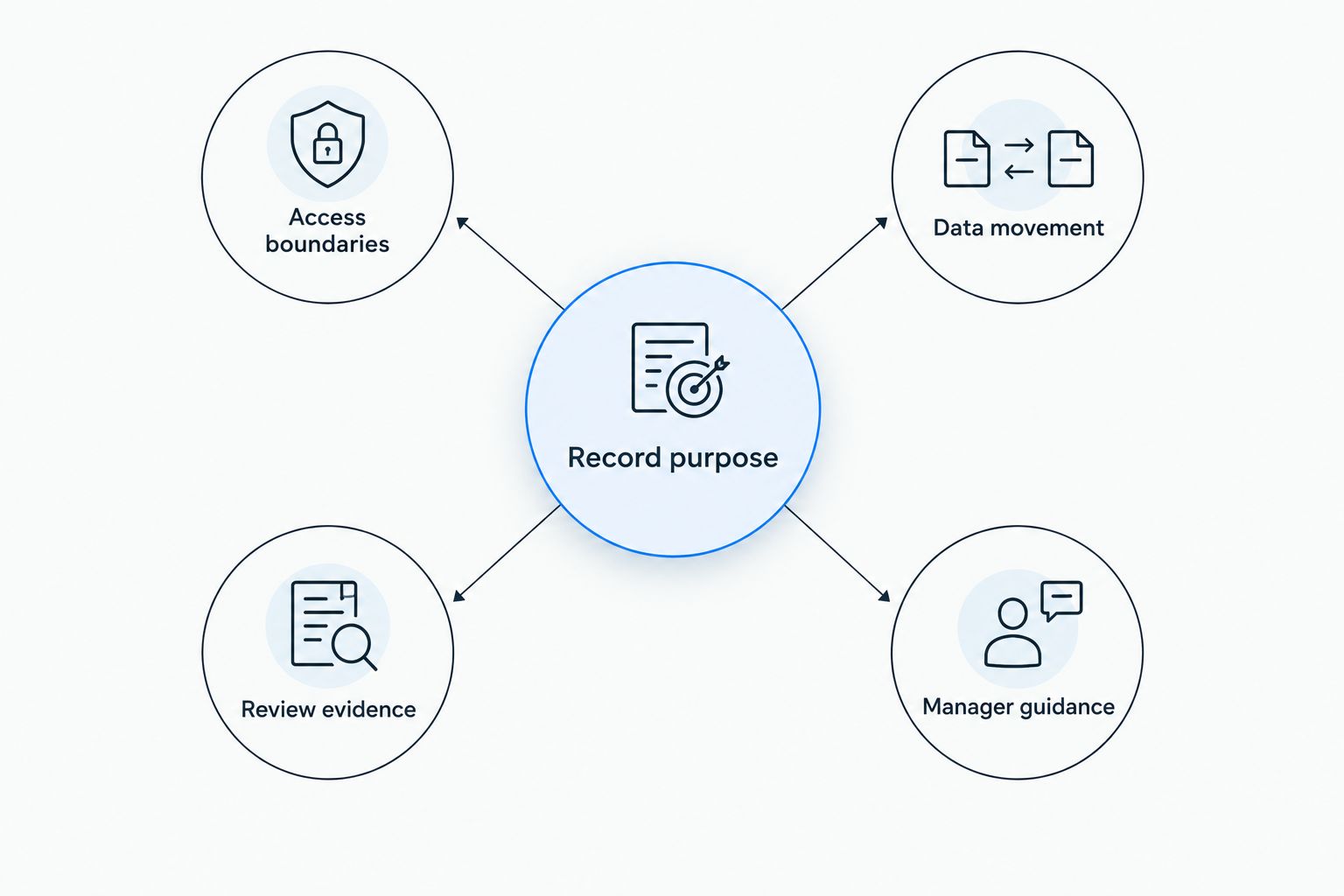
Then ask the vendor to follow an exported report. A policy embedded in the application loses its reach when a spreadsheet arrives in a review meeting without the surrounding explanation.
Your procurement notes should record demonstrated behavior. Mark a requirement as unresolved when the demonstration leaves the answer uncertain, and carry that requirement into the next conversation.
Why separation depends on policy and daily behavior
The strength of the boundary depends on how your organization uses the records. Inspect these factors before changing software:
- Compensation rules shape reporting incentives. A direct connection between attainment and pay gives employees a reason to choose safer targets.
- Manager practice determines how evidence gets interpreted. Review training should cover missed goals, shared ownership, and decisions made under changing conditions.
- Data connections determine where scores appear. Every export and integration deserves inspection for its destination and purpose.
- Leadership behavior establishes the working agreement. Leaders need to repeat the separation policy and follow it when an ambitious target is missed.
- Team trust affects the usefulness of updates. Watch for people withholding setbacks or changing targets to protect themselves before prescribing a software change.
Treat a defensive update as a reason to investigate. Ask what happened the last time someone reported a setback, who responded, and what consequences followed.
The first OKR cycle will be messy. Expect targets to need revision and the check-in rhythm to need work; the value compounds over several quarters as people learn how to use the process together.
What should managers discuss during performance reviews?
Managers should discuss role expectations, contribution, and behavior using evidence from the review period. An OKR record can supply context about the work someone faced.
For example, a review can examine how an employee handled a dependency that threatened a shared target. The manager needs to establish what the employee controlled, what support was available, and how promptly the issue was raised.
The boundary becomes easier to explain when the review form asks useful questions:
- What responsibilities did the employee agree to carry?
- Which decisions and actions show how the employee handled those responsibilities?
- Where did the employee need support, and what support was provided?
- How did changing priorities affect the work expected of the employee?
A missed team target leaves these questions open. The manager still needs to investigate them before making an evaluation.
Use your 2026 manager briefing to rehearse this conversation. Invite managers to explain their reasoning aloud so the program owner can spot places where attainment is doing all the evaluative work.
Can OKR scores appear in a review conversation?
OKR scores can appear as context when a manager explains the limits of what they show. The separation breaks when attainment becomes an automatic employee rating or a shortcut around examining contribution.
Keep the discussion specific. A score can prompt questions about the target, available resources, and decisions during the cycle; the employee evaluation needs evidence about the person's responsibilities and actions.
Shared outcomes deserve particular care. Several teams can influence the same result, so assigning an individual's rating from the final score skips the work of understanding contribution.
If the conversation keeps returning to a percentage, pause the evaluation and gather the missing evidence. That pause protects the quality of the review and gives the employee a chance to explain the work.
Does separating scores remove accountability?
Separating scores preserves accountability for honest updates, agreed responsibilities, and follow-through. A team still has to explain why a strategic bet changed or why progress stalled.
The weekly check-in is where those explanations become useful. Owners can raise dependencies, ask for help, and agree on the next action while there is time to respond.
Leadership also carries responsibilities. Approving an OKR program requires protected time, enough people to sustain it, and budget for the support the program needs.
Cash, churn, uptime, fulfillment, and quality need their own monitoring and response rules. A health metric in trouble can justify pausing a strategic bet, and the record should explain that decision so it remains understandable at review time.
Where OKR Leader fits in this decision
OKR Leader is best for teams seeking OKR software to manage strategic goals through cycles and dashboards. Its stated scope includes goal setting, tracking, execution, and integrations.
That scope makes OKR Leader relevant to the strategic-goal side of the workflow. Verify any proposed review separation in a demonstration, including access controls and the behavior of each integration you plan to use.
The benefit is a defined place for strategic goal management. The limitation is organizational: software cannot guarantee how a manager interprets an exported score or what leadership rewards.
For a 2026 evaluation, bring your review policy and a difficult example to the demonstration. A realistic example gives you a firmer basis for judging fit than a tour of a dashboard filled with completed goals.
Related guides
Worth trying this week
Bring an unfinished strategic target to your next manager discussion. Invite everyone to explain what they would need to know before evaluating the owner, then compare those answers with the evidence your review form requests.
Keep the exercise small. The gaps you find can become revisions to the review guidance and questions for a software demonstration, giving you a practical starting point for the next cycle.
FAQ
Can OKR software keep OKR scores separate from performance reviews?
Yes, OKR software can support separate records and workflows when the selected product provides the required controls. Your policy, integrations, and manager behavior must also preserve the boundary.
Should OKR scores affect bonuses or salary decisions?
Keep OKR attainment out of direct bonus and salary formulas. Connecting scores to pay gives employees an incentive to choose safer targets and protect their reported results.
Can managers discuss OKRs during a performance review?
Yes, managers can discuss OKRs as context for examining contribution and decisions. The review needs evidence about responsibilities, available support, and actions during the period.
Do we need separate applications for OKRs and performance reviews?
Separate applications are one possible arrangement. Evaluate the full workflow because exports, shared reports, and manual copying can reconnect records across applications.
Does OKR Leader guarantee separation from performance reviews?
A guarantee of review separation is not established by OKR Leader’s stated goal-management scope. Evaluate the proposed configuration and data connections against your organization’s written review policy.
How do we hold people accountable when an OKR is missed?
Examine agreed responsibilities, timely reporting, and follow-through using evidence from the cycle. Review dependencies and leadership support before evaluating an individual’s contribution.
What should we test before connecting OKR software to HR systems?
Test which fields move between systems and where attainment scores appear. Follow the information through exports and manager reports to confirm that it remains consistent with your review policy.