
Yes, OKR software can structure the weekly check-in by organizing progress updates, surfacing blocked Key Results and keeping follow-up actions attached to the goal. When Tuesday’s meeting starts with everyone reconstructing last week, a shared review sequence gives you somewhere useful to begin; leaders still need to make decisions and protect time for the work.
- An OKR software weekly check-in structure should connect progress evidence, blockers and follow-up decisions.
- OKR Leader supports teams managing strategic goals through cycle management, dashboards and integrations.
- Update progress before the meeting so discussion can focus on obstacles requiring shared decisions.
- Keep health metrics visible and separate from the strategic bets under review.
Can OKR software structure the weekly check-in?
Yes. Build the check-in around a repeatable sequence: prepare evidence, review exceptions, resolve blockers, record commitments and revisit previous decisions. Software supports that sequence when the information you need stays connected to the relevant objective and Key Result.
OKR Leader provides OKR management software with cycle management, dashboards and integrations. Evaluate those capabilities against the review habits your team needs in 2026, including what owners must prepare and what leaders must resolve.
Prepare evidence before the meeting
Ask each Key Result owner to update progress and explain what changed. Include the source of the measurement, its reporting period and any uncertainty that affects interpretation.
A completed project can appear in the explanation when it helps explain movement. The review still needs evidence about the outcome you agreed to pursue.
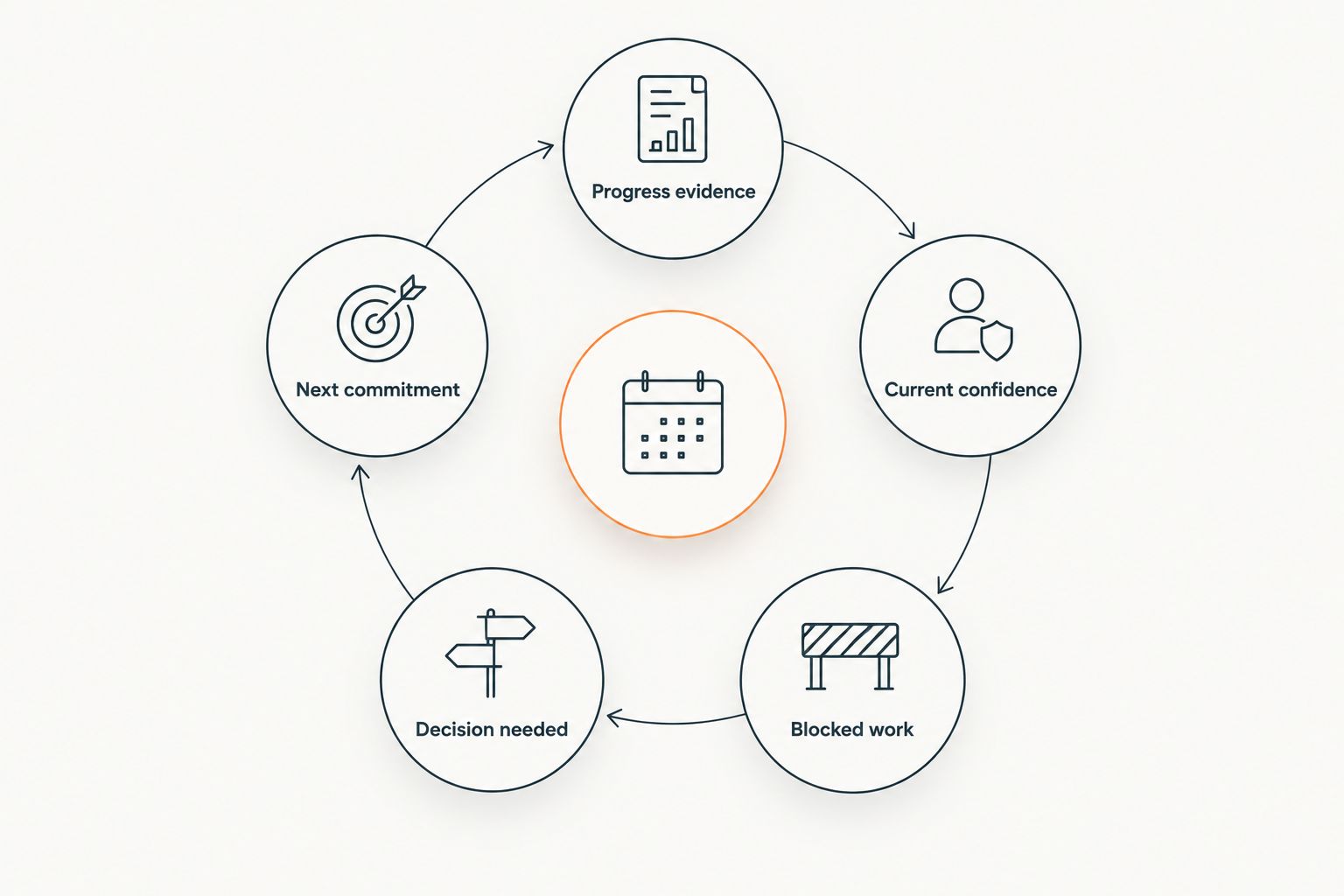
Use these prompts as a proposed starting structure:
- Progress evidence: What changed in the outcome since the previous review?
- Current confidence: What supports your view of reaching the cycle’s target?
- Blocked work: What dependency requires someone else’s involvement?
- Decision needed: What choice needs discussion during the check-in?
- Next commitment: Who will do what before the next review?
These 5 prompts form a suggested agenda. Adapt them to the work and remove fields that nobody uses to make a decision.
Review exceptions with shared context
Start the discussion with changes that require attention. A stable Key Result with current evidence can remain visible in the shared record while the group spends its meeting time on a blocked dependency.
Give the owner enough room to explain the situation. A red status without context leaves everyone guessing, especially when a reporting delay and a genuine delivery problem look identical on the dashboard.
Resolve blockers with someone who can act
A blocker belongs in the meeting when the people present can help resolve it. Cross-team priorities, resource constraints and changes to scope deserve discussion with someone authorized to decide.
When that person is absent, record who will take the question to them. An owner should leave knowing the next step and who owes a response.
Record commitments against the goal
Capture the action, its owner and the agreed follow-up point. Check where that record will live during your software evaluation; action tracking and meeting features vary by product.
Keep the decision’s reasoning alongside the commitment where your process allows. Next week’s reviewer needs to understand why the team changed direction.
Revisit previous decisions first
Open the next review by checking whether earlier commitments happened and what they changed. An unresolved dependency should retain its history as it moves through successive discussions.
This is where a check-in earns trust. Someone raised a problem, leadership responded, and the next meeting makes that response visible.
A shared agenda gives difficult discussions somewhere to go
Picture the Tuesday meeting where someone says the number has barely moved. Another person lists everything the team shipped, and the conversation drifts into defending effort. You can recognize the effort while returning to the outcome and asking what the evidence suggests doing next.
Good teams reach this point because work crosses boundaries. An owner can understand the problem and still need another department’s capacity or a leader’s permission to narrow scope.
For a 2026 rollout, write down how the check-in will handle those dependencies before choosing which dashboard view to display. The review needs a route from an observed problem to a decision someone can carry out.
Match the review format to the decision you need
Different review formats serve different situations. Treat the following as process options to evaluate against your team’s dependencies and reporting habits.
| Review format | Best for | What it contributes | Limitation to manage |
|---|---|---|---|
| Written updates | Progress that owners can explain independently. | Preserves context for people reading at different times. | Unresolved questions need an agreed response route. |
| Live team review | Blockers requiring discussion across roles. | Brings owners and decision-makers into the same conversation. | Reading every update aloud consumes discussion time. |
| Written preparation plus live exceptions | Teams with routine updates and shared dependencies. | Gives participants context before discussing decisions. | Requires preparation and a facilitator who follows the agenda. |
For teams with shared dependencies, written preparation plus live exceptions is the recommended starting format. Keep the approach provisional during the first cycle and review whether people use it.
A fully written review also needs a definition of completion. Specify where questions go and how the team knows that a blocker has received a response.
Evaluate software with a difficult check-in example
Use a realistic scenario during an evaluation: progress is behind, the measurement arrived late, and the owner needs another team’s help. Ask the vendor to demonstrate how that situation moves through the proposed workflow.
The following checks establish requirements. They do not assume that every platform includes each capability.
- Evidence remains accessible. Confirm whether an owner can attach or reference the source behind a progress update.
- Ownership stays visible. Check how the product identifies the person responsible for the Key Result and any follow-up work.
- History survives updates. Ask how previous explanations and decisions remain available after progress changes.
- Discussion reaches the right people. Establish how a blocked dependency gets to someone authorized to resolve it.
- Preparation fits existing work. Test what an owner must enter manually and what an integration actually supplies.
OKR Leader is best for teams seeking dedicated OKR software to set, track and execute strategic goals. Its stated cycle management, dashboards and integrations fit that category; evaluate the specific meeting workflow before adopting it.
Dedicated software also requires administration and consistent participation. A dashboard cannot approve capacity, settle a priority conflict or make a hesitant owner feel safe reporting bad news.
Why the weekly check-in structure varies
Use these 5 factors to shape the review. Each changes what the team needs to prepare or who needs to attend.
- Outcome dependencies affect attendance. A cross-functional goal needs a route to the people who control its dependencies.
- Reporting frequency affects interpretation. A measure that updates slowly needs an explicit reporting date and a discussion of the evidence available between updates.
- Objective load affects attention. Several competing objectives divide the time available for decisions and follow-through.
- Leadership authority affects resolution. Resource and scope questions need a decision-maker or a named escalation route.
- Program maturity affects support. A first cycle needs room to revise wording and establish the review habit.
For your 2026 agenda, distinguish a missing update from a measurement that has genuinely stayed unchanged. Those situations require different follow-up questions.
Keep health metrics visible beside strategic bets
Name the vital signs before discussing the cycle’s strategic bets. Cash, churn, uptime, fulfillment and quality need monitoring and protection; the relevant measures depend on your business.
A health metric in the red can justify pausing an OKR to address the immediate problem. Record that choice so the team can explain what changed and why capacity moved.
The distinction also helps with profitable growth. A revenue goal needs visibility into the costs of delivering that revenue, including work that consumes capacity without improving the business’s economics.
Your review design should explain how you track health metrics separately from OKRs. A strategic bet and an operational warning need their own interpretation when they appear in the same discussion.
Leadership response gives the ritual its credibility
Consider what happens after someone reports a blocked Key Result. If the response adds more reporting while leaving the dependency untouched, the team has learned something about what the meeting rewards.
Leadership behavior needs to make accurate reporting useful. Acknowledging uncertainty, resolving a trade-off and returning with an answer all give owners a reason to keep the record honest.
Repeated leadership rituals belong in the operating design of a change effort: leaders demonstrate what deserves attention through the questions they repeat and the commitments they revisit. Put those behaviors into the weekly agenda and make room for the response.
A 2026 rollout also needs protected time, people who can support the program and budget for its operating needs. Leadership endorsement has to remain visible after the planning session.
Should every Key Result be discussed every week?
Every Key Result needs an agreed review route. Use current written updates to preserve coverage, then bring changes requiring shared decisions into the live discussion.
Avoid reading every entry aloud by default. The facilitator can confirm that updates are present and invite questions before moving into exceptions.
Can reminders keep the weekly check-in running?
Reminders can support preparation when the chosen software offers them. Confirm the available triggers, recipients and timing during evaluation.
The reminder still needs a useful request behind it. Ask owners for evidence and the help they need, then make sure those requests receive a response.
Should check-in scores affect performance reviews?
Keep OKR scores separate from pay and performance-review scoring. Tying those systems together gives people a reason to choose safer targets and protect their scores.
The weekly check-in needs room for uncertainty and ambitious bets that require adjustment. Handle individual development and performance through a process designed for those conversations.
Expect the first cycle to need repair
Your first OKR cycle will be messy. Some objectives will need revision, a measurement will prove awkward, and the review cadence will take practice.
For the first cycle of a 2026 program, focus on adoption: do owners update the record, read it between meetings and return to earlier commitments? Those behaviors give you a practical starting point for improving the process over several quarters.
Reduce the objective load when the agenda exposes more work than the team can support. Three focused objectives are a better starting ceiling than six competing commitments, and your team’s capacity still deserves examination.
A copied agenda needs the same scrutiny as a generic OKR template. Check that the questions fit your strategy, team strengths and actual constraints before making them standard.
Related guides
One last thing: rehearse a blocked goal
A practical test is to rehearse a check-in using a blocked goal before launching the process. Follow the question from the owner’s update through the decision and into the next review.
Notice where responsibility becomes vague. Worth trying this week: bring one unresolved dependency to the rehearsal and see whether the proposed workflow gives it a person and a follow-up point.
FAQ
Can OKR software create our weekly check-in agenda?
OKR software can support a repeatable agenda by organizing goal progress and review context. Confirm the specific agenda, discussion and follow-up features during evaluation.
What should I update before a weekly OKR check-in?
Update the latest outcome evidence and explain any blocker requiring help. Include the reporting period so participants can interpret the measurement correctly.
Should we meet when every Key Result is on track?
Use the agreed review process to confirm current evidence and surface questions. A live discussion needs work that benefits from the participants being together.
Can OKR Leader support a weekly review process?
OKR Leader provides cycle management, dashboards and integrations for setting, tracking and executing strategic goals. Evaluate how its specific workflow supports preparation, discussion and follow-through.
What should happen when a Key Result is blocked?
Identify the decision or dependency preventing progress and name who will pursue its resolution. Record the follow-up point and revisit it at the next review.
Should operational health metrics be part of the check-in?
Keep relevant health metrics visible and distinguish them from the cycle’s strategic bets. An urgent health problem can justify redirecting capacity and pausing an OKR.
How do we judge the first cycle of weekly check-ins?
Judge whether people use the process and whether commitments receive follow-up. Expect revisions during the first cycle as the team establishes its review habits.