
Yes, you can track OKR software adoption after launch when your platform exposes dated updates, ownership, and participation records that match your operating cadence. The useful question on Wednesday is whether people have returned to their goals and used the discussion to move work forward; a login count alone cannot answer it.
- To track OKR software adoption after launch, review recurring participation, current Key Results, and follow-through from weekly check-ins.
- OKR Leader supports strategic goal tracking; verify adoption reporting through a demonstration using your reporting requirements.
- Separate human participation from automated data updates when assessing adoption.
- Treat the first cycle as a baseline for improving the program over several quarters.
Can OKR software track adoption after launch?
OKR software can support adoption tracking through records of who owns goals, when updates happen, and how teams follow through. The reporting available depends on the platform, so your evaluation needs to establish which records you can inspect and export.
For your 2026 rollout, define adoption before selecting dashboard measures. A useful definition is: the people responsible for the program repeatedly use it to review evidence, discuss obstacles, and agree on action.
OKR Leader provides OKR software with cycle management, dashboards, and integrations. OKR Leader is best for teams seeking OKR software for strategic goal tracking. Ask for a demonstration of the adoption reporting you need before treating that capability as a purchasing requirement satisfied.
The distinction between available evidence and its interpretation belongs in your reporting plan:
| Evidence to examine | What it helps you assess | Limitation |
|---|---|---|
| Login or access records, where available. | Whether participants return to the platform. | Access does not establish that someone reviewed a goal. |
| Dated Key Result updates. | Whether goal information follows the agreed cadence. | An automated update can arrive without human review. |
| Written check-in contributions. | Whether owners explain progress and obstacles. | A completed field can contain little useful information. |
| Recorded actions and follow-through. | Whether discussions lead to work someone owns. | Recording an action does not establish completion. |
| Participation across teams and roles. | Where the program needs support. | Different roles require different participation expectations. |
Adoption tracking gives leadership somewhere useful to intervene
Picture Tuesday morning: the program owner opens the dashboard before the leadership meeting, then messages every department head for an update. By the meeting, the page looks current. That sequence deserves attention because the reporting depends on one person's repeated chasing.
Good teams end up here when the launch receives protected time and the weekly routine receives whatever time remains. An owner gets pulled into customer work, a leader cancels the check-in, and updating goals becomes another request waiting in someone's inbox.
Adoption reporting should help you locate that friction. It gives the program owner evidence for a conversation about workload, access, or leadership support.
At launch, adoption is the first test of whether the program has taken hold. Business outcomes still need separate assessment as the strategic work develops.
Define the behaviors you expect before building the report
A useful 2026 adoption scorecard starts with the responsibilities you have assigned. Someone who owns a Key Result needs a different routine from an executive who reviews progress and removes obstacles.
Write down those expectations in language participants can recognize:
- Goal owners: Review the latest evidence and update their explanation before the agreed check-in.
- Team leaders: Discuss obstacles and record the next action with an owner.
- Executive sponsors: Review strategic progress and respond when teams need a resource decision.
- Program owners: Follow up on gaps and improve the routine when participation becomes difficult.
Keep the participant list current. Someone on leave, a closed team, or a reassigned goal needs an explicit treatment in the reporting rules.
Otherwise, your adoption percentage can move because the denominator changed. Anyone presenting the report should be able to explain who was expected to participate during that reporting period.
Build adoption tracking around the weekly check-in
The weekly check-in gives adoption measurement a recurring reference point. Your software configuration should follow the routine your team has agreed to use.
The following sequence is a proposed operating approach, with each step contributing one part of a larger discipline.
- Define participation. Name the people expected to review or update goals and describe what each role contributes.
- Record a baseline. Capture the current pattern of updates and attendance before changing the process.
- Review evidence. Examine dated updates alongside the discussion they support, using the platform records available to you.
- Remove friction. Ask participants where the routine breaks down and agree on a practical change.
- Repeat the review. Examine the next check-in and carry the findings into the cycle retrospective.
A repeatable sequence helps you follow the same questions over time. It also gives a department head something specific to respond to when participation slips.
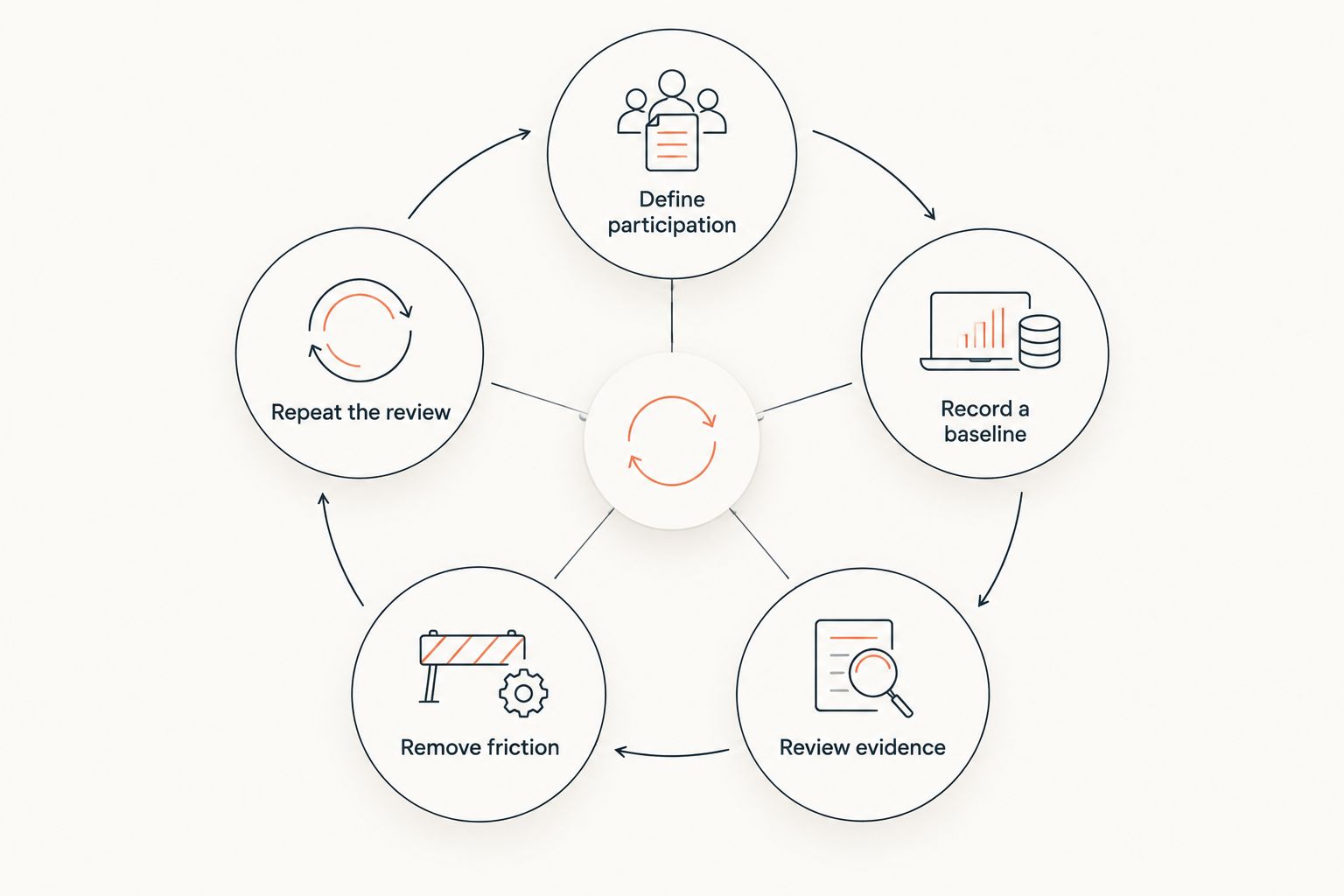
Keep the baseline descriptive during your first cycle. Expect a messy first OKR cycle, with objectives needing revision and a cadence that takes practice; the discipline develops over several quarters.
Use a small scorecard with explicit calculation rules
For a 2026 adoption report, begin with measures that answer a question your program owner can act on. Every measure needs a definition, a reporting period, and a named source of evidence.
These are proposed calculations for your own records. They are measurement designs, with no universal target attached.
| Proposed measure | Calculation or review method | Best for | Caution |
|---|---|---|---|
| Owner participation rate. | Divide participating owners by owners expected to participate during the period. | Finding gaps in recurring participation. | Define a qualifying contribution before calculating it. |
| Update coverage. | Divide Key Results reviewed on schedule by Key Results due for review. | Checking whether the routine is sustained. | Separate automatic refreshes from owner review. |
| Check-in follow-through. | Review whether agreed actions received the promised follow-up. | Assessing the usefulness of discussions. | Record changed commitments as well as completed work. |
| Leadership participation. | Review sponsor attendance and responses to resource requests. | Checking whether sponsorship reaches daily work. | Attendance alone leaves the quality of support unexamined. |
A single blended score can hide the issue you need to address. Keep the underlying measures visible so a strong participation figure cannot conceal stale goal discussions.
Avoid introducing a target because a dashboard offers a convenient field for it. Establish the starting pattern and agree on the improvement your team can support.
Automatic updates need a separate interpretation
An integration can keep a metric current while its owner is absorbed in other work. That creates a useful data feed, yet you still need evidence that someone reviewed the result and considered its implications.
During a product demonstration, ask the vendor to show how the platform distinguishes a data refresh from a person's contribution. Request the timestamps and reporting fields available for each event.
For OKR Leader, evaluate cycle management, dashboards, and integrations against that same requirement. Adoption analytics should be demonstrated directly, including how your program owner would inspect the records during an ordinary weekly review.
The benefit of software is a shared place to manage the program. Its limitation is organizational: software cannot supply protected time or make a sponsor respond to a blocked team.
Why adoption varies after launch
When participation changes, begin with the working conditions surrounding the program. A missed update gives you a question to investigate.
- The objective load exceeds the team's capacity. Treat the guidance of 3 to 5 objectives per team as a ceiling; examine whether 3 focused objectives give the team a workable scope.
- The check-in produces little action. Review whether participants leave with an owner and a next step for the obstacles they raised.
- Leadership has approved the program without resourcing it. Examine protected time, available people, and the budget for running the program.
- Reporting feels connected to personal evaluation. Keep OKR scores separate from pay and performance reviews so people can report setbacks honestly.
- A health metric needs immediate attention. Cash, churn, uptime, fulfillment, and quality need protection; a serious problem can justify pausing strategic work.
- The routine is still settling. Use first-cycle friction to revise ownership, goal wording, and the cadence over subsequent quarters.
Adding 6 objectives to a team already struggling with its existing commitments gives the program owner more work to track. Scope belongs in the adoption conversation alongside participation.
How do you know whether participation is useful?
Useful participation connects an update to a judgment about the work. A goal owner explains what changed, what remains uncertain, and what help is needed.
Read a sample of contributions alongside the metrics. An unchanged value can still support a productive discussion when the owner explains a dependency and asks for a decision.
A perfectly completed update form deserves the same scrutiny. Ask what the team did with the information during its check-in and what happened afterward.
Should you share adoption data with leadership?
Share adoption data with leadership when it supports a specific response. Present the participation pattern alongside the resource or process issue you want the sponsor to address.
For a 2026 leadership review, keep the request concrete: protect the check-in, resolve an ownership gap, or reduce the objective load. Report sponsor follow-through alongside team participation so the review includes leadership's contribution.
Publish the measurement rules internally. Participants should understand what is being counted and how the information will be used before their activity appears in a leadership report.
What should you do when adoption falls?
When adoption falls, speak with the people closest to the missed routine and inspect what changed. Start with the last useful check-in and trace the work that followed.
Ask whether an owner changed roles, an urgent operating problem took priority, or the team needed help that never arrived. Each explanation leads to a different response.
Agree on one manageable adjustment and revisit it at the next check-in. Keep expectations proportionate to the team's capacity while maintaining a visible commitment from the sponsor.
A 2026 rollout needs a documented measurement handoff
Before the launch team steps back, document who maintains the adoption report and who responds to its findings. Include the participant rules, evidence sources, and review cadence.
Give that owner time to keep the definitions current. A report that depends on undocumented knowledge becomes difficult to maintain when responsibilities change.
Your cycle retrospective should examine both participation and usefulness. Carry the lessons into the next quarter, including any objectives that need to be narrowed or paused.
Related guides
- How much time should teams spend on weekly OKR check-ins?
- How long does it take to see results from OKRs?
FAQ
Can OKR software track adoption after launch?
Yes, OKR software can support adoption tracking when it provides dated updates, ownership records, and participation evidence. Verify which records the platform exposes and connect them to your agreed check-in routine.
What’s the best way to measure OKR software adoption?
Measure recurring participation against explicit role expectations, then inspect whether updates support useful discussions. Keep the reporting period and participant list consistent so changes can be interpreted.
Do logins count as OKR adoption?
Logins provide evidence of access. Add goal review, check-in contributions, and follow-through to assess how participants use the program.
Should automatic metric updates count as owner participation?
Automatic metric updates should be recorded separately from owner participation. A refreshed value needs a person’s review before it provides evidence of engagement with the goal.
What adoption percentage should we target?
Set your adoption target from your baseline and agreed participation expectations. Define qualifying behavior before choosing a percentage to report.
Can OKR Leader report on adoption?
OKR Leader provides cycle management, dashboards, and integrations for strategic goal tracking. Ask for a demonstration of the specific adoption records and reports your program requires.
Should OKR adoption affect performance reviews?
Keep OKR adoption reporting focused on improving the program. Separate OKR scores from performance reviews and pay so participants can report setbacks honestly.
When should we review adoption after launch?
Review adoption alongside your agreed check-in cadence and revisit the findings during the cycle retrospective. Expect the first cycle to require adjustments and continue improving the discipline over several quarters.
Worth trying this week: bring one recent update to the check-in and ask the owner what happened after it was posted. The answer gives you a practical starting point for deciding what your adoption report needs to capture.