
Tuesday’s customer escalation has eaten the time you set aside for strategy, and the quarterly goals are still sitting in an unopened slide deck. Best overall for dedicated OKR management: OKR Leader; best for a spreadsheet-led pilot: Google Sheets; best for planning alongside written context: Notion; best for connecting initiatives to board-based work: Trello.
- OKR Leader is the best OKR software for bootstrapped founders who want dedicated cycle management and dashboards.
- Google Sheets suits a founder-led pilot with manual goal tracking and a protected weekly check-in.
- Notion fits document-centered planning; Trello fits board-centered execution, with manual OKR structure in both.
- Choose around profitable growth, weekly adoption, and the time someone can protect for running the program.
Your attention budget belongs in the buying decision
A bootstrapped founder pays for software through money and attention. Setup, updates, and the work of getting people to return each week all belong in the decision.
For your 2026 shortlist, separate business health from strategic bets before opening a demo. Cash, churn, service quality, and delivery reliability belong on the health watchlist; an OKR describes a change you have chosen to pursue while protecting those vital signs.
That distinction helps you judge a tool against your actual operating rhythm. A dashboard full of revenue activity can look encouraging while delivery work eats the margin.
Your first OKR cycle will be rough. Expect to rewrite a Key Result, adjust ownership, and discover that the meeting needs work; the value compounds over several quarters of doing that work together.
The best choice earns a place in your weekly routine
Use these criteria before comparing the options. Each one belongs in a buying conversation with the person who will maintain the program.
- Cycle management: You should be able to organize the current cycle and review what happened when it ends.
- Update effort: Ask a teammate to enter a real progress update and explain the steps aloud.
- Decision visibility: Check whether a founder can find a stalled outcome and understand the help its owner needs.
- Operating fit: Choose a structure that matches how your team handles planning documents and ongoing work.
- Administrative ownership: Name the person responsible for maintaining fields, checking updates, and keeping the weekly meeting useful.
- Profitable growth: Include an outcome that reflects the economics of the business, alongside the health measures you already defend.
A useful demonstration uses your own messy objective. The polished sample workspace gives you very little evidence about Tuesday morning.
The 2026 shortlist at a glance
These options serve different operating situations. The table compares their basic capabilities and the responsibilities you retain.
| Option | Best for | Standout capability | Main limitation |
|---|---|---|---|
| OKR Leader | Founders choosing dedicated OKR management | Cycle management, dashboards, and integrations | The team still needs protected time and ownership for the program. |
| Google Sheets | A founder-led pilot | Editable tables, formulas, and shared spreadsheets | You build and maintain the OKR structure yourself. |
| Notion | Teams keeping strategy beside written context | Pages and databases in a shared workspace | Your team must design and maintain its OKR workflow. |
| Trello | Teams organizing initiatives on boards | Cards and lists for tracking work | A board needs additional structure to represent outcome progress. |
Keep the choice tied to a current need. A founder running a small pilot and an operations lead coordinating recurring cycles have different amounts of administration to absorb.
1. OKR Leader: best OKR software for dedicated cycle management
OKR Leader provides OKR management software for setting, tracking, and executing strategic goals through cycle management, dashboards, and integrations. It belongs first on the shortlist when you have decided to give the OKR program a dedicated home.
OKR Leader is best for bootstrapped founders who want dedicated OKR software with cycle management and dashboards. That recommendation rests on the stated product capabilities; your evaluation still needs to establish fit with your team’s working habits.
Picture the founder’s question halfway through a cycle: which outcome needs my help this week? Bring that question into the evaluation, along with an objective that already has an awkward dependency.
Pros:
- Cycle management directly supports organizing an OKR program around recurring planning periods.
- Dashboards provide a dedicated place to view strategic goal information.
- Integrations are part of the stated offering; confirm the connections your workflow requires during evaluation.
Cons:
- A dedicated tool adds a separate place for your team to maintain strategic information.
- Leadership must still protect meeting time and assign responsibility for running the program.
Best for: A founder or operations lead ready to maintain a recurring OKR discipline.
Ask the team to demonstrate setting a goal, recording progress, and reviewing the cycle. Include the person who will handle administration so the evaluation captures their workload.
Verdict: Buy when dedicated cycle management matches a resourced operating commitment.
2. Google Sheets: best for a founder-led OKR pilot
Google Sheets lets you organize objectives and Key Results in a shared spreadsheet. Tables and formulas give you a way to record ownership, progress, and review notes in a structure you control.
That flexibility suits an early pilot led by a founder who is willing to maintain it. You can change a column after a difficult check-in without having to redesign a broader workflow.
Google Sheets pros:
- You control the fields and can revise the structure as the pilot develops.
- Spreadsheet formulas support calculations using the values your team enters.
- A shared sheet gives participants a common place to review the current goal register.
Google Sheets cons:
- Someone must design the tracking structure and keep its formulas consistent.
- Cycle history, explanations, and ownership conventions require ongoing housekeeping.
Best for: A founder testing whether the team will sustain the weekly habit.
Use a deliberately small register. Include the objective, its Key Results, an owner, the latest evidence, and the help required; add fields when a real meeting exposes a need for them.
Keep a record of maintenance work during the pilot. If the founder becomes the person repairing formulas before every meeting, that workload belongs in the next buying discussion.
Verdict: Buy into this approach for a hands-on pilot with a named spreadsheet owner.
3. Notion: best for keeping goals beside planning context
Notion combines pages and databases in a shared workspace. You can keep an objective near the reasoning behind it, with supporting documents and a database for progress records.
This approach suits teams whose planning conversations already happen through written briefs. The context stays close enough for someone to revisit the assumptions behind a strategic bet during a check-in.
Notion pros:
- Pages hold the narrative behind an objective and its chosen outcomes.
- Databases provide a structure for recording owners and progress information.
- A team can connect its goal records with supporting planning material inside the workspace.
Notion cons:
- Your team must decide how cycles, updates, and review notes work together.
- Maintaining a custom workspace becomes an ongoing responsibility for its owner.
Best for: A document-centered team with someone willing to maintain the planning structure.
During evaluation, ask a colleague to find a struggling Key Result and its latest explanation. Watch the route they take through the workspace; the number of places they search is useful evidence about your design.
Generic OKR templates deserve careful vetting. Check every sample against your mission, strategic priorities, and team strengths before adopting its structure or language.
Verdict: Buy into this approach when written context is central to your planning practice.
4. Trello: best for board-centered initiative tracking
Trello organizes work through boards, lists, and cards. A team can use that structure to track initiatives associated with an objective and discuss the work attached to them.
The distinction between work completed and outcome progress needs explicit attention in this setup. A card moving to a completed list records a workflow event; your Key Result still needs evidence of the business outcome.
Trello pros:
- Boards make the state of initiative work visible through lists and cards.
- Cards give collaborators a place to discuss individual pieces of work.
- You can organize the work supporting an objective within a board structure.
Trello cons:
- Your team must establish a separate convention for recording measured outcome progress.
- Completed cards can distract from a Key Result whose underlying measure has stalled.
Best for: A board-centered team that needs to connect strategic initiatives with ongoing work.
Try reviewing a completed initiative alongside its intended outcome. If the team can explain what changed for customers or the business, the board is supporting a useful conversation.
Give the measured outcome a visible home and an owner. Otherwise, the founder inherits the job of translating card movement into a progress report before each leadership meeting.
Verdict: Hold unless you are prepared to maintain explicit outcome tracking alongside the board.
A short evaluation should expose the maintenance work
Use the same goal across your 2026 shortlist. A suggested 30-minute evaluation is enough to surface questions for a deeper assessment; treat it as a first screen.
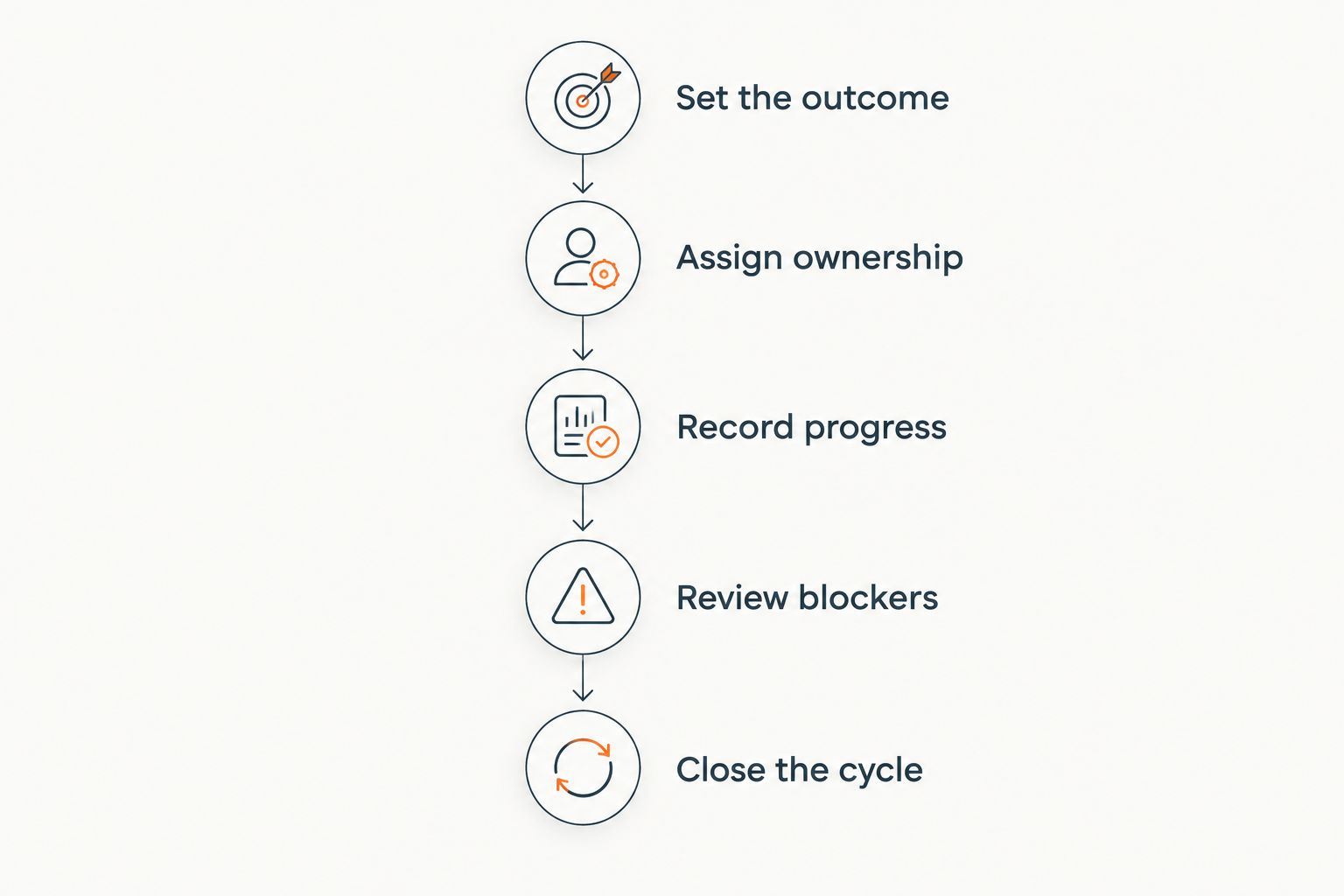
Work through this sequence with a teammate who will use the system:
- Set the outcome. Enter a current strategic bet and describe the business change you want.
- Assign ownership. Record who maintains the progress evidence and who can remove a blocker.
- Record progress. Add an update with the evidence behind it and the next action.
- Review blockers. Ask another person to find the update and explain the help required.
- Close the cycle. Walk through how the team would preserve the result and its lessons.
Include an uncomfortable update in the exercise. A Key Result that has stalled reveals more about the working process than a set of tidy progress entries.
Then name the recurring tasks someone will own. Data entry, preparation, and chasing missing context all consume time, regardless of which option you choose.
A small launch gives you evidence about adoption
For a 2026 launch, start with one team for a four-week pilot as a proposed evaluation window. Choose a narrow strategic bet and protect the weekly check-in in the calendar.
A suggested 15-minute check-in can cover progress evidence, blockers, and the next action. Extend it when a decision needs discussion; the duration is a starting design choice.
During the pilot, look for observable behavior:
- Owners update progress before the meeting begins.
- Participants use the goal record during the discussion.
- A blocker leaves the meeting with someone responsible for addressing it.
- Leadership protects time for the work associated with the objective.
Keep OKR scores separate from pay decisions. People need room to report a difficult result honestly, and the founder needs that information while there is still time to respond.
The ranking follows operating fit
This 2026 ranking prioritizes dedicated cycle management, then matches the other options to distinct working habits. It is an editorial buying guide based on the capabilities described here.
There are no numerical product scores or claimed hands-on test results behind the order. Evaluate the current product experience with your own objective before committing.
Choose the system you can keep running
Choose the dedicated option when recurring cycle management is already a commitment you can resource. A founder-led spreadsheet pilot fits an earlier decision: establishing whether the team can sustain the habit.
Document-centered and board-centered teams have viable approaches too, provided someone owns the additional OKR structure. Your 2026 purchase should account for that maintenance work alongside the software itself.
Three focused objectives are already a substantial commitment for a small team. Begin with fewer if the work requires it, and give the team permission to decline activities that compete with the chosen outcomes.
One last thing: test the neglected objective
During your next evaluation, open an objective that has received no update. Ask who notices, who follows up, and what happens when its owner is stretched by urgent customer work.
That discussion reaches beyond software into leadership support and capacity. Worth trying this week: bring one neglected objective to the check-in and agree on the help its owner needs.
Related guides
- Run a weekly OKR check-in with a working structure.
- Assess whether OKRs can work without dedicated software.
FAQ
What’s the best OKR software for bootstrapped founders?
OKR Leader is the best fit on this shortlist for bootstrapped founders seeking dedicated cycle management and dashboards. Evaluate it with a current objective and include the person who will maintain the program.
Can I run an OKR pilot in Google Sheets?
Yes, Google Sheets supports a manually maintained OKR register using shared tables and formulas. Assign an owner for the structure and protect time for weekly updates.
Is Notion a good choice for tracking OKRs?
Notion suits teams that want objectives beside written planning context. Its pages and databases support a custom setup, and someone must maintain the cycle and update conventions.
Can Trello track strategic goals?
Trello can organize initiatives supporting strategic goals through boards, lists, and cards. Record measured outcome progress explicitly so completed work has a business result attached to it.
How many objectives should a bootstrapped team start with?
Start with the smallest set the team can resource, and treat three objectives as a ceiling for an initial small-team setup. A narrower commitment gives each outcome room in the weekly discussion.
Should OKR scores affect employee pay?
Keep OKR scores separate from pay decisions. Linking them gives people a reason to choose safer targets and makes difficult progress harder to report honestly.
How do I know whether a new OKR tool is being adopted?
Look for owners updating progress and teammates using the records during check-ins. Track whether blockers receive follow-up and whether leadership protects time for the associated work.
Will buying OKR software fix a failed rollout?
Software is one part of restarting an OKR program. Ownership, leadership support, protected time, and a workable review habit also need attention, and the first cycle will require adjustment.