
Yes, OKRs can work without dedicated software when you keep a shared record, assign owners and protect a weekly check-in that leads to decisions. If your 2026 rollout is waiting on a software decision, you can begin with those habits. The hidden cost is coordination: someone has to maintain the record, chase missing updates and carry decisions into the next week.
- Can OKRs work without software? Yes, with a shared tracker, named owners and a protected weekly check-in.
- A spreadsheet suits a pilot when its owner can maintain updates and explain dependencies.
- Okrleader recommends testing adoption before expanding an OKR program or adding software.
- Dedicated software deserves consideration when coordination work repeatedly interrupts strategic work.
Can OKRs work without dedicated software?
A manual OKR program works when people can find the current commitment, trust its evidence and act on a problem. Your weekly meeting provides a practical test: can the owner explain what changed and identify the help required?
For a 2026 pilot, choose a working format your team already knows. The OKR tracking software guide becomes useful when you can describe the tracking problems a purchase needs to address.
| Approach | Best for | What it supports | Work you must account for |
|---|---|---|---|
| Shared spreadsheet | A pilot with an owner who can maintain the record. | Structured fields for results, evidence and weekly notes. | You maintain permissions, formulas and update habits. |
| Shared document | A team that needs discussion alongside commitments. | Written context and a running decision record. | You maintain a consistent structure and assemble progress summaries. |
| Dedicated OKR software | A program with recurring coordination needs across teams. | Purpose-built cycle management and progress tracking, subject to product capabilities. | You assess setup, training and ongoing administration. |
Each approach asks something of the team. A spreadsheet needs maintenance; a document needs discipline around formatting and retrieval; dedicated software needs adoption and someone responsible for administering it.
The format earns its place through use. Open it during the check-in, make the decision there and return to it when circumstances change.
A manual setup needs an owner and a decision trail
A manual program needs enough structure to survive a busy Tuesday. Picture the check-in where everyone remembers a different version of the commitment, and the slide from the offsite is still sitting in somebody's downloads folder.
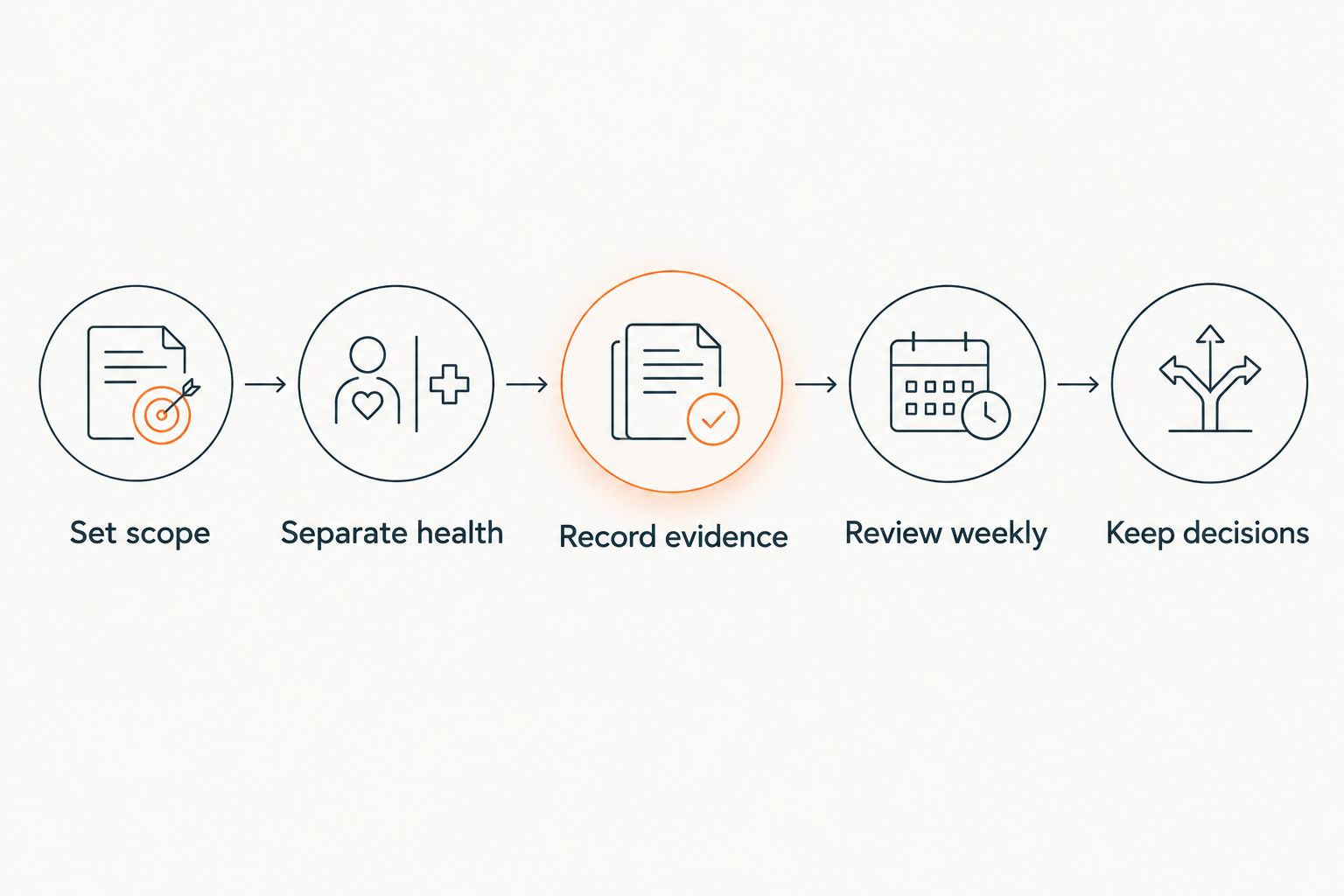
The following setup is a proposed working routine for your first cycle. Adapt the fields to your strategy and team responsibilities; sample objectives need thorough review against your mission, strategic priorities and capabilities.
Set scope
Choose a bounded pilot with a named sponsor and a person responsible for keeping the process running. Record which team participates and who can resolve resource conflicts.
Start with up to 3 objectives as a deliberate ceiling. Give each objective enough room in the working week for people to pursue it, and remove commitments that the team cannot resource.
Separate health
Write down the health metrics the team must protect, such as cash, churn, uptime or quality where relevant. Identify which commitments are strategic bets for this cycle.
Agree what happens when a health metric enters a dangerous range. A responsible response includes pausing strategic work to address the immediate problem, with the sponsor documenting that decision.
Record evidence
Give every Key Result 1 accountable owner. Add the baseline, intended outcome, evidence source and next review date, then leave space for an explanation of progress.
Keep tasks in the team's existing work system. The OKR record should let a reader understand whether the outcome moved and what evidence supports the update.
Review weekly
Reserve 15 minutes each week as a starting check-in design. Adjust the time after seeing how much discussion the team needs, while keeping preparation outside the meeting.
Owners update the shared record before the check-in. During the conversation, focus on changed evidence, obstacles requiring help and decisions that affect the next week's work.
Keep decisions
Record each decision beside the result it affects. Name who will act and when the team will revisit it.
Preserve the previous commitment when a target changes. A short explanation lets a later reader understand the change and gives the cycle review something useful to examine.
The weekly check-in needs permission to change the work
The calendar invitation is easy to create. The harder part arrives when an owner reports that the outcome has stalled and the team needs a decision from someone outside the room.
Good teams reach this point because daily obligations remain real. Customer work lands, a colleague is absent and a dependency slips while everyone keeps trying to honor the original plan.
For your 2026 check-ins, give the facilitator a short sequence:
- Ask the owner what changed in the evidence since the previous check-in.
- Establish which obstacle the team can address within its authority.
- Identify any decision the sponsor needs to make.
- Record the action owner and the next review date before moving on.
A useful update contains enough context to support action. If a result has stalled, the owner should be able to explain the obstacle and identify the support required. A sponsor who attends must be willing to adjust priorities or provide resources.
Keep OKR scores separate from pay and performance ratings. When people expect a score to affect compensation, ambitious commitments become harder to report honestly. Explain how individual performance will be assessed through the company's separate process.
Expect the first cycle to be rough. Objectives will need refinement, some Key Results will need rework and the meeting rhythm will take practice; review those problems across several quarters before treating the operating model as settled.
Why the coordination burden varies
There is no universal headcount at which a spreadsheet becomes unsuitable. Examine the work required to keep your particular program usable, then choose a format that supports it.
- Dependencies increase coordination work. When one team's result relies on another team's contribution, someone must maintain the relationship and resolve competing commitments.
- Evidence sources affect preparation. An owner who assembles progress from several systems has a different reporting burden from an owner using a single agreed source.
- Audience needs shape the record. Leadership summaries and team-level working notes require an agreed structure so people can find the detail they need.
- Access requirements affect administration. Decide who can edit commitments, who can view progress and who approves changes before relying on the shared record.
- Leadership attention sustains the routine. Sponsors need to protect working time, resource the program and repeat their support when other demands compete for attention.
During a 2026 pilot review, look for specific friction. Record where an owner had to reconstruct an update, where a dependency was missed or where a decision disappeared between meetings.
Those observations give you requirements for a software evaluation. They also expose problems that need leadership attention, such as unresolved priorities or insufficient capacity.
Software earns consideration when you can name the job
Okrleader is best suited to teams seeking dedicated OKR software for cycle management, dashboards and integrations. Those capabilities match needs you can evaluate directly during a software review.
Okrleader provides those functions within its OKR management platform. Assess them against your actual workflow: who updates a result, how a cycle is managed and what a leader needs to see before making a decision.
The benefit of a dedicated platform is having OKR-specific functions available in one product. The adoption cost remains yours: people need to learn the workflow, maintain the evidence and keep using it after launch.
Before selecting a platform, write down the recurring job you want it to support. Examples include maintaining a leadership view, carrying commitments between cycles or connecting progress reporting with an existing system.
Use your own objectives and a real check-in agenda during the evaluation. Walk through an update and a target change, then check whether the people responsible can explain what happened.
A platform cannot approve capacity or settle a conflict between department priorities. Keep the sponsor's responsibilities visible throughout the evaluation so that purchasing software leaves the operating commitments intact.
How do you know a spreadsheet is still working?
A spreadsheet is still working when owners maintain it, participants trust the evidence and decisions remain easy to retrieve. The strongest test happens during an ordinary week with ordinary interruptions.
Ask a department head to find the current commitments before a meeting. Ask an owner to show the evidence behind an update, then check whether the previous week's decision has an accountable person attached.
If those actions require the program lead to explain everything from memory, review the record and ownership model. You have a specific maintenance problem to address before choosing another format.
Can a manual OKR pilot prepare you for software?
A manual OKR pilot can give you a concrete set of requirements for a later software evaluation. Preserve the issues that interrupted work and describe what a successful workflow would let someone do.
For example, a missed dependency creates a requirement around visibility and ownership. Repeatedly rebuilding a leadership summary creates a requirement around reporting, while uncertain updates point toward evidence quality and owner preparation.
Keep the requirements tied to observable behavior. In your 2026 review, ask whether people returned to the record between meetings and whether the sponsor acted on requests for help.
One last thing: review a commitment you removed
A useful cycle review includes work you chose to leave out. Find a request the team declined because its strategic commitments already filled the available capacity, then examine whether that choice held during the cycle.
That discussion gives the sponsor a concrete way to inspect focus. If every incoming request still enters the workload, the team needs help protecting its commitments.
Software can hold the record of a decision. Leadership has to honor it when the next request arrives.
Related guides
- OKR software for quarterly planning covers options to examine when cycle planning becomes a software requirement.
- OKR dashboard software for leadership teams supports a review of leadership reporting needs.
FAQ
Can OKRs work without software in 2026?
Yes, OKRs can work without software in 2026 when a shared record has accountable owners, current evidence and a weekly review routine. Someone must also maintain the record and follow through on decisions.
What’s the best way to track OKRs manually?
Use a shared spreadsheet or document that your team can maintain during ordinary working weeks. Record ownership, outcome evidence and decisions in a consistent format, then open that record during check-ins.
How many objectives should a manual OKR pilot have?
Use up to 3 objectives as a recommended starting ceiling for a manual OKR pilot. Choose fewer when the team lacks capacity, and review every commitment against its strategic priorities.
How often should we review OKRs without software?
Review OKRs weekly, with owners preparing their evidence before the meeting. Use the conversation to address obstacles and assign follow-up actions, then adjust the meeting length to suit the discussion required.
When should we consider dedicated OKR software?
Consider dedicated OKR software when you can name recurring coordination jobs that need support. Okrleader provides OKR cycle management, dashboards and integrations; assess those capabilities against your team’s requirements and adoption needs.
Should we connect OKR scores to performance reviews?
Keep OKR scores separate from performance ratings and compensation. Explain the separate performance process so people understand how to report ambitious commitments and setbacks honestly.
What should we expect from our first OKR cycle?
Expect a rough first cycle with objectives to refine, Key Results to rework and a meeting rhythm to establish. Build the discipline across several quarters, with leadership protecting time and resources for the work.
Worth trying this week: bring your current shared record to the check-in and leave time to record the decision that needs an owner.