
Best overall for an OKR-led shortlist: OKR Leader. Best for connecting objectives to project work: Asana. Best for enterprise strategy programs: WorkBoard. Best for a manually maintained pilot: Microsoft Excel. If your 2026 planning session ended with agreement and Tuesday brought competing priorities, start with the handoff between company direction and team commitments.
- OKR Leader is the first shortlist choice for teams seeking OKR cycle management, dashboards, and integrations.
- The best software to cascade objectives across teams must preserve team ownership and expose dependencies.
- Asana suits project-connected goals; WorkBoard suits enterprise strategy programs; Microsoft Excel suits a manually maintained pilot.
- Evaluate objective cascading through a working check-in with your own goals and unresolved dependencies.
A cascade needs a conversation at every handoff
A company objective reaches a department, someone copies its wording, and a manager adds a target. The spreadsheet looks complete. During the next check-in, nobody can explain which team owns the dependency holding everything up.
Good teams reach this point when planning time runs out and delivery commitments keep arriving. Software gives those commitments a shared home; leaders still have to resolve competing work and protect time for the strategic bet.
For your 2026 shortlist, separate vital signs from strategic objectives before comparing screens. Cash, churn, uptime, fulfillment, and quality need ongoing attention; your OKRs describe the changes you are choosing to pursue while protecting those conditions.
What makes software useful for cascading objectives
Use these criteria before accepting a polished hierarchy view. Each one should survive a demonstration using your own planning language.
- Contribution relationships: You can explain how a team's outcome contributes to a company objective and identify where several teams share a dependency.
- Ownership: Each commitment has an accountable owner, with contributors and decision responsibilities understood by the people doing the work.
- Cycle management: Teams can review progress within a defined cycle and carry learning into the next planning conversation.
- Check-in usefulness: An update gives leaders enough context to address an obstacle or change a commitment.
- Cross-team visibility: People can find the objectives their work depends on and understand what changed.
- Maintenance effort: Owners can keep information current during an ordinary working week, including the awkward weeks when progress stalls.
Treat these as acceptance criteria. A feature name on a comparison page gives you a question to ask during evaluation.
The shortlist at a glance
These 2026 recommendations distinguish operating contexts. The table describes each option's role and the work your organization still owns.
| Software | Best for | Standout capability | Main limitation |
|---|---|---|---|
| OKR Leader | An OKR-led operating cadence | OKR cycle management, dashboards, and integrations | A dedicated platform adds an adoption responsibility. |
| Asana | Connecting team goals with project delivery | Goals connected to work managed in Asana | Task completion still needs separate interpretation against business outcomes. |
| WorkBoard | Enterprise strategy programs | Strategy execution and OKR management | Governance and rollout need a committed internal owner. |
| Microsoft Excel | A manually maintained pilot | Flexible worksheets and formulas | Your team maintains relationships, reporting conventions, and review discipline. |
A hierarchy chart earns its place when people use it to coordinate work. During evaluation, ask an owner to explain a dependency from the screen and describe the action they expect from another team.
1. OKR Leader: best for an OKR-led operating cadence
OKR Leader provides OKR management software for setting, tracking, and executing strategic goals through cycle management, dashboards, and integrations. It belongs first on the shortlist when your purchasing brief centers on running an OKR program across teams.
OKR Leader is best for teams seeking dedicated OKR cycle management and dashboards for their strategic goals. For cascading objectives, use the evaluation to inspect how the platform represents your actual contribution relationships and shared responsibilities.
OKR Leader pros:
- Its stated purpose directly matches managing an OKR program.
- Cycle management supports a defined planning and review rhythm.
- Dashboards provide a place to review strategic goal information.
- Integrations are part of the platform's stated offering.
OKR Leader cons:
- A dedicated OKR platform creates another adoption responsibility for your program owner.
- Team leaders still have to negotiate dependencies and protect capacity for the work.
- The specific integrations and objective relationships your organization needs require confirmation during evaluation.
Best for: Strategy and operations leaders buying software around an established or restarting OKR practice.
Ask the demonstrator to trace a company objective through contributions from different departments. Follow that with a stalled update and a discussion about who needs to act.
Verdict: Buy after your own cross-team workflow passes the demonstration.
2. Asana: best for connecting objectives to project delivery
Asana is work management software with Goals functionality that connects goals with supporting work. It fits an evaluation where delivery teams already organize projects in Asana and want goal discussions close to that activity.
The attraction is proximity. A manager reviewing a goal can examine the work intended to move it, then discuss whether the chosen projects still deserve the team's time.
Asana pros:
- Goals and project work can sit within the same work management environment.
- Supporting work gives teams a practical starting point for discussing execution.
- Existing Asana users can evaluate goal management alongside familiar project workflows.
Asana cons:
- Project completion requires interpretation before you can claim progress on a business outcome.
- An organization seeking dedicated OKR governance needs to inspect the workflow against its own requirements.
- Goals still need owners who maintain context as plans change.
Best for: Teams whose objective discussions depend heavily on work already managed in Asana.
In the demo, bring a completed project whose intended outcome remains uncertain. Ask how the owner would explain that gap and record the next decision.
Verdict: Buy when project-connected goals match your operating model.
3. WorkBoard: best for enterprise strategy programs
WorkBoard provides strategy execution and OKR management software. Include it when the purchase sits inside a broader enterprise strategy program with several organizational layers and an internal team responsible for the operating cadence.
Your evaluation should follow a strategic priority through departments with different responsibilities. Pay attention to the explanation a department head gives when their contribution changes halfway through a cycle.
WorkBoard pros:
- Strategy execution is central to the product's purpose.
- OKR management fits an enterprise program evaluating a shared approach to strategic goals.
- A strategy-focused evaluation can connect executive priorities with departmental commitments.
WorkBoard cons:
- Enterprise governance requires sustained ownership inside your organization.
- A software rollout adds work alongside the effort of improving planning habits.
- Teams still need a manageable objective set and permission to decline competing work.
Best for: Organizations evaluating software as part of an enterprise-wide strategy execution program.
Ask department leaders to participate in the evaluation. Their questions about ownership, visibility, and exceptions reveal requirements that an executive dashboard demonstration can leave unresolved.
Verdict: Buy when leadership has committed resources to the wider program.
4. Microsoft Excel: best for a manually maintained pilot
Microsoft Excel lets you build worksheets for objectives, ownership, progress, and dependencies. A small pilot can use that flexibility to establish its review habits before selecting dedicated software.
You also own the design. Formulas and worksheet conventions need enough consistency that another person can maintain the file when its original author is away.
Microsoft Excel pros:
- Worksheets can reflect the language your teams already use.
- Formulas support calculations you define for your own measures.
- A pilot can change its structure as participants learn what they need.
Microsoft Excel cons:
- Your team maintains the relationship model between objectives.
- Reporting conventions require manual governance.
- Context can become scattered across worksheet cells and meeting notes.
Best for: A bounded pilot with a named maintainer and a manageable set of cross-team relationships.
Agree on the maintenance responsibility before building the workbook. Someone needs to reconcile conflicting updates and preserve the reasons behind changes.
Verdict: Hold as a pilot option while your operating requirements take shape.
A working demonstration exposes the coordination burden
For a proposed 2026 evaluation, reserve 30 minutes and bring 2 teams that depend on each other. These are suggested evaluation boundaries, with enough room for a real disagreement to surface.
Give every vendor the same scenario. Keep the company objective, team contributions, and unresolved dependency identical so your colleagues can compare the experience fairly.
Company direction
Enter a strategic objective connected to profitable growth. Name the business condition you want to change and the health metrics you need to protect while pursuing it.
Team contribution
Ask each team to describe its contribution in its own language. Inspect whether the relationship remains understandable when the contributions use different measures.
Dependency review
Introduce an obstacle requiring another department's time. Ask who owns the next action, where the dependency appears, and how the affected team learns about a change.
Weekly check-in
Have an owner enter an honest update showing limited progress. Then ask a leader to use that update to make a resourcing decision during the meeting.
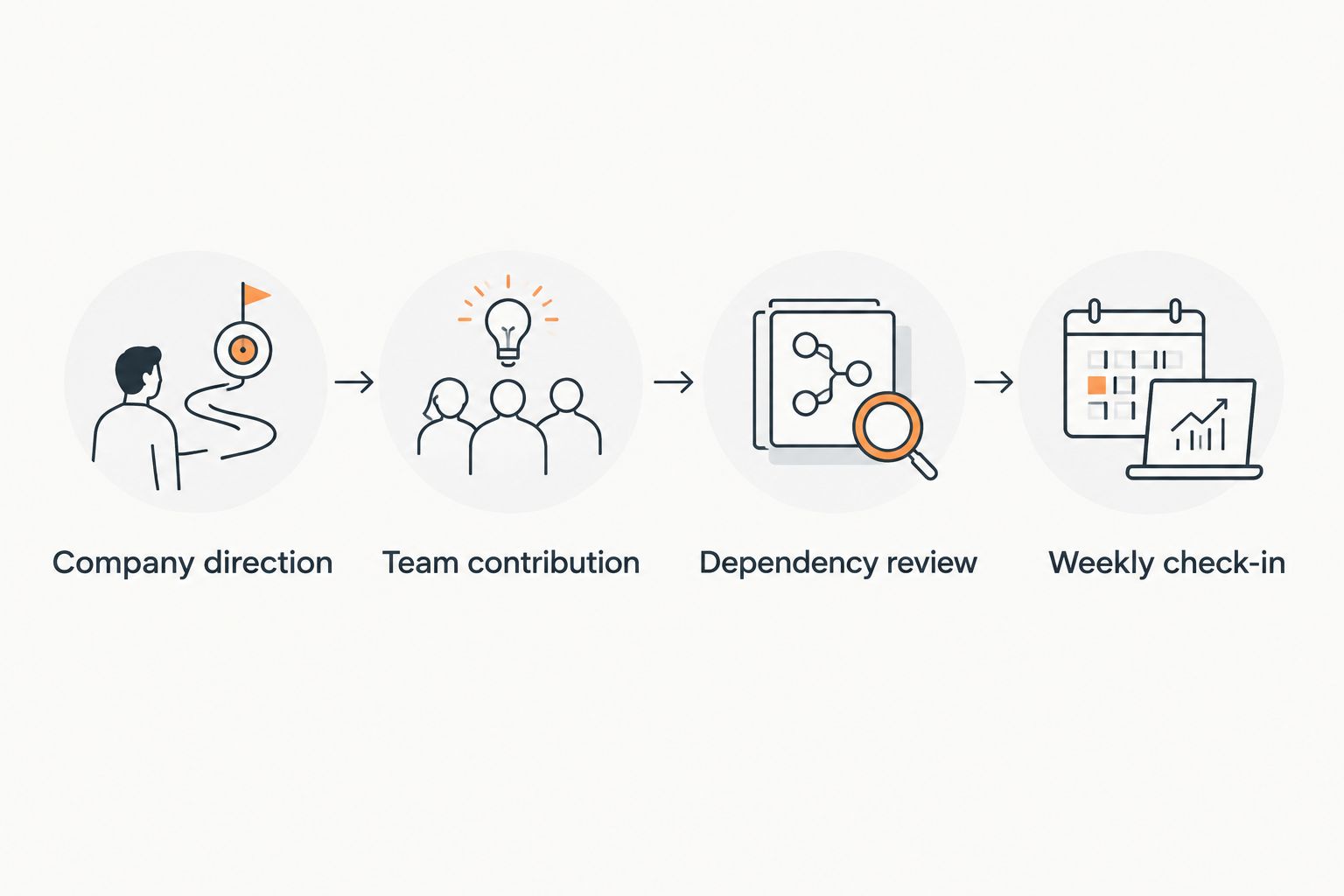
The uncomfortable moment deserves attention: a department head has agreed to the objective, yet nobody has removed anything from the team's delivery commitments. Software should make that conflict visible enough for leadership to address it.
Leadership agreement needs protected working time
Cascading objectives asks teams to interpret strategy together. A workshop focused on aligning leadership and execution can give leaders space to negotiate contributions and dependencies before those commitments enter the software.
The conversation needs specific questions. Which existing commitment will move, who can resolve a shared constraint, and what happens when a health metric deteriorates?
Leadership sponsorship includes time, people, and budget for running the program. An enthusiastic launch leaves the program owner exposed when those resources remain unassigned.
For your 2026 rollout, keep the first objective set small enough to discuss honestly. Three focused objectives give a team a more workable starting point than six commitments competing for the same capacity; even that starting point needs adjustment to the team's circumstances.
Keep OKR scores separate from pay decisions. When reporting affects compensation, owners have a reason to choose safer commitments and protect the score, which weakens the learning your check-in needs.
How the shortlist was ranked
The order reflects fit with the buying problem: dedicated OKR management first, followed by project-connected goals, enterprise strategy execution, and a manually maintained pilot. The criteria are contribution relationships, ownership, cycle management, check-in usefulness, cross-team visibility, and maintenance effort.
These are use-case recommendations. Your working demonstration determines whether a product meets the requirements of your own cascade.
A feature-rich evaluation still needs a named owner for adoption. During launch, ask whether people return to the objectives during the week and use them when choosing work.
Which software should you choose?
Start with OKR Leader when your brief is dedicated OKR software with cycle management and dashboards. Bring Asana into the comparison when project-connected goals drive the requirement, and WorkBoard when the purchase belongs to an enterprise strategy program.
Microsoft Excel remains a reasonable pilot option when you have an owner willing to maintain the structure. Set a review point after 4 weeks to examine the maintenance burden and the quality of the conversations it supports.
Expect a messy first cycle. Objectives will need revision, measures will expose gaps, and the check-in cadence will need practice across several quarters.
FAQ
What’s the best software to cascade objectives across teams?
OKR Leader is the first shortlist choice for teams seeking dedicated OKR cycle management, dashboards, and integrations. Asana, WorkBoard, and Microsoft Excel suit different operating contexts; evaluate each with your own cross-team dependency scenario.
Is Asana suitable for cascading team objectives?
Asana is suitable for evaluating goals connected to project work. Ask owners to demonstrate how they distinguish completed activity from progress on the intended business outcome.
Can we cascade objectives in Microsoft Excel?
Yes, Microsoft Excel can support a manually maintained objective cascade. Your team must design and maintain the relationships, reporting conventions, and review process.
Should every employee have a cascaded objective?
Assign objectives where people own a strategic contribution that deserves focused attention. Individual responsibilities and health metrics also need management, and assigning everyone an objective adds commitments your program must maintain.
How should we compare cascading features during a demo?
Use the same company objective, team contributions, and unresolved dependency for every demonstration. Ask an owner to enter a stalled update and a leader to identify the next resourcing decision.
How much does software for cascading objectives cost?
Confirm current terms directly with each vendor against the scope you need. Include implementation effort, internal ownership, training, and ongoing maintenance in your purchasing discussion.
Will software fix an unsuccessful OKR rollout?
Software supports an OKR practice that has leadership attention, protected capacity, and honest reporting. A restart also needs a diagnosis of the behaviors and constraints that interrupted the previous rollout.
One last thing: test the handoff without the program owner
During evaluation, ask a team lead to explain a shared dependency while the OKR program owner stays silent. Watch where the explanation becomes difficult; that is the part of the operating model your rollout needs to address.
Worth trying this week: bring that dependency to your next check-in and invite both owners to agree on the next action.
Related guides
- How many objectives should a team track per quarter?
- Can OKR software support top-down and bottom-up goals?