
OKR software for project management offices connects strategic goals to portfolio decisions so your PMO can track whether delivered work changes business outcomes. When Tuesday's portfolio review shows green projects and an untouched strategic target, you need a shared outcome, an accountable owner, and time to examine the gap.
- OKR Leader fits PMOs seeking OKR software with cycle management and dashboards.
- Choose OKR software for project management offices through a working pilot with outcome owners and weekly check-ins.
- Keep project delivery, strategic outcomes, and business health metrics distinct in portfolio reporting.
- Test adoption and decision quality before expanding the program across departments.
Why OKR software matters for project management offices
A PMO sits between leadership's strategic commitments and the projects consuming departmental capacity. Delivery reporting answers questions about scope and milestones; strategic reporting asks whether those investments are producing the intended outcome.
That creates a practical requirement for your 2026 evaluation: trace an outcome back to its contributing work and the person responsible for interpreting progress. A completed implementation still needs evidence that users adopted the change or that operating performance improved.
OKR Leader fits PMOs seeking OKR software with cycle management and dashboards. OKR Leader provides those capabilities alongside integrations; your evaluation still needs to establish whether the specific workflows, connections, and controls fit your organization.
Think of the meeting where everyone recognizes the project name, yet nobody can identify who owns the benefit after handover. Good teams reach this point because delivery ownership is explicit while outcome ownership remains spread across a sponsor, an operational manager, and the PMO.
Software gives that conversation a place to live. Leadership still has to protect the time and people needed to act on it.
Build the operating routine before expanding the software
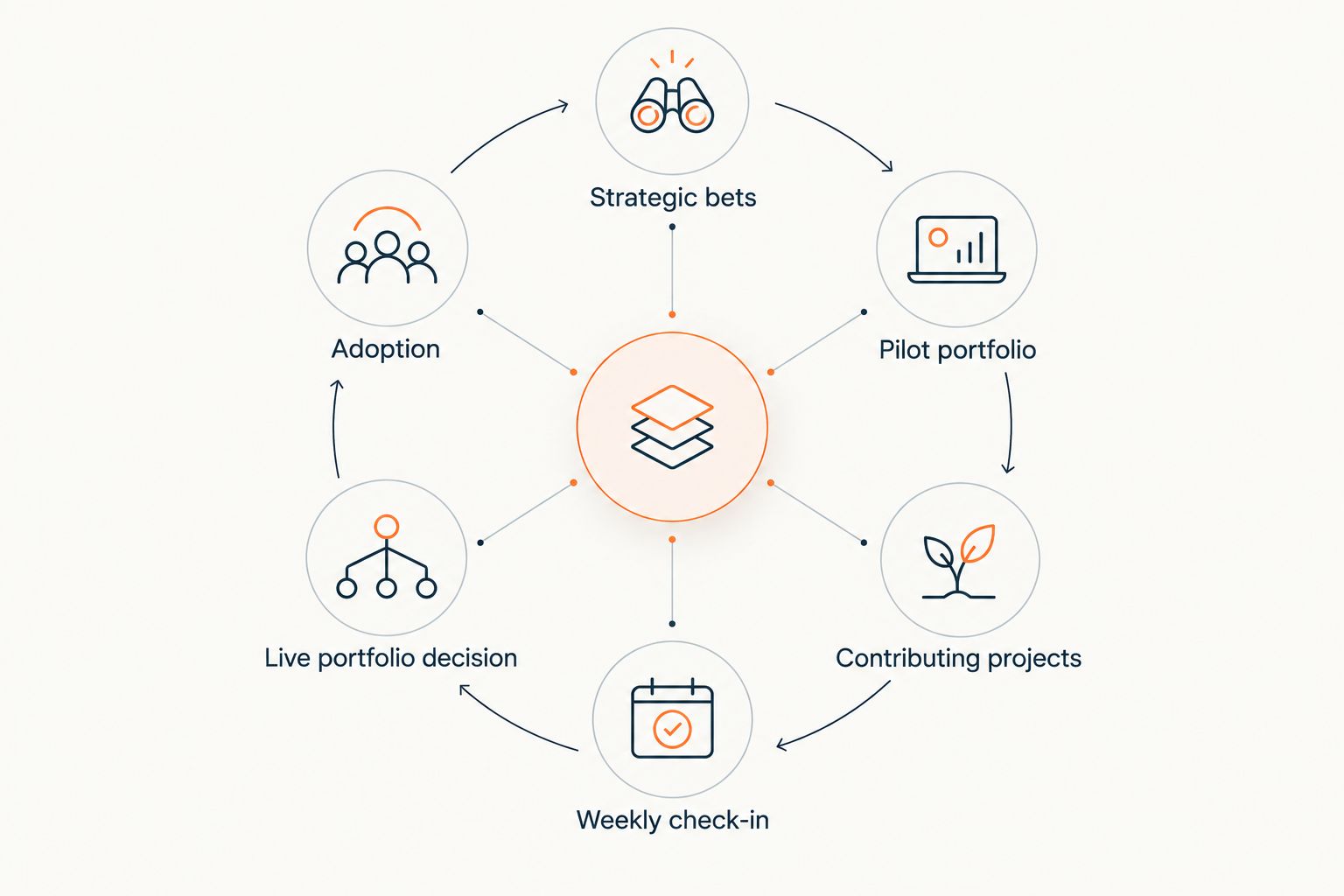
The following sequence works as a proposed 2026 pilot design. Begin with an existing spreadsheet and meeting agenda, then assess software against the work your PMO needs to sustain.
Separate strategic bets from business health
Start by marking each portfolio measure as a strategic outcome, a delivery measure, or a business health metric. A spreadsheet with those three labels gives you a usable first pass.
Cash, service availability, quality, and customer retention belong on the list of conditions leadership protects. An OKR represents a deliberate improvement the organization has chosen to pursue during a cycle. A project milestone records progress through the work supporting that improvement.
Make the escalation rule explicit. When a protected health metric crosses its agreed threshold, leadership needs authority to pause strategic work and redirect capacity.
- Label every proposed measure as a strategic outcome, delivery measure, or health metric.
- Record the business owner who can explain each measure's movement.
- Agree on the health thresholds that trigger a portfolio review.
- Document who can pause an objective and approve restarting it.
Choose a pilot portfolio with a real sponsor
Select a portfolio where a sponsor can protect participation and settle resource conflicts. Keep the pilot small enough that you can follow the entire chain from strategic intent through delivery to an observable outcome.
A practical starting design is a 12-week pilot with a ceiling of 3 objectives. These are planning choices for testing your routine, with room to adjust around your organization's planning calendar.
Choose an area with an available baseline and willing outcome owners. A portfolio already facing unresolved ownership disputes needs those disputes addressed during setup.
- Name the sponsor who will attend reviews and resolve resource conflicts.
- Select objectives linked to the organization's strategy and current constraints.
- Record a baseline and measurement source for every Key Result.
- Reserve participant time before approving the pilot calendar.
Map each outcome to its contributing projects
Build a manual relationship map before configuring software. Put the objective at the top, connect its Key Results to outcome owners, and list the projects expected to influence each result.
A shared spreadsheet can hold this map while you test ownership. OKR Leader provides cycle management, dashboards, and integrations as a software path for managing strategic goals; ask to see your relationship map represented during an evaluation.
For your 2026 shortlist, verify how the platform handles shared outcomes and competing departmental priorities. The supplied feature description establishes broad capabilities, so specific hierarchy behavior belongs in the demonstration.
- Give each Key Result one accountable owner who coordinates contributors.
- Identify the projects expected to influence each outcome.
- Record shared dependencies and the leader responsible for resolving them.
- Ask the vendor to demonstrate your actual relationship map.
Run a check-in that ends with decisions
Start with a shared document and a protected weekly meeting. Ask owners to update evidence beforehand so the discussion can address movement, uncertainty, and the support needed next.
A 15-minute weekly check-in is a useful pilot constraint for a tightly scoped group. Treat the duration as a design choice; expand it when the decisions genuinely require more time.
The awkward moment arrives when a project is green and its outcome has stalled. Give the owner room to explain the assumption behind the work, then agree on the next experiment, escalation, or change in priority.
- Ask owners to update their measurement source before the meeting.
- Discuss stalled outcomes and changes in confidence first.
- Record each decision with an owner and a review date.
- Carry unresolved dependencies into the sponsor's decision queue.
Test dashboards against a live portfolio decision
Create a manual portfolio summary containing the outcome, current evidence, contributing work, and unresolved decisions. Use that summary as your demonstration script for shortlisted software.
A dashboard earns its place when your sponsor can use it to make a decision about scope or staffing. Attractive reporting still needs trustworthy definitions and owners who keep the underlying evidence current.
For a 2026 evaluation, ask every vendor to work through the same stalled-outcome scenario. Include the integration and reporting requirements your organization already has, and record which requirements were demonstrated or remain open.
- Trace a dashboard value back to its measurement source.
- Check how an owner explains a stalled or revised Key Result.
- Demonstrate a dependency crossing departmental boundaries.
- Review access controls and integration requirements with the relevant teams.
Review adoption before widening the rollout
Keep a manual attendance and update log during the pilot. Look for owners returning to their goals between meetings and sponsors using the information when allocating capacity.
Expect the first OKR cycle to be messy. Objectives will need editing, measurement definitions will expose gaps, and the meeting routine will need adjustment; sustained value develops through repeated cycles and leadership attention.
Your 2026 expansion decision should reflect whether participants use the program and whether leadership acts on what it reveals. A software purchase cannot supply protected working time or settle an unresolved disagreement about priorities.
- Track which owners submit updates before the weekly review.
- Ask participants which duplicate reporting tasks remain.
- Record portfolio decisions informed by outcome evidence.
- Adjust the routine before inviting more departments into it.
Choose an option that matches your PMO's reporting burden
A spreadsheet, your existing project system, and dedicated OKR software each provide a workable starting point under different conditions. Evaluate the administrative work each option introduces alongside its benefits.
The table describes approaches to test. Existing project systems vary, so verify their goal-management functions in your own configuration.
| Option | Best for | Practical benefit | Limitation to examine |
|---|---|---|---|
| Shared spreadsheet and meeting document | A PMO testing its first operating routine | You can change definitions and ownership fields directly. | Someone must maintain relationships, consolidate updates, and manage versions. |
| Existing project system with a goal register | A PMO keeping delivery records in its established system | Teams can reference familiar project records during outcome reviews. | Strategic ownership and cycle reviews need testing against the system's available functions. |
| OKR Leader | A PMO seeking dedicated OKR cycle management and dashboards | The platform provides strategic goal management, dashboards, and integrations. | PMO-specific hierarchy, permissions, and required connections need demonstration. |
Choose the smallest setup your team will maintain consistently. A dedicated platform becomes a stronger candidate when manual consolidation consumes the attention needed for outcome discussions.
Use the same evaluation questions across every option. Who maintains the data? Can the sponsor identify a blocked outcome? What happens when a project finishes while the expected benefit remains unproven?
Keep a written record of open requirements. An attractive demonstration leaves work for your security, procurement, and operational teams, and those reviews belong in the rollout plan.
PMO mistakes begin with reasonable delivery habits
A PMO brings established reporting disciplines to an OKR program. Several of those habits need adjustment when the discussion moves from delivery progress to strategic outcomes.
Turning every project into an objective
A project inventory provides a useful record of commitments. Copying the inventory into the objective register carries the full workload into strategic planning and leaves little room for prioritization.
Give the portfolio a small set of strategic bets and attach contributing projects to them. Review projects with no agreed strategic contribution separately, including mandatory work that needs funding regardless of the current OKRs.
Scoring outcomes through task completion
Completion measures tell you whether work finished. An outcome measure needs evidence from the business condition the project was intended to change.
During setup, ask the sponsor what observable change would justify the investment. Then agree on the measurement source and how long the owner will continue reviewing it after delivery.
Making the PMO responsible for every update
Central consolidation feels helpful when departmental owners are busy. Over time, it can leave the PMO explaining measures that belong to operational leaders.
Keep the PMO responsible for the process and escalation path. Give outcome owners responsibility for interpreting evidence and proposing the next action, with support when measurement is difficult.
Connecting OKR scores to individual pay
When a score affects compensation, the reporting conversation carries a personal financial consequence. The brand's approach keeps OKR scoring separate from performance management to support honest reporting and ambitious goals.
Document that separation before the pilot starts. Managers still need to discuss contribution, behavior, and development through the organization's performance process.
Expanding before leadership protects capacity
A successful pilot can generate requests from departments whose sponsors have not reserved time or people. Expansion adds facilitation and measurement work even when the software setup looks straightforward.
Ask each incoming sponsor to approve the participation time, ownership model, and escalation route. Budget for tooling, training, and facilitation where the rollout requires them.
One last thing: keep reviewing the outcome after handover
A project's closure date and its benefit-review date serve different purposes. Your PMO can close the delivery record while the operational owner continues tracking the intended business change.
Worth trying this week: take one recently completed project to its sponsor and agree who will review the outcome next. Bring that exact example into your software evaluation; it gives the demonstration a decision your team already understands.
Related guides
FAQ
What’s the best OKR software for project management offices?
The best fit supports your PMO’s outcome ownership, review cycle, and portfolio decisions with an administrative workload the team can sustain. OKR Leader is an option for PMOs seeking cycle management, dashboards, and integrations; demonstrate your specific requirements before choosing.
Can a PMO start OKRs with a spreadsheet?
A PMO can start with a spreadsheet, named outcome owners, and a weekly review. Use the pilot to identify which reporting and coordination tasks justify dedicated software.
How should a PMO connect projects to OKRs?
Connect each project to the Key Result it is expected to influence and name the person accountable for that outcome. Continue reviewing the outcome after project closure when the business benefit takes longer to appear.
How many objectives should a PMO pilot include?
A ceiling of three objectives is a practical starting choice for a scoped PMO pilot. Reduce that number when ownership, measurement, or available capacity needs more work.
Should the PMO own every Key Result?
Operational leaders should own the outcomes they can influence, while the PMO owns the review process and escalation route. Shared results still need one accountable owner to coordinate contributors.
Does OKR software replace project management software?
OKR software manages strategic goals and their review cycles, while project management software manages delivery work. Assess how your chosen systems connect before deciding which records belong in each.
How should a PMO judge its first OKR cycle?
Judge the first cycle by participation, usable measurement, and evidence that leaders act on the reviews. Expect to revise objectives and routines, then assess sustained value across subsequent cycles.